


Партнерка на США и Канаду по недвижимости, выплаты в крипто
- 30% recurring commission
- Выплаты в USDT
- Вывод каждую неделю
- Комиссия до 5 лет за каждого referral
· large number of users can gain access
· management can exercise control over access
· need specialised knowledge and skills for installation and maintenance
Software used by auditor includes GAS and Computerised audit Working Paper Programme
Characteristics of CWPP – must have the ability to :
· transfer TB electronically
· allocate schedule codes to accounts / generate lead schedules, journal entries and prev year’s balances
· consolidate group accounts
· record important matters for easy revision by auditor
· generate variation and ratio analyses
· adapt master programmes to needs of individual clients and also develop audit tests for key balances
· generate journals (and convert them to standard journals)
· generate financials without having to transfer data to another software package.
General characteristics for choice of CWPP :
· cost and maintenance
· system support / supplier support
· adaptability or capacity for expansion
· ease of installation
Technical characteristics of CWPP :
· automatic generation of lead schedules
· ability to have important info or notes on hand for review and revision by audit partner
· ability to transfer and adapt to each client
· ability to generate journals for discussion and then to transfer then into standard journals.
|
Factor’s that influence decision to use CAAT’s :
· complexity of client’s system
· volume of transactions / output
· data stored in electronic form
· computer skills of audit team
· attitude of client
· utilities available at client
· cost associated with obtaining the data
· compatibility of firm’s hardware and software with client’s
· potential loss of independence – CAAT’s need co-operation of client and is system orientated
Audit functions that can be performed using data-orientated CAATs :
· sorting and file re-organisation
· summarisation, stratification and frequency analysis
· extracting samples
· exception reporting
· file comparison – e. g. current masterfile to prior year’s masterfile
· analytical review – e. g. extraction of ratios
· casting and recalculation
· examining records for inconsistencies, inaccuracies and missing data (and creating a report of this)
Advantages of CAAT’s :
· can achieve audit efficiency by saving time
· reduction in audit costs
· improves quality of audit (as larger samples or all the data can be tested CAAT’s achieves more extensive reperformance, precision and conclusive results)
· better knowledge of computerised info system
· can deal with large volumes
· audit staff develop improved expertise
· reduces reliance on client’s computer personnel (IT staff)
· improves client service
|
· computer knowledge, competence and experience
· timing of testing
· other considerations :
Ш cost of software to benefits achieved
Ш possible need for specialised equipment / peripherals
Ш risk of CAAT’s corrupting client’s data and so need to back up data for audit testing purposes for on-line system
Planning with CAAT’s very important - specifically :
· knowledge of client’s business
· audit plan – audit staff training, experience, hardware needed, how does client retain data etc
· data file management – audit testing data must recon to client’s info (e. g. control totals)

|
Computer controls :
· general controls
· programmed controls
General controls Application controls
Manual controls (can NEVER be computerised) | · organisational and management controls · staff practices (e. g. rotation of staff) | · input controls (completeness) · checking of recons |
Programmed controls (can ONLY be programmed) | · access control over programs · passwords on operating systems | · input controls (accuracy) · field size test |
Combination of manual and programmed controls (EITHER computerised or manual) | · system development and implementation controls · project authorisation | · input controls (validity) · authorisation of input documents (either manually signed or entering of authorisation code) |
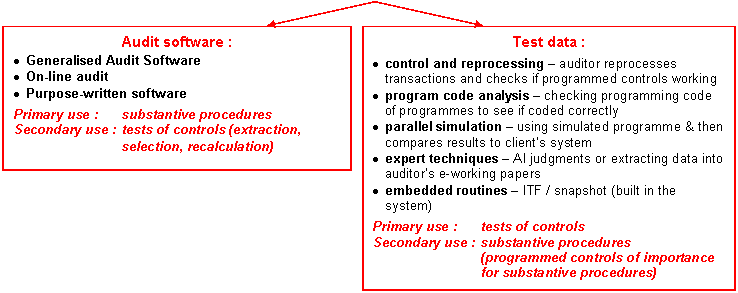
Methods of testing controls using programmed controls :
· control and reprocessing – re-process selected transactions under the auditor’s supervision. So program first checked by auditor and the processing is aimed at testing the functioning of the programmed controls
· program code analysis – investigation of program coding of production programs to ensure that the necessary programmed controls are present and that the program is correctly coded. Needs high level of technical knowledge and auditor must also ensure that program documentation relates to the production programs in use
· simulation – processing client’s data on auditor’s simulated program and then comparing the results with the client’s results.
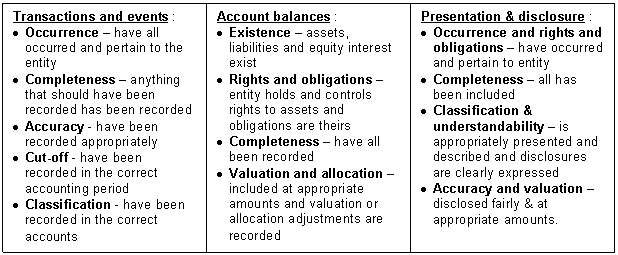
Transactions Balances (assets, liabs Presentation
Assertion / Events equity interest) disclosure
Occurrence | X | X | |
Completeness | X | X | X |
Accuracy | X | X | |
Cut-off | X | ||
Classification | X | X | |
Existence | X | ||
Rights & Obligations | X | X | |
Valuation & Allocation | X | X |
 |
Assertions for Statement of Financial Position transactions and balances :
Assertion Audit objective - to obtain satisfaction that :
Completeness | individual transactions and balances in respect of specific kind of asset or liability are fully accounted for in the accounting records and financials |
Valuation & allocation | the balance for the specific asset or liability has been accounted for at the appropriate carrying value and that the transactions have been correctly allocated to the proper period and recorded at the proper amount |
Existence | at a given date the asset or liability did exist and the transactions did take place during the period in question |
Rights & obligations | at a given date the asset or liability pertains to the entity and that the transactions did take place during the period in question |
Presentation & disclosure | the asset or liability was disclosed, classified and described in accordance with the applicable legal requirements and generally accepted accounting practice |
Assertions for Statement of Comprehensive Income transactions and balances :
Assertion Audit objective - to obtain satisfaction that the specific revenue or expenditure :
Completeness | transactions and balances are fully accounted for in the accounting records and financial statements |
Occurrence | · transactions actually took place during the period in question (occurrence) · transactions pertain to the entity (validity) |
Cut-off / accuracy / classification | transactions are recorded in the proper period, are correctly allocated and are recorded at the proper amount |
Presentation & disclosure | balances are disclosed, classified and described in accordance with the applicable legal requirements and generally accepted accounting practice (ISA’s & 4th schedule) |
Procedures used by auditor to obtain audit evidence :

|
Из за большого объема этот материал размещен на нескольких страницах:
1 2 3 4 |
