

Партнерка на США и Канаду по недвижимости, выплаты в крипто
- 30% recurring commission
- Выплаты в USDT
- Вывод каждую неделю
- Комиссия до 5 лет за каждого referral
2. An example of a horizontal system is a(n) ____.
a. | inventory application | c. | payroll application |
b. | application for a Web-based retailer | d. | medical practice application |
ANS: A, C PTS: 1 REF: 8
3. A business process describes a specific set of ____.
a. | transactions | c. | events |
b. | employees | d. | results |
ANS: A, C, D PTS: 1 REF: 10
4. Product-oriented firms produced ____.
a. | retail services | c. | computers |
b. | routers | d. | microchips |
ANS: B, C, D PTS: 1 REF: 11
5. Database administration involves ____.
a. | network administration | c. | data design |
b. | user access | d. | backup |
ANS: B, C, D PTS: 1 REF: 29
MODIFIED TRUE/FALSE
1. System software consists of programs that support day-to-day business functions and provide users with the information they require. _________________________
ANS: F, Application
PTS: 1 REF: 8
2. Value-added services such as consulting, financing, and technical support can be more profitable than hardware. _________________________
ANS: T PTS: 1 REF: 11
3. Rational Unified Process documents the experience of Microsoft’s own software development teams. _________________________
ANS: F
Microsoft Solutions Framework
MSF
PTS: 1 REF: 27
4. Rapid application development focuses on team-based fact-finding. _________________________
ANS: F
Joint application development
Joint application development (JAD)
JAD
JAD (joint application development)
PTS: 1 REF: 27
5. User support provides users with technical information, training, and productivity support. _________________________
ANS: T PTS: 1 REF: 29
TRUE/FALSE
1. Most firms give their IT budgets a low priority in bad economic times.
ANS: F PTS: 1 REF: 4
2. A mission-critical system is one that is unimportant to a company’s operations.
ANS: F PTS: 1 REF: 7
3. In an information system, data is information that has been transformed into output that is valuable to users.
ANS: F PTS: 1 REF: 7
4. In an information system, information consists of basic facts that are the system’s raw material.
ANS: F PTS: 1 REF: 7
5. The success or failure of an information system usually is unrelated to whether users are satisfied with the system’s output and operations.
ANS: F PTS: 1 REF: 10
6. Although the business-to-business (B2B) sector is more familiar to retail customers, the volume of business-to-consumer (B2C) transactions is many times greater.
ANS: F PTS: 1 REF: 14
7. TP systems are inefficient because they process a set of transaction-related commands individually rather than as a group.
ANS: F PTS: 1 REF: 16
8. In a knowledge management system, a knowledge base consists of logical rules that identify data patterns and relationships.
ANS: F PTS: 1 REF: 17
9. A knowledge management system uses inference rules, which consist of a large database that allows users to find information by entering keywords or questions in normal English phrases.
ANS: F PTS: 1 REF: 17
10. Most large companies require systems that combine transaction processing, business support, knowledge management, and user productivity features.
ANS: T PTS: 1 REF: 17
11. Because they focus on a longer time frame, middle managers need less detailed information than top managers, but somewhat more than supervisors who oversee day-to-day operations.
ANS: F PTS: 1 REF: 18-19
12. Many companies find that a trend called empowerment, which gives employees more responsibility and accountability, improves employee motivation and increases customer satisfaction.
ANS: T PTS: 1 REF: 19
13. CASE tools provide an overall framework for systems development and support a wide variety of design methodologies, including structured analysis and object-oriented analysis.
ANS: T PTS: 1 REF: 20
14. It is unusual for system developers to mix and match system development methods to gain a better perspective.
ANS: F PTS: 1 REF: 22
15. In the systems planning phase, a key part of the preliminary investigation is a feasibility study that reviews anticipated costs and benefits and recommends a course of action based on operational, technical, economic, and time factors.
ANS: T PTS: 1 REF: 23
16. In the systems analysis phase, the first step is requirements modeling, where business processes are investigated and what the new system must do to satisfy users is documented.
ANS: T PTS: 1 REF: 23
17. In object-oriented design, objects possess characteristics called properties, which the object inherits from its class or possesses on its own.
ANS: T PTS: 1 REF: 24
18. A scalable design can expand to meet new business requirements and volumes.
ANS: T PTS: 1 REF: 24
19. In object-oriented design, a message requests specific behavior or information from another object.
ANS: T PTS: 1 REF: 25
20. Microsoft offers a development approach called Microsoft Solutions Framework (MSF), which documents the experience of its own software development teams.
ANS: T PTS: 1 REF: 27
21. An IT group provides technical support, which includes application development, systems support and security, user support, database administration, network administration, and Web support.
ANS: T PTS: 1 REF: 28
work administration includes hardware and software maintenance, support, and security.
ANS: T PTS: 1 REF: 29
panies typically require that systems analysts have a college degree in information systems, computer science, business, or a closely related field, and some IT experience usually is required.
ANS: T PTS: 1 REF: 32
24. The responsibilities of a systems analyst at a small firm are exactly the same as those at a large corporation.
ANS: F PTS: 1 REF: 33
25. A corporate culture is the set of beliefs, rules, traditions, values, and attitudes that define a company and influence its way of doing business.
ANS: T PTS: 1 REF: 33
COMPLETION
1. _________________________ refers to the combination of hardware, software, and services that companies use to manage, communicate, and share information.
ANS:
Information technology (IT)
IT
PTS: 1 REF: 4
2. _________________________ is a step-by-step process for developing high-quality information systems.
ANS: Systems analysis and design
PTS: 1 REF: 7
3. A(n) _________________________ combines information technology, people, and data to support business requirements.
ANS: information system
PTS: 1 REF: 7
4. An IT department team includes _________________________ who plan, develop, and maintain information systems.
ANS: systems analysts
PTS: 1 REF: 7
5. A(n) _________________________ is a set of related components that produces specific results, such as routing Internet traffic, manufacturing microchips, and controlling complex entities like the Mars Rover.
ANS: system
PTS: 1 REF: 7
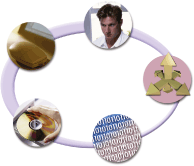
6. In the accompanying figure showing the components of an information system, _________________________ consist(s) of everything in the physical layer of the information system.
ANS: hardware
PTS: 1 REF: 8
7. In the accompanying figure showing the components of an information system, _________________________ refer(s) to the programs that control the hardware and produce the desired information or results.
ANS: software
PTS: 1 REF: 8
8. In the accompanying figure showing the components of an information system, _________________________ is/are the raw material that an information system transforms into useful information.
ANS: data
PTS: 1 REF: 9
9. In the accompanying figure showing the components of an information system, _________________________ describe(s) the tasks and business functions that users, managers, and IT staff members perform to achieve specific results.
ANS: processes
PTS: 1 REF: 9
10. In the accompanying figure showing the components of an information system, the people, called _________________________, interact with an information system, both inside and outside the company.
ANS:
users
end users
PTS: 1 REF: 10
11. The newest category of company is the _________________________ whose primary business depends on the Internet rather than a traditional business channel.
ANS:
Internet-dependent firm
dot-com company
.com company
PTS: 1 REF: 12
12. Traditional companies sometimes are called _________________________ companies because they conduct business primarily from physical locations.
ANS: brick-and-mortar
PTS: 1 REF: 12
13. Internet-based commerce is called _________________________ and includes two main sectors: B2C (business-to-consumer) and B2B (business-to-business).
ANS:
e-commerce
electronic commerce
I-commerce
Internet commerce
PTS: 1 REF: 13
14. _________________________ technology uses high-frequency radio waves to track physical object.
ANS:
RFID
Radio frequency identification
RFID (Radio frequency identification)
Radio frequency identification (RFID)
PTS: 1 REF: 16
15. A truck fleet dispatcher might run a series of _________________________ scenarios to determine the impact of increased shipments or bad weather.
ANS: what-if
PTS: 1 REF: 16

|
Из за большого объема этот материал размещен на нескольких страницах:
1 2 3 4 |
