

Партнерка на США и Канаду по недвижимости, выплаты в крипто
- 30% recurring commission
- Выплаты в USDT
- Вывод каждую неделю
- Комиссия до 5 лет за каждого referral


Academic Advisor Manual for Coop Training
The Coop Training Program
Contents
Co-op Training for CBA students. 3
Benefits of Co-op training. 3
Co-op training objectives. 3
CO-OP training processes. 4
The Role of the Academic Advisor in Coop Training. 5
1. Prior to enrollment of the student in the coop training: 5
2. During the coop training: 6
3. After the Coop Training, Report Writing and Final Evaluation: 6
Evaluation Criteria. 8
Appendix. 9
Form no. A1 - Oral Presentation Assessment Criteria 10
Form no. A2 - Report Assessment Criteria 13
Form no. A3 – Follow up call form 16
Report Reminder Fax Letter Template 17
Coop Training Learning Objectives 18
Learning Objectives of CBA Academic programs: 19
Accounting, Finance, Human Resources Management, Marketing, Management Information System
CO-OP Training at CBA
Co-op Training for CBA students
Co-op training is a capstone or final activity of the undergraduate students at CBA that formally integrates practical work experience into the student’s program of studies. The students are required to spend at least six hours every week for a minimum of 16 weeks in training related to their discipline in an a business entity. The training program is a jointly agreed, monitored and evaluated by the faculty advisor and a business supervisor from the business entity. Co-op training is a partnership between the students, the businesses and CBA towards developing a highly qualified work-force in the nation.
Benefits of Co-op training
There are benefits to both the students and the business organization. Students gain valuable work experience through on-the-job training (paid or unpaid). Co-op placements can lead to full-time employment. The employer has access to a year-round supply of well-motivated and highly qualified students eager to gain experience in the work force. The business can evaluate co-op students in a work environment before making a permanent job offer.
Co-op training objectives
These are the primary objectives of the Co-op training:
· To broaden and deepen student knowledge in the area on their specialization
· To improve skills needed for successful career, such as:
o Analytical problem solving skills
o Computer skills using various software applications
o Communication skills: verbal, presentation and writing
o Team work
o Interpersonal skill
· Improve professional behavior and conducts
· Understand the role of business ethics
|
CO-OP training processes
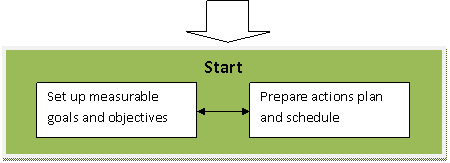
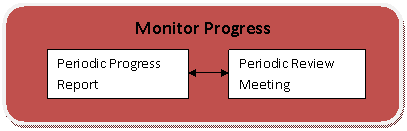
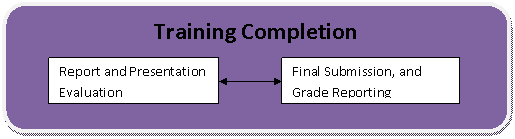
The following flow chart shows the overall Co-op process. It consists of 4 stages with several steps. Each step is described in detail in this section.
 |
 |
 |
 |
 |
 |
The Role of the Academic Advisor in Coop Training
Below are guidelines for academic advisors to follow during the coop advising period. These guidelines are categorized into 3 categories: prior to training, during coop training, and after the coop training (report writing and final evaluation).
1. Prior to enrollment of the student in the coop training:
The first step in advising starts after the student registers for coop training course and meet the career center to arrange for a training position in a company. Once the student is assigned to a specific job, he/she should meet with the academic advisor before they start their training. The role of the academic advisor in this step is the following:
ü Meet the student to discuss the requirements to pass the coop training course (refer to student’s manual page 4).
ü Inform the student that he/she should attend the Coop Training Orientation workshop during the orientation week every semester and should have a copy of the Student’s Manual of Coop Training.
ü Sign the student information form Form no. S1 filled by the student. Keep a copy for your record in the student file and send the original to the Career Center.
ü Initiate contact with the business supervisor to define the student’s duties and responsibilities. The business supervisor should send you a job description for the student. (Refer to employer manual Trainee’s job description Form no. E1).
ü Make sure that the job description satisfies the learning objectives of internship of your academic program (refer to program learning objectives in pages 16-21)
ü Within 2-4 weeks after the registration, the student will submit a document describing his/her co-op training objectives and his action plans to achieve those objectives, signed by his business supervisor using Form no. S2 for writing objectives, list of tasks and schedule of tasks to achieve the Co-op objectives (see appendix). The objectives must be SMART (Specific Measurable Achievable, Realistic and Time framed). (Student will be given training on objectives writing during orientation).
ü Once the objectives and schedule are approved, and signed by the academic advisor, student starts his/her training.
ü Student agree on a regular schedule to meet his academic supervisor for 30-45 minutes at least 6 times during the Coop training to review his/her progress and submit a brief summary of activities during the prior two weeks using Form 2 for progress report (see attached) signed by his/her business supervisor. Academic advisor will review his/her progress and give his/her comments on the progress report Form no. S3.
ü After completion of his tasks and activities, student obtains his/her evaluation and completion report from the business advisor and submits to the academic advisor, using Form no. E3 Business Supervisor Evaluation Report.
2. During the coop training:
ü Request the students to submit a weekly progress report describing their tasks in the training. Refer to progress report form Form no. S3 in Student’ manual.
ü Request the employer to send you a weekly attendance report, Form no. E2, for the student. In case the business supervisor forgot or didn’t send you the weekly reports you can remind them formally by sending them a letter as a reminder. (refer to Report Reminder Letter Template, page 15)
ü Keep frequent contact with the business supervisor, approximately 3 times during the training period, either over the phone or with a site visit in order to check on the student’s performance. In order to document the follow up with the employer, use the Coop Follow up form, Form no. A3, page 14.
3. After the Coop Training, Report Writing and Final Evaluation:
ü Once approved by the faculty advisor, the student prepares the final draft and submits 3 copies. He/she schedules a presentation of his co-op training within 1-2 weeks after the approval of the draft. Faculty advisor selects 2 other faculties as review committee members, to review the report and be present at the presentation.
ü Student prepares a power point presentation and makes the presentation to the faculty advisor and the review team.
ü The review team gives their feedbacks and grades using the Presentation Evaluation Form Form no. A1.
ü Student submits the final report properly bound along with the presentation (soft copy) to the academic advisor.
ü Academic advisor completes Grade Form and submits grade using Opera to the Vice Dean for Academic Affairs for final approval and grade processing. In case, a student did not finish his Co-op within the semester he/she gets an IC.
ü Ask the business supervisor to evaluate the student’s performance and send you the evaluation either by fax or e-mail, (not with the student). Refer to Business Supervisor’s Evaluation of the Student Form no. E3.
ü Ask the business supervisor to provide you with his/her feedback regarding the academic program. (refer to Business Supervisor’s Evaluation of the Academic Program Form no. E4)
ü After the business supervisor fill the above mentioned survey, send copies to Quality assurance department and copies to the Head of your Department and Career Center.
ü Guide the student throughout the report writing. (refer to report writing guidelines in Student’ Manual)
ü Evaluate the student’s performance and assign a final grade to the course using
Form no. A2 .
ü Ask the student to fill the Student’s Evaluation of Coop Training & Employer, Form no. S4, and then send the original to Quality assurance department and copies to the Head of your Department and the career center.
ü At the end of every semester fill the field experience report, available at the quality assurance forms, and send it to your head of department who will review it and then send it to the quality assurance department.
ü Keep one copy of the student’s coop report with the student coop file, one copy to be sent to the Career Center, and one copy to the Library.
ü Prepare a coop file and submit it to the head of the department
ü Students writes and submits his draft co-op training report to the academic advisor using the report writing guidelines and using appropriate writing style ( for example APA style).
|
Evaluation Criteria
The total grade for the coop training course is 100 marks distributed according to the following:
Assessment Procedure | Weight |
Writing Co-op objective, plan (approach) and schedule (Form no. S1) | 10% |
Business Supervisor evaluation (Form no. E3) | 20% |
Final Presentation evaluated by Academic Committee (Form no. A1) | 20% |
Weekly Performance & Attendance Reports evaluated by Academic Advisor (Form no. S2 & Form no. E2) | 10% |
Report Evaluation by Academic Advisor (Form no. A2) | 40% |
Total Score | 100% |
· Business Supervisor’s Evaluation: the business supervisor’s Final Evaluation form is submitted by the business supervisor after the student completes the coop training period.
· Final Presentation evaluated by Academic Committee: a committee of minimum three instructors should attend and evaluate the student’s final presentation. But the final grading of the presentation is the responsibility of the academic advisor. Refer to oral presentation Assessment Form no. A1 page 8.
· Weekly Performance & Attendance Reports evaluated by Academic Advisor: this evaluation is for the student’s commitment regarding attendance in the workplace and sending weekly performance reports on time during the training period.
· Report Evaluation by Academic Advisor: This evaluation is for the Report by using the Report Assessment form. Refer to Report Assessment Criteria Form no. A2 page 10.
|
Appendix
Form no. A1 Oral Presentation Assessment Criteria
Form no. A2 Report Assessment Criteria
Form no. A3 Coop Follow up Form
Report Reminder Fax Letter Template
Coop Training Learning Objectives
Learning Objectives of CBA Academic programs:
Accounting, Finance, Human Resources Management, Marketing, Management Information System

| |
 |
Student name: ______________________________________________ Employer: __________________________________
Major: __________________________________________ Co-op Semester(s) __ Fall __ Spring __ Summer
 Evaluator’s Name: _______________________________ Date: ___________________________________
Information/Instructions:
1. Evaluate the student’s presentation by giving her/him a grade for each performance factor of evaluation from the grading scheme in the below table. Total grade from 32.
2. Calculate the total number of grade at the end of the table to determine the student’s total grade.
3. If you want to elaborate on items in this evaluation you can do this in the “Comments” part.
4. Sign and give this evaluation form to the academic advisor of the student.
Performance Factor | Grading Scheme | Grade obtained | |||
4 | 3 | 2 | 1 | ||
1) Introduction (Organization) | The introduction is inviting, states the main topic and previews the structure of the presentation. | The introduction clearly states the main topic and previews the structure of the presentation, but is not particularly inviting to the listener. | The introduction states the main topic, but does not adequately preview the structure of the presentation nor is it particularly inviting to the listener. | There is no clear introduction of the main topic or structure of the presentation. | |
2) Main content | The presentation reflected a thorough knowledge of all aspects of the topic | The presentation reflected a thorough knowledge but didn’t cover all aspects of the topic | The presentation covered all aspects of the topic but briefly | The presentation didn’t cover all aspects of the topic and didn’t reflect thorough knowledge | |
3) Quality of the content | Information clearly relates to the main topic. It includes several supporting details and/or examples. | Information clearly relates to the main pporting details and/or examples are not enough. | Information clearly relates to the main topic. No details and/or examples are given. | Information has little or nothing to do with the main topic. | |
4) Organization | presentation is very organized with well-constructed slides reflecting logical sequence | Information is organized with well-constructed slides. | Information is organized, but slides are not well-constructed. | The information appears to be disorganized. | |
5) Standard of English | No grammatical or spelling errors. | Almost no grammatical or spelling errors | A few grammatical or spelling errors. | Many grammatical or spelling errors. | |
6) Audio / Visual Content | Audio-Visual resources are incorporated, related to the topic and used effectively as supportive material | Audio-Visual resources are incorporated, related to the topic but are not used effectively as supportive material | Audio-Visual resources are incorporated but not fully related to the topic | Audio-Visual resources are incorporated, but are not at all related to the topic | |
7) Conclusion (Organization) | The conclusion is strong and leaves the audience with a feeling that they understand what the presenter is "getting at." | The conclusion is recognizable and ties up almost all the loose ends. | The conclusion is recognizable, but does not tie up several loose ends. | There is no clear conclusion, the presentation just ends. | |
8) Response to Questions | The student responded effectively to all questions raised by the audience | The student responded effectively to most of the questions raised by the audience | The student responded effectively to few questions raised by the audience | The student responded to the questions but mainly with irrelevant answer | |
Total Grade |
Additional Comments:
 |
|
|
|
|
|
|
Signature:__________________
| |
|
Student name: ______________________________________________ Employer: __________________________________
Major: __________________________________________ Co-op Semester(s) __ Fall __ Spring __ Summer
Evaluator’s Name: _______________________________ Date: ___________________________________
Information/Instructions:
1. Evaluate the student’s report by giving her/him a grade for each performance factor of evaluation from the grading scheme in the below table. Total grade from 28.
2. Calculate the total number of grade at the end of the table to determine the student’s total grade.
3. If you want to elaborate on items in this evaluation you can do this in the “Comments” part.
4. This evaluation form should only be filled by the academic advisor of the student.
Performance Factor | Grading Scheme | Grade Obtained | |||
4 | 3 | 2 | 1 | ||
1) Organization | Information is very organized with well-constructed paragraphs and subheadings. | Information is organized with well-constructed paragraphs. | Information is organized, but paragraphs are not well-constructed. | The information appears to be disorganized. | |
2) Standard of English | No grammatical, spelling or punctuation errors. | Almost no grammatical, spelling or punctuation errors | A few grammatical spelling, or punctuation errors. | Many grammatical, spelling, or punctuation errors. | |
3) Introduction (Organization) | The introduction is inviting, states the main topic and previews the structure of the paper. | The introduction clearly states the main topic and previews the structure of the paper, but is not particularly inviting to the reader. | The introduction states the main topic, but does not adequately preview the structure of the paper nor is it particularly inviting to the reader. | There is no clear introduction of the main topic or structure of the paper. | |
4) Main content | All topics are addressed and all questions answered with at least 2 sentences about each. | All topics are addressed and most questions answered with at least 2 sentences about each. | All topics are addressed, and most questions answered with 1 sentence about each. | One or more topics were not addressed. | |
5) Quality of the content | Information clearly relates to the main topic. It includes several supporting details and/or examples. | Information clearly relates to the main topic. It provides 1-2 supporting details and/or examples. | Information clearly relates to the main topic. No details and/or examples are given. | Information has little or nothing to do with the main topic. | |
6) Referencing | All sources (information and graphics) are accurately documented in the desired format. | All sources (information and graphics) are accurately documented, but a few are not in the desired format. | All sources (information and graphics) are accurately documented, but many are not in the desired format. | Some sources are not accurately documented. | |
7) Conclusion (Organization) | The conclusion is strong and leaves the reader with a feeling that they understand what the writer is "getting at." | The conclusion is recognizable and ties up almost all the loose ends. | The conclusion is recognizable, but does not tie up several loose ends. | There is no clear conclusion, the paper just ends. | |
Total Grade |
Additional Comments:

|
|
 |
|
|
Signature:__________________
|
Name of student: ____________________________________
Major: _____________________________________________
Company: ______________________________ Tel. ________________________
Student’s academic supervisor: ___________________________________
Student’s business supervisor: _______________________________
Date: __________________________
Time of call: ______________________________

 Type of call phone
Site Visit
 Reason for the call: Update on students progress
 Discussion on a specific issue
Follow up for previous issue
Summary of the call:
Action plan (if required):
Academic Supervisor’s name: ____________________________
Signature: _________________________________
Report Reminder Fax Letter Template
To Ms/Mr …………………………………… From ……………………….…………………
Company …………………………………… Coop advisor ………………………………
Fax ……………………………………………. Direct no. ……………………………………
Date…………………………………… Email..........……………………………………
Fax………………………………………………
SUBJECT:
After reviewing the weekly reports sent by ………………………………… with regard to the coop student ………………………………………. It has come to our attention that the attendance report for week.......... of the coop training is missing that includes the period from …………………….. In addition to not receiving a copy of the final evaluation form.
Due to the college’s concern in not considering this period a time of absence without an excuse, we hope you will cooperate with us and only send the missing attendance sheets mentioned above, or fill the forms attached and returning them to us by fax as soon as possible so that we may submit the final grades on time.
Thank you for your cooperation with us and look forward to hearing from you.
Regards,
Academic Advisor’s name and signature
Note: (this template could also be sent as an e-mail message)
Institutional Development Division
QAC
Coop Training Objectives for all Academic Programs
Upon the successful completion of the Coop training CBA student will be able to:
o Bridge the gap between theory and practice, through experiential learning.
o Experience the workplace environment and culture.
o Gain hands-on experience in relation to his/ her academic program.
o Network with employers and professionals in the business community.
o Explore different career options and clarify his/ her career goals.
o Learn how to compete confidently in the job market.
o Develop leadership & social skills.
o Take charge of his/ her own performance on the job, punctuality and responsibility.
Learning Objectives per Major
Accounting |
Knowledge: Graduates of the Accounting program will be able to: · Recognize the importance of accounting information for the decision making process, · Produce the financial accounting statements. |
Cognitive Skills: Graduates of the Accounting program will be able to: · Analyze and draw reasoned conclusions concerning the relationship between the financial statements. · Apply and evaluate alternative accounting practices. · Act in implementing accounting or financial tasks. · Manipulate financial statements to provide decision makers by the appropriate information. |
Interpersonal Skills and Responsibility: Graduates of the Accounting program will be able to: · Deal with ethical and professional accounting issues · Respond to current circumstances accordingly. |
Finance |
Knowledge: Graduates of the Finance program will be able to:
|
Cognitive Skills: Graduates of the Finance program will be able to: · Manipulate and use financial and market data to solve problems. · Students will interpret and analyze financial statements and perform financial analysis · Students will appropriately apply capital budgeting and working capital management strategies · Apply quantitative and qualitative information along with analysis, argument and commentary in · appropriate form. · Apply statistical models and analyze financial and investment phenomena |
Interpersonal Skills and Responsibility: Graduates of the Finance program will be able to: · work effectively in groups as well as individually. · have proper time management skills as a requirement to meet deadlines for projects submission. · work with integrity at all times, handling stressing situations where prompt decisions are required. |
Human Resource Management |
· Show understanding and ability to apply the subject matter in hypothetical situations. · Apply the subject matter in real situations. · Apply the subject matter critically and analytically. · Develop their own principles or models useful in management |
Management Information System |
Knowledge: Graduates of the MIS program will be able to: The students will work as a trainee in the company, his/her tasks must be in the field of MIS, Tasks include:
|
Cognitive Skills: Graduates of the MIS program will be able to: · Design a complete system · Analyze and evaluate system · Design web based applications (website) · Analyze process processes and show how IT can implement and enhance business processes. |
Interpersonal Skills and Responsibility: Graduates of the MIS program will be able to: · Deal with ethical and professional issues regarding designing systems. · Manage MIS projects regarding allocating resources, facilitate communication between team members. · Facilitate communication between the business needs and recent technology to achieve the business goals |
Marketing |
Students will be able to: · Recognize the structure of the marketing department in the organization · Evaluate the role of the marketing department in the business · Observe their business supervisor and colleagues application of different marketing concepts, strategies and tools · Apply different marketing knowledge and practices such as customer service, promotion, pricing, market research marketing planning etc.. · Researching and solving marketing problems |
