

Партнерка на США и Канаду по недвижимости, выплаты в крипто
- 30% recurring commission
- Выплаты в USDT
- Вывод каждую неделю
- Комиссия до 5 лет за каждого referral
Chapter 3
Financial Decision Making and the Law of One Price
ppose your employer offers you a choice between a $5000 bonus and 100 shares of the company stock. Whichever one you choose will be awarded today. The stock is currently trading for $63 per share.
ppose that if you receive the stock bonus, you are free to trade it. Which form of the bonus should you choose? What is its value?
ppose that if you receive the stock bonus, you are required to hold it for at least one year. What can you say about the value of the stock bonus now? What will your decision depend on?
a. Stock bonus = 100 Ч $63 = $6,300
Cash bonus = $5,000
Since you can sell (or buy) the stock for $6,300 in cash today, its value is $6,300 which is better than the cash bonus.
b. Because you could buy the stock today for $6,300 if you wanted to, the value of the stock bonus cannot be more than $6,300. But if you are not allowed to sell the company’s stock for the next year, its value to you could be less than $6,300. Its value will depend on what you expect the stock to be worth in one year, as well as how you feel about the risk involved. You might decide that it is better to take the $5,000 in cash than wait for the uncertain value of the stock in one year.
3-5. You have decided to take your daughter skiing in Utah. The best price you have been able to find for a roundtrip air ticket is $359. You notice that you have 20,000 frequent flier miles that are about to expire, but you need 25,000 miles to get her a free ticket. The airline offers to sell you 5000 additional miles for $0.03 per mile.
ppose that if you don’t use the miles for your daughter’s ticket they will become worthless. What should you do?
b. What additional information would your decision depend on if the miles were not expiring? Why?
a. The price of the ticket if you purchase it is $t. The price if you purchase the miles is $p x 5000. So you should purchase the miles.
b. In part a, the existing miles are worthless if you don’t use them. They are not worthless now, so you must add in the cost of using them. Because there is no competitive market price for these miles (you can purchase at 3ў but not sell for that price) the decision will depend on how much you value the existing miles (which will depend on your likelihood of using them in the future).
 3-9. You run a construction firm. You have just won a contract to construct a government office building. Constructing it will take one year and require an investment of $10 million today and $5 million in one year. The government will pay you $20 million upon the building’s ppose the cash flows and their times of payment are certain, and the risk-free interest rate is 10%.
a. What is the NPV of this opportunity?
b. How can your firm turn this NPV into cash today?
a. 
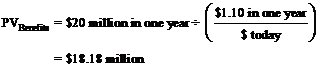

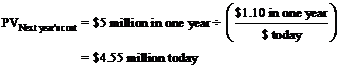

b. The firm can borrow $18.18 million today, and pay it back with 10% interest using the $20 million it will receive from the government (18.18 Ч 1.10 = 20). The firm can use $10 million of the 18.18 million to cover its costs today and save $4.55 million in the bank to earn 10% interest to cover its cost of 4.55 Ч 1.10 = $5 million next year.
This leaves 18.18 – 10 – 4.55 = $3.63 million in cash for the firm today.
 3-10. Your firm has identified three potential investment projects. The projects and their cash flows are shown here:

Suppose all cash flows are certain and the risk-free interest rate is 10%.
a. What is the NPV of each project?
b. If the firm can choose only one of these projects, which should it choose?
c. If the firm can choose any two of these projects, which should it choose?
a. 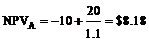
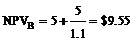
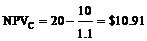
b. If only one of the projects can be chosen, project C is the best choice because it has the highest NPV.
c. If two of the projects can be chosen, projects B and C are the best choice because they offer a higher total NPV than any other combinations.
3-11. Your computer manufacturing firm must purchase 10,000 keyboards from a supplier. One supplier demands a payment of $100,000 today plus $10 per keyboard payable in one year. Another supplier will charge $21 per keyboard, also payable in one year. The risk-free interest rate is 6%.
a. What is the difference in their offers in terms of dollars today? Which offer should your firm take?
ppose your firm does not want to spend cash today. How can it take the first offer and not spend $100,000 of its own cash today?
a. 

Costs are lower under the first supplier’s offer, so it is better choice.
b. The firm can borrow $100,000 at 6% from a bank for one year to make the initial payment to the first supplier. One year later, the firm will pay back the bank $106,000 (100,000 Ч 1.06) and the first supplier $100,000 (10 Ч 10,000), for a total of $206,000. This amount is less than the $210,000 (21 Ч 10,000) the second supplier asked for.
3-15. The promised cash flows of three securities are listed here. If the cash flows are risk-free, and the risk-free interest rate is 5%, determine the no-arbitrage price of each security before the first cash flow is paid.


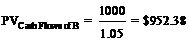

While the total cash flows paid by each security are the same ($1000), securities A and B are worth less than $1000 because some or all of the money is received in the future.
3-16. An Exchange-Traded Fund (ETF) is a security that represents a portfolio of individual stocks. Consider an ETF for which each share represents a portfolio of two shares of Hewlett-Packard (HPQ), one share of Sears (SHLD), and three shares of General Electric (GE). Suppose the current stock prices of each individual stock are as shown here:
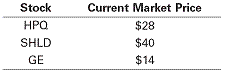
a. What is the price per share of the ETF in a normal market?
b. If the ETF currently trades for $120, what arbitrage opportunity is available? What trades would you make?
c. If the ETF currently trades for $150, what arbitrage opportunity is available? What trades would you make?
a. We can value the portfolio by summing the value of the securities in it:
Price per share of ETF = 2 Ч $28 + 1 Ч $40 + 3 Ч $14 = $138
b. If the ETF currently trades for $120, an arbitrage opportunity is available. To take advantage of it, one should buy the ETF for $120, sell two shares of HPQ, sell one share of SHLD, and sell three shares of GE. Total profit for such transaction is $18.
c. If the ETF trades for $150, an arbitrage opportunity is also available. It can be realized by buying two shares of HPQ, one share of SHLD, and three shares of GE, and selling one share of the ETF for $150. Total profit would be $12.
