

Партнерка на США и Канаду по недвижимости, выплаты в крипто
- 30% recurring commission
- Выплаты в USDT
- Вывод каждую неделю
- Комиссия до 5 лет за каждого referral
Okada, H. and Honjo, S., 1973. The distribution of oceanic coccolithophorids in the Pacific. Deep Sea Research and Oceanographic Abstracts, 20: 355-374.
Olsen, J., Anderson, N. J. and Knudsen, M. F., 2012. Variability of the North Atlantic Oscillation over the past 5,200 years. Nature Geosci, 5: 808-812.
Paillard, D., Labeyrie, L. and Yiou, P., 1996. Macintosh program performs time-series analysis. Eos Trans. AGU, 77: 379.
Parrilla, G. and Kinder, T. H., 1987. The Physical Oceanography of the Alboran Sea. Naval ocean research administration
184: 1-26.
Pena, L. D., Calvo, E., Cacho, I., Eggins, S. and Pelejero, C., 2005. Identification and removal of Mn-Mg-rich contaminant phases on foraminiferal tests: implications for Mg/Ca past temperature reconstructions. Geochem. Geophys. Geosyst., 6.
Pйrez-Folgado, M., Sierro, F. J., Flores, J. A., Cacho, I., Grimalt, J. O., Zahn, R. and Shackleton, N., 2003. Western Mediterranean planktonic foraminifera events and millennial climatic variability during the last 70 kyr. Marine Micropaleontology, 48: 49-70.
Reimer, P. J., Baillie, M. G.L., Bard, E., Bayliss, A., Beck, J. W., Blackwell, P. G., Bronk Ramsey, C., Buck, C. E., Burr, G. S., Edwards, R. L., Friedrich, M., Grootes, P. M., Guilderson, T. P., Hajdas, I., Heaton, T. J., Hogg, A. G., Hughen, K. A., Kaiser, K. F., Kromer, B., McCormac, F. G., Manning, S. W., Reimer, R. W., Richards, D. A., Southon, J. R., Talamo, S., Turney, C. S.M., van der Plicht, J. and Weyhenmeyer, C. E., 2009. IntCal09 and Marine09 radiocarbon age calibration curves, 0-50,000 years cal BP. Radiocarbon, 51: 1111-1150.
Rodу, X., Baert, E. and Comнn, F. A., 1997. Variations in seasonal rainfall in Southern Europe during the present century: relationships with the North Atlantic Oscillation and the El Niсo-Southern Oscillation. Climate Dynamics, 13: 275-284.
Rohling, E. J., Den Dulk, M., Pujol, C. and Vergnaud-Grazzini, C., 1995. Abrupt hydrographic change in the Alboran Sea (western Mediterranean) around 8000 yrs BP. Deep Sea Research Part I: Oceanographic Research Papers, 42: 1609-1619.
Sбnchez-Goсi, M., Cacho, I., Turon, J., Guiot, J., Sierro, F. J., Peypouquet, J., Grimalt, J. and Shackleton, N., 2002. Synchroneity between marine and terrestrial responses to millennial scale climatic variability during the last glacial period in the Mediterranean region. Climate Dynamics, 19: 95-105.
Sarhan, T., Garcнa Lafuente, J., Vargas, M., Vargas, J. M. and Plaza, F., 2000. Upwelling mechanisms in the northwestern Alboran Sea. Journal of Marine Systems, 23: 317-331.
Schiebel, R. and Hemleben, C., 2000. Interannual variability of planktic foraminiferal populations and test flux in the eastern North Atlantic Ocean (JGOFS). Deep Sea Research Part II: Topical Studies in Oceanography, 47: 1809-1852.
Sierro, F. J., Hodell, D. A., Curtis, J. H., Flores, J. A., Reguera, I., Colmenero-Hidalgo, E., Bбrcena, M. A., Grimalt, J. O., Cacho, I., Frigola, J. and Canals, M., 2005. Impact of iceberg melting on Mediterranean thermohaline circulation during Heinrich events. Paleoceanography, 20: PA2019.
Stuiver, M. and Braziunas, T. F., 1993. 14C Ages of Marine Samples to 10,000 BC Radiocarbon, 35: 137-118
Stuiver, M. and Reimer, P. J., 1993. Extended 14C data base and revised CALIB 3.0 14C Age calibration program. Radiocarbon, 35: 215–230.
Sumner, G., Homar, V. and Ramis, C., 2001. Precipitation seasonality in eastern and southern coastal Spain. International Journal of Climatology, 21: 219-247.
Thierstein, H. R. and Young, J. R. (Editors), 2004. Coccolithophores: from molecular processes to global impact, 565 pp.
Villanueva, J., Pelejero, C. and Grimalt, J. O., 1997. Clean-up procedures for the unbiased estimation of C37 alkenone sea surface temperatures and terrigenous n-alkane inputs in paleoceanography. Journal of Chromatography A, 757: 145-151.
von Grafenstein, R., Zahn, R. and Tiedemann, R., 1999. Planktonic d18O records at Sites 976 and 977, Alboran Sea: stratigraphy, forcing, and paleoceanographic implications. In: W. B. Curry, N. J. Shackleton and C. Richter (Editors), Proceedings Ocean Drilling Program Scientific Results, 154, pp. 299-318.
Wanner, H., Solomina, O., Grosjean, M., Ritz, S. P. and Jetel, M., 2011. Structure and origin of Holocene cold events. Quaternary Science Reviews, 30: 3109-3123.
Weaver, P. P.E. and Pujol, C., 1988. History of the last deglaciation in the Alboran Sea (western Mediterranean) and adjacent north Atlantic as revealed by coccolith floras. Palaeogeography, Palaeoclimatology, Palaeoecology, 64: 35-42.
Winter, A. and Siesser, W. G. (Editors), 1994. Coccolithophores, Cambridge, U. K.
, 242 pp.
Zazo, C., Goy, J.-L., Somoza, L., Dabrio, C.-J., Belluomini, G., Improta, S., Lario, J., Bardajн, T. and Silva, P.-G., 1994. Holocene sequence of sea-level fluctuations in relation to climatic trends in the Atlantic-Mediterranean linkage coast. Journal of Coastal Research, 10: 933-945.
Table 1. Age model for core HER-GC-T1. aPoznan Radiocarbon Laboratory. bWoods Hole Oceanographic Institution.
Radiocarbon (Sample/Laboratory code) | Foram Type | Depth (cm) | Radiocarbon Age (yr BP) | Calendar Age (yr cal BP) |
SEC1_2/ Poz-53233a | G. inflata | 2 | 440 ± 25 | 74.5±74.5 |
SEC1_21/OS-87586b | G. inflata | 21 | 1810 ± 25 | 1386.5±102 |
SEC1_63/ Poz-53234a | G. inflata | 63 | 4175 ± 35 | 4276±143 |
SEC2_17/ Poz-53235a | G. inflata | 107 | 6100 ± 40 | 6543.5±134 |
SEC2_54/OS-87587b | G. inflata+ N. pachyderma | 144 | 7350 ± 35 | 7827.5±113 |
SEC3_12/ Poz-53236a | N. pachyderma | 202 | 10400 ± 60 | 11496±261 |
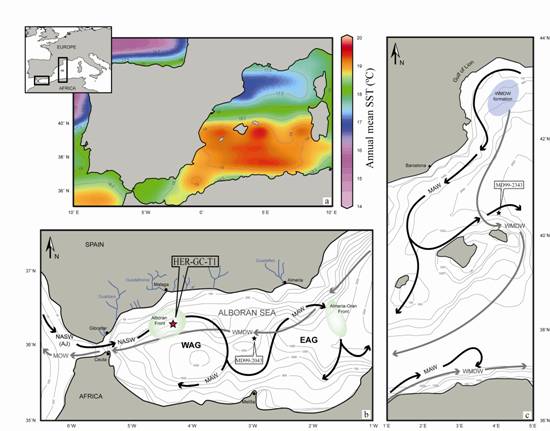
Figure 1. a) Map of the annual mean SST (єC) in the Western Mediterranean Sea. b) Study area and HER-GC-T1 core location in the Alboran Sea. c) Gulf of Lions area where the WMDW formation occurs. Black arrows trace general superficial circulation. Grey arrows trace general deep circulation. NASW: North Atlantic Surface Water, entering the Alboran Sea as the Atlantic Jet: AJ. MAW: Modified Atlantic Water. WMDW: Western Mediterranean Deep Water. MOW: Mediterranean Outflowing Water. WAG: Western Anticyclonic Gyre. EAG: Eastern Anticyclonic Gyre.
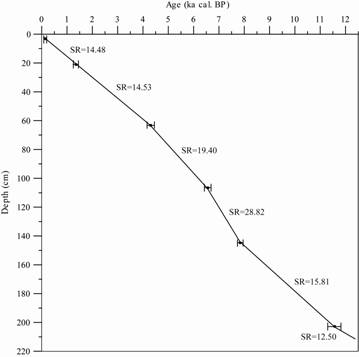
Figure 2. Age control points are marked by a black dot and associated error bars. The solid line that joins them is the age given in ka cal. BP. SR stands for sedimentation rate, given in cm*ka-1.
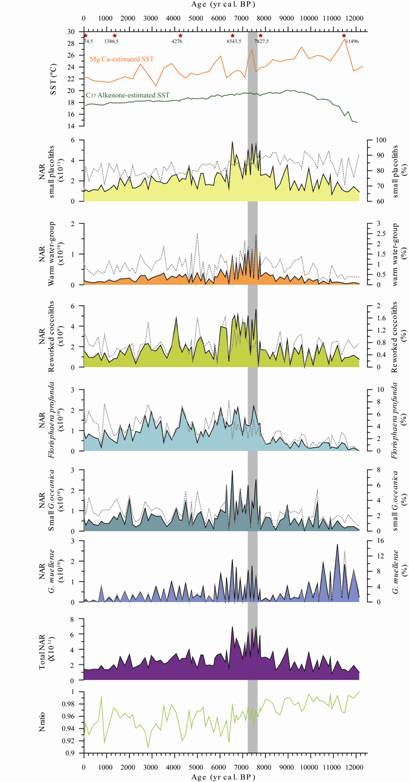
Figure 3. Mg/Ca-estimed SST (°C) from core HER-GC-T1. Nannofossil Accumulation Rate (NAR) (coccoliths*cm-2*ky-1) (black lines) and percentage abundance (%) (dashed line) of the coccolithophore assemblage. N ratio (small placoliths/(small placoliths+F. profunda). The grey bar indicates the 7.7 ka cal. BP event. Red stars stand for age control points (yr cal. BP) (Table 1).
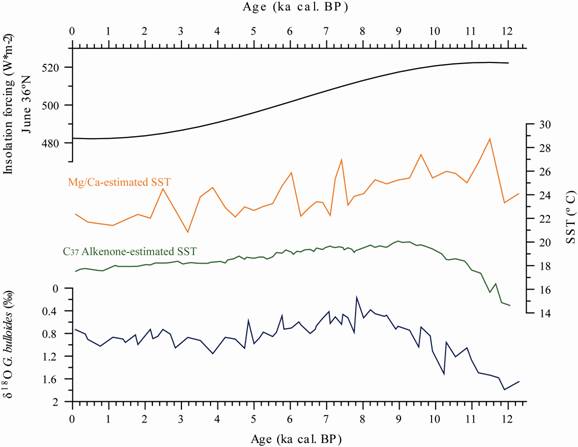
Figure 4 a) Insolation curve (June, 36° N) (Laskar, 1990). b) Mg/Ca-estimated SST (°C). c)  -estimated SST (°C). d) δ18O record (‰) (Note that vertical axis is reversed).
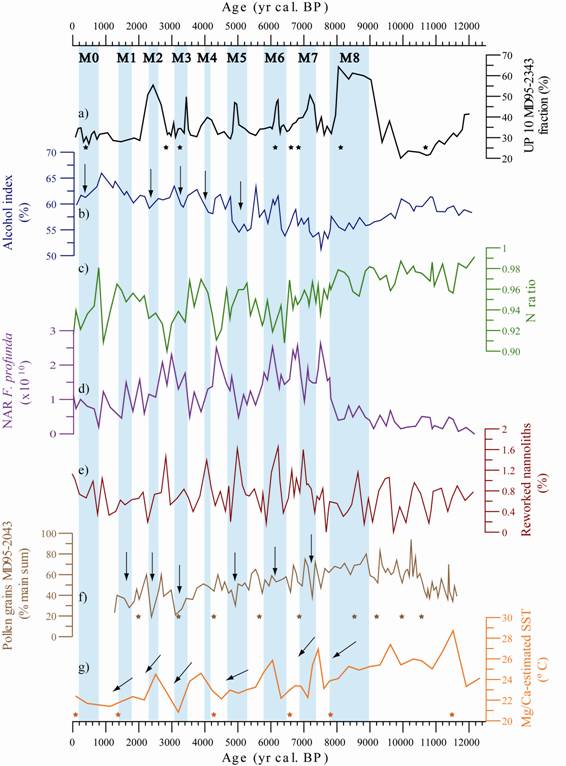
Figure 5. Paleorecords from core HER-GC-T1 compared to other environmental paleorecords. a) UP 10 record from core MD95-2343 north of Minorca (Frigola et al., 2007). Black stars stand for age control points (ka cal. BP). b) Alcohol index from core HER-GC-T1 c) N ratio. d) NAR of F. profunda. e) Relative abundance of reworked nannoliths. f) Pollen grains from core MD95-2043 in the Alboran Sea for all temperate and Mediterranean forest taxa (Fletcher et al., 2012). Age control points are marked by brown stars (Cacho et al., 1999). g) Mg/Ca-estimated SST. Occurrence of Minorca abrupt events (M events) are represented by bars.

Figure 6. a) Inferred NAO circulation pattern (Olsen et al., 2012). b) Comparison of PCA3 (Olsen et al., 2012) and UP10 fraction (reversed vertical axis) from core MD95-2343 north of Minorca (Frigola et al., 2007). c) Comparison of PCA3 with reworked nannoliths (reversed vertical axis) from HER-GC-T1 in the Alboran Sea. d) Comparison of PCA3 with Mg/Ca-estimated SST (reversed vertical axis) from HER-GC-T1 in the Alboran Sea. Pale brown bars represent the occurrence of Minorca abrupt events M5 to M0 (Frigola et al., 2007).
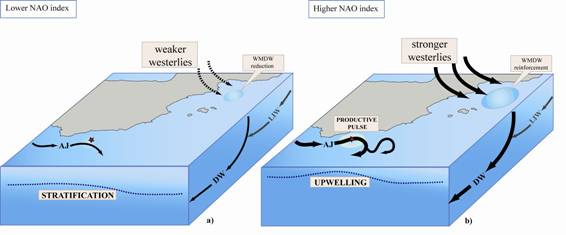
Figure 7. WMDW: Western Mediterranean Deep Water. LIW: Levantine Intermediate Water. DW: Deep waters (WMDW+LIW). MAW: Mediterranean-Atlantic water. AJ: Atlantic Jet. a) Scenario [1]: Persistent lower NAO index. Weaker westerlies trigger a slackening of the WMDW formation. This along with lesser and warmer AJ influx promotes deepening of the nutricline, which lead to long-term stratification events). b) Scenario [2]: dominant higher NAO index. Stronger westerlies enable a reinforcement of the WMDW formation. This along with major and colder AJ entering the Alboran Sea, lead to shoaling of the nutricline and a major vertical mixing. Accordingly, upwelling events occurs.

|
Из за большого объема этот материал размещен на нескольких страницах:
1 2 3 4 5 6 |
