

Партнерка на США и Канаду по недвижимости, выплаты в крипто
- 30% recurring commission
- Выплаты в USDT
- Вывод каждую неделю
- Комиссия до 5 лет за каждого referral
CHAPTER 19
CASH AND LIQUIDITY MANAGEMENT
.
SLIDES
S19.1: Key Concepts and Skills
S19.2: Chapter Outline
S19.3: Reasons for Holding Cash
S19.4: Target Cash Balance
S19.5: Understanding Float
S19.6: Quick Quiz I
S19.7: Example: Measuring Float
S19.8: Example: Cost of Float
S19.9: Cash Collection
S19.10: Example: Accelerating Collections – Part I and II (2 pages)
S19.12: Cash Disbursements
S19.13: Investing Idle Cash
S19.14: Seasonal Cash Demands
S19.15: Characteristics of Short-Term Securities
S19.16: Cash Management Models Appendix 19A
S19.17: Quick Quiz
S19.18: Summary
CHAPTER ORGANIZATION
S19.1: Key Concepts and Skills
S19.2: Chapter Outline
19.1 REASONS FOR HOLDING CASH
The Speculative and Precautionary Motives
The Transaction Motive
Costs of Holding Cash
Cash Management versus Liquidity Management
19.2 DETERMINING THE TARGET CASH BALANCE
The Basic Idea
Other Factors Influencing the Target Cash Balance
19.3 UNDERSTANDING FLOAT
Disbursement Float
Collection Float and Net Float
Float Management
Over-the-Counter Collections
Controlling Disbursements
19.4 INVESTING IDLE CASH
Temporary Cash Surpluses
Characteristics of Short-Term Securities
Some Different Types of Money Market Securities
19.5 SUMMARY AND CONCLUSIONS
APPENDIX 19A—CASH MANAGEMENT MODELS
The BAT Model
The Miller-Orr Model: A More General Approach
ANNOTATED CHAPTER OUTLINE
19.1 REASONS FOR HOLDING CASH
S19.3: Reasons for Holding Cash
A. The Speculative and Precautionary Motives
Speculative motive—to take advantage of unexpected opportunities (marketable securities and credit lines also satisfy this motive).
Precautionary motive—in contrast to the unexpected opportunity, the occasional unexpected outlay. (Again, credit and securities can also satisfy this motive.)
What is needed to satisfy the speculative and precautionary motives is an ability to pay quickly—a need that is met with liquidity. Although cash is the most liquid asset, assets such as marketable securities are near substitutes for cash. Furthermore, an ability to borrow quickly is also a close substitute for cash.
Although holding cash and near-cash assets imposes opportunity costs on the firm, it can be shown that the existence of this "financial slack" is consistent with shareholder wealth maximization. Specifically, it is clear that the ability to take advantage of unexpected financial opportunities - an unexpected (and probably temporary) fall in the price of raw materials, or the ability to take a discount offered on purchases - is valuable to the firm. Additionally, in a paper that appeared in the Journal of Financial Economics in 1984, Myers and Majluf demonstrated that the lack of financial slack could cause financial decision-makers to forego positive-NPV projects because of the signalling costs incurred in a common stock issue.
B. The Transaction Motive
Since cash inflows and outflows are not perfectly synchronized, the cash balance serves as a buffer between collections and disbursements.
C. Costs of Holding Cash
The opportunity cost to holding cash balances is the return that could be earned if the funds were invested in other asset(s). However, converting other assets into cash (or borrowing) has costs. The target cash balance must take both of these into account.
It may be helpful to have students consider how they handle their personal cash balances. Some may deposit their paychecks or student loan proceeds in a non-interest-paying checking account to use throughout the quarter. Point out that these students are foregoing interest they might receive on a savings account, even though the balance might approach a low level by the end of the term. But if a student wants to maximize the interest s/he could receive on the savings account, s/he would have to carefully monitor the checking account balance to ensure that it maintains a minimum amount to cover checks written. Note that a happy balance (no pun intended) exists between having too much idle cash in the account and too little.
Now recast the example in terms of an optimum for a company—the marginal benefit of the liquidity that a large cash balance provides versus the marginal value of the interest received on Treasury bills; i. e., the investment of cash balances into Treasury bills is a zero net present value investment.
D. Cash Management versus Liquidity Management
Liquidity management is a fairly broad area which concerns the optimal quantity of liquid assets a firm should have on hand. Cash management deals with the mechanisms for optimizing the collection and disbursement of cash.
19.2 DETERMINING THE TARGET CASH BALANCE
A. The Basic Idea
If a firm tries to keep its cash holdings too low, it finds itself running out of cash. Even if it can raise short-term capital, it is costly. On the other hand, if the firm has too much cash on hand, it faces opportunity costs.
In general, other things equal,
1. The greater the interest rate, the lower the target cash balance.
2. The greater the trading cost, the higher the cash balance.
B. Other Factors Influencing the Target cash Balance
1. Borrowing is likely to be more expensive than selling marketable securities.
2. The need to borrow depends on management’s desire to hold low cash balances.
S19.4: Target Cash Balance
19.3 UNDERSTANDING FLOAT
S19.5: Understanding Float
A. Disbursement Float
Book or ledger balance—what the firm's records show its cash balance to be.
Available or collected balance—what the bank says the cash balance is.
Float = available balance – book balance
Disbursement float happens when the firm writes checks that don't clear immediately.
B. Collection Float and Net Float
Collection float happens when the firm deposits checks that aren't cleared immediately.
Net float = disbursement float + collection float
Here's a tip for motivating discussion of float. Ask the class if any of them have written a check a day or two prior to receiving their weekly payroll check, even though, on the day the check was mailed, their checking balance was not sufficient to cover it. (Don't be surprised when you get several sheepish grins in response.) The students could view the payroll check received as a collection which they deposit prior to the mailed checks being returned for payment to their bank. When s/he deposits the check, the bank's record of the checking account balance would be larger than the amount in the student's personal checking account records (book balance). On the day of the deposit, as the text states, "the bank thinks the firm [or the student] has more cash than [he] really does."
C. Float Management
The three components of float are:
1. Mail float—the time the check is in the mail
2. Processing float—handling time between receipt and deposit
3. Availability float—time to clear the banking system
Float management means speeding collections (reducing collection float) and slowing disbursements (increasing disbursement float).
1. Measuring Float
There are two distinct cases: (a) periodic collections and (b) continuous or steady-state collections.
For periodic collections, average daily float equals
(check amount × days delay)/(# days in period).
Example: Periodic collections
Suppose a $10,000 check is mailed to Priam, Inc. every two weeks. It spends 2 days in the mail, 1½ days at Priam offices, and is credited to Priam’s bank Accountdays after deposit, so the total delay is 5½ days. Over the 14 day period, the float is $10,000 for 5.5 days, and $0 for 8.5 days; then the cycle starts over. The average daily float is (5.5 × $10,000 + 8.5 × 0)/14 or simply (5.5 × $10,000)/14 = $3,928.57.
Example: Continuous collections
Suppose average daily checks arriving at Hector Company amount to $2,000, and suppose further that they take an average of 3 days to arrive in the mail, 1 day to process, and 2 days to be credited to Hector's bank account. The total collection delay is 3 + 1 + 2 = 6 days, and average daily float is 6 × $2,000 = $12,000 (i. e., on any given day the amount paid but uncollected is $12,000). Eliminating all delays would free up $12, the same token, eliminating 1 day's delay frees up $2,000.
2. Cost of the (collection) float
The benefit of reducing collection delays is directly reflected in the change in average daily float. Every dollar reduction in average daily float is a dollar freed up for use in perpetuity. The change in the average daily float that any scheme to hasten collections might make is also the most the firm would be willing to pay for faster collections.
Example: Periodic collections
What is the most Priam would pay to speed up its collections by a half day? If the collections delay were reduced from 5.5 days to 5, average daily float would go from (5.5 × $10,000)/14 to (5 × $10,000)/14. i. e., from $3,928.57 to $3,571.43. So the benefit of collecting a half day faster is $357.14, and this is the most they would pay.
Example: Continuous collections
How much would Hector Co. save if they reduce their collection delay from 6 days to 3 days? At 3 days, average daily float is 3 × $2,000 = $6,000 and the change in average daily float is $12,000 – $6,000 = $6,000.
Category of Funds | Availability Date | |
Cash or electronic payments | Day after deposit date | |
Government checks | Day after deposit date | |
Local checks | Two days after deposit | |
Nonlocal checks | Five days after deposit |
(Source: Corporate Liquidity, by Kenneth L. Parkinson and Jarl G. Kallberg. Homewood, Illinois:Richard D. Irwin, Inc., 1993.)
I sometimes reinforce the concept of net float through an example emphasizing the balance sheet changes resulting from an increase in collection float and a decrease in disbursement float. Begin by having the class consider a firm that has credit sales of $100,000 per day. Inventory of $80,000 per day is purchased on credit. The company collects its average receivable in 30 days and takes an average of 20 days to pay its accounts payable. The balance sheet would appear as:
Acc. Rec | $3,000,000 | | Acc. Pay | $1,600,000 |
This situation requires external funds sources of $1,400,000. Checks, whether received or sent, will require three days for mail delivery. A negative net float of $60,000 (–$100,000 × 3 + $80,000 × 3) exists. If the company could speed up its receivables collection by one day, only 29 days sales' would be in receivables. If the company could also delay its disbursements by one day, it would be taking 21 days to pay its float would become a positive $120,000 (–$100,000 × 2 + $80,000 × 4). The balance sheet would initially change to:
Add. Cash | $ 180,000 | | Acc. Pay | $1,680,000 | |
Acc. Rec | $2,900,000 |
The accounts receivable debit balance is reduced by $100,000, resulting in a source of funds. Additionally, the accounts payable credit balance is increased by $80,000, resulting in an additional source of funds. The net source equals this change in float of $180,000. The additional cash can be used to reduce the external funds required ($2,900,000 – $1,680,000) to $1,220,000.
Note: For a lengthy discussion of legal and ethical questions and issues surrounding cash management, see Institutional Investor, September 1985, "Cash management: Where do you draw the line?", by Barbara Donnelly, pp. 69–79. The story focuses on the E. F. Hutton check kiting scandal. The article makes a good class handout and is a sure bet to generate discussion.
S19.6: Quick Quiz I
S19.7: Example: Measuring Float
S19.8: Example: Cost of Float
D. Over-the-Counter Collections
In an over-the-counter system, customers pay in person at field offices or stores. Most large retailers, utilities, and many other firms receive at least some of their payments this way. Because the payments are made at a company location, there is no mail float. If payments are made by cheque, there still is cheque-clearing time.
S19.9: Cash Collection
Lockboxes—special post office boxes, tended by banks on behalf of clients, to which cheques are sent in an effort to reduce mail, processing, and clearing delays.
S19.10: Example: Accelerating Collections – Part I and II (2 pages)
Electronic Collection Systems—Common applications are preauthorized payments and debit cards.
Cash Concentration—using lockboxes and other collection systems helps firms collect cheques. But, until the cash is concentrated in a central account, the cash has little use to the firm.
E. Controlling Disbursements
S19.12: Cash Disbursements
Zero-balance account—rather than keep cash balances in several accounts to pay checks, funds are concentrated in a central account and transferred from this account to ZBA accounts as checks are presented. The balance in the concentration account is typically lower than maintaining balances in several accounts.
Drafts—drafts differ from checks in that they are payable by the issuer rather than banks. Drafts are presented to the issuer by banks who act as agents. Only then do funds need to be deposited to cover them.
19.4 INVESTING IDLE CASH
A. Temporary Cash Surpluses
1. Seasonal or cyclical activities
2. Planned or possible expenditures—cash for capital expenditures, dividends, debt retirement, legal contingencies, acquisitions, etc.
S19.13: Investing Idle Cash
S19.14: Seasonal Cash Demands
B. Characteristics of Short-Term Securities
Corporate treasurers seeking to acquire liquid assets seek those with the following characteristics:
-short maturity
-low default risk
-high marketability
"Marketability" suggests that large amounts of an asset can be bought or sold quickly with little effect on the current market price. This characteristic is usually associated with financial markets that are "broad" and "deep". Broad markets are those with a large number of participants; deep markets, on the other hand, contain participants who have the ability to engage in large transactions.
S19.15: Characteristics of Short-Term Securities
C. Some Different Types of Money Market Securities
Let students know that the current money market rates are presented daily in The Wall Street Journal. Various money market instruments and their current rates can be found on the Credit Markets page in Section C, under the title "Money Rates." Remind students that these rates change on a daily basis, as a function of market conditions.
19.5 SUMMARY AND CONCLUSIONS
APPENDIX 19A Cash Management Models
S19.16: Cash Management Models Appendix 19A
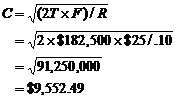
A. The BAT (Baumol-Allais-Tobin) Model
Define:
C = optimal cash transfer amount (amount of securities to sell)
F = the fixed cost of selling securities to replenish cash
T = the cash needed for transactions over the planning period
R = opportunity cost of cash the interest rate on marketable securities
Assume cash is paid out at a constant rate through time.
1. The opportunity—costs—average cash balance × interest rate = (C/2) × R
2. The trading costs—number of transactions × cost per transfer = (T/C) × F
3. The total cost—opportunity costs + trading costs = (C/2) × R + (T/C) × F
4. The solution—the minimum occurs where opportunity costs = trading costs:

Rearranging:

Solving for C:

This can also be found by differentiating total cost with respect to C:

Setting this to zero and solving for C yields:
Example:
Hermes Co. has cash outflows of $500 a day, the interest rate is 10% and the cost of a transfer to cash is $25.
T = 365 × $500 = $182,500 | F = $25 | R = .10 |

B. The Miller-Orr Model: A More General Approach
The Miller-Orr model offers a general approach to handling uncertain cash flows.
1. The Basic Idea
Define:
U* | = upper limit on cash balance |
L | = lower limit on cash balance |
C | = target cash balance |
When cash reaches U*, the firm transfers U* – C* dollars from cash to securities. If cash falls below L, the firm sells C* – L worth of securities to add to cash.
2. Using the Model
Given the variance  of cash flow ("cash flow" refers to both the amounts that go into and come out of the cash balance) per period, the interest rate per period (period may be a day, week, or month as long as the two are consistent), and L, the target balance and upper limit are given by:
C* = L + ( × F ×
× F ×  )1/3 and U* = 3 × C* – 2 × L
Example:
Suppose F = $25, R = 1% per month, and the variance of monthly cash flows is $25,000,000 per month. Assume a minimum cash balance of $10,000.
C | = $10,000 + ( | |
= $10,000 + $3,605.62 = $13,605.62 | ||
U* | = 3 × $13,605.62 – 2 × $10,000 | |
= $40,816.86 – $20,000 = $20,816.86 |
C. Implications of the BAT and Miller-Orr Models
From both:
-The higher the interest rate (opportunity cost), the lower the target balance.
-The higher the transaction cost, the higher the target balance.
From Miller-Orr:
-The greater the variability of cash flows, the higher the target balance.
D. Other Factors Influencing the Target Cash Balance
-Flexible versus restrictive short-term financing policy.
-Compensating balance requirements.
-The number and complexity of checking accounts.
S19.17: Quick Quiz
S19.18: Summary
