

Партнерка на США и Канаду по недвижимости, выплаты в крипто
- 30% recurring commission
- Выплаты в USDT
- Вывод каждую неделю
- Комиссия до 5 лет за каждого referral
17 December 2015
RIA 2015 Housing Forum NCOSS Sydney 19 November 2015
Forum Summary
Rights & Inclusion Australia (RIA) and ANUHD thank NCOSS, all presenters and delegates for significant contributions and involvement in progressing our joint agenda for more equitable, inclusive and accessible housing in Australia.
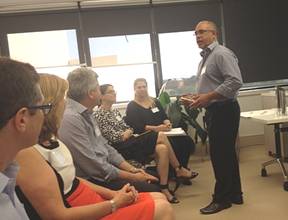
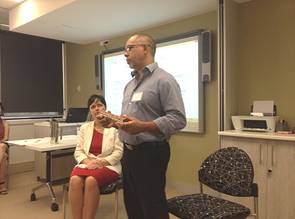
Michael West Welcome to Country
RIA Chair Michael Fox introduced this 5th Housing Forum – and Michael West gave an excellent Welcome to Country emphasising the importance of equity & inclusion.
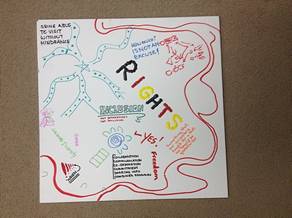
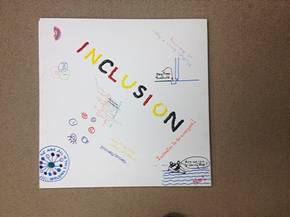
Workshop delegates participated with Michael West
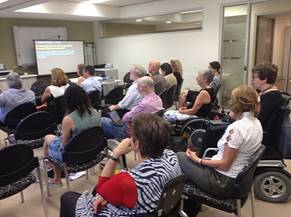
The Forum was attended by 35± presenters and delegates with real time captioning and transcript seamlessly provided by The Captioning Studio. Available presenters papers will be posted on the RIA website www. riaustralia. org in due course.
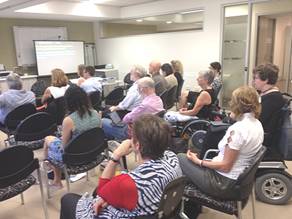
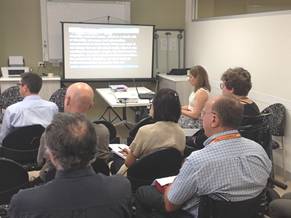
Forum delegates Real time captioning
The RIA 2015 Housing Forum was opened by Tanya Davies MP, NSW Parliamentary Secretary for Youth, Affairs and Homelessness, representing Premier Mike Baird.
Tanya conveyed the Premier’s best wishes and said ‘The work that you do today is going to help formulate the strategy that the New South Wales Government takes up to tackle this challenge that we all have.’
Tanya discussed the current challenges in our social housing and affordable housing sector, and the increasing challenges of our ageing demographic and the impact of the NDIS.
The forthcoming NSW Housing Strategy plans to meet the growing demand for affordable housing across the state and is based on extensive consultations – and the Communities Plus program will provide new generation housing developments
Tanya said the Premier and Minister Hazzard are committed to developing the solutions and options necessary to assist people with needs to transition out of social housing into the affordable housing sector.
Michael Fox thanked Michael and Tanya for attending and opening our Forum.
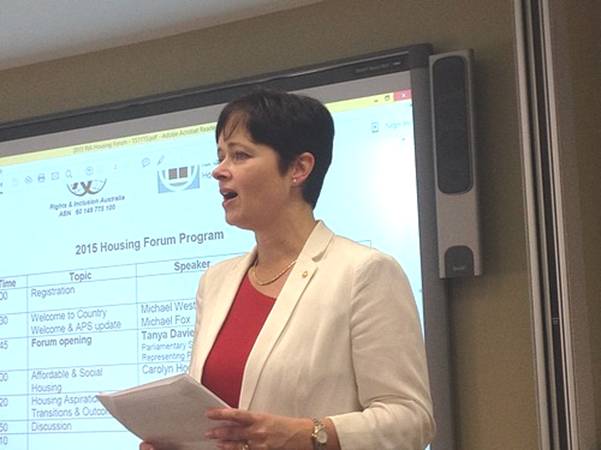
Tanya Davies MP Opening the RIA 2015 Housing Forum
Carolyn Hodge, NCOSS Senior Policy & Advocacy Officer and discussed housing and needs from the social rather than the physical infrastructure perspective. Key issues include workplace participation rates, median gross incomes per week, rental affordability, appropriateness of properties, support to make applications.
NCOSS, with a range of stakeholders, is involved in a $1 billion NSW investment to create of approximately 3,000 new units of social and affordable housing
Carolyn chairs the Disability Network Forum, with focus on integration and transitioning supported accommodation from government hands in NSW to the not‑for‑profit sector. NCOSS is also actively involved in the delivery of disability inclusion action plans.
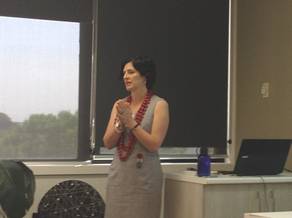
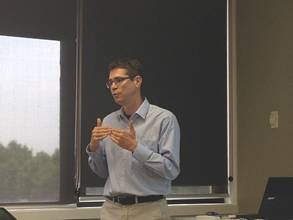
Carolyn Hodge NCOSS Ilan Wiesel UNSW
Ilan Wiesel, Senior Research Fellow, Built Environment UNSW, discussed the AHURI network (Australian Housing & Urban Research Institute) study and Disability Housing Futures Group – related to people with severe and profound disability. Ilan discussed affordability, security of tenure, different needs and implications of actually designing and locating housing appropriately. He noted that the National Housing Supply Council estimates a national supply shortage of 180,000 dwellings.
The AHURI study available data and surveys estimates a current affordable housing need for about 110,000 people – including NDIS participants living with parents, and people living in congregate accommodation such as boarding houses and aged care.
Ilan discussed social housing demand, private rental difficulties and the Shared Equity Model where a purchaser buys a share from the housing provider. Ongoing issues include cost effectiveness, taxation, standards and urban planning.
Discussion
Lively discussion included the problems of limited information about the extent and locations of adaptable and LHA (Livable Housing Australia) housing, need for ease of housing modifications, industry perceived ‘lack of demand’, current status of disability inclusion action plans and the complexity of the APS (Access to Premises Standard) review process.
Michael Fox thanked Carolyn and Ilan – and advised that the current APS review is scheduled to report by 1 May 2016, with limited consultations. He also advised that the BCA (Building Code of Australia) amendments are now on a 3 year cycle with the next amendments in February 2016 and February 2019.
Dr Margaret Ward, ANUHD Convenor, discussed access and equity with focus on how the National Disability Strategy commitment to accessible housing is set to fail. Margaret illustrated her discussion around the story of the King with no clothes.
In 2010 National Dialogue industry, government and consumer stakeholders signed up to voluntary LHA guidelines with an aspirational target of all new housing providing minimum access features by 2020. The schedules 2013 review did not occur so ANUHD and RIA carried out an extensive stakeholders review.
There are over 140,000 new dwellings constructed in Australia each year and ANUHD and RIA estimate that about 5% of the aspirational housing goal will be achieved by 2020. Margaret said the only practical solution is to regulate minimum accessibility features in the BCA / NCC (National Construction Code) – and the ANUHD / RAI position paper now has support from over 150 stakeholder organisations Australia wide. Margaret’s PowerPoint is available from RIA.
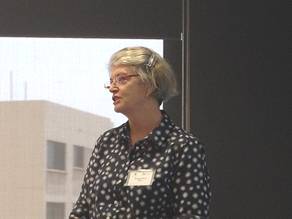
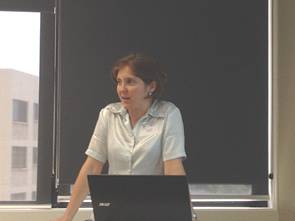
Dr Margaret Ward Emily Steel
Emily Steel, RIA director, ANUHD and ARATA member, discussed an OT research program with Dr Natasha Layton from Victoria on how to achieve inclusive communities with appropriate housing. The research starting point is UN CRPD Article 19 Living independently & being included in the community and the CRPD has monitoring powers.
Emily raised concerns about the scope of the NDIS, economic security and how communities impact on people’s health. She noted that the WHO (World Health Organisation) is focussed on the ability of communities to reduce health care needs.
Emily suggested that the National Disability Strategy and the DDA show that inclusive communities can increase social, education and employment participation. Participation can reduce stress and is a good predictor for quality of life and a more peaceful society. Emily noted that Stella Young said no individual can make all the changes necessary for us to be inclusive communities – it takes effort from all of us.
The research involved people with a range of disabilities – articulating practical solutions for interdependence rather that independence, and ways to be more socially and economically productive through more inclusive services and premises.
Emily said ‘the National Disability Strategy (NDS) is the most critical thing we can do in the next generation to improve inclusion in Australia…. but the NDIS may fail … because it will not deliver the economic and social outcomes we want unless we can also deliver on the NDS. This falls to all of us to do together.’
Emily’s PowerPoint is available from RIA.
Discussion
Comments included concern at the new BCA / NCC moving to 3 year cycle, the need to expedite the accessible housing adenda, and the importance of Australia’s ratification of the CRPD with a requirement for accessible housing and communities – together with our ageing demographic.
The relevance of UK adaptable housing, minimal cost of adaptability provisions and NDIS opportunities were discussed, together with the strong consumer support for mandatory accessible housing legislation compared to voluntary support by industry and government.
Emily commented that ‘I work from the assumption that in fact we're in a society that has very rigid ideas about what is normal and therefore what competence is and we attribute more to individual differences rather than actually looking at what we can do within our environment in all of those dimensions. There's so much more we could do so that we get the benefit of diversity.’
Michael Fox thanked Margaret and Emily – and said after morning tea our first speaker will be Jennifer Harwood from Standards Australia. Our advertised presenter Tim Wheeler advised yesterday that due to unexpected commitments he could not attend today.
We are pleased to welcome Jennifer to our Forum, and again thank Standards Australia for hosting our 2014 Housing Forum.
Jennifer Harwood, Standards Australia Senior National Sector Manager, said Standards Australia is a member based, independent, not‑for‑profit and non‑government organisation, and our Standards only come into effect when they are called up into legislation. Standards Australia represents ISO and develops Standards through a consensus process.
The objectives of Standards Australia are to ‘make sure our standards provide the greatest net benefit to the community’ and to be a sustainable organisation. Standards are updated continuously and are prioritised towards greatest net benefit and maximum number of people.
Jennifer outlined procedures for updating a Standard, with two submission dates each year, and update requests need to provides a clear scope, explain the net benefit and provide evidence of stakeholder support. Each submission goes through a project approval stage, and if approved, a draft document is prepared for public comment.
In relation to AS1428, Jennifer advised that the Wayfinding Standard is now at the public comment stage. The AS1428 Committee currently has the adaptable housing and fixtures and fittings Standards on hold and this relates to the current APS review. Any Standard referenced in the BCA / NCC needs to meet ABCB (Australian Building Codes Board) requirements.
Standards Australia is also trialing accessible formats for AS1428, including diagram descriptions, simplified document structure and alternate formats.
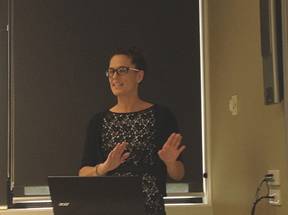
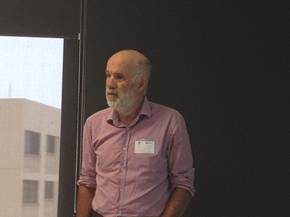
Jennifer Harwood Peter Johns
Peter Johns, RIA member and ACT Government Senior Manager, said that ACT public housing generally meets adaptable or LHA standards. He said the aim is to ensure a dedicated supply of affordable rental properties through the Housing Assistance Act. The housing aim is to meet tenants needs now and in the future.
The ACT Government has a significant program to revitalise the public housing portfolio, with 10% currently under renewal over the next 4 to 5 years. The intent is for public housing to work with broader ACT Government objectives, including urban renewal. Our human services blueprint aims to give ‘the right services at the right time for the right duration of people and our services are targeted specifically to the circumstances of each household.’ The government works with a wide range of community based organisations and specific support programs are being trialled in a number of areas in Canberra.
Housing issues include affordability, housing stress, subsidies and financial support – and tenancies provide support for people who have a range of disabilities, together with issues related to mental health, drug, alcohol and family violence. Public housing research clearly indicates a mismatch between tenant requirements and available dwellings. There are currently about 2,500 people on the Canberra waiting list with 3 categories of need – priority housing, high needs housing and standard housing. Peter said the ACT Government has about 11,500 dwelling, mainly 3 bedroom. Approximately 50% of applicants seek a 2 bedroom dwelling and 20% request 4 or more bedrooms. Accordingly several multi-unit sites are being redeveloped for 1200 new accessible or adaptable units.
Discussion
Jennifer advised that the request for an update of AS4299 came from the Committee – but this is not a priority. Jennifer agreed to follow up status of draft AS1428.8 on housing. Jennifer said that if a proposal is submitted and agreed, Standards Australia can allocate a project manager, but the agenda is driven by the ABCB.
Discussion on public housing included clarification by Peter that the redevelopment sites will be for private sale, the ACT Government is in discussion with HIA and MBA regarding economic development and adaptable housing, and is proposing display villages with an accessible house. The Territory plan requires 10% of housing to be adaptable, but there are no requirements for affordable housing. However the ACT Government requires 20% of green field developments housing to be affordable.
The issue of latent demand was discussed – and Peter emphasised the need for good examples to influence community change, and the sharing of knowledge. Michael Fox thanked Jennifer and Peter.
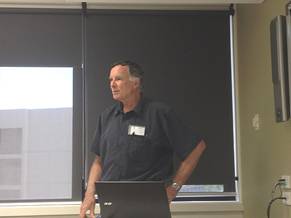
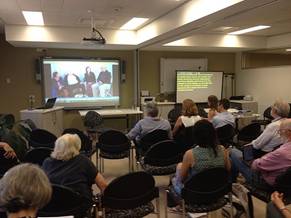
Geoff Barker ‘Universal Design in Housing’ film
Geoff Barker and RIA member and new director, Zel Iscel attended the recent AHURI Conference in Perth and were jointly involved in production of the excellent film ‘Universal Design in Housing’ shown at the Forum.
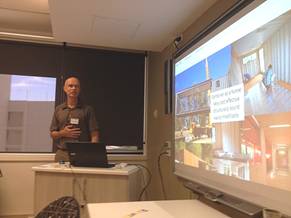
Peter Hojgaard-Olsen
Peter Hojgaard-Olsen provided a brief presentation about more environmentally appropriate, flexible and accessible housing with Danish references. Further information is available from RIA.
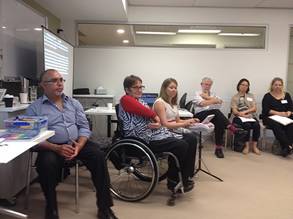
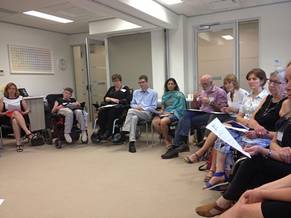
The afternoon Workshop commenced with Michael West discussing the cultural significance of Rights, Inclusion and Australia – and Forum delegates participated in a round table discussion and participation session.
Margaret Ward presented and described a proposed draft ANUHD / RIA Action Plan – with the goal of minimum access provisions in the BCA / NCC for all new and extensively modified housing in Australia.
Margaret noted the important corollary that this needs to be supported by the housing industry through education, training and awareness raising.
Key Action Plan components include
v Contact and liaison with stakeholders
v Create new draft building standards and legislation
v Optimise supporters
v State by State / Territory support
v Political mechanisms and champions
Delegates debated all components of the draft Action Plan – including the importance of including government and industry stakeholders, and acknowledging the significant LHA awareness raising and achievements since 2010.
Government stakeholders and links discussed included the NDS, NDIS, HRC, CRPD and CRPD Protocol.
The Workshop discussed the draft Action Plan in detail, with questions and comments including
Where is the roadblock to progressing minimum access regulations in housing?
Political and industry aspects were discussed including the process for the ABCB to progress this housing agenda. The opportunity to work together with LHA and all stakeholders, to move from a voluntary to regulatory basis, was supported by delegates.
What hooks and links should be pursued?
Key links include the NDS and UN CRPD, together with the NDIS, UNSW, Standards Australia and the Summer Foundation. There is potential to use the optional protocol of the UN CRPD through a class action.
Delegated noted the DDA (and AHRC) is based on public services and facilities, and is complaints based – whereas the BCA / NCC specifies access only to the door in Class 2 buildings, but not through the door (i. e. width of doorway, circulation space).
Creating new building regulations
Research, and comprehensive economic analysis of cost benefits and cost effectiveness are critical – with focus on the community cost of not regulating. This includes the impact on NDIS expenditure and demonstrating the cost shifting implications across all government sectors.
Political and sector support
Approaches discussed included the Committee for Sydney and major housing developers involved with the National Dialogue and LHA, as leaders of change.
State by state support
Delegates suggested that if 2 or 3 states / territories, together with consumers and industry, support the regulatory transition – the housing goal can be achieved. RIA agreed to investigate opportunities for detailed economic analysis / project officer support with the NSW government and other sources including Trusts.
The Workshop agreed to adopt the draft Action Plan as a basis for progressing the ANUHD / RIA agenda, and also to approach Standards Australia regarding an update of AS4299 Adaptable Housing.
Michael Fox thanked Michael West, Margaret Ward, and all presenters and delegates, for active participation and involvement in the 2015 RIA Housing Forum.
Time | Topic | Speaker | Organisation |
0900 | Registration | ||
0930 | Welcome to Country Welcome & APS update | Michael West Michael Fox | Chair RIA |
0945 | Forum opening | Tanya Davies MP Member for Mulgoa Parliamentary Secretary for Youth Affairs and Homelessness Representing Premier Mike Baird | |
1000 | Affordable & Social Housing | Carolyn Hodge | NCOSS Senior Policy & Advocacy Officer |
1020 | Housing Aspirations, Transitions & Outcomes | Ilan Wiesel | City Futures UNSW |
1050 | Discussion | ||
1110 | Morning Tea | ||
1140 | Access & Equity – Housing for all | Dr Margaret Ward | ANUHD |
1200 | Creating inclusive communities | Emily Steel | RIA / ARATA / ISO |
1220 | Discussion | ||
1230 | Housing Standards | Jennifer Harwood | Senior National Sector Manager Standards Australia |
The Current State of Housing Policies | Peter Johns | Senior Manager ACT Government | |
1300 | Discussion | ||
1315 - 1415 | Lunch – Own arrangements | ||
1415 | Workshop Group Discussions | Consolidating next housing actions | RIA / ANUHD / ALL |
1515 | Workshop Summaries | ||
1545 | Forum recommendations | ||
1615 | Close, networking & drinks | ||
1700 | RIA Annual General Meeting | ||
2015 Housing Forum Program
