

Партнерка на США и Канаду по недвижимости, выплаты в крипто
- 30% recurring commission
- Выплаты в USDT
- Вывод каждую неделю
- Комиссия до 5 лет за каждого referral
Title Should Be in Bold, 24-Point Type and Centered, Please Use Title Case
Author name(s) [Full name, 11-point type, centered, Times New Roman]
Author affiliation and full address (9-point type, centered, Times New Roman)
Author e-mail address: (9-point type, centered, Times New Roman)
Abstract: Basic guidelines for the preparation of a technical paper for OECC/PS 2016 are presented. This document is itself an example of the desired layout (inclusive of this abstract) and can be used as a template if you are using Microsoft Word. The abstract is limited to 35 words and cannot contain equations, figures, tables, or references. It should concisely state what was done, how it was done, principal results, and their significance. (10-point type, italicized, Times New Roman)
Keywords: (9-point type, italicized, Times New Roman)
I. Introduction
This document contains information regarding desktop publishing format, type sizes, and typefaces. Style rules are provided that explains how to handle equations, units, figures, tables, abbreviations, and acronyms. Sections are also devoted to acknowledgments and references. (10-point type, Times New Roman)
For additional information not included in these instructions, please contact the paper submission office at *****@***co. jp.
II. Technical Work Preparation
The total paper length must be Three (3) pages. No extra pages are permitted.
A. Format (size 10, Italic)
Prepare your technical work in single-spaced, single-column format, on A4 paper sheet (210Ч297 mm).
Set top and bottom margins to 25 mm, and left and right margins to 20 mm. Paragraph indentation is 4 mm. Use one space-line between sections, and between text and tables or figures. Use 10-point Times New Roman, and do not use hyphens at the end of a line.
B. Type Sizes and Typefaces
Please use Times New Roman” typeface and embed all fonts (See your software’s “Help” section if you do not know how to embed fonts).
Table I provides samples of the appropriate type sizes and styles to use.
TABLE I
FONT: Times New Roman / (size 8)
Type Sizes and Styles for OECC/PS 2016 Paper
Type size (pts) | Regular | Bold | Italic | Small caps |
8 | Figure captions, table text, figure text, footnotes, subscripts and superscripts | Table captions | ||
9 | Authors’ affiliation, references, Keywords | Keywords title | ||
10 | Body text, equations, Abstract | Abstract title | Subheadings | Title of sections |
11 | Authors’ names | |||
24 | Title of the paper |
C. Section Headings
A primary section heading is enumerated by a Roman numeral followed by a period and is flush left. A primary heading should be in small caps. The first letter of each important word is capitalized.
Do not number Appendix, Acknowledgment and References.
A secondary section heading is enumerated by a capital letter followed by a period and is flush left above the section. The first letter of each important word is capitalized and the heading is italicized.
D. Figures and Tables
Figures and tables should be centered (except for small figures less than 2.6 in. or 6.6 cm in width, which may be placed side by side) and located inside paper margins. Text should not wrap around figures or tables; table captions (8-point font) should be centered above tables, and figure captions (8-point font) should be centered below figures (for example, “Fig. 1. Laser”). Both should appear as close as possible to where they are mentioned in the main text.
In labeling figure axes please use words rather than symbols. Put units in parentheses as in Fig. 1.
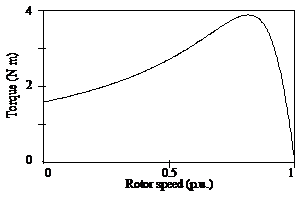
Fig. 1. Torque-speed characteristic of a three-phase induction motor.
Large figures and tables may span both columns, but may not extend into the page margins. Figure captions have to be below the figures; table captions have to be above the tables.
Do not put captions in "text boxes" linked to the figures. Do not put borders around your figures.
All figures and tables must be placed just after they are first mentioned. Digitize your tables and figures.
E. Numbering
Do not number pages.
Number reference citations: consecutively in square brackets [1].
Number footnotes separately with superscripts. Place the actual footnote at the bottom of the column in which it is cited.
All figures and tables must be numbered consecutively. Use Arabic numerals for figures and Roman numerals for tables.
F. Abbreviations and Acronyms
Define less common abbreviations and acronyms the first time they are used in the text, even after they have been defined in the abstract. Do not use abbreviations in the title unless they are unavoidable.
G. Math and Equations
Use either the Microsoft Equation Editor or the MathType commercial add-on for MS Word for all math objects in your paper.
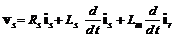
Number equations consecutively with numbers in parentheses flush with the right margin, as in (1).
Be sure that the symbols in your equation have been defined before the equation appears or immediately following.
 (1)
(1)
where Rs is the stator phase resistance.
III. Units
Use International System of Units (SI - MKSA) as primary units. British units could be used as secondary units in parentheses.
IV. Conclusions
Conclusions are one of the most important parts of a paper. Please give careful consideration to this section. Once authors have completed this step, they then can move on to the submission site and submit the paper
Appendix
Appendixes, if needed, have to appear before the Acknowledgment.
Acknowledgment
Please place an eventual Acknowledgment here, before the References. Put sponsor acknowledgments in an unnumbered footnote on the first page.
References
List only one reference per reference number according to the following samples:
[1] G. Eason, B. Noble, and I. N. Sneddon, “On certain integrals of Lipschitz-Hankel type involving products of Bessel functions,” Phil. Trans. Roy. Soc. London, vol. A247, pp. 529-551, April 1955.
[2] J. Clerk Maxwell, A Treatise on Electricity and Magnetism, 3rd ed., vol. 2. Oxford: Clarendon, 1892, pp. 68-73.
[3] I. S. Jacobs and C. P. Bean, “Fine particles, thin films and exchange anisotropy,” in Magnetism, vol. III, G. T. Rado and hl, Eds. New York: Academic, 1963, pp. 271-350.
[4] K. Elissa, “Title of paper if known,” unpublished.
[5] R. Nicole, “Title of paper with only first word capitalized,” J. Name Stan. Abbrev., in press.
[6] Y. Yorozu, M. Hirano, K. Oka, and Y. Tagawa, “Electron spectroscopy studies on magneto-optical media and plastic substrate interface,” IEEE Transl. J. Magn. Japan, vol. 2, pp. 740-741, August 1987 [Digests 9th Annual Conf. Magnetics Japan, p. 301, 1982].
[7] M. Young, The Technical Writer’s Handbook. Mill Valley, CA: University Science, 1989.
[8] J. Du and H. Ohsaki, “Numerical analysis of eddy current in the EMS-maglev system.” Proc. of 6th Int. Conf. on Electrical Machines and Systems (ICEMS 2003), Beijing (China), Nov. 2003, pp.761-764.
