

Партнерка на США и Канаду по недвижимости, выплаты в крипто
- 30% recurring commission
- Выплаты в USDT
- Вывод каждую неделю
- Комиссия до 5 лет за каждого referral
Introduction
This Guide outlines the Investment Philosophy and the Investment Process that James Gregory Financial Ltd has put in place for its clients. It is a proposition which we believe can add significant value to an individual’s investment portfolio.
We have confidence in this process as we involve widely acknowledged expert organizations to carry out all of the vital aspects of the management of our clients’ investment portfolios.
We have put in place an Investment Process which involves the spread of assets, monitoring and rebalancing of portfolios, all of which we believe will deliver real benefits to our clients.
The process is designed to allow James Gregory Financial Ltd to ensure that your investment portfolios continue to be monitored in accordance with your agreed investment strategies and your tolerance for risk.
James Gregory Financial Ltd are aligned with a number of strategic providers to deliver an investment process suitable for its clients
Investment Philosophy
1. Investors should understand the reasons for investing and how their portfolio is designed to meet their goals. The world of investing can be complex and often not transparent. We believe in keeping things simple. We are keen that every client understands our recommendations and how they fit with their own financial objectives.
When delivering investment advice, we always start with a detailed understanding of your financial planning objectives. These inform decisions about the level of investment risk that needs to be taken.
2. A conversation about risk and its many dimensions is the essential first step when investing. All investments involve some degree of risk - it's important that you understand this before you invest.
The reward for taking on risk is the potential for a greater investment return. If you have a financial goal with a long time horizon, you are likely to do better by carefully investing in asset categories with greater risk, like equities, rather than restricting your investments to assets with less risk, like cash. On the other hand, investing solely in cash investments may be appropriate for short-term financial goals.
Your capacity for loss is very different to your attitude to risk – understanding this is a key part of our investment process. A conversation with you will help inform decisions about the level of investment risk that needs to be taken and
that you can afford to take, rather than simply the maximum amount of risk that you feel happy with.
We will use a specialist risk profiling tool –Dynamic Planner, which is provided by Distribution technology. to help us establish the risk profile that is right for you. But we will also have a conversation with you about the profile to make sure that you understand what it means and how the profile needs to change to meet your particular situation. The great benefit of the tool is that it creates an unbiased view of your risk profile, and therefore is an excellent starting point for the conversation.

3. Investing for the long term is very different than saving for the short term. While there is an understandable desire to keep things safe when investing, the corrosive impact of inflation and thus the value of investing for the long term in more risky assets are compelling.
Real assets such as equities, property and commodities tend to make a better investment than the apparently safer option of cash deposits in the long run.
4. The bulk of long-term returns come from asset allocation.
It is widely accepted that asset allocation has the biggest influence over the variance in portfolio returns.
This means that investors and their advisers should be devoting the bulk of their effort to constructing the most suitable asset allocation model, based on individual investment objectives and individual attitude towards
investment risk. This is where we focus our attention when delivering investment advice.
5. Diversification using mainstream asset classes can reduce risk without destroying returns. Diversification is a strategy that can be neatly summed up by the timeless adage "Don't put all your eggs in one basket." The strategy involves spreading your money among various investments with the intention that if one investment loses money, the other investments may more than make up for those losses.
The portfolio’s we recommend are diversified at both asset class and stock level. But importantly they stay close to the sset allocation outcome which has been determined as appropriate for you.
The use of these so – called multi-asset are rebalanced inside the fund wrapper. This means that the asset mix of these portfolios stays true to the asset allocation that meets your risk need, and is often conducted at lower cost than we can probably achieve by rebalancing it directly. (It will take us some time to implement the switches for each client and each fund in each tax wrapper - automatic rebalancing reduces this cost (and is especially efficient for smaller portfolios). Also that fact that switching portfolios outside the fund wrapper which could lead to Capital Gains Tax (CGT) liability is removed.
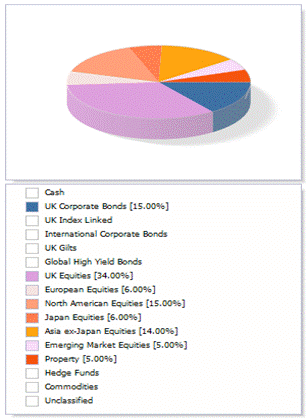
The portfolios are typically diversified geographically across all the major asset classes and aligned to your agreed risk profile, an example of an investment risk 7 profile is shown below:-
6. Costs are certain and returns are not
Costs are certain and fund performance is not. It therefore makes sense to reduce costs wherever it is safe to do so.
There are three main costs with investing in funds:
1. The Annual Management Charge (AMC) – is the fee that the manager charges;
2. The Total Expense Ratio (TER) – this is the AMC plus legal, audit, depositary, safe custody and other costs;
3. Trading costs – these are the costs of buying and selling the investments inside a fund
Even though TER’s are not the whole cost of running a fund, they are a powerful predictor of fund returns.
Understanding and seeking to reduce costs where safe to do so is a key part of our investment process.
7. Tax and access are important
Making investment tax efficient is a sensible objective and wherever we can we will try to reduce the tax your investments will pay. Use of pension wrappers and ISAs will assist in this objective.
We also use new technology platforms, known as wraps or fund supermarkets, to hold your investments, where appropriate. These offer safety, access to your valuations (so you can see how your investments are doing) and tax wrappers (pensions and ISAs for example). They also allow us to move your money between funds cost effectively if we need to in future.
8.Active management and passive strategies can both play a valuable role.
We wish to tailor the best solution to your needs and financial goals
There is a role for active (where the fund manager tries to beat the market, but incurs higher costs), and passive funds (which track the index at low cost) within a well-managed investment portfolio.
9.Investment success comes from the consistent application of a robust process.
There are numerous ways to approach the construction and on-going management of an investment portfolio. Without the application of a robust process, the emotional aspects of
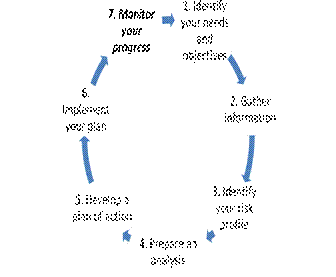
investing can prevent investors from making the best decisions. As a firm, we consistently apply a multi-stage investment advice process designed to deliver suitable advice for every client. The outcome is tailored to meet individual objectives but the process itself is always the same.
As with any plan we need to regularly review progress to make sure we are on track. We will discuss and agree with you the best way to achieve this.
10.Compliance and Business Support.
With the ever important compliance and regulatory responsibilities we have. It is vitally important that we have scalable and compliant business model. ‘Simply Biz’ facilitate this requirement by assisting us in maintaining a robust process and fit for purpose process

‘Simply Biz’ support over 2000 firms in the UK, and are the leading directly authorised support firm within the market. In addition to the core compliance services market leading technology solutions, technical guidance and innovative business offerings are available
Risk Warnings.
All investments carry risk.
The risk that the buying power of your capital decreases over time.
The risk that the growth you experience is variable.
The risk that you might get back less than you invested.
The risk that you do not achieve one of your objectives.
Investment Process
We use our Investment Philosophy to help us determine the most suitable portfolio for each client:
· Understanding risk is important
· Matching your portfolio to your risk profile is essential
· Asset allocation is the key to success.
· Costs are important
· Diversification (not putting all your eggs in one basket) is a sound principle
· Funds are a cost effective way to access investments for many customers, though specialist managers may be appropriate for part of larger portfolios
Customer - Initial Consultation
· A chance to ask questions and understand our service
· An opportunity for us to find out what assistance you may require
· Discuss the options available to you from our menu of services
· Information about our charges
Fees for this part of the service are at our expense
Financial Analysis and Research Process
· Agree basis for working together
· We collect and assess all relevant personal and financial data
· We clarify your current position and how you have arrived there, with the intention of ensuring you are in a position to make an informed choice on the type of products that will best suit your needs
· We establish your life goals, personal circumstances, aspirations and concerns for your family.
· We will take into account your time horizon. This is based on historic drawdown of the asset mixes and is designed to reduce specific client loss
· You are asked to complete a short risk questionnaire compiled from Dynamic Planner. The questionnaire has been designed by Distribution technology who are the UK’s leading risk profile provider
· The portfolios we select are matched to risk profiles 1-10. They are monitored on an ongoing basis
· We clarify your relevant risk profile to the tolerance suggested. We are then able to determine which of the risk rated portfolio’s, is the most suitable for you, if appropriate
· A second meeting arranged to explain and discuss our recommendations
· Having completed the preparatory work, we will prepare our recommendations to assist you in achieving your goals
· We work with strategic partners to prepare the most suitable recommendations for your needs, these include:-



Recommendation and Implementation
· We agree the plan to implement the strategy to achieve your objectives over a given period of time.
· Handling of all fund and policy administration on your behalf
· Regular up-dates to keep you informed of progress
· Confirmation of all actions taken on your behalf in writing
Ongoing service/Review
- We offer three defined levels of on-going Service to meet your specific requirements and we will agree on the most suitable for your needs, if required
The Portfolios
· We have a process for selecting client portfolios
- Our client portfolios are selected to meet client needs and not the other way round - we are outcome driven, not product driven. You should be aware that although we know how the portfolios have performed historically, the future will be different so we need to regularly review them.
· We have a preferred list of risk managed solutions that we select for these clients. We advise both passive and active solutions.
· The most effective tax wrapper for the client’s tax position may impact the selection of the method of investment.
· Portfolios are regularly rebalanced regularly to maintain the client’s risk profile.
· Our passive portfolios maintain investors exposure across key global asset classes, they are cost effective and low maintenance investment solution. They are typically used with smaller Investors.
· Our actively managed portfolio’s typically have higher charges than the passive funds, but are designed for the manager to make specific investments with the goal of outperforming the benchmark
· Multi Asset funds are commonly used pooling and rebalancing makes them cost and tax efficient
- Structured deposit accounts are term deposits with a variable return linked to the performance of an underlying asset. Guaranteed products are suitable for low risk investors and provides a capital guarantee at the end of a fixed term
Platforms
· Wraps or fund supermarkets offer a cost effective way for you to access tax wrappers (e. g. pension and ISAs).
· They allow you to hold investments from more than one fund manager. Any switches that are made may be faster using platforms.
· You can also see the value of your investments online – with analysis to see how your investments have performed.
· Platforms also allow us to monitor your investment tax effectively
· Your investments are held by an independent custodian, potentially offering an additional layer of security.
· Our selection of platform will be partly driven by the costs of trading and availability of our preferred investment solutions.
· The ability to access a true fund rather than a mirror fund
· To obtain discounts and rebates on Initial and AMC’s
Having researched the platform market and completed our own due diligence, we have identified that the Aviva and Nucleus Platforms are most suitable for our Client proposition. We continue to monitor this position on an annual basis.

The Aviva wrap platform has exceeded £3 billion of funds under management held on the wrap as at Feb 2014. It offers a wide range of tax wrappers, funds and services to choose
from. The wrap is managed and governed within the Aviva Life division of Aviva PLC. Aviva is the world’s sixth largest insurance group and the largest insurance services provider in the UK. It is considered financially strong and holds a (A-)strong credit rating from Standard & Poors.
Nucleus is an online wrap based business platform with access to over 2,200 fund. It was founded in 2006 by a number of high quality IFAs who shared a commitment to creating a market where advisors have the infrastructure and desire to place the client centre stage. Since foundation Nucleus has established itself as a major force for change in the market
The research undertaken included:-
- Financial Strength The level of clear and transparent charging
- The competitive charging structure when compared to other providers in this market place Any restrictions on investment and tax wrappers Whether they provide access to a wide range of different tax wrappers Whether they provide access to model investment portfolios Whether they provide access to discretionary fund management Whether they have any excellent service standards
· Whether they provide a fund rebalancing facility which will be instrumental in ensuring they meet your long term financial objectives
Discretionary Managers
· We may also use expert discretionary managers to construct bespoke portfolios for clients with higher risk profiles or with larger amounts of capital. The extra costs make it inefficient at small portfolio sizes
· We may use these discretionary managers for risk adjusted model portfolios which would be cheaper than the bespoke option but making use of the discretionary managers resource and investment expertise that is available
.
Our current Discretionary Manager of choice is Vestra Wealth LLP. We believe that the overall benefit that they can provide clients within this niche market can be very beneficial.

· Vestra have £5.4 billion in assets under management as at the end of October 2015, and have won numerous awards.
· They have a whole of market approach with no bias towards funds or managers, clear investment parameters and active risk monitoring
Our research and due diligence for our selected Discretionary managers is monitored annually.
