

Партнерка на США и Канаду по недвижимости, выплаты в крипто
- 30% recurring commission
- Выплаты в USDT
- Вывод каждую неделю
- Комиссия до 5 лет за каждого referral
31. According to Generally Accepted Accounting Principles, costs are:
A. recorded as incurred.
B. recorded when paid.
C. matched with revenues.
D. matched with production levels.
E. expensed as management desires.
32. Depreciation:
A. is a noncash expense that is recorded on the income statement.
B. increases the net fixed assets as shown on the balance sheet.
C. reduces both the net fixed assets and the costs of a firm.
D. is a non-cash expense which increases the net operating income.
E. decreases net fixed assets, net income, and operating cash flows.
33. When you are making a financial decision, the most relevant tax rate is the _____ rate.
A. average
B. fixed
C. marginal
D. total
E. variable
34. An increase in which one of the following will cause the operating cash flow to increase?
A. depreciation
B. changes in the amount of net fixed capital
C. net working capital
D. taxes
E. costs
35. A firm starts its year with a positive net working capital. During the year, the firm acquires more short-term debt than it does short-term assets. This means that:
A. the ending net working capital will be negative.
B. both accounts receivable and inventory decreased during the year.
C. the beginning current assets were less than the beginning current liabilities.
D. accounts payable increased and inventory decreased during the year.
E. the ending net working capital can be positive, negative, or equal to zero.
36. The cash flow to creditors includes the cash:
A. received by the firm when payments are paid to suppliers.
B. outflow of the firm when new debt is acquired.
C. outflow when interest is paid on outstanding debt.
D. inflow when accounts payable decreases.
E. received when long-term debt is paid off.
37. Cash flow to stockholders must be positive when:
A. the dividends paid exceed the net new equity raised.
B. the net sale of common stock exceeds the amount of dividends paid.
C. no income is distributed but new shares of stock are sold.
D. both the cash flow to assets and the cash flow to creditors are negative.
E. both the cash flow to assets and the cash flow to creditors are positive.
38. Which equality is the basis for the balance sheet?
A. Fixed Assets = Stockholder's Equity + Current Assets
B. Assets = Liabilities + Stockholder's Equity
C. Assets = Current Long-Term Debt + Retained Earnings
D. Fixed Assets = Liabilities + Stockholder's Equity
E. None of the above
39. Assets are listed on the balance sheet in order of:
A. decreasing liquidity.
B. decreasing size.
C. increasing size.
D. relative life.
E. None of the above.
40. Debt is a contractual obligation that:
A. requires the payout of residual flows to the holders of these instruments.
B. requires a repayment of a stated amount and interest over the period.
C. allows the bondholders to sue the firm if it defaults.
D. Both A and B.
E. Both B and C.
41. The carrying value or book value of assets:
A. is determined under GAAP and is based on the cost of the asset.
B. represents the true market value according to GAAP.
C. is always the best measure of the company's value to an investor.
D. is always higher than the replacement cost of the assets.
E. None of the above.
42. Under GAAP, a firm's assets are reported at:
A. market value.
B. liquidation value.
C. intrinsic value.
D. cost.
E. None of the above.
43. Which of the following statements concerning the income statement is true?
A. It measures performance over a specific period of time.
B. It determines after-tax income of the firm.
C. It includes deferred taxes.
D. It treats interest as an expense.
E. All of the above.
44. According to generally accepted accounting principles (GAAP), revenue is recognized as income when:
A. a contract is signed to perform a service or deliver a good.
B. the transaction is complete and the goods or services are delivered.
C. payment is requested.
D. income taxes are paid.
E. All of the above.
45. Which of the following is not included in the computation of operating cash flow?
A. Earnings before interest and taxes
B. Interest paid
C. Depreciation
D. Current taxes
E. All of the above are included
46. Net capital spending is equal to:
A. net additions to net working capital.
B. the net change in fixed assets.
C. net income plus depreciation.
D. total cash flow to stockholders less interest and dividends paid.
E. the change in total assets.
47. Cash flow to stockholders is defined as:
A. interest payments.
B. repurchases of equity less cash dividends paid plus new equity sold.
C. cash flow from financing less cash flow to creditors.
D. cash dividends plus repurchases of equity minus new equity financing.
E. None of the above.
48. Free cash flow is:
A. without cost to the firm.
B. net income plus taxes.
C. an increase in net working capital.
D. cash that the firm is free to distribute to creditors and stockholders.
E. None of the above.
49. The cash flow of the firm must be equal to:
A. cash flow to stockholders minus cash flow to debtholders.
B. cash flow to debtholders minus cash flow to stockholders.
C. cash flow to governments plus cash flow to stockholders.
D. cash flow to stockholders plus cash flow to debtholders.
E. None of the above.
50. Which of the following are all components of the statement of cash flows?
A. Cash flow from operating activities, cash flow from investing activities, and cash flow from financing activities
B. Cash flow from operating activities, cash flow from investing activities, and cash flow from divesting activities
C. Cash flow from internal activities, cash flow from external activities, and cash flow from financing activities
D. Cash flow from brokering activities, cash flow from profitable activities, and cash flow from non-profitable activities
E. None of the above.
51. One of the reasons why cash flow analysis is popular is because:
A. cash flows are more subjective than net income.
B. cash flows are hard to understand.
C. it is easy to manipulate, or spin the cash flows.
D. it is difficult to manipulate, or spin the cash flows.
E. None of the above.
52. A firm has $300 in inventory, $600 in fixed assets, $200 in accounts receivable, $100 in accounts payable, and $50 in cash. What is the amount of the current assets?
A. $500
B. $550
C. $600
D. $1,150
E. $1,200
53. Total assets are $900, fixed assets are $600, long-term debt is $500, and short-term debt is $200. What is the amount of net working capital?
A. $0
B. $100
C. $200
D. $300
E. $400
54. Brad's Company has equipment with a book value of $500 that could be sold today at a 50% discount. Its inventory is valued at $400 and could be sold to a competitor for that amount. The firm has $50 in cash and customers owe it $300. What is the accounting value of its liquid assets?
A. $50
B. $350
C. $700
D. $750
E. $1,000
55. Martha's Enterprises spent $2,400 to purchase equipment three years ago. This equipment is currently valued at $1,800 on today's balance sheet but could actually be sold for $2, working capital is $200 and long-term debt is $800. Assuming the equipment is the firm's only fixed asset, what is the book value of shareholders' equity?
A. $200
B. $800
C. $1,200
D. $1,400
E. The answer cannot be determined from the information provided
56. Art's Boutique has sales of $640,000 and costs of $480,000. Interest expense is $40,000 and depreciation is $60,000. The tax rate is 34%. What is the net income?
A. $20,400
B. $39,600
C. $50,400
D. $79,600
E. $99,600
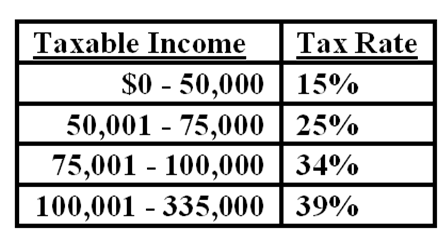
57. Given the tax rates as shown, what is the average tax rate for a firm with taxable income of $126,500?
A. 21.38%
B. 23.88%
C. 25.76%
D. 34.64%
E. 39.00%
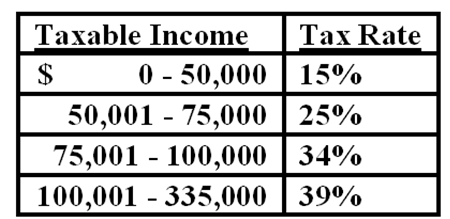
58. The tax rates are as shown. Your firm currently has taxable income of $79,400. How much additional tax will you owe if you increase your taxable income by $21,000?
A. $7,004
B. $7,014
C. $7,140
D. $7,160
E. $7,174
59. Your firm has net income of $198 on total sales of $1,200. Costs are $715 and depreciation is $145. The tax rate is 34%. The firm does not have interest expenses. What is the operating cash flow?
A. $93
B. $241
C. $340
D. $383
E. $485
60. Teddy's Pillows has beginning net fixed assets of $480 and ending net fixed assets of $530. Assets valued at $300 were sold during the year. Depreciation was $40. What is the amount of capital spending?
A. $10
B. $50
C. $90
D. $260
E. $390

|
Из за большого объема этот материал размещен на нескольких страницах:
1 2 3 4 5 6 7 |
