

Партнерка на США и Канаду по недвижимости, выплаты в крипто
- 30% recurring commission
- Выплаты в USDT
- Вывод каждую неделю
- Комиссия до 5 лет за каждого referral
Publication is available for discussion in the framework of the on-line Internet conference “Butlerov readings”. http:///readings/
Submitted on December 18, 2015.
Transformations of peroxide Δ3-carene and (-)-α-pinene ozonolysis products by the action of hydrazine sulfate in isopropanol
© Yulia V. Legostaeva,+ Lilia R. Garifullina, Ivan S. Nazarov, and Gumer Yu. Ishmuratov*
Ufa Institute of Chemistry of RAS. Prospect Oktyabrya, 7. Ufa, 450054. Bashkortostan Republic. Russia.
Phone: +7 (347) 235-60-66. E-mail: *****@***ru
___________________________________
*Supervising author; +Corresponding author
Key words: Δ3-carene, (-)-α-pinene, peroxide ozonolysis products, hydrazine sulphate.
Abstract
The reactivity and chemoselectivity of the hydrazine sulfate as the new reagent in the transformations of peroxide ozonolysis products of cyclic monoterpenes (Δ3-carene and (-)-α-pinene) in comparison with the known semicarbazide hydrochloride was studied. It is shown that the sulphate hydrazide derivative is less active, and also less selective reagent (with respect to the (-)-α-pinene) in the reaction with peroxidic products of the ozonolysis of Δ3-carene and (-)-α-pinene in comparison with semicarbazide hydrochloride.
Introduction
Previously, we reported that hydrazine derivatives (2,4-dinitrophenylhydrazine and semicarbaside and thiosemicarbaside, semicarbaside and phenylhydrazine hydrochlorides) are reducing agents of structurally different peroxide olefin ozonolysis products to carbonyl compounds and their derivatives [1].
In continuation of the research, this paper presents the data on transformations of peroxide ozonolysis products of accessible natural monoterpenes (Δ3-carene (1) and (-)-α-pinene (2)) in isopropanol under the action of hydrazine sulfate as a new reducing agent.
Results and discussion
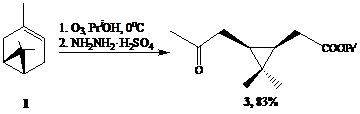
It is revealed that intermediate peroxides with a high (83%) yield formed from cyclic olefin 1 become the only product, i. e. keto-isopropyl ether 3, as in the case of semicarbaside hydrochloride we have previously used [2]. Note also the lower reactivity of hydrazine sulfate as compared to the latter compound: peroxides disappeared in the reaction mixture after 120 hours, not 48 hours.
Identical keto-isopropyl ether 4 was obtained as a major product (with a yield of 56%) after treating peroxide ozonolysis products of another cyclic alkene 2 within 144 hours. However, the reaction mixture was also observed to contain smaller amounts of other two compounds. These are keto acid 5 and keto semiacetal 6. The former is obviously the product of acid hydrolysis of ether 4. The latter is likely to be its precursor and transforms into it under the action of reduction products of the agent itself (NH2NH2·H2SO4) with peroxide products of (-)-α-pinene ozonolysis (2).

Experimental part
Measurements were made using the equipment of the Chemistry Centre for Shared Use. The thin layer IR spectra were recorded using the IR Prestige-21 (Fourier Transform Spectrophotometer – Shimadzu). The NMR spectra were recorded using the Bruker АМ-300 spectrometer [operating frequency 300 MHz and 500 MHz for 1H and 75.47 MHz for 13С] in CDCl3 solution with the inner standard of TMS. The 13С NMR spectra were detected in the JMOD regime. The GLC analyses were performed using the Chrom-5 chromatograph [column length 1.2 m, silicon SE-30 (5%) as a stationary phase with the Chromaton N-AW-DMCS (0.16-0.20 mm), operating temperature 50-300 ºС] and Chrom-41 chromatograph [column length 2.4 m, PEG-6000 as a stationary phase, operating temperature 50-200 ºС], with helium taken as a carrier gas. The TLC analysis was made with Sorbfil plates (Russia). For column chromatography we applied SiO2 (70-230) from Lancaster (UK). The data on elemental analysis for all the compounds were consistent with those calculated earlier. The productivity of the ozonizer was 35 mmol О3 per hour.
Treatment of peroxide terpene (1,2) ozonolysis products with hydrazine sulfate. The ozone-oxygen mixture was bubbled through a solution of 3.7 mmol olefin 1 or 2 in 25 ml i-PrOH at 0 ºС on the basis of 1 mol О3 per 1 mol double bond. The reaction mixture was blown through argon. Under stirring at the same temperature, 1.70 g (13.1 mmol) of NH2NH2×H2SO4 was added, kept stirring at room temperature until peroxides disappeared (iodine test for starch), distilled from i-PrOH and the residue was dissolved with CHCl3 (150 ml), washed with water (4x15 ml), dried with Na2SO4 and evaporated.
Ozonolysis of Δ3-carene (1). The residue (1.0 g) was chromatographed (SiO2, hexane/tert-butylmethyl ether, 10:1→1:1) and 0.69 g (83%) of keto isopropyl ether 3 was obtained.
Isopropyl[(1R,3S)-2,2-dimethyl-3-(2-oxopropyl)cyclopropyl]acetate (3). Rf 0.58 (hexane/tert-butylmethyl ether, 3:2), IR and 13С NMR spectra were identical to those reported earlier [2].
Ozonolysis of (-)-α-pinene (2). The residue (1.1 g) was chromatographed (SiO2, hexane/tert-butyl methyl ether, 10:1→1:1) and 0.46 g (56%) of keto isopropyl ether 4, 0.13 g (20%) of keto acid 5 and 0.11 g (13%) of semiacetal 6 were obtained.
Isopropyl [(1S,3S)-3-acetyl-2,2-dimethylcyclobutyl]acetate (4). Rf 0.62 (hexane/tert-butylmethyl ether, 2:1), IR and 13С NMR spectra were identical to those reported earlier [2].
(3-Acetyl-2,2-dimethylcyclobutyl acid (5). Rf 0.22 (hexane/tert-butyl methyl ether, 2:1), IR and 13С NMR spectra were identical to those reported earlier [3].
1-[3-(2-Hydroxi-2-isopropoxiethyl)-2,2-dimethylcyclobutyl]ethanone (6). Rf 0.37 (hexane/tert-butylmethyl ether, 2:1).
The IR spectrum (KBr), n, cm-1: 1110 (С-О-С), 3392 (ОН). The 1Н NMR spectrum, d, ppm: 0.82 s (CcisH3), 1.23 d (6Н, 2 СН3), 1.32 s (CtransH3), 1.83-2.05 m (1Н, С4Н2), 2.08 s (3Н, СН3С(О)), 2.15 m (2Н, СН2СН), 2.25-2,35 m (1Н, С1Н), 2.90 m (1Н, С3Н), 4.02 m (1Н, СН(СН3)2), 4.9 m (СНОН), 5.7 bs (ОН).
The 13С NMR spectrum, d, ppm: 22.12 q (СН3), 23.23 q (СН3), 24.77 q (2СН3), 29.98 t (С4H2), 30.16 q (СН3С(О)), 38.09 t (СН2), 38.37 d (С3H), 43.16 s (С2), 53.79 d (С1H), 67.54 d (СН(CH3)2), 103.45 d (CН(OН)OCH(CH3)2), 208.03 s (С=О).
Conclusions
Hydrazine sulfate is less active and in relation to (-)-α-pinene less selective agent regarding peroxide products of Δ3-carene and (-)-α-pinene ozonolysis as compared to semicarbaside sulfate.
References
[1] G. Yu. Ishmuratov, Yu. V. Legostaeva, L. P. Botsman, R. R. Muslukhov, M. P. Yakovleva, R. F. Talipov. Vestn. Bash. Univ. 2009. No.1. P.27. (russian)
[2] G. Yu. Ishmuratov, Yu. V. Legostaeva, L. R. Garifullina, L. P. Botsman, Z. I. Idrisova, R. R. Muslukhov, G. A. Tolstikov. Russ. J. Org. Chem. 2013. Vol.49. No.10. P.1409.
[3] G. Yu. Ishmuratov, Yu. V. Legostaeva, L. R. Garifullina, L. P. Botsman, R. R. Muslukhov, G. A. Tolstikov. Butlerov Communications. 2014. Vol.38. No.6. P.129. ROI: jbc-02/14-38-6-129
In the Russian version of this article, the Reference Object Identifier – ROI: jbc-01/16-45-2-63
Превращения пероксидных продуктов озонолиза Δ3-карена
и (-)-α-пинена при действии сернокислого гидразина в изопропаноле
© Легостаева+ Юлия Викторовна, ,
и Ишмуратов* Гумер Юсупович
Уфимский институт химии РАН. пр-т Октября, 71. г. Уфа, 450054. Республика Башкортостан. Россия. Тел.: +7 (8347) 235-58-01. Е-mail: insect@anrb.ru
_______________________________________________
*Ведущий направление; + Поддерживающий переписку
Ключевые слова: Δ3-карен, (-)-α-пинен, пероксидные продукты озонолиза, сернокислый гидразин.
Аннотация
Исследована реакционная способность и хемоселективность сернокислого гидразина как нового реагента в превращениях пероксидных продуктов озонолиза циклических монотерпенов (Δ3-карена и (-)-α-пинена) в сравнении с известным гидрохлоридом семикарбазида. Показано, что сернокислое производное гидразина является менее активным, а в отношении к (-)-α-пинену в меньшей степени селективным реагентом в реакции с пероксидными продуктами озонолиза Δ3-карена и (-)-α-пинена по сравнению с гидрохлоридом семикарбазида.
