

Партнерка на США и Канаду по недвижимости, выплаты в крипто
- 30% recurring commission
- Выплаты в USDT
- Вывод каждую неделю
- Комиссия до 5 лет за каждого referral
| Международный союз электросвязи Бюро стандартизации электросвязи |

Осн.: | Циркуляр 22 БСЭ SG2/JZ | – Администрациям Государств – Членов Союза |
|
Тел.: | +41 22 730 5855 | Копии: – Членам Сектора МСЭ-Т – Ассоциированным членам, участвующим в работе ИК2 МСЭ-Т – Академическим организациям − Членам МСЭ – Председателю и заместителям председателя 2-й Исследовательской комиссии МСЭ-Т – Директору Бюро развития электросвязи – Директору Бюро радиосвязи |
|
Предмет: | Подготовительный вопросник для пересмотра Добавления 2 к Рекомендации МСЭ‑T E.164 о переносимости номеров |
Уважаемая госпожа,
уважаемый господин,
1 В соответствии с работой 2‑й Исследовательской комиссии МСЭ-Т и ее намерением пересмотреть Добавление 2 к Рекомендации МСЭ-Т E.164 "Переносимость номеров" предлагаю вам заполнить подготовительный вопросник (содержащийся в Приложении 1) по следующему URL: https://www. itu. int/en/ITU-T/studygroups/2017-2020/02/Pages/Questionnaires/E164supp2.aspx. Был бы признателен, если бы вы заполнили этот онлайновый вопросник не позднее 31 сентября 2017 года.
2 В вопроснике содержатся руководящие указания, а пример заполненного Японией вопросника содержится по следующему URL: https://www. itu. int/en/ITU-T/studygroups/2017-2020/02/Documents/Questionnaire/Attachment-1v2.pdf.
3 Ответы на данный вопросник дадут 2-й Исследовательской комиссии МСЭ-Т необходимые данные для пересмотра Добавления 2 к Рекомендации E.164.
С уважением,
Чхе Суб Ли
Директор Бюро
стандартизации электросвязи
Приложение: 1
ANNEX 1
(to TSB Circular 22)

April 2017

Background of this Questionnaire
Despite the ongoing transition towards an all-IP infrastructure, telephone numbers are still continually being used as the basic (primary) identifier. Accordingly, existing number portability implementations still have a significant influence on the mechanisms used for call routing and interconnection of IP-technology-based networks.
Number portability is a national matter and various kinds of approaches are thought to be studied/planned/implemented in each country toward establishing an all-IP infrastructure. Therefore sharing actual examples of such cases would be very useful for numbering stake-holders including network operators and service providers or venders in order to smoothly proceed with the work of such as national/international interconnection and its implementation. Finally, this might serve as a useful reference to some other countries with ambitions for deploying IP-technology-based networks.
Information-1: Number portability database solution
In clause 12.2 of Number Portability Supplement (E.164 Supplement 2), five options are listed as potential solutions that address the implementation of a number portability database. Overview diagrams for each of the solutions are shown in Figure 1 in the last 2 pages. This figure will be referred from the questions later.
Information-2: ENUM-like technology (see Note) utilization
In section 12.2.1 of E.164 Supplement 2, four examples of an ENUM-like technology utilization for solutions corresponding to each number portability database option in clause12.2 are listed. Overview diagrams of those examples are shown in Figure 2 in the last 2 pages. This figure will be referred from the questions later.
NOTE – An ENUM-like technology here means a technology providing capabilities similar to those provided by the standardized infrastructure ENUM. In addition, infrastructure ENUM is defined in [IETF RFC 5067] as an ENUM system that is technically based on [IETF RFC 6116] and is defined and used only inside a network and among networks for routing purposes.
More specifically in the present Questionnaire, the term “ENUM-like” system represents the nationally defined DB system and query mechanism which is used to map an ITU-T E.164 number into a uniform resource indicator (URI) or domain name, or another national database system providing the appropriate mapping functionalities between ITU-T E.164 numbers and URI and/or domain names and/or IP addresses.
Question 1: Current number portability database solution
Implementation of number portability and routing of calls differ from country to country based on various kinds of national requirements and mandates and consequently there is no single solution that suits all countries. So this question focuses on the general features of the current database solution deployed in each country.
Q1-1 Is the number portability databases solution currently adopted in your country included in Figure 1 (Examples of number portability databases solutions)?
(Please Check (ü) the box.)
Yes, it is included in Figure 1. | No, it is not included in Figure 1. | |||
Q1-2 If the answer is Yes in Q1-1 above, which number portability databases solution in Figure 1 is adopted in your country?
(Please Check (ü) the box.)
Solution A | Solution B | Solution C | Solution D | Solution E |
Q1-3 If the answer is No in Q1-1 above, please describe the general features of the current database solution adopted in your country.
ü General features:

Question 2: Direction for future number portability database solution
In the process of an ongoing transition towards an all-IP infrastructure, a nationally defined DB system and query mechanism, for instance an ENUM-like system, is then used to map an ITU-T E.164 number into a uniform resource indicator (URI) or domain name, or another national database system providing the appropriate mapping functionalities between ITU-T E.164 numbers and URI and/or domain names and/or IP addresses.
Q2-1 Is the number portability databases solution for all-IP infrastructure which is/will be/is being planned to be adopted in your country included in Figure 2 (Examples of ENUM-like technology utilization)?
(Please Check (ü) the box.)
Yes, it is included in Figure 2. | No, it is not included in Figure 2. | |||
No decision has been made yet. |
| |||
| ||||
| ||||
Q2-2 If the answer is Yes in Q2-1 above, which number portability databases solution for all-IP infrastructure in Figure 2 is adopted, or will be adopted in the future, in your country?
(Please Check (ü) the box.)
Local ENUM with no sharing of NP data among operators | Local ENUM with common/shared NP data among operators | |||
National ENUM with collective NP data from all operators | Hierarchical ENUM | |||
Q2-3 If the answer is No in Q2-1 above, please describe the general features of the database solution for all-IP infrastructure adopted, or which will be adopted in the future, in your country.
ü General features:

Additional comments
If you have any additional comments on the two above questions, please share below:

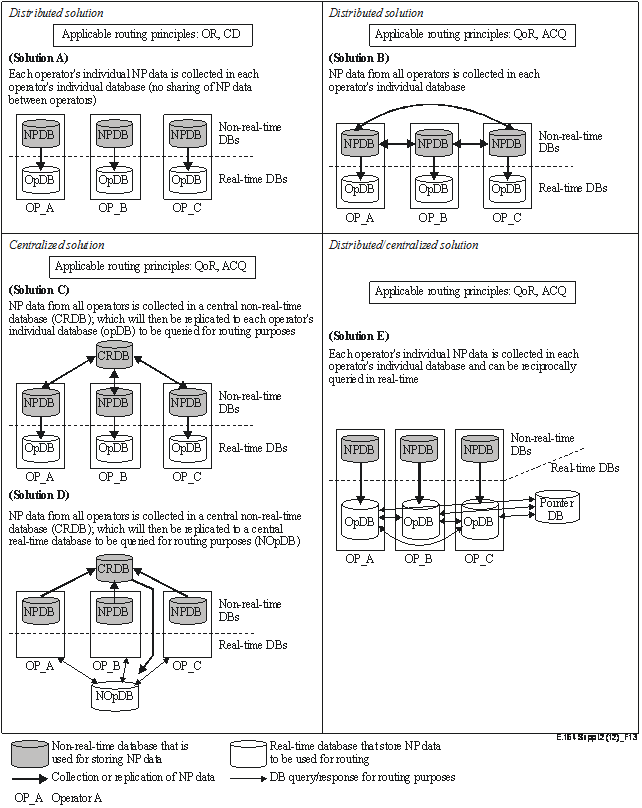
(Note) Extracted from ITU-T E.164 Supplement 2: Number portability (06/2014)
Figure 1 – Examples of number portability databases solutions
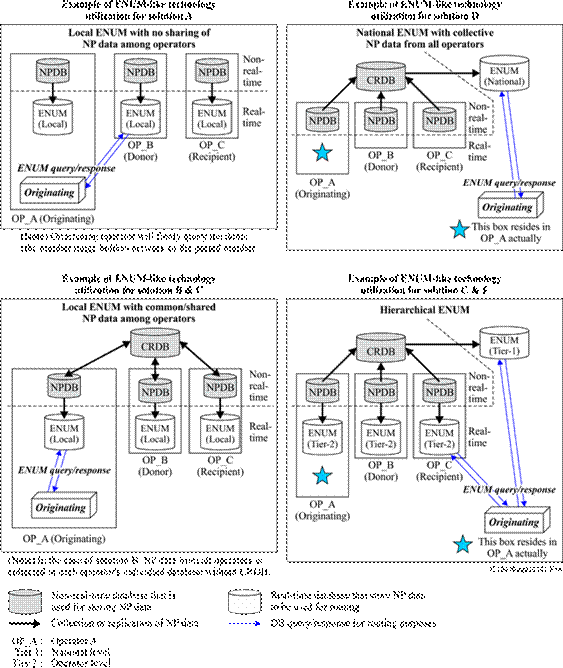
(Note) Extracted from ITU-T E.164 Supplement 2: Number portability (06/2014)
Figure 2 – Examples of ENUM-like technology utilization
______________
