

Партнерка на США и Канаду по недвижимости, выплаты в крипто
- 30% recurring commission
- Выплаты в USDT
- Вывод каждую неделю
- Комиссия до 5 лет за каждого referral
В учебнике для XI класса, так же как и в учебнике для X класса, представлена рубрика Words not to be confused. В ней рассматриваются слова, которые зачастую вызывают сложности при их дифференциации. Ср.: amiable – amicable; take – bring – fetch и так далее. При этом для некоторых пар (триад) различия подробно излагаются в учебнике, а для других они устанавливаются самими учащимися, что помогает им вырабатывать навык вдумчивой работы со словарём, умение анализировать словарную дефиницию.
В этом же подразделе (New Vocabulary) учащиеся встречаются с заданиями на перевод, базирующийся на новой лексике. Им также предлагаются различные упражнения на повторение уже знакомых слов, причём как обязательный компонент каждой части этот раздел содержит также задания на словообразование. Часть из них составлена в формате ЕГЭ.
ГЛАВА 2. ПРАКТИЧЕСКАЯ ЧАСТЬ.
2.1 Word formation.
Exercise 1
Compound Adjectives.
Melissa was forgetful, relaxed, cheerful, kind and intelligent if perhaps a little proud of herself, hypocritical, egotistical and snobbish at times.
Replace the adjectives by the following compound ones:
Big-headed, self-centered, absent-minded, quick-witted, two-faced, easy-going, stuck up, good-tempered, warm-hearted.
Exercise 2
Fill the blanks with the words given below to form new compound adjectives
Bald
Dust
Hot
Problem
Bright
Fire
Kind
Ready
British
Fool
High
Single
Broad
Hard
Narrow
Soft
Brown
Round
Pig
Tax
Hands
Home
Polo
Wide
1) ____ -
____ - eyed
____ -
2) ____ -
____ - proof
____ -
3) ____ -
____ - minded
____ -
4) ____ -
____ - necked
____ -
5) ____ -
____ - made
____ -
6) ____ -
____ - free
____ -
7) ____ -
____ - headed
____ -
8) ____ -
____ - hearted
____
Exercise 3
Compound Adjectives.
Answer the questions by using a compound adjective which is opposite in meaning to the adjective in the question.
Example. Is he working full-time? No, part time.
1) Isn’t she rather short-sighted?
2) Is your brother well off?
3) Would you say the boy is well-behaved?
4) Are her shoes high-heeled?
5) Is this vase mass-produced?
6) Do they live in south-east England?
Exercise 4
Complete each sentence with a word beginning with the prefix.
1) A lot of people in the Third World are under_____ (undernourished).
2) Many countries like China and India are over_____ (overpopulated).
3) She has been un_____ since the factory closed last year (unemployed).
4) That company has had to close because of mis_____ (mismanagement).
5) A lot of the housing there is sub_____ (substandard).
6) After the earthquake they had to start re____ the city (rebuilding).
7) The audience stood around the live statue in a semi_____ (semi-circle).
2.2 Phrasal Verbs.
Exercise 1
Complete the requests with these verbs:
Keep to, stop off, stay over, set off, get in touch with, go off, pick me up, catch up with.
1) Could you _____ outside the hotel in ten minutes, please.
2) Is it all right, if I just _____ on my own.
3) When can I _____ the tour guide, please?
4) Do you think we could _____ at the shops for a couple of minutes?
5) Would it be possible to _____ an extra night in Winnipeg and _____ the train later?
6) Could you possibly be here at ten, please, as we have to _____ the time – table?
7) Could you please tell me what time we _____ tomorrow?
1) – pick me up
2) – go off
3) – get in touch with
4) – stop off
5) – stay over/ catch up with
6) – keep to
7) – set off
Exercise 2
Match the words and expressions below with the verbs in the text (1 – 11).
Appear, discover, learn from, look at in detail (2), make a note of, mention, pass, postpone, start, understand.
Last month I had an important English exam. I decided not to put off (1) studying (as I normally do!) and got up early every morning to get down to (2) work straight away. I’m a morning person and I got a lot out of (3) my revision sessions. I always began by going over (4) a practice test I had done – checking my answers and finding out (5) what thing I’d got wrong. I also tried to work out (6) why I’d made mistakes. If I didn’t understand something, I’d write it down (7) and then bring it up (8) in class with my teacher. She was very helpful and she went through (9) all of the things that would probably come up (10) in the exam. In The end, the exam wasn’t so bad after all and I think I got though (11) it. Mind you, I still haven’t had my results yet.
1) – postpone
2) – start
3) – learn from
4) – looking at in detail
5) – discovering
6) – understand
7) – make a note of
8) – mention
9) – looked at in detail
10) – appear
11) - passed
Exercise 3
Match a phrasal verb with take in Column A with its correct meaning in column B.
A | B |
1. You need to take a few days off work. 2. I’m thinking of taking up golf to get some exercise. 3. He’s very good at taking off famous politician. 4. I really should take on one or two more waiters. The restaurant is so busy. 5. This table takes up to much room in the kitchen. Lets put it somewhere else. 6. Sales of the new BMW have taken off. 7. He’s so bossy. Whenever I try and work with him, He just takes over. | a) to imitate another person to make people laugh b) to occupy space or time c) to employ d) to suddenly increase, to do well e) to have a holiday or a change f) to take control g) to start a new hobby |
2.3 Word Families.
Exercise 1
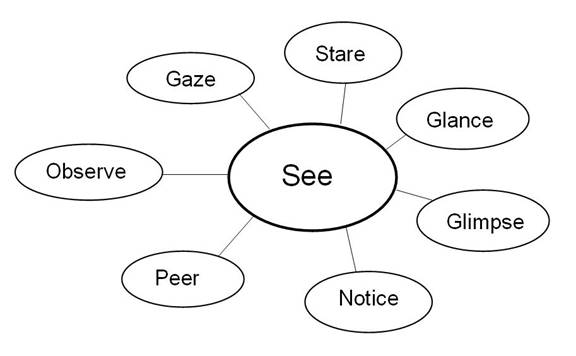
See
Yesterday I glanced out of the window and noticed a man observing a house opposite through a telescope. I thought I glimpsed a woman inside the house. Then I saw someone else peering into the window of the same house. I gazed at them wondering what they were ddenly the first man stopped staring through his telescope. He went and hit the other one on the head with the telescope and I realized that I had witnessed a crime.
Which of the verbs in the text suggests looking in the following ways:
1) As a crime or accident occurs?
2) Closely, finding it hard to make things out?
3) In a scientific kind of way?
4) Quickly?
5) Fixedly?
6) At something but getting only a brief view?
Exercise 2
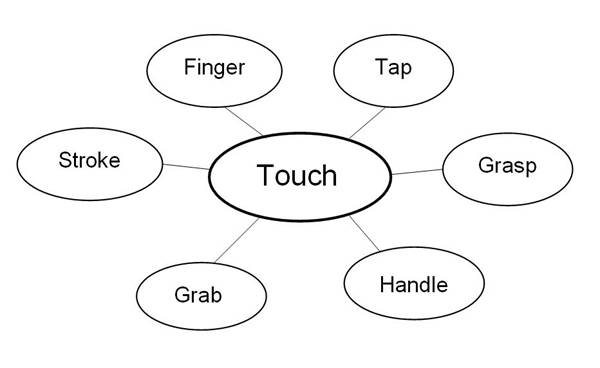
Read the text.
Touch
She nervously fingered her collar. He stroked the cat and petted the dog.
She tapped him on the shoulder. He grasped my hand and we ran.
She grabbed her briefcase and ran to the bus stop.
The thief snatched her handbag and disappeared into the crowd.
Press the button. Please handle the goods with great care.
Replace the underlined words with more precise verbs from the opposite page.
1) I touched the dog a number of times.
2) He knocked lightly on the door.
3) She took my hand firmly.
4) Touch the button to start.
5) The lecturer touched his notes nervously.
6) He touched the cat affectionately.
7) The robber took the money and ran.
8) She picked up, carried and put down the boxes carefully.
Exercise 3
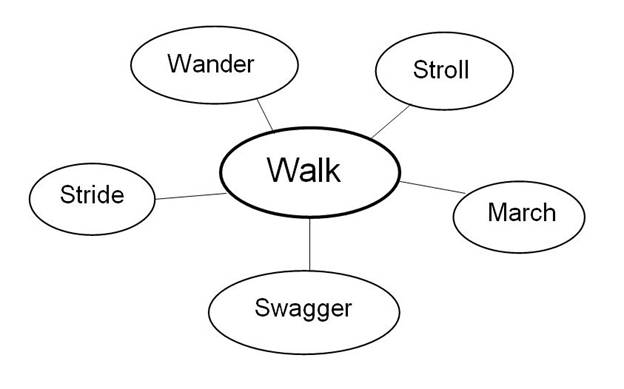
Which of the verbs best describes:
1) Walking for pleasure without hurrying (stroll)
2) Walking fast, taking big steps (stride/strode/stridden)
3) Walking as if you think you are very important (swagger)
4) Walking in a military way or with a lot of energy (march)
5) Walking without a specific purpose (wander)
Exercise 4
Match the following verbs with a general meaning to a group of verbs in the box.
1) Tell
2) Move
3) Think
4) Hold
5) Laugh
6) Say
7) Throw
8) Walk
9) Eat
a) exclaim/mutter/insist say
b) giggle/chuckle/snigger laugh
c) writhe/wriggle/fidget move
d) hurt/toss/lob throw
e) stagger/wander/tiptoe walk
f) munch/nibble/swallow eat
g) wonder/consider/reckon think
h) order/inform/instruct tell
i) clutch/grasp/hug hold
2.4 Confusing Words.
Exercise 1
glance / look / stare
1. He glanced / stared blankly at the paper in front of me. 2. If you look / stare carefully you can just see our house from here. 3. She glanced / stared quickly at her friend and they burst out laughing. 4. He sat looking / staring into space. 5. To look / stare at him you'd never think he was nearly fifty. 6. Why is he glancing / staring at me like that? It is not polite. 7. I glanced / stared up quickly to see who had come in. 8. She glanced / stared at him in despair. 9. He glanced / stared through the report. 10. He looked / stared up blankly at the hole in the ceiling. 11. They glanced / stared at me in mute amazement. 12. At first glance / stare the problem seemed easy.
Exercise 2

|
Из за большого объема этот материал размещен на нескольких страницах:
1 2 3 4 5 6 7 |
