

Партнерка на США и Канаду по недвижимости, выплаты в крипто
- 30% recurring commission
- Выплаты в USDT
- Вывод каждую неделю
- Комиссия до 5 лет за каждого referral
© 2013
Dmitrikov V. P., Doctor of Technical Sciences
Padalka V. V., Сandidate of Сhemical Іciences
Poltava State Agrarian Academy
Procenko O. V., Сandidate of Сhemical Іciences
Kolomeyets V. I., teacher
Dniprodzerzhinskiy State Technical University
PROCESSING OF EXHAUST LEADEN-CADMIUM GALVANIC ELEMENTS
REPORT 2. FLOWSHEET OF PROCESSING
Reviewer – Doctor of Pedagogical Sciences, Professor M. V. Grineva
The results of researches on the reagent processing of exhaust leaden-cadmium galvanic elements and accumulators which serve as the second raw material for electrical engineering industry are produced. The features of the technological planning, ecological and economic aspects of processing, are considered. The stages of the processing of exhaust leaden-cadmium galvanic elements and accumulators are analyzed. The improved methodology is offered and the flowsheet of processing is developed.
Keywords: agrarian machines, accumulators, galvanic elements, processing, technology of utilization.
Statement of the problem. The most important part of the technological planning of the whole enterprise, basic and auxiliary production workshops and options is a creation of flowsheet which represents intercommunication and character of separate technological processes and equipment. As a project document a flowsheet is the graphic image of aggregate of operations which make a complete technological process, and are accompanied by description and necessary calculations (by a calculation-explanatory message) [6].
The specificity of chemical and mechanical behavior of the exhaust power sources determine the composition and structure of the flowsheet of their processing.
The technical level and quality of flowsheet is defined by detailed elaboration of individual technological nodes of pre-planned chart [4]. A technological node is usually called a device (building, car) or their group, in which one of the stages of technological processes, required to achieve a given degree of processing of source material, including recycled material for specialized businesses, shops or recycling facilities, begins and ends.
Analysis of major studies and publications which discuss the problem. Main directions of utilization of exhaust leaden-cadmium galvanic elements (general name LDE) and accumulators were concretized before [2]. In order to choose the optimal variant of utilization of exhaust LDE information retrieval and information-analytical system should be used, if necessary to connect the expert system and mathematical modeling [3].
Chemical transformations, physical and technical processes, that accompany them, were studied on the shredded storage-battery crow-bar in the conditions [1,5]. Workings off the technology of processing of LDE executed on results of laboratory researches, taking into account the features of their flowing.
The synthesis of flowsheets on the basis of variety of variants of different technological knots is conducted, for example, by the method of the dynamic programming – foot-pace acceptance of decisions on determination of optimum variant on the basis of the chosen criterion of optimum ( a minimum of general charges or a maximum of economic result which takes into account the size of preventive loss to an environment or value of paying for permitted resetting). An important role is played here by concrete heuristic rules (recommendations).
At a continuous process the receipt of more high-quality products is provided and relatively smaller amount of waste is formed, the loss of raw materials is also reduced. An equipment for continuous processes usually differs by the greater productivity. In addition, continuous processes are relatively easily exposed to mechanization and automation. Their application is more rational in the productions of high-power. In a number of cases in a periodic chart include continuously working technological knots (rectifications, extractions, dryings and others like that).
Purpose and task of research. The purpose is creation of technology of processing of exhaust LDE. The main task is development of apparatus-technological flowsheet of processing and complete utilization of exhaust LDE.
Results. On the basis of the conducted researches the chart of chemical transformations of SKE and apparatus - technological flowsheet of utilization of exhaust LDE is developed (table).
Used LDE from the bunker 1 fall on roller crusher 2, and the crushed material – into the bunker 3 and further on conveyor hopper 4 and 5 with dosing. Crushed material from the hopper 5 and sulfuric acid from tank 7 through dispenser 8 gets in the reactor 6 equipped with a mechanical stirrer with electric.
A cadmium and oxide of lead (IV) dissolve in sulphuric acid with recovery of lead (IV) into the lead (II). Surplus of hydrogen through drop-reflector 9 and refrigerator 10 gets to gas collector 11.
The pump H gives mash from a reactor 6 on nutch filter 12, which continuously divides mash into sediment and filtrate. Sediment of sulfate of lead (II) after filter 12 gives a screw 13 in a reactor 14. For converting of sulfate of lead (II) into the carbonate of lead (II) in a reactor the saturated solution of carbonate of sodium gets from a capacity 15 through a metering device 16. Mash from a reactor 14 gets on a nutch filter 17, which continuously divides it into sediment and filtrate.
Sediment of carbonate of lead after filter 17 is subjected to drying in a dryer 18 and to calcinations in a heat chamber 19 with the receipt of oxide lead (IV) and oxide carbon (IV) which gets on storage. Lead oxide restore in the oven 20 to metallic lead, which falls on the stock and water steam forms condensation.
After filter 17 solution of sodium sulfate is evaporated in a boil-off 21 and is dried in a dryer 22, whereupon the sodium sulfate as a crystallohydrate is given on storage. Filtrate (solution of cadmium sulfate) after filter 12 is given in reactor 23.
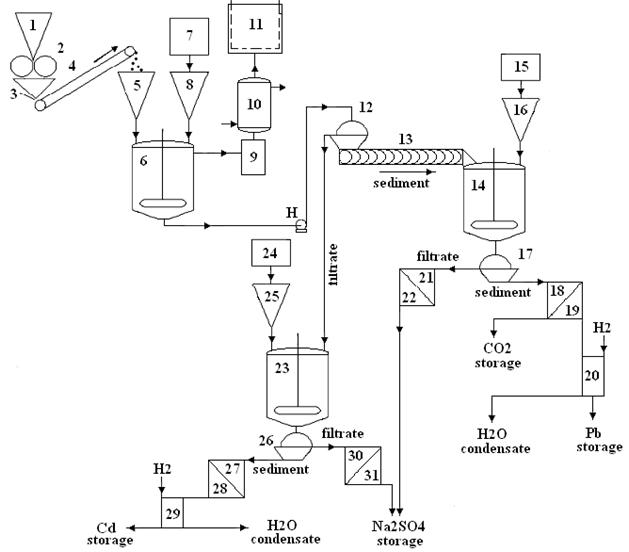
Table. Apparatus-technological flowsheet of processing of exhaust LDE
For transformation of cadmium sulfate on cadmium hydroxide the concentrated solution of sodium hydroxide from a capacity 24 through a metering device 25 is give in a reactor, and mixture of sediment of cadmium hydroxide and solution of sodium sulfate, that appeared, acts on a filter 26. Filtrate (solution of sodium sulfate) after a filter 26 is given in a boil-off 30 and further on stock as a crystallohydrate.
After filter 26 sediment of cadmium hydroxide is given in a dryer 27 and heat chamber 28 for the receipt of dry cadmium hydroxide, which is pierced and renewed in a stove 29 to the metallic state and then is sent to storage, and an aquatic pair forms a condensation. The combined water vapor condensates are used to prepare solutions of reagents that require technological process.
Conclusions. The apparatus-technological flowsheet of processing of exhaust LDE is developed. The offered method allows to turn in the sphere of production the components of LDE as commodity products: lead and cadmium – for electrical engineering industry, compound of lead and cadmium – for galvanic and metallurgical industry, sulfate of sodium – for a glass production, gaseous hydrogen and oxygen, crumb of plastic and condensate of non-salt water – for technical aims.
REFERENCES:
1. П. Производство тяжелых цветных металлов из лома и отходов. - Харьков: Основа. - 1992. - 399 с.
2. П. Технологія переробки відпрацьованих свинцево-кадмієвих гальванічних елементів. Повідомлення 1. Принципи переробки хімічні реакції / , ,
, В. І. Коломєєц // Вісник Полтавської державної аграрної академії. – 2011. – №4. –
С. 147 – 150.
3. П. Нечеткости определений экспертной системы мониторинга химических загрязнителей // Вестник НТУ «ХПИ». – 2004, – №38. – С. 17–20.
4. И. Процессы и аппараты химической технологии. В 2-х кн.: Часть 1. Теоретические основы процессов химической технологии. Гидромеханические и тепловые процессы и аппараты. – М.: Химия. – 1995. – 400 с.
5. Технология вторичных цветных металлов / , , Э. Кляйн и др. – М.: Металлургия. – 1981. – 280 с.
6. Chemical and Process Design Handbook / James G. Speight. – New York etc.: McGraw-Hill. – 2002. – 1029 p.
