


Партнерка на США и Канаду по недвижимости, выплаты в крипто
- 30% recurring commission
- Выплаты в USDT
- Вывод каждую неделю
- Комиссия до 5 лет за каждого referral
pм = p - Дp.
Найдем величину дополнительного давления Дp под мениском при полном смачивании.

 , где Fn =у·l, l – длина окружности;
Fn = у2рrм =2рr у, где r – радиус мениска.
If we draw a tangent to inner surface of liquid through point D, then the angle between surface of solid and tangent, built inside the liquid, is called the angle of capillarity of liquid and marked with И («tau»).
For wetting liquid angle 0< И <
 .
.
With И=0 complete wetting occurs.
For nonwetting liquid angle И is obtuse (
 < И < р).
With И= р complete nonwetting occurs.
One and the same liquid can be wetting for one solids and nonwetting for other. For example, water wets glass, soil, timber, degreased wool fiber, flax and does not wet fats, resins («rolls up into balls»).
1.9. Capillary phenomena
Let us consider the surface of liquid with convex rface tension force is directed inside the liquid and tends to reduce its surface. Together with this some force Дp is formed, then total pressure under convex surface of meniscus is equal to the sum of external pressure p and additional pressure Дp, i. e.
pm = p + Дp.
If the surface of liquid has concave meniscus, then additional pressure Дp is directed outside and total pressure is defined as follows
pm = p - Дp.
Let us find additional pressure Дp below meniscus under complete wetting.

 , where Fn =у·l, l – perimeter of circle;
Fn = у2рrm =2рr у, where r – meniscus radius.
Пусть S – площадь периметра основания полусферы, то есть площадь круга: S=р(rм )2 , тогда 
 – формула Лапласа (частный случай).
Для поверхности произвольной формы закон Лапласа имеет вид :
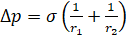
 (6),
(6),
где
r1, r2 – радиусы кривизны двух взаимно перпендикулярных нормальных сечений поверхности в данной точке.
В результате действия дополнительного давления в узких трубках уровень жидкости изменяется (поднимается или опускается). Такое явление называют капиллярностью, а узкие трубочки по которым поднимается или опускается жидкость называют капиллярами (от лат. «капилля» - волос).
Свойством капиллярности обладают вещества, имеющие пористую структуру, называемые гигроскопическими. Например, вата, бинт, фильтрованная бумага, сухой мел.
Высота поднятия жидкости в капиллярных трубках зависит от поверхностного натяжения жидкости: чем больше поверхностное натяжение, а радиус трубки и плотность жидкости меньше, тем больше высота поднятия жидкости по капилляру.
Если капилляры представляют собой разветвленную трубку, то при попадании пузырька воздуха, может произойти закупорка сосуда – газовая эмболия. Например, при инъекциях лекарственных средств необходимо следить за тем, чтобы в кровеносные сосуды не попадали пузырьки воздуха.
Газовые пузырьки в крови могут появиться у водолазов при быстром подъёме с большой глубины, у летчиков и космонавтов при разгерметизации кабины или скафандра на большой высоте, при переходе газов крови из растворенного состояния в свободное в результате понижения атмосферного давления.
Let S be area of hemisphere bedding perimeter, i. e. area of a circle: S=р(rm )2 then 
 – Laplace formula (particular case).
For arbitrary shaped surface Laplace law has the appearance:
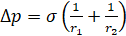
 (6),
(6),
where
r1, r2 – radiuses of curvature of two mutual perpendicular normal surface cross sections at a given point.
As a result of additional pressure in narrow pipes the level of liquid changes (goes up or down). This phenomenon is called capillarity, and narrow pipes, along which liquid goes up or down, are called capillaries (from Latin «capilla» - hair).
Capillarity property can be found in substances, which have porous structure, and are called hygroscopic. For example, cotton wool, bandage, filtered paper, dry chalk.
Height of liquid rise in capillary pipes depends on surface tension of liquid: the more surface tension and the less radius of pipe, the bigger height of liquid rise along the capillary is.
If capillaries form a branched pipe, then under presence of air bubble vas occlusion may occur – gaseous embolism. For example, while making injections of medicinal agents it is necessary to make sure that air bubbles don not get into blood vessels.
Divers may have gaseous bubbles in blood during quick ascent from large depth, pilots and astronauts may have it during loss of cabin or spacesuit pressure, during transition of gases in blood from dissolved state into free state as a result of reduction of atmospheric pressure.
1.10. Методы измерения вязкости жидкости
Итак, при течении реальной жидкости отдельные слои воздействуют друг на друга силами, касательными к слоям. Это явление называют внутренним трением или вязкостью. Макроскопическое движение, возникающее в жидкости, постепенно уменьшается из-за сил внутреннего трения после прекращения действия причин (сил), вызывающих это движение.
Вязкость зависит от природы жидкости или газа, от температуры, от давления при низких температурах. При повышении температуры вязкость газов увеличивается, а жидкостей – уменьшается. Явление вязкости в жидкости можно рассматривать следующим образом. Пусть два слоя жидкости, отстоящие друг от друга на расстоянии dx, имеют скорости х1 и х2. Со стороны слоя, который движется быстрее, на слой, который движется медленнее, действует ускоряющаяся его сила. Наоборот, на быстрый слой действует тормозящая сила со стороны медленного слоя. Это силы внутреннего трения, направленные по касательной к поверхности слоя. Они тем больше, чем больше площадь соприкасающихся слоёв, и зависят от изменения скорости течения жидкости (или газа) при переходе от слоя к слою, подчиняясь уравнению Ньютона:

 , где
, где

 – изменение скорости, отнесённое к расстоянию между слоями в направлении, перпендикулярном скорости (градиент скорости);
Ѕ – площадь соприкасающихся слоёв;
з – коэффициент вязкости (вязкость) жидкости.
Вязкостью з называют величину, численно равную силе внутреннего трения, возникающей между соприкасающимися слоями жидкости, площадью соприкосновения равной единице при градиенте скорости между ними равным единице.
1.10. The measuring methods of viscosity of liquids
In the flow of real liquid some layers affect each other with forces, tangent to the layers. This phenomenon is called internal friction or viscosity. Macroscopic motion, arising in liquid, gradually decreases because of the forces of internal friction after termination of reasons (forces), which cause this motion.
Viscosity depends on the nature of liquid or gas, temperature, pressure at low temperatures. At temperature rise the viscosity of gases increases and viscosity of liquids decreases. The phenomenon of viscosity in liquid can be considered as follows. Let two layers of liquid, placed at a distance dx, have speeds х1 and х2. The layer which moves slower is affected by accelerating force from the layer which moves faster. Vice versa, the quick layer is affected by retarding force from the side of the slow layer. These are forces of internal friction, directed along the tangent to the surface of the layer. The larger the square of tangent layers, the bigger these forces and they depend on speed change in the flow of liquid (or gas) at crossing from one layer to another, following Newton’s equation:

 , where

 – speed change, related to the distance between the layers in the direction, perpendicular to the speed (speed gradient);
Ѕ – square of tangent layers;
з –coefficient of viscosity of liquid.
Viscosity з is a term for magnitude, numerically equal to the force of internal friction, which arises between the tangent layers of liquid, square of surface contact equal one at speed gradient between them equal one.
Для жидкостей, течение которых подчиняется уравнению Ньютона, вязкость не зависит от градиента скорости. Эти жидкости являются ньютоновскими, а вязкость – нормальной. Если жидкости не подчиняются уравнению Ньютона, то их называют неньютоновскими, а вязкость – аномальной.

|
Из за большого объема этот материал размещен на нескольких страницах:
1 2 3 4 5 6 7 8 9 10 11 12 13 |
