


Партнерка на США и Канаду по недвижимости, выплаты в крипто
- 30% recurring commission
- Выплаты в USDT
- Вывод каждую неделю
- Комиссия до 5 лет за каждого referral
УДК 316.454.5
Khalikova Svetlana Sergeevna – Candidate of Sociological Sciences, docent of the sociology, social work and law chair of the Far-Eastern institute of management – branch of RANEPA (Khabarovsk). Email: *****@***ru
Socio-cultural interaction of Russia and China in the border area 1
The article presents the analysis of interaction of Russia and China as a result of contemporary global processes, reorientation of Russia to the East, marks the peculiarities of development of relations between the countries, cooperation mechanisms. The results of a sociological research "The West and the East of Russia: comparative analysis of intercultural interaction in the Russian-European and Russian-Chinese borderland" are analyzed here. The sociological research was conducted among the students of the Khabarovsk universities, which reflects the view of the younger generation on the prospects of development of border territories of the Russian Federation and the establishment of relations with China.
Социокультурное взаимодействие России и Китая в приграничном пространстве 2
В статье представлен анализ взаимодействия России и Китая как результат современных глобальных процессов, переориентации России на восток, обозначены закономерности и особенности развития отношений между странами, механизмы сотрудничества. Проанализированы результаты социологического исследования «Запад и Восток России: сравнительный анализ межкультурного взаимодействия в российско-европейском и российско-китайском приграничье», проведенного среди обучающихся в вузах города Хабаровска, которое отражает мнение молодого поколения о перспективах развития приграничных территорий РФ и установлении отношений с Китаем.
Keywords: migration, Russian-Chinese relations, border region, cross-cultural interaction.
Ключевые слова: миграция, российско-китайские отношения, приграничный регион, межкультурное взаимодействие.
In the modern world the role of cooperation with neighboring countries is increasing due to the active socio-cultural and economic cooperation. The interaction of Russia with China is of particular importance. According to the researchers, this is because a sudden turn to the East was made in Russia in the period after 2000 due to a number of circumstances. Firstly, from a global standpoint, developed over many decades "Europe-orientated" Russian development has exhausted itself both strategically and functionally. Secondly, in the conditions of global instability and expectations of appearance of crisis situations in the future, as well as taking into account forecasts of the authoritative international organizations (IMF, the World Bank, OECD). The Russian authorities saw the area of economic well-being and development in the Asia Pacific region. Production and consumption potentials of the region are seen as very attractive to intensify and expand international cooperation. Thirdly, having serious problems in the implementation of regional policy in the Far East, Russia connects the positive changes in territorial development through cooperation with the Asia-Pacific economies. [1]
The main directions of cooperation and the principles of Russian-Chinese relations are reflected in the Treaty on good-neighborliness, friendship and cooperation between the Russian Federation and the People's Republic of China, signed on 16 July 2001 in Moscow. [2]
The history of relations between Russia and China dates back several centuries and went through a number of stages, when it was of different character. Recently a qualitatively new period in China-Russia relations has come. China and Russia moved towards a strategic partnership, interest to each other is continuously growing among the public of the two countries, trade-economic cooperation is developing, science and culture contacts are expanding.
Russia is an area lying at the crossroads of two cultural traditions – east and west, an independent branch of European culture with a strong Asian component. Due to this peculiarity of Russian culture, its dialogue with other cultures, including Chinese culture, is greatly facilitated. As for the intercultural cooperation between China and Russia, a number of factors may be marked there, which determine its originality: civilized, historical, political, economic, social, geographical, etc. The development of vehicles and communications has a strong impact on the Russian-Chinese intercultural interaction. Cultural tourism between China and Russia is developing and seems to be an important channel of acquaintance of citizens of both countries with the culture of the neighboring country.
Currently, different mechanisms of cooperation between Russia and China are used: summits, meetings of the heads of governments, four commissions, which are devoted to the different areas of investment, trade-economic, energy and humanitarian cooperation headed by Vice-premiers, working groups. All this work is put on a system basis. It allows the countries to achieve impressive results. The year of Russia in China and China in Russia, the national language years, years of tourism, the years of friendly youth exchanges, years of mass media of Russia and China launched in 2006, as well as the opening of the Confucius Institutes at Russian universities (2007) gave a significant impulse to contacts in science, culture, education and other humanitarian sectors. All of them actively increase the confidence of people of both countries and strengthen their relationships.
The current model and practice of bilateral relations is a concrete example of how to build bilateral relations in the XXI century. Together with Russia China is ready to work on the implementation of the cooperation agreements reached by the leaders of both countries to use the favorable opportunities, to continue developing the idea of peaceful elaboration of the Chinese-Russian friendship. They should be transmitted from generation to generation, to turn the advantage of high level of political relations between both countries into the actual results of practical cooperation and interaction in the international affairs, to strive for a greater progress in the Chinese-Russian relations in order to make a greater contribution to peace, security and stability in the region and around the world. [3]
The border area, where Russia and China are in a direct contact, is the Russian Far East, namely the Khabarovsk, Primorsk, Zabaikalsk territories, the Amursk region, the Jewish autonomous region. In this area labor migration is actively developing, and to a greater degree there is a migration of Chinese citizens on the Russian territory, because of the high population density in the border provinces. As the result the close Russian-Chinese relations are formed, and not only in trade-economic sphere. The number of mixed marriages between citizens of China and Russia are constantly increasing.
The residents of the Russian border regions actively use the possibility of "shop-tours", treatment, rest in the Chinese resorts, although due to the ruble exchange rate the flow of the Russian tourists has slightly decreased. In addition to the exchange of students between educational institutions of both states, the youth uses the opportunity to get higher education in Chinese universities. According to the students, involved in the sociological research, we need to develop cross border relations in the production of industrial goods (46.3%), in health services (16.1%), in education and science (12.3%) and agriculture (12.1%). [4]
Over the last two decades the number of Russian-speaking population in China has significantly increased, as well as people of different age categories in the Far East who want to learn Chinese. China becomes attractive for the Russians not only as a tourist object, but as a place of a permanent residence. A favorable economic environment contributes to business development, attracting young, energetic and enterprising people. Thus, there is unequal exchange – highly skilled resources leave the territory of Russia, but in Russia we get medium and low-skilled labor force from China.
According to the Russian researchers, the danger is that there`s an outflow of the most active part of the population of working age adapted to difficult climatic conditions. And mostly people of retirement and pre-retirement ages remain. But in the last 4-5 years there's a disturbing tendency in this age group too. Urban retirees move to live in a neighboring state, selling or renting their apartments. They buy apartments in the nearby Chinese towns, the cost of which is 2-3 times cheaper, and they settle in the neighboring country where the cost of living is 2 – 3 times lower than in Russia too. These tendencies allow us to make a paradoxical and insulting conclusion, that "the displacement of the Russian population by the Chinese doesn`t happen, the population itself is leaving the Far East". [5]
And the ever-decreasing number of population on the territory of the Far Eastern regions creates alertness. So, in 1991 – 2010 the Far East lost 1780 thousand people, or 22.1% of its population (more than every fifth inhabitant), including 225.5 thousand people (12.7%) accounted for the natural decline and 1554.5 million (87.3%) – a migration outflow. The maximum population number – 8064 thousand people – was in 1991 and 6284 thousand people lived in the Far East at the beginning of 2011. Over the next three years (2011-2013), the population decreased by 58 thousand people, and 6226 thousand inhabitants registered in the region on 1 January 2014. Thus, during the years of reformation in the Far East the population decreased by 1838 thousand people. From 1991 to 2014 the population decreased by 284.8 thousand of its own population (17.5%) in the Khabarovsk territory. [6]
The results of sociological research, conducted among the students of higher educational institutions, show the desire of the majority of people to move to another country, including China, to fulfill their life aspirations. [4] So, three quarters (72.3 per cent) of the respondents would definitely make use of the opportunity to study abroad and this prospect does not attract only a fifth of them (18.1%). More than a half of them (68%) are willing to work outside the country and they would have moved to the permanent place of residence if it were possible (49.9%). (Fig. 1)
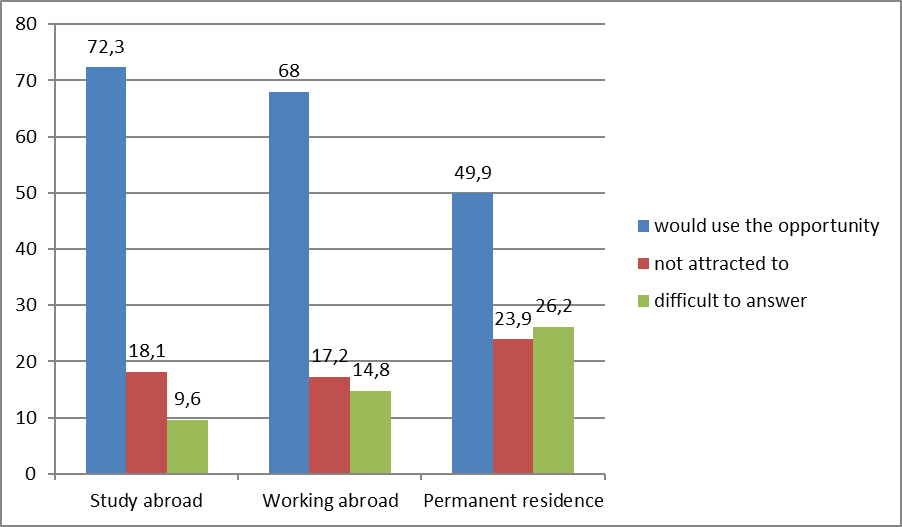
Fig. 1. The distribution of answers to the question "How do you feel about education, working abroad, relocation to another country for permanent residence?". (% of respondents)
Among the reasons to leave the country the respondents noted, first of all, the offer of well paid job (49%), and the lowering of the standard of living (15.2%), the lack of worthy job by specialty (9.2%) and marriage outside of Russia (7.6%). Every fifth respondent is not going to leave the country (19%). [4]
In general, the interviewed students consider the migration of Russian citizens to other countries as a negative phenomenon. However, if the migrants return to the territory of Russia, it may even be beneficial, in terms of the exchange of experience, technology, and intercultural interaction. (Table 1)
Table 1
The distribution of answers to the question: "Migration of the Russian citizens to other countries is...?" (per cent of respondents)
Variant of answer | % |
good for Russia, Russian influence increases in the world | 5,6 |
useful if they come back | 23,7 |
bad, because the most active people are leaving | 60,7 |
difficult to answer | 10,3 |
Meanwhile, a half of the surveyed students is concerned about migration flows of Chinese to Russia, as, in their opinion, it creates a danger to the territorial integrity of our country (50.3%), a quarter (26%) – believes that it contributes to the economic development of the Far East, and another 23.7% was undecided. Some of them see the development and rise of China as a potential threat to Russia. (Fig. 2)
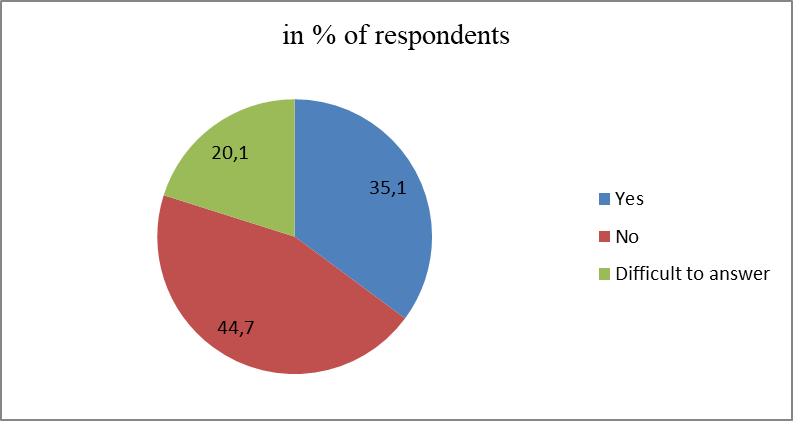
Fig. 2. The distribution of answers to the question: "Does China's rise represent a threat to Russia?"
However, the modern researchers believe that some weakening of Russia gave a distinct advantage in Asia to China, and it "suddenly found that it was stronger than ever before", but we should not hurry to join the opinion of "China`s threat". China in fact has become a powerful international factor. Now all the countries have to reckon with China in everything. It came to the position of the world leader in the production of many kinds of industrial and agricultural products. In such circumstances it is quite natural that the national consciousness of the Chinese people is clearly growing, moreover they are fed by reviving memories of the historic contribution of the Chinese nation to the world civilization. Household simplicity and low cost of living make a Chinese person competitive in the field of economic competition, of course beyond the terms of technology. However, China has many internal problems and challenges. They do the country for many decades "a civilization, which is closed in itself", focusing not on the external expansion but on the internal construction. [7]
The respondents appreciated the interdependence of Russia and China almost as an equivalent. So, the question "Russia-China: who needs whom more?" 38.7% answered “China needs Russia”, 32.9% – “Russia needs China” and 28.4% was undecided. The majority of the respondents believes that in general China has a positive attitude towards Russia and wants to help it (42.3%), one-third (33.1%) has not yet formed an opinion on this issue, 11.2% said that China wants to weaken Russia and turn it into a dependent state and only 6% believes that the fate of our country is absolutely indifferent to it.
Considering the interaction of China and Russia, it is noted that Russia can be an equal partner with China (72.5% of the respondents), and only 12.5% denied such a possibility, another 15% was undecided. For the majority of the respondents (66.0%) the regions of Russia bordering with China are an additional capacity to accelerate the modernization of the country, 15.2% believes that it creates a danger for its territorial integrity, 18.8% was undecided. [4]
The further development of relations between both countries dictates the need to expand partnership with China and strengthen cooperation in all areas. The development strategy of the Far East will allow it to develop in conditions of what happens in the world without damaging the territorial integrity of Russia. In the context of cross-border relations, the Far East might be "a window to Asia" not only for Russia, but also for Europe. The course of the Russian leaders on the development and strengthening of constructive partnership and cooperation with China can be considered as one of the major achievements of Russian foreign policy. One of the most effective ways of the elimination of real and potential threats is a full-fledged socio-economic development with China in the interests of the Russian society. From this perspective, the development of mechanisms of socio-cultural mediation in opposite directions is the most natural function of the border regions and one of the main factors of their development.
Literature and the sources:
1. Рензин, межстрановые конфигурации в АТР как фактор изменения интеграционных позиций России / // Власть и управление на Востоке России. – 2015. – № 4
2. Договор о добрососедстве, дружбе и сотрудничестве между Российской Федерацией и Китайской Народной Республикой 16 июля 2001 г. // Российская газета – Федеральный выпуск. – 17 июля 2001 г. – № 000 (0)
3. Ли, Ш. Российско-китайские отношения на современном этапе / Ш. Ли // Молодой ученый. – 2016. – № 15. – С. 355 – 357.
4. Социологическое исследование «Запад и Восток России: сравнительный анализ межкультурного взаимодействия в российско-европейском и российско-китайском приграничье». Генеральную совокупность представляют студенты старших курсов вузов г. Хабаровска. Методом анкетного опроса охвачено 462 респондента. Ошибка выборки не превышает ±4%. Полевой руководитель – к. соц. н. .
5. Кочегарова, и Восток России: сравнительный анализ приграничного взаимодействия с соседними государствами / // Горизонты экономики. – 2015. – № 3. – С. 33 – 41.
6. Мотрич, миграционных процессов в Хабаровском крае / , // Вопросы статистики. – 2015. – № 1. – С. 54 – 64
7. Пылкова, как феномен культуры (на примере Дальнего Востока России) : автореферат дисс. ... канд. культ. наук по специальности 24.00.01 Теория и история культуры / . – Комсомольск-на-Амуре, 2004. – 24 с.
1 The article was written with the support of RFBR project No. 16-06-00125 "The West and East of Russia: a comparative analysis of intercultural interaction in the Russian-European and Russian-Chinese borderland"
2 Статья выполнена при поддержке РФФИ проект № 16-06-00125 «Запад и Восток России: сравнительный анализ межкультурного взаимодействия в российско-европейском и российско-китайском приграничье»
