


Партнерка на США и Канаду по недвижимости, выплаты в крипто
- 30% recurring commission
- Выплаты в USDT
- Вывод каждую неделю
- Комиссия до 5 лет за каждого referral
Metropolitan Ethnography: Rural Imaginaries in the Age of Urban Academies
David G. Anderson
Department of Anthropology
University of Aberdeen
The history of anthropology has often been that of the history of discovery: of reaching out across frontiers to describe poorly known peripheries. In recent years, the discipline has tried to reform itself into one which studies human and non-human predicaments anywhere and increasingly also within metropolitan spaces. Rather than turning its back on its colonial past, this paper argues that the turn to urban anthropology in many ways reinvents the stereotypes and assumptions of previous generations perhaps more through silence than through categorisation. A strong marker of Euroamerican (including Eurasian) anthropology has always been its urban headquarters. Metropolitan laboratories have been the places where the rules and frames of ethnography have been shaped. Although the overt subject of anthropology might shift, the discipline continues to play an important role in how rural places are imagined. In this paper I discuss the way that anthropological objects have been constructed primarily across the global North. I argue that a significant challenge for the discipline today is not to learn to imagine the urban experience but instead to unlearn it. The challenge is to imagine how anthropological knowledge can be rooted in other than urban places.
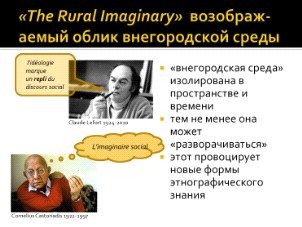
Данное выступление основано на представлениях обо всем, что находится за пределами города и особенно центральных научных заведений. Терминология в статье заимствована из работы французских теоретиков Клода Лефорта и Корнелиуса Касториандиса об общественном вoображаемом (l’imaginaire social). В русском языке сложно найти термин, который бы характеризовал внегородские пространства без обязательной ссылки на то, что они не находятся в городе. Стандарное слово «сельские» напоминает сразу архитехтуру села, а не специфическую местность саму по себе. В докладе, я выбирал слово «внегородской» чтобы растолковать понятние «rural» взятое из западноевропейских языков. Главная тема доклада состоит в критике того как жизнь внегородских жителей представляется в коридорах столичных лабораторий, а также бросает вызов тому, чтобы представить как антропологическое знание может укорениться за пределами городов.
Концепция Лефорта и Касториандиса была выработана, чтобы доказать положительную роль идеологии власти в оформлении неожиданных примеров социального переустройства на более справедливых условиях. Они заметили, что идеология класса или государства не сможет заменить здравого смысла, а только подкрепляет его. Официальная идеология не бывает гладкой, а всегда сопровождаются созданием «складкок». В «разворачивании» этих скадок, они считают, что они нашли источник общественого творчествa (cultural creativity). В данном докладе я развиваю их концепицию дальше с предложением того, что стереотипы внегородской среды также создают складки, которые взращиваются в новых формах антропологического знания.
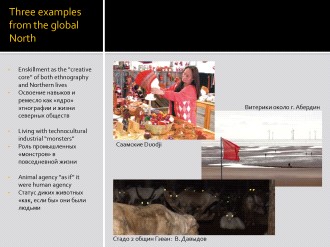
В долкаде я расматриваю три примерах в основном из «глобального Севера»: (1) пример о народном творчестве в прямом смысле – производство предметов, которые служат символами национальной культуры; (2) пример о роли промышленных «монстров» в повседневной жизни. Здесь я имею виду важную роль развития промышленной инфрастрактуры в ущерб национальных сообществ, а также их возражение; (3) в последнем примере я рассматриваю «новые» формы одомашнивания диких животных как занятие, которое преобразуется новые сложные типы социальных отношений. Все три примера дают возможность размышлять как антропология может определять себя уверенно в «нестоличних» местах.
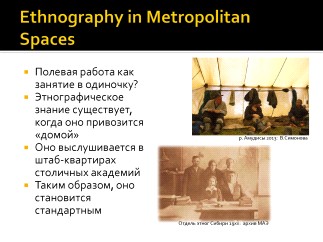
Like many disciplines, anthropology defines itself by its methods. In most national traditions it is a discipline that requires the strict personal commitment of the ethnographer to long-term exposure to an alternate culture. In most, anthropology further defines itself by its relativism and its patience with alternate worldviews. Finally, an increasingly important hallmark of the discipline is the procedure of ‘object-creation’: once the authoritative construction of a particular society or nationality; now the reflection of a particular theme such as ‘gender’ or ‘development’. Each of these activities is often packed into the notion of ‘fieldwork’, which suggests semantically that it is the opposite of the laboratory work. But to what degree is laboratory experience – the experience of proximity, debate, and discipline – truly absent in the creation of anthropological knowledge?
It is difficult to generalize about all anthropological traditions, but for most, ethnographic facts are thought to exist and reproduce themselves ‘out there’ and can only be witnessed when the ethnographer travels away to record them. Nevertheless, anthropological knowledge only comes into being when these stories are ‘brought home’. The formal concepts, are created in the company of other anthropologists at conferences and seminars, during one-to-one meetings with one’s supervisor, or in academic papers. For the most part, these meetings or readings are built within the architecture of an urban academy – its seminar rooms, libraries, and servers. Co-presence of our colleagues in a physical time and place serves as an important validation of our generalizations, perhaps in a much stricter sense than in the replication of the results formed of physical and chemical experiments. Despite the stereotype of ethnographic experience being a lonely one, ethnographic knowledge is formed collectively as in a laboratory.
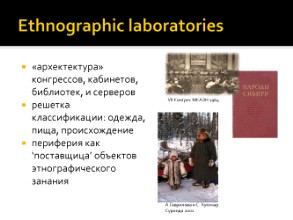
Этнографические лаборатории бывают разной мощности. Мы с моим коллегой из Кунста Камера Дмитрием Арзютовым занимаемся изучением истории Отдела этнографии Сибири Музея антропологии и этнографии как «лаборатория». Она в ходе не одного десятилетия работы над книгой «Народы Сибири» внесла большой вклад в признание многих сибирских идентичностей. Книга эта, как хорошо известно, зажила собственной жизнью в английском переводе благодаря усилиям американского антрополога Сола Такса и издательства «University of Chicago Press». Дискуссия вокруг этой книги – предмет подробных стенографических отчетов – привела к тому что книга стала образцом этнографического описания. Человеческая идентичность в этой книге выводится на координатную сетку, оси которой определены различными сферами жизни: одеждой, пищей, происхождением и т. п. Книга стала своего рода энциклопедической точкой отсчета при дальнейшем изучении данного региона.
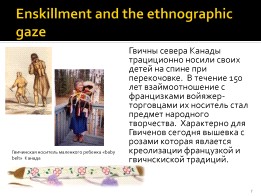
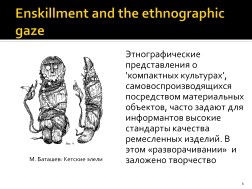
To my mind what is striking about this ethnographic entrepreneurship is the power that it holds to create a certain rural imaginary. In contemporary fieldwork people often volunteer examples of clothing, reindeer saddles, or children’s cribs - without being asked - as markers of their culture or identity. The material markers of identity have been raised so high as markers as culture that they obscure other idioms of civil relationships such as kinship or reciprocity. In the ethnographic rural imaginary, the periphery produces symbols that speak of culture. The speeches are heard in the urban academy. However the social imaginary is a symbolic, ideological force that both dominates human action as well as creates possibilities which ‘fold’ open for new or different actions. Ethnographic imaginaries of compact cultures reproducing themselves through material objects often set high standards of craftsmanship for informants which can be a matter of pride and self-identity, and thereby affirm local identities as much as represent them. However this materiality often creolises in interesting ways which point to other intuitions.
For example, across the North material objects often fold-open into specific historic or sacred sites on the landscape which hold powerful meanings. Studies of enskillment and embodied forms of practice are now a
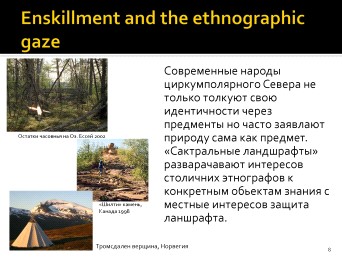
widely publishable genre where the frame of recognition lies not with urban audience but among enskilled practitioners themselves. Skilled craftsmen can sit anywhere in both rural and urban settings. In this case, the frame of the problem provides the criteria by which the categories and theories work. For all of these examples texts and ideas are still discussed in urban laboratories, but the laboratories function ‘as-if’ they were fieldsites.
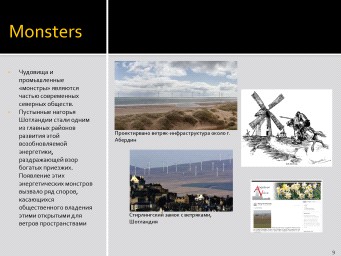
В обсуждениях представлений о внегородской среде интересно следить как городские этнографические представления формируют новые отношения. Один из ярких примеров этого связан с мерами по охране окружающей среды в горной Шотландии. Шотландия – старинный край, в ходе своей бурной истории выступавший и колонизируемой страной, и страной-колонизатором – прекрасна ныне своими тихими пейзажами, как правило, внегородскими. Ее заросшие вереском долины служат теперь охотникам-спортсменам и туристам, которые стремлятся к встрече с «чистой природой». Глобализация не столь терпелива, чтобы оставить без внимания подобную иронию истории. Шок от перебоев с поставками топлива сделали приоритетным вопросом создание сети возобновляемых источников энергии – ветряков. Пустынные нагорья, отделенные от людей, стали одним из главных районов развития этой возобновляемой энергетики, раздражающей взор богатых приезжих туристов. Появление этих энергетических монстров вызвало ряд споров, касающихся общественного владения этими открытыми для ветров пространствами. Приезжие желают сохранить эти ландшафты ради их эстетической ценности, а потомки тех, от которых отобрали землю, предпочитают покорять их, используя для развития устойчивой энерги.
Чудовище или монсторы, как говорят нам фольклористы, это любое действующее лицо, «неуместное» по причине своей внешности, размера, веса и силы. По словам Артуро Эскобара, ветряк поступает как яркая иллюстрация технокультуры, столь основательно смешивающей природное и культурное, городское и внегородское. Технокультурный монстр, по Лефорту, создает «складки» которые открывают возможность переформатировать городские и внегородские интересы самым хаотическим и непредсказуемым образом. Этнография энвайрон-ментализма описывает в данном случае предмет так, что речь идет как минимум о совершенно ином представлении о внегородской среде.
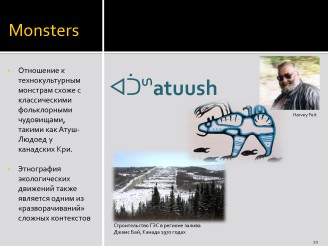
Подобных технокультурных монстров можно встретить и по всей приполярной Арктике. Обычно мы сталкиваемся с ними в виде проектов гидроэнергетических станцией, сильнейшему трансформационному влиянию которых подвергаются все арктические народы. У канадского этнографа Харви Фэйта в его запоминающемся исследовании индейцы кри, живущие возле залива Джеймса, воспринимают эти постройки как «чудовищ-людоедов», пожирающих землю и общество. Политические лидеры кри говорят, что этих могучих чудовищ можно было бы привлечь к общественно-полезной деятельности подобно тому, как это сделали с Атусшем – людоедом их устной традиции. В данном примере фольклор не служит только «маркером» компактности и отличие внегородской культурной группы, а демонстрирует красноречивые образы и нравственные уроки, помогающие людям в их встрече с промышленными монстрами, которые возродились в немного иной форме, но все равно способными к переговорам.
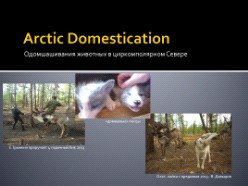
In thinking about the question of the rural imaginary I have reflected a lot on the issue of domestication – a theoretically-rich domain where one finds both postulates of what defines humans separate from animals and a spatial metaphor of what defines rurality. Тhe hard work of creating a domestic animal - often thought to have been an event which has taken place far away both in space but in time – also takes place in the here and now either through management, conservation, or design. From what we know from complex relations between hunters and animals in the circumpolar North, it is rare that an animal is tracked down and subjugated as if it were fleeing. Most accounts document a mutual understanding described in terms of mutual perception (Ingold 2000), mimesis (Willerslev 2007), or even seduction (Scott 1989) – although in some violence also plays a role (Brightman 1993). These ethnographic accounts place their emphasis on emotions and skill over canniness. When one entertains the idea that human persons and animal persons inhabit a similar realm of intuition and mutual-understandable action, the ethnographic task then becomes one of categorising them. It is very rare that animal realms are portrayed ‘as-if’ they were exactly the same as human societies. They seem to experience the world and react to it in a unique way, and in that is the ethnographic challenge.
A useful illustration of this is perhaps an overly formalized one. One of the classic experiments that forms the rural imaginary of human-animal relationships is the much-cited Novosibirsk Arctic fox experiment. Here several generations of scientists at the Institute of Cytology and Genetics through a rigid regime of natural selection have created an Arctic fox that behaves with docility and warmth as if it were a cat. The experiment is widely quoted in biology and archaeology for identifying physical markers of domestication. However as a circumpolar ethnographer, what is striking if not shocking is the idiom of helplessness and dependency that is used to define domestication. This type of ‘cuddly’ domestication is a type of behaviour that it is safe to say is unknown in most settings of the circumpolar North – settings where domestic animals are expected to have autonomy and the stamina to look after themselves. The radical sense of autonomy bred into dogs, reindeer, and perhaps even domestic salmon, is one of the reasons cited by biologists for putting the Arctic as a region where ‘full domestication has not occurred yet’ or is ‘incomplete’. Rather than condemn the region as being an incomplete fulfilment of a rural imaginary, I would argue that ethnography can play an important role in folding this imaginary into a more mature definition of interrelationship.
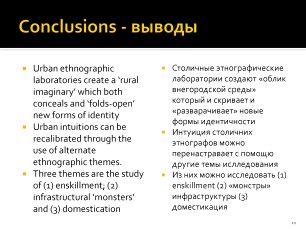
В своем докладе я обратил внимание на специфику органциации этногафической практики на глобальном севере как работу столичной лаборатории. Несмотря на то, что работа этнографа расматривается как работа одинокого человека, концепция из «поля» переформируется в архитектуре некоторых столичных лабораторий. Столичные этнографические лаборатории, таким образом, создают «облик внегородской среды», который, и скрывает, и «разварачивает» новые формы идентичности. С помощью этих трех примеров я показал как можно перенастроить интуицию столичных этнографов, давая возможость этнографии укорениться за пределами городов. Я описал (1) освоение навыков (enskillment), (2) «монстры» инфраструктуры, и (3) доместикацию. В докладе я показал, что важным вызовом современного развития антропологии является необходимость не учиться представлять городской жизненный опыт, а напротив – разучиться это делать. Вызов состоит в том, чтобы представить себе, как антропологическое знание может укорениться в любой местности - в городе и за его пределами.
