


Партнерка на США и Канаду по недвижимости, выплаты в крипто
- 30% recurring commission
- Выплаты в USDT
- Вывод каждую неделю
- Комиссия до 5 лет за каждого referral
ЗАДАНИЯ ДЛЯ СТУДЕНТОВ ЗО специальности 160100 НА VIII СЕМЕСТР
Для сдачи зачёта (экзамена) студентам предлагается выполнение следующих заданий:
1) Перевод четырёх предлагаемых текстов с листа (!!! Во время перевода текстов преподавателю можно пользоваться только списком слов с переводом).
2) Контрольная работа №8 – первый текст не переводится - по тексту выполняются задания со II-VI, задание VII – грамматическое, письменный перевод текста в задании VIII.
3) Тема: “Famous pilots and aircraft designers ” – “Знаменитые летчики и авиастроители ”
4) Перевод текста, предлагаемого экзаменатором.
Защита контрольных работ и перевода технических текстов проводится по расписанию во время сессии, а также в течение семестра по четвергам с 17.05 - 20.00. Тексты переводятся с листа. Вы читаете текст на английском языке, затем его переводите, глядя на английский вариант текста. Разрешается пользоваться, составленным вами словарем по предложенным текстам.
N. B. Просьба распечатать контрольные работы и тексты и принести их на зачет.
1) 4 текста на перевод с листа:
TEXT 1
Baroness Raymonde de Laroche
Born on 22 August 1882 in Paris, Elise Raymonde Deroche was the daughter of a plumber. She had a fondness for sports as a child, as well as for motorcycles and automobiles when she was older. As a young woman she became an actress and used the stage name "Raymonde de Laroche". Inspired by Wilbur Wright's 1908 demonstrations of powered flight in Paris and being personally acquainted with several aviators, including artist-turned-aviator Lйon Delagrange, who was reputed to be the father of her son Andrй, de Laroche determined to take up flying for herself.
In October 1909, de Laroche appealed to her friend, aviator and aeroplane builder Charles Voisin, to instruct her in how to fly. On 22 October 1909, de Laroche went to the Voisin brothers' base of operations at Chalons, 90 miles (140 km) east of Paris. Voisin's aircraft could only seat one person, so she operated the plane by herself while he stood on the ground and gave instructions. After she mastered taxiing around the airfield, she lifted off and flew 300 yards (270 m).
On 8 March 1910, de Laroche became the first woman in the world to receive a pilot licence when the Aero-Club of France issued her licence #36 of the Fйdйration Aйronautique Internationale (International Aeronautics Federation or F. A.I.).
De Laroche participated in aviation meetings at Heliopolis in Egypt as well as Saint Petersburg, Budapest and Rouen. During the show in St. Petersburg, she was personally congratulated by Tsar Nicholas II. There, she was presented once again as "Baroness" de Laroche. Thereafter, the title became commonly used.
In July 1910 de Laroche was participating in the week long airshow at Reims in France. On 8 July her aeroplane crashed and she suffered such severe injuries that her recovery was in doubt, but two years later she was fit again and had returned to flying. On 26 September 1912 she and Charles Voisin were involved in a car crash. Voisin was killed, and she was severely injured.
On 25 November 1913 de Laroche won the Aero-Club of France's Femina Cup for a non-stop long-distance flight of over 4 hours duration.
During World War I, as flying was considered too dangerous for women, she served as a military driver, chauffeuring officers from the rear zones to the front under fire.
In June 1919 de Laroche set two women's altitude records, one at 15,700 feet (4,800 m); and also the women's distance record, at 201 miles (323 km).
On 18 July 1919 de Laroche, who was a talented engineer, went to the airfield at Le Crotoy as part of her plan to become the first professional woman test pilot. She co-piloted an experimental aircraft (whether she flew this plane or was a passenger at the time is not known); on its landing approach the aeroplane went into a dive and crashed, killing both de Laroche and the co-pilot.
There is a statue of de Laroche at Le Bourget Airport in France.
From 6 March to 12 March 2010, to celebrate the Centennial of Licensed Women Pilots, women pilots from eight countries on three continents used 20 types of aircraft to establish a new world record: 225 girls and women introduced to piloting by a woman pilot in one week.
Notes
go into a dive - входить в пикирование
chauffeuring - работать шофёром, возить кого - либо
taxiing - руление
TEXT 2
Valery Chkalov: Becoming a star
In the fall of 1935, Chkalov’s friend and colleague, Georgy Baydukov, suggested the idea of a non-stop transpolar flight to the United States. Chkalov conceded after a minor hesitation, and in the spring of 1936 the crew, consisting of Chkalov, Baydukov and Aleksandr Belyakov, the navigator, requested permission from the Soviet authorities to fulfill their project. The authorities, however, only approved a non-stop flight from Moscow to the Far East. On 20 July 1936, Chkalov’s team set out on their legendary flight to the Far East, and by 22 July after flying 5,825 miles in 56 hours in the heaviest weather conditions, Chkalov landed his ANT-25 monoplane on Udd Island on the eastern coast of the Soviet Union, later renamed Chkalov. For this flight the three members of the crew were decorated with the order of Lenin – Chkalov for the second time – becoming Heroes of the Soviet Union and instant nationwide celebrities. All Soviet authorities, including Stalin, gathered on the airfield to greet the heroes of the successful flight.
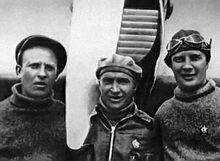
On 18-20 June 1937,Chkalov’s dream finally came true as he and his legendary crew, co-pilot Georgy Baidukov and navigator Aleksandr Belyakov, finally performed the first ever non-stop transpolar flight to the United States, successfully ending it at Pearson Airfield in Vancouver, Washington State.
The ANT-25 flight, relatively uneventful for the first 24 hours, later proved to be a feat of strength and endurance for the three experienced cold-weather pilots. As they approached the Polar Region, the aircraft’s magnetic compass became inoperable. Navigation from then on relied solely on dead reckoning and a solar heading indicator. To make matters worse, headwinds and storms slowed the ANT-25’s progress and caused fuel to be consumed at an alarming rate. These impediments threatened the crew’s already scarce oxygen supplies. The plane was in constant danger of icing, since only the plane’s propeller was capable of de-icing. At one point during the flight even the engine coolant was about to freeze up. The crew quickly thought to put their drinking water supply to use, only to discover that it, too, was frozen.
After a 63-hour flight, covering a total distance of 5,288 miles, the plane landed at Vancouver’s Pearson Airfield, with a mere eleven gallons of fuel left in its tanks. Chkalov was the first to exit the plane, yelling, “Guys! Look, General Marshall is waiting for us!” Baidukov, still inside the cockpit, was wondering who exactly was waiting for them – a general or a marshal, misled by the last name of General George C. Marshall, America’s future Army Chief of Staff. Besides, the Soviet aviator was unaware that the rank of marshal simply didn’t exist in the United States.
The hero pilots were surprised at the crowds of cheering spectators anxious to see them. The warm reception at the airfield was just a prelude to a meticulously planned, month-long tour of the United States that lay ahead of the Soviet aviators. Instant stars, they were praised by the American press. Wherever they went they were greeted with an artillery salute, local beauty queens placed laurels on their heads and celebrities lined up for an autograph. The festivities reached their height with a specially organized parade in New York City and a visit with US President Franklin Delano Roosevelt. While at the White House, Chkalov was attracted by many of the paintings on the walls. Roosevelt explained it was during his maritime past that he’d developed a love for the naval theme. To that, Chkalov remarked simply: “Your collection would look a lot better with our Aivazovsky in it.” A brightened up Roosevelt then admitted: “I really do love Aivazovsky a lot…”
The daring record of the Soviet aviators was commemorated in 1975 with the erection of a large monument at Pearson Airfield in Vancouver, Washington.
Back in the Soviet Union, Chkalov was just as famous and loved by both the authorities and common people: as Stalin’s favorite, he’d also become the role model for all Soviet boys who dreamt of becoming pilots, and all Soviet girls who dreamt of marrying them and waiting for them to return from their transpolar flights. Chkalov and his fellow pilots were decorated with the Order of the Red Banner for the flight.
Notes
dead reckoning - счисление пути
impediments – затруднения, помехи, преграды
laurels – лавровый венок, лавры победителя
meticulously – тщательно, педантично, скрупулезно, до мелочей
Text 3
George Steedman Hislop
George Steedman Hislop was born on February 11, 1914 in Edinburgh and educated at Clydebank High School. After serving an apprenticeship as a fitter and completing a Higher National Certificate in mechanical engineering, he attended the Royal Technical College, Glasgow, and took a First-class external degree from London University. He was awarded a James Caird scholarship in Aeronautics to pursue research at Cambridge, where he gained his doctorate and joined the University Air Squadron, training as a pilot. In November 1939 Hislop joined the A&AEE, where he worked on the development of fighters and bombers operating at high altitude and the associated meteorological and physiological problems; he also joined many test flights as an observer. Hislop was first introduced to the helicopter during his wartime work at the Aeroplane and Armament Experimental Establishment (A&AEE) at Boscombe Down. In late 1944 the helicopter arrived there for trials, and he had his first flight in the basic Sikorsky R4.
Hislop transferred to Farnborough in April 1945 as a senior scientific officer, looking at the behaviour of aircraft flying at high speed, but was soon asked to carry out exploratory research work on helicopters. He flew regularly on test flights of the R4. It was the beginning of his long association with rotary wing aircraft. Two years later he joined British European Airways’ research and long-term development department, which resulted in the formation of British Airways Helicopters.
Hislop was the senior assistant involved in the monitoring, programming and financial control of the unit. Initially, the main activity was a night postal service in East Anglia, but the long-term goal was carrying passengers between cities.
When in 1952 the Ministry of Civil Aviation asked for a large intercity passenger-carrying helicopter, Fairey Aviation’s proposal was accepted. A year later Hislop joined Fairey as chief designer (helicopters) responsible for building and testing the 40-seat Fairey Rotodyne. This complex aircraft was well ahead of its time, drawing a letter of intent from BEA; there was also interest from some American airlines. But when BEA pulled out of the project the Rotodyne was cancelled in 1962.
Hislop developed the ultralight helicopter, which was later developed into the highly successful Scout and Wasp military helicopters.
In 1960 Westland Aircraft took over Fairey, and Hislop joined the parent company. Two years later he was appointed technical director, later becoming managing director and, in 1973, executive vice-chairman. During this period he led the development and introduction into service of six types of military helicopter, including the Wessex and Sea King. He also played a major role in launching the production of the giant Anglo-French helicopter programme which led to the Gazelle and the Lynx, both built in large numbers — an advanced Lynx is still in operational service.
Hislop served as chairman of the council of the Helicopter Association of Great Britain and as its vice-president. He was president, in 1973, of the Royal Aeronautical Society, which in 1961 had awarded him the Simms Gold Medal. He also received the British Gold Medal for Aeronautics (1972) and the Royal Aero Club’s Louis Breguet Memorial Trophy.
Notes
apprenticeship – обучение (профессиональное)
a fitter – слесарь, механик, наладчик
Text 4
Andrei Nikolayevich Tupolev
Andrei Tupolev was born in the village of Pustomazovo (Russian: Пустомазово), near the city of Kimry, Tver region, Russia. He was the sixth of seven children born to his parents. After first being educated at home, he studied at the Gymnasium in Tver and graduated in 1908. He then applied for courses at two Russian universities and was accepted at both: Imperial Moscow Technical School (IMTU Russian: ИМТУ) and the Institute of Railway Engineers. He accepted the place at IMTU. In 1909, Tupolev began studying aerodynamics under the Russian aviation pioneer N. E. Zhukovski. During this time he built one of the world's first wind tunnels which led to the formation of an aerodynamic laboratory at IMTU.
In 1911, Tupolev was accused of taking part in revolutionary activities, including demonstrations and distribution of subversive literature, and was arrested. He was later released on condition that he return to his family home in Pustomazovo and was only allowed to return to IMTU in 1914. He completed his studies in 1918 and was awarded the degree of Engineer-Mechanic when he presented his thesis on the development of seaplanes.
By 1920 the IMTU had been renamed the Moscow Higher Technical School (MVTU) and Tupolev was teaching a course there on the basics of aerodynamic calculations.
Tupolev was a leading light of the Moscow-based Central Aero and Hydrodynamics Institute (TsAGI; Russian: Центральный аэро-гидродинамический институт; ЦАГИ) from 1929 until his death in 1972. The Central Design Office or TsKB (Russian: Центральное конструкторское бюро; ЦКБ) based there produced bombers and some airliners, which in the years before World War II were based partially, especially in his 1930s-era designs, and on the all-metal aircraft design concepts pioneered by Hugo Junkers. In 1925, he designed a twin-engine bomber, the TB-1, which was considered one of the most advanced designs of the time. In 1937, an improved version designated the TB-3 made a landing at the North Pole.
As the number of qualified aircraft designers increased, Tupolev set up his own office, producing a number of designs designated with the prefix ANT (Russian: АНТ) from his initials.
However, on October 21, 1937, Tupolev was arrested together with Vladimir Petlyakov and the entire directorate of the TsAGI and EDO on trumped up charges of sabotage, espionage and of aiding the Russian Fascist Party. Many of his colleagues were executed. In 1939, Tupolev was moved from a prison to an NKVD “sharashka” (an informal name for secret research and development laboratories in the Soviet Gulag labor camp system) for aircraft designers in Bolshevo near Moscow, where many ex-TsAGI people had already been sent to work. The “sharashka” soon moved to Moscow and was dubbed "Tupolevka" after its most eminent inmate. Tupolev was tried and convicted in 1940 with a ten-year sentence. During this time he developed the Tupolev Tu-2, He was released in July 1941 "to conduct important defence work." (He was not rehabilitated fully until two years after Joseph Stalin's death in 1953.)
Notes
subversive – диверсионная, антиправительственная
Контрольная работа № 8
по английскому языку для студентов специальности 160100(самолёто-, вертолётостроение) заочного отделения
VIII семестр
Прочитайте и переведите текст (устно).
Ronald Ashford CBE 1932-2008
Ronald Ashford was born in Wokingham, Berkshire, in 1932 and attended St Edward’s School, Oxford, from where he went to the De Havilland Aeronautical Technical School in 1949. As he served his apprenticeship, Ashford took flying lessons. Possession of a private pilot’s licence was professionally useful but flying was, for Ashford, also a leisure pursuit. He was an active private pilot from 1950 until 1997.
Ashford joined De Havilland in 1953. For his National Service he took an RAF short-service commission, returning to Hatfield in 1958. Over the next ten years he flew alongside test pilots with De Havilland and then with Hawker Siddeley when the two companies merged in 1959. Besides the Comet, he worked on test flights for the Trident and the DH125 corporate jet. He also worked on the Royal Navy’s DH110 Sea Vixen, an earlier model of which had crashed at the 1952 Farnborough air show, killing both crew and 29 spectators.
By the mid 1960s, Hatfield began to lose its luster as an aerospace development centre. Ashford moved in 1968 to the Air Registration Board, the organisation responsible for setting and overseeing technical safety standards for British aircraft. He saw it rolled into the Civil Aviation Authority in 1972, becoming director general of the airworthiness division in 1983, and head of the operational safety division in 1987.
Ashford was involved in the investigation into the Manchester air disaster of 1985, in which 54 people died when a British Airtours Boeing 737 caught fire. Many of the deaths were caused by smoke inhalation and the accident prompted calls for aircraft to carry protective fire hoods for passengers. Ashford commissioned research into that idea and into cabin sprinkler systems together with the improvement of access to passenger exits. After research and testing it was concluded that the difficulties created by smoke hoods and sprinklers outweighed their potential benefits. However, much improvement in the access to and usability of exits was achieved and is now required as a standard.
At the ARB and the CAA Ashford worked with Concorde teams in the radical rethinking of standards that hitherto had applied to subsonic airliners. From the Anglo-French project there emerged close co-operation between European airworthiness authorities, eventually leading to the Joint Aviation Authorities, based near Amsterdam. Ashford was the senior CAA member with the JAA from 1989, and on leaving the CAA in 1992 he was its secretary general, a full time office, until 1994.
II. Выберите правильный вариант ответа на вопросы к тексту.
1. Where was Ronald Ashford born?
a) in Oxford;
b) in Wokingham;
c) in London.
2. When did Ashford move to the Air Registration Board?
a) in 1968 ; b) in 1964; c) in 1965. | b) 25 – 30 |
3. Where was Ashford involved in 1985?
a) in the investigation into the Manchester air disaster;
b) in test flights for the Trident;
c) in the construction of an aerospace development centre.
III. Закончите предложения по содержанию прочитанного текста.
4. Ronald Ashford … in 1949.
a) … became director general of the airworthiness division …;
b) …was born…;
c) … went to the De Havilland Aeronautical Technical School ….
5. He was … from 1950 until 1997.
... a student in Oxford...; ...unemployed …; … an active private pilot....6. From the Anglo-French project there emerged … .
a) … problems between European airworthiness authorities... ;
b) … close co-operation between European airworthiness authorities …;
c) … co-operation between European trading authorities ….
IV. Подберите эквивалент к данному русскому слову или словосочетанию.
7 . профессиональное обучение
a) private lessons | b) his own study | c) apprenticeship |
8. вести контроль, курировать
a) oversee | b) predict | c) emerge |
9.противопожарная система a) wireless system | b) sprinkler system | c) subscriber system |
10. гражданская авиация
a) civil aviation | b) military forces | c) corporate aircraft |
11. прежде, до сих пор, ранее
a) however | b) though | c) hitherto |
12. дозвуковая
a) ultrasonic | b) subsonic | c) supersonic |
13. полётопригодность, лётные качества
a) timetable | b) airworthiness | c) maintenance |
V. Выберите соответствующее определение данным словам из текста.
| jet; b) merge ; c) inhalation ; d) usability; e) spectator ; f) luster ; g) accident; h) hood. |
14. airplane
15. breathing in
16. air chamber
17. crack-up
18. shine
19. practicableness
20 eyewitness
21. join
VI. Прочитайте предложения и укажите соответствует ли данное утверждение действительности: если соответствует напишите после предложения T - true, если не соответствует то F-false, при этом письменно подтвердите ваш ответ примером из текста.
22. Air Registration Board is the organisation responsible for setting and overseeing technical safety standards for British aircraft.
23. Ashford joined De Havilland in 1957.
24. At the ARB and the CAA Ashford worked with Concorde teams.
VII. Выберите правильный перевод предложений с инфинитивом.
25. He joined the army because he wanted to protect his motherland.
a) Он пошёл служить в армию, так как хотел защищать родину.
b) Он хотел служить в армии и защищать родину.
с) Он защищал родину и служил в армии.
26. I am very happy to have met you.
a) Я очень рад, что встречу тебя.
b) Я очень рад, что повстречал тебя.
с) Я очень рад, что встречаю тебя.
27. He remembered to have been told about the flight.
a) Oн вспомнил, что ему нужно сказать о полёте.
b) Он вспомнил, что он говорил о полёте.
с) Он вспомнил, что ему говорили о полёте.
Выберите правильный предлог или союз.
28. …the mid 1960s, Hatfield began to lose its luster as an aerospace development centre.
a) on | b) by | c) for |
29. He was an active private pilot …1950 until 1997.
a) from | b) at | c) with |
30. He became a head … the operational safety division in 1987.
a) beyond b) above c) of
VIII. Переведите текст письменно:
John Glenn
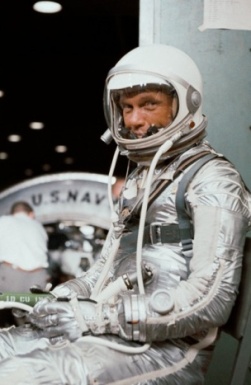
With the exception of Neil Armstrong, perhaps no astronaut has achieved as much fame as has the native Ohioan and Marine Corp fighter pilot turned astronaut/senator, John Glenn. What’s curious about this is why. He wasn’t the first man in space (that would be Yuri Gagarin of the USSR,) nor was he even the first American in space (which would be Alan Shepherd,) and he never flew in space again until he caught a ride as a passenger on the space shuttle Discovery in 1998 (making him, at age 77, the oldest man to fly in space.)
What he did do, however, is still noteworthy: he was the first American to orbit the Earth, doing so three times in 5 hours on February 20, 1962. While a fairly unimpressive feat by today’s standards, it was quite an accomplishment in 1962—especially when one couldn’t be sure that the entire rocket wouldn’t just explode on the launch pad during liftoff! Glenn later retired from NASA, and eventually became a U. S. Senator and perennial Presidential contender, though he never achieved the degree of fame in twenty years of politics that he did in just a few hours onboard Freedom 7.
