


Партнерка на США и Канаду по недвижимости, выплаты в крипто
- 30% recurring commission
- Выплаты в USDT
- Вывод каждую неделю
- Комиссия до 5 лет за каждого referral
УДК 378.14(571.620)
Elena Aleksandrovna Smirnova – Candidate of Sociology, docent of the sociology, social work and the right chair of the Far-Eastern institute of management – branch of RANEPA (Khabarovsk). E-mail: *****@***ru
Particularity of the student's professional choice: representation's dynamic
of educational process
The article presents the results of a study of vocational attitudes, job preferences and the image of the ideal job among students of educational institutions. The relevance of studying the influence of professional choice is related to the necessity of consideration of features of reproduction of labor resources in the Khabarovsk territory. The article analyzes the changes in the preferences of students to selected professional activity. Focuses on the dynamics of building professional development pathways. It is revealed that depending on the rate of change of the indicators of satisfaction with higher education, i. e. the higher the age and rate, the more difficult the process of transformation of views about the work of selecting certain expectations. Proposed recommendations for proforientatsionnoe with applicants and students of educational institutions.
Профессиональный выбор обучающихся как фактор развития трудового потенциала региона
В статье представлены результаты исследования профориентационных установок, рабочих предпочтений и образа идеальной работы у обучающихся высших образовательных организаций. Актуальность изучения влияния профессионального выбора связана с необходимостью рассмотрения особенностей воспроизводства трудовых ресурсов в Хабаровском крае. Современный рынок труда нуждается в мобильных, компетентных, конкурентоспособных профессионалах. В статье проанализированы изменения в предпочтениях обучающихся к выбранной профессиональной деятельности. Акцентируется внимание на динамике построения профессиональных траекторий развития. Выявлено, что в зависимости от курса изменяются показатели удовлетворенности высшим образованием, т. е. чем старше возраст опрашиваемых и выше курс обучения, тем сложнее происходит процесс трансформации представлений о работе, выбора определенных ожиданий. Предложены рекомендации для образовательных организаций Хабаровского края по проведению профориентационной работы как с абитуриентами, так и с обучающимися образовательных организаций.
Key words: sociological research, studying, career guidance, professional choice, professional's self-determination, the labour market.
Ключевые слова: социологические исследования, обучающиеся, профориентационная работа, профессиональный выбор, профессиональное самопределение, рынок труда.
Today the problem of professional orientation is becoming increasingly important. In the era of consumption and informational saturation the question of career choice against the backdrop of polyvectoral development of professional growth arises before the learners. Considering their future professional activity, young people focus not on the existing realities of the labor market but on the possibility of obtaining the prestigious profession, career advancement, highly paid salary. The selection process of career settings is associated with the constant selection situation. A professional career is regarded by an individual as an ability to achieve designed benefits on the one hand and as the definite matrix of valuable professional settings on the other hand. The vision transformation of the professional trajectory occurs in the course of training of the future specialists under the influence of the accumulated educational resource and obtaining the intended symbolic capital in the economic, image, status and role form.
Currently, the modern economy is focused on the rejuvenation of business. The Russian government contributes to the implementation of this strategy, and the Far Eastern region follows this direction. The Far East is a territory of advancing socio-economic development that is reflected in the necessity of the formation of labor potential, possessing the necessary professional competencies. The macro-region covers an area of 6169.3 thousands of kilometers on extent with a population of about 6.3 million people. On the one hand, the occupied area of the region is almost 36% of the territory of the Russian Federation, and on the other hand, the number of people living in the area is about 5% of the population of the whole country. These figures emphasize again the fact that the population density of our region is the lowest in the Russian Federation. According to the official statistics in the Far East, in particular in the Khabarovsk territory, the population outflow increased in recent years. In 2015 compared with 2014, the migration outflow increased more than 1.5 times. So, in 2014, the figure was 2535 people and in 2015 – 4927 people. And as the youth is more than 30% of the total population of the Khabarovsk territory, the migration outflow is observed in this category of people too. Therefore, the questions arise: "How is the implementation of the Federal law ”On the territories of advancing socio-economic development in the Russian Federation?” possible at this ratio of the area and the number of living people?", " How to provide the economy and social sphere with professional personnel?", “How to create attractive conditions for the application of labor potential in the macro-region to reduce the outflow of the young people?”
There is no doubt that this problem has been discussed both in scientific circles and in public and business areas not for the first year. The public authorities are working on mechanisms of solving this problem. One of the important points of retaining of the young people on the territory, according to the author, may be the formation of educational potential. Education is intended to be a basic resource that will allow the youth not only to gain knowledge in a particular profession, but also to promote decent employment in the region.
So the fourth-year students have the most urgent need in education, 50% of them say that their higher education is not enough to build a career. The first year students, in contrast, note that the education will be enough. That indicator was chosen by 50% of the freshmen. However, 6% of the second year students chose the entirely negative answer but half of the respondents said that their higher education was rather not enough, and only 13% of them are fully satisfied with the received education. In the third year of studying it is possible to fix the stagnation because an insignificant gap in the data for response categories prevails in the answers of the students: "Rather no than yes" – 29%, "Rather yes than no" – 26%, “Yes” – 23%. It can be concluded that there is partial satisfaction with the education in this category, as well as a small percentage of categorical degree of dissatisfaction with the education they receive on the selected areas ("Not good enough" was chosen by 16% of respondents).
Thus, the transformation of the satisfaction degree of the received higher education has the wave-like nature and reaches the peak in the fourth year.
One of the most important indicators of interest in receiving a specialized education is a conscious choice of an educational institution and educational program. The students were asked a question "When had you defined your specialty?" which gave the possibility to determine the course where there was the lowest percentage of "random individuals". It was fixed on the third year of education (65%). The students of the first course chose an educational program only during the period of the admission campaign (100%). And here we can note that the satisfaction in education of the students of the first courses was due to the lack of preferences in education in a specific field of training. The result was also influenced by the factor that there was less and less professional orientation work with each year, or it wore a formal nature. So the maximum number of answers to the question “Had there been a professional orientation work at your school?” was recorded in the graduates` recruitment 2010. The graduates of 2015 demonstrated that career guidance was conducted poorly, either they did not know about it or didn't want to take part in that campaign. Thus, it is important to note that the year of admission to the University has become an important criterion in the selection of the areas of learning (figure 1).
As subjective parameters that determine the final choice of a university entrant traditionally are the following: prestige of the University ("brand") and of the chosen profession, employment opportunities, the cost of education, etc. 1 So according to the survey, the students of the graduate courses were more interested in the prestige of a profession, then the percentage is reduced depending on the course and reaches the zero index in the first year. The important criterion determining the choice of a profession is "the availability of education". That response was recorded by 75% of respondents learnt in the first year; thereafter the percentage of responses is reduced to a minimum and is 25% (the fourth-year students).
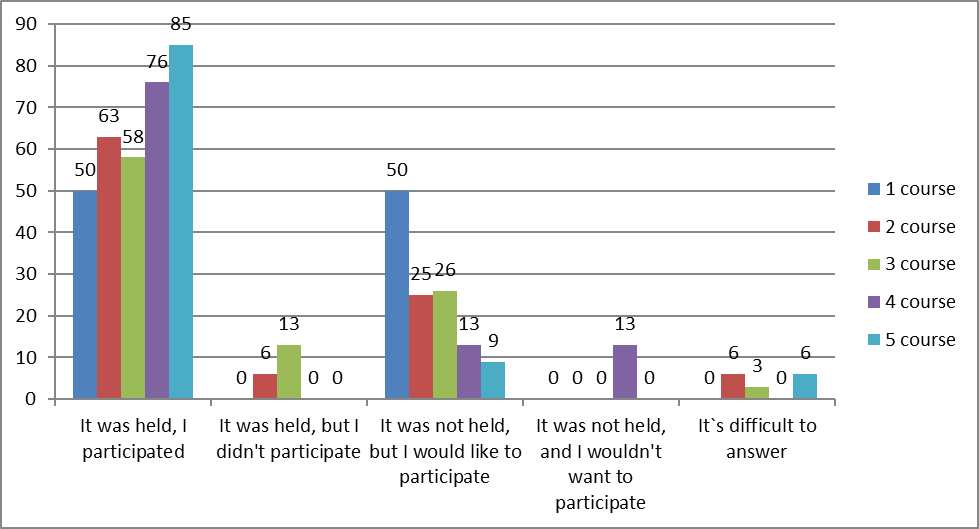
Fig. 1. The distribution of answers to the question: “Had there been a professional orientation work at your school?” (the percentage of the respondents)
Ideas about the content of the education are an important factor, influencing the satisfaction of the received education, the expected result of the development of an educational program. So the randomness of the choice of a profession by the first-year students is directly connected with the desire of entrants to get a diploma and specialty. The given indicator was selected by 50% of the respondents studied in the first year. The second year students, after a process of adaptation to the changed conditions, noted the need to expand their knowledge for the purpose of carrying out professional activities. When half of the time allocated to the development of the educational program is completed, a fixed desire not only to get a diploma of education, but also to "expand the knowledge" is observed. This need occurs in the second year of learning and is growing to the third and fourth years, when the changes in the trajectory towards the dominance of self-realization and improvement of the professional skills appear. The students of the graduate courses (50%) show the greatest interest in the educational process, then the interest in the learning process decreases and this figure is 25% of the number of the respondents in the first year (figure 2).
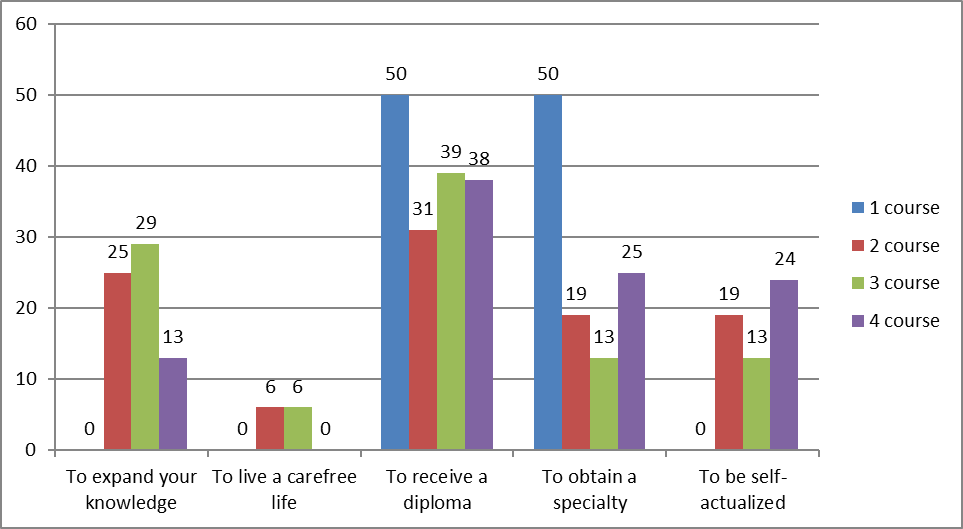
Fig. 2. The distribution of answers to the question: "What is the most important in the learning process in the University?" (the percentage of the respondents)
The desire to obtain higher education by the students of the first and second courses in the areas of "Sociology" and "Social work" is associated with the preference to get highly paid jobs. The given indicator noted 50% of the surveyed students, along with the need to have a high social status and desire to become a professional in the chosen activity. The students of the third course, along with the desire to get highly paid jobs (although the figure is 39% of the respondents), tend to be the professionals and occupy a high social position, and are ready to develop their abilities and personal qualities as well. When the learning process is coming to its logical conclusion, the opinion of the respondents on the need for higher education is changing. The development of abilities and personal qualities becomes the most significant for this category of students. Thus, the graduates` desire to become a professional, to have a well-paid job and to develop skills and personal qualities are equally prevalent ones, meanwhile less importance is given to the desire of a high social position in the society (figure 3).
The completion of education is always associated with a job searching, but the question of finding a job is also relevant in the first year. The greatest confidence to the parents and relatives in obtaining the information about an employment is fixed at the first-year students. The given indicator is chosen by the 50% of the respondents. A significant part of the responded freshmen (25%) trusts the information received from the representatives of the Department. In the second year the situation is changing in favor of the authority in the form of personal acquaintances and relationships (the indicator is chosen by 44% of the respondents), the Internet (25%), vacancy fairs (13%). In the third year the percentage of the students who are oriented on the personal acquaintances and contacts in choosing a job is slightly reduced (36%). The students begin to trust the information obtained from the Internet sources (29%), as well as from the parents and relatives (16%).
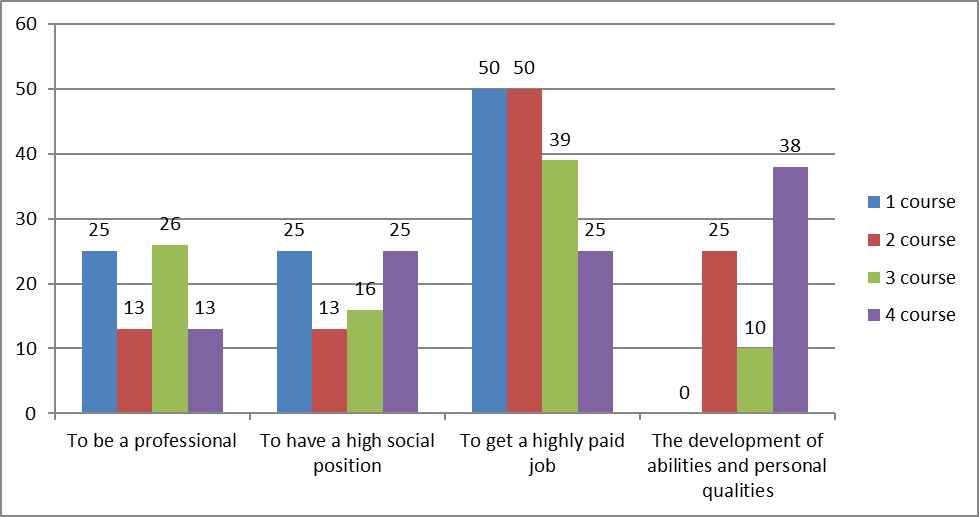
Fig. 3. The distribution of answers to the question: "What for do you need higher education in your opinion?" (the percentage of the respondents)
Thus, the choice of the parental authority as a source of an employment is relevant for the students of the first and fourth courses, the freshmen are fixed to trust the Department and faculty to the maximum, the choice of personal relations is the most relevant for students of the third course, and the authority of the personal relationships and acquaintanceships – for the graduates.
The choice of a workplace is also associated with such an indicator as the opportunity for career growth. According to the survey, we can say that the first year students have a clearly expressed desire to "make a career", and already by the second year it is transformed in the desire to "just work". These changes are also typical of the students of the third courses. The most vital desire "just work" is expressed by the interviewed graduates (91%), and only 9% of them strive to build a career. Thus, depending on the course, there is a decrease interest in career growth and there is the graduates` maximum desire to "regular work without much desire to make a career".
When building the career trajectories, the most important parameter for the first-year students is the presence of freedom and independence in their work (50%), stability and reliability (25%). The sophomores have the need for the embodiment of their ideals and values in their work (19%), "to be a master of his craft" (13%), "to manage people, projects, business processes" (13%). The desire "to be a master of his craft" is dominated at the third course (39%). The availability of a stable and reliable job is reduced as compared with the second course and reaches again the absolute maximum at the graduate course (50%), where there is also a students` desire to make "the impossible possible" in their practice (25%).
At the peak of their career, the first-year students would like to lead a small team or a large division, and also to occupy a high position in the state or municipal administration, or to become an entrepreneur or the head of a private firm. In the second course this trend is almost saved but there is a desire to be the leader of an enterprise, it is not associated with the professional training. In the third course the students` interest in the leadership positions is on the decrease and then it increases again in the fourth course, herewith the preference is given to the public authorities and municipal management, but a desire to be an entrepreneur is significantly reduced. But no matter how the desire for a career change is transformed, a job is a way to provide themselves for all the students. Starting with the second course, a vector determining an informative part of a potential job is significantly expanded. In the second course not only an interest in a way of providing themselves (56%) but also the opportunity to develop their knowledge and potential (25%), the opportunity for career growth and high status (13%) appear. In the third course the attitude to a professional activity as a way of providing increases up to 61%, but up to 16% the choice of the possible implementation of their knowledge is reduced. In the fourth course the answer "a way to provide oneself" remains the same high with a difference of 1 per cent, up to 25% of the respondents choose the opportunity to realize their potential, but the position of choosing a career is thus reduced up to 13% (figure 4).
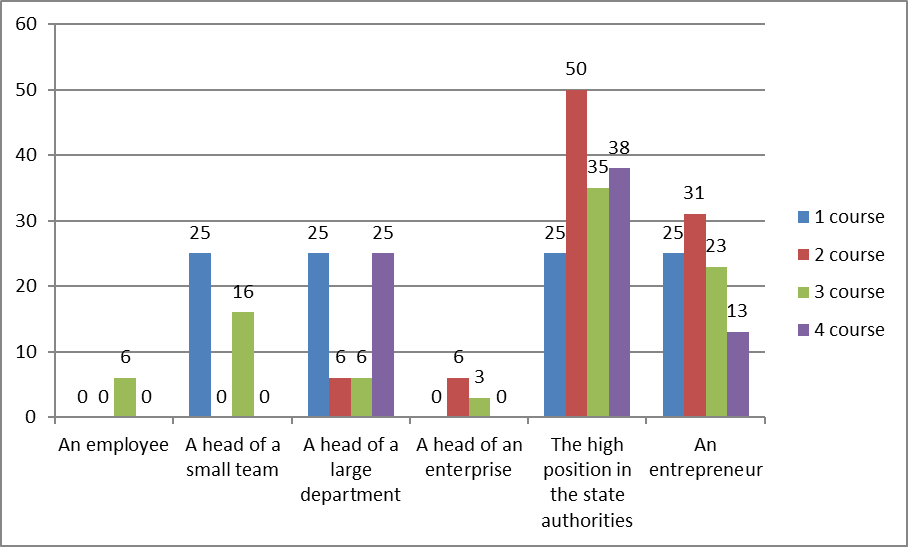
Fig. 4. The distribution of the answers to the question: "What position would you like to take at the peak of your career?" (the percentage of the respondents)
The construction of the career trajectories is always connected with the certain risks. So, building a career, the first year students are ready to move to another city. That indicator was chosen by 75% of the surveyed students. 38% of sophomores are ready to refuse in rest and entertainment in order to achieve their career expectations, but the desire of moving to another city is reduced and only 25% of them are ready to it. The students of the second course are ready to sacrifice the family creation (13%) and to work in an organization with the strict regulations (6%). The third year students are ready to change their place of residence (39%), but they are not ready to take risks (13%). The fourth course students are more pragmatic and ready to move to another city for building a career – 38%, limit their rest and entertainment – 25%. Thus, the second-year students are the "maximalists" as far as the risks regard which they are ready to take.
Thus, in the course of the study were highlighted features of professional selection of students in the dynamics of representations in the learning process. In the variable "work after higher education", influenced by age. At the same time, define the following dependency - the older the respondent, the more difficult to find jobs in their field. Age is one of the key indicators and the impact on the ratio of students to employment prospects.
Career Guidance – a continuous process of interaction between educational organizations as to future applicants and with students of higher educational institutions, aimed not only at solving problems, "set in professional educational organizations", but also to create conditions for the formation of future employment settings in Khabarovsk the edges.
Literature and the sources:
Слободянюк, образовательного потенциала в Формировании миграционного настроения молодежи Дальнего Востока РФ / // Власть и управление на Востоке России. – 2012. – № 4 (61). – С. 193 – 200. О территориях опережающего социально-экономического развития в Российской Федерации : федер. закон от 01.01.01 г. [Электронный ресурс] // Российская газета. – № 000 (29) от 31.12. 2014 г. –.– Режим доступа: https://rg. ru/2014/12/31/territorii-dok. html Территориальный орган Федеральной службы государственной статистики по Хабаровскому краю [Электронный ресурс] –.– Режим доступа: http://habstat. gks. ru/wps/wcm/connect/rosstat_ts/habstat/ru/statistics /population/ Трансформация карьерных и профориентационных установок обучающихся: социологическое исследование / научн. рук. и исполн. // Дальневосточный институт управления – филиал РАНХиГС.– Хабаровск, 2016. – 66 с. (Опрошено 70 обучающихся по направлениям подготовки «Социология», «Социальная работа» Дальневосточного института управления – филиала РАНХиГС; тип выборки: квотная; тип исследования: экспериментальное, пилотажное). Инструкция о порядке проведения профессионально-психологического собеседования или тестирования в высших учебных заведениях от 01.01.2001 г. [Электронный ресурс] –.– Режим доступа: http:///article/item/id/459 Кривоносова, образовательных программ как фактор мотивации обучения в вузе / , // Власть и управление на Востоке России. – 2015. – № 2 (71). – С. 139 – 146. Дидковская, профессиональной карьеры послевузовской молодежи / // Высшее образование в России. – 2012. – № 8 – 9. – С. 90 – 96. Лиджи-Горяева, -трудовые стратегии выпускников профессиональных учебных заведений Калмыкии / -Горяева, // Вестник института комплексных исследований аридных территорий. – 2010. – № 2 (21). – С. 109 – 120. Назарова, стратегии российского студенчества в условиях рискогенности / // Историческая и социально-образовательная мысль. – 2011. – № 3. – С. 71 – 75.
1 Krivonosovа L. A., Smirnova E. petitiveness of educational programs as a motivator of study at the University // Power and management in Eastern Russia № 2 (71). 2015 – P. 140.
