


Партнерка на США и Канаду по недвижимости, выплаты в крипто
- 30% recurring commission
- Выплаты в USDT
- Вывод каждую неделю
- Комиссия до 5 лет за каждого referral
АКТУАЛЬНОСТЬ АДАПТАЦИИ МОБИЛЬНЫХ ПРИЛОЖЕНИЙ В ОБРАЗОВАТЕЛЬНЫХ ЦЕЛЯХ
,
cтудентка Факультета дистанционного обучения
РЭУ им.
,
cтудентка Факультета дистанционного обучения
РЭУ им.
,
cтарший преподаватель кафедры иностранных языков №1
РЭУ им.
Аннотация
Данная статья посвящена важности адаптации мобильных приложений так широко распространенных сегодня, особенно с точки зрения их использования в образовательных целях. Адаптированные мобильные приложения сегодня – это не просто удобная вещь. Они используются в масштабах глобального рынка и должны ему соответствовать. Любой пользователь, загружающий себе мобильное приложение, в том числе и для обучения, может находиться где угодно. Поскольку эти приложения доступны везде, то и должны быть адаптированы и готовы к использованию человеком в любой точке мира. Сегодня наличие адаптированных мобильных приложений особенно актуально, особенно для студентов.
Ключевые слова: смартфон, мобильное обучение, мобильное приложение, адаптация.
the importance of mobile applications localization for educational purposes
Mischenko Y. S,
Shulunova A. S,
Students, Distant Faculty,
Plekhanov Russian University of Economics, Moscow, Russia
Sizova Y. S.,
Foreign language lecturer,
Plekhanov Russian University of Economics, Moscow, Russia
Abstract
The article is devoted to significance of localization of mobile applications so popular nowadays, especially for educational purposes. Mobile appllications localization is no longer just a nice-to-have. Their markets are global, so applications should be too. The next user to download any application, and for education as well, could be located anywhere. While it might be globally available, it might not be global-ready. Today, having a localized application is necessary, mainly for students.
Keywords: smartphone, M-learning, mobile application, localization.
It is impossible to discuss mobile applications and their use for educational purposes before first looking at the history of mobile phones. John F. Mitchell and Dr. Martin Cooper of Motorola demonstrated the first hand-held mobile phone in 1973, using a handset weighing around 4.4 pounds (2 kg). Since then, technology has moved at an astonishing rate including features on phones people would never have thought possible like controlling the temperature of house while they are out or monitoring heart rate and blood pressure, all through mobile apps of course.
So what is a mobile application? The easiest definition determine it as a software application developed specifically for use on small, wireless computing devices. Mobile applications are designed with consideration for the demands and constraints of the devices and to take advantage of any specialized capabilities they have.
The first application entitled to entertain, was the game snake, created in 1998 as a standard pre-loaded game on Nokia phones, which became a global sensation. Snake was a game where you controlled a line of dots that, with imagination, looked like a snake. As you ruled the snake in a small square screen you tried to eat little squares. These squares made it longer with the goal being to not let front end touch anywhere else on snake’s body.
Todays applications are vastly different in all ways to Snake. For example, some of the most popular apps are Candycrush (time wasting games are still going strong apparently), Twitter, Snapchat, YouTube, Minecraft, Pandora, Netflix, and Facebook.
Nowadays smart phones or laptops so deeply penetrated to markets of developed and developing countries that demand on apps is increasingly high all over the world.
There are two leading companies on the market of mobile applications: Apple and Google, which provide users by apps through iOS App store and Play market. Everyday app developers add around 1000 products to App store, and twice more to Play market. [4]
Market analysis is presented on the picture bellow. Google Play expanded its download lead over iOS thanks to first-time smartphone users in emerging markets like India and Southeast Asia. Meanwhile, iOS increased its revenue lead over Google Play thanks to its continued strength in another Asian market: China.
Picture 1. Market analysis of 3rd quarter 2015
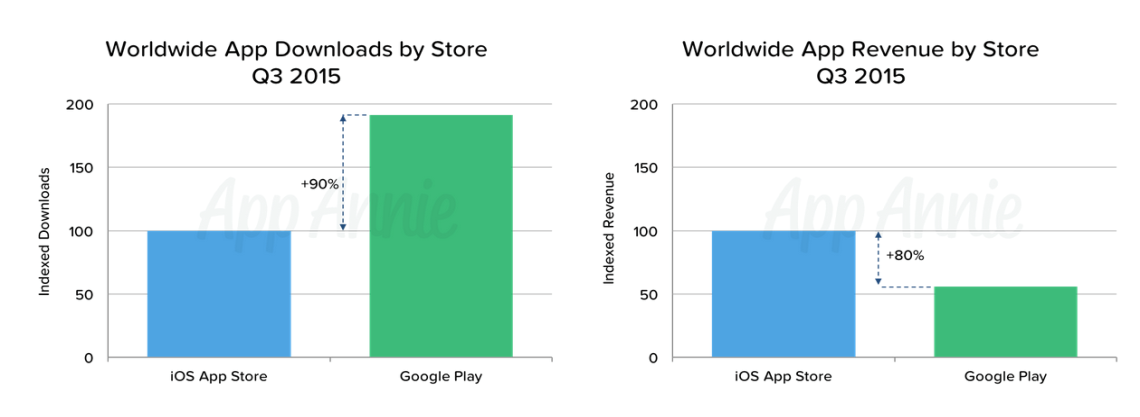
In Q3 2015, worldwide downloads on Google Play were about 90% higher than on the iOS App Store, up from an 85% lead in Q2 2015. Emerging markets like India, Indonesia and fast-rising Vietnam were primary growth drivers as the population of first-time smart phone owners continued to grow. As sub-$50 smart phones gain prominence in these regions, they are likely to attract users with very different needs compared to those buying devices priced $200 or above. Targeting new user segments at the lower end of the market may give local app developers an opportunity to stand out from the crowd. On the other end of the spectrum, worldwide revenue on the iOS App Store was about 80% higher than on Google Play in Q3 2015, up from 70% in Q2 2015. iOS download growth has been rising in China ever since the iPhone 6 and 6 Plus went on sale last year. [2]
Development of mobile applications is quite profitable field at the present time. It has low barrier of entry to the market. The minimum essential equipment consists of a computer, skills of software engineering and conceptual idea. Previously, building applications was complex and there were huge barriers to getting the applications into the hands of users, especially business users. Now, any employee can take ideas and turn them into app solutions faster than ever before, without the need for deep expertise in code and systems. Developing a great app is one of his key priorities in every company which main goal is to go up-market therefore it is important to localize application. Localization should be an essential part of the process when launching an app or website across different markets.
According to the ITU Telecommunication Development Bureau, [by 2017 the percentage of the global population that use mobile phones is set to increase to 69%. However, that said, only 34% of Apple iOS, 39% of Android and 25% of Windows users speak English as their mother tongue]. [3] Global brands will therefore miss out on revenue if they translate mobile apps and websites poorly or by not localising them at all.
We have found several reasons why applications localization is important:
- there are nearly 7 billion mobile users worldwide, accounting for 95.5% of the world population; there’re more than half of the world’s mobile subscribers (52.1%) in Asia Pacific; by 2016, Africa and the Middle East will overtake Europe as the second largest region for mobile subscribers; just 14 countries account for more than 61% of the global mobile subscriptions. China is №1, followed by India, the United States, Indonesia, Brazil, Russia, Japan, Vietnam, Pakistan, Nigeria, Germany, the Philippines, Bangladesh, and Mexico.
Internationalization prepares your application to make it easier for localization to take place later on. Internationalization generally requires you to change your software to ensure that it isn’t geared toward a single country, locale, language, or culture. Localization is different. It requires you to add appropriate resources to your software to ensure that a given country, locale, language, or culture is supported.
Think of it this way – internationalization produces global-ready software that can easily be localized for a given market. Applications localization, which is a subset of software localization, is traditionally the second step in the process. It enables you to actually adapt software for another market.
Localisation is often left until after an app or website’s development, which can add to the amount of costly revisions. There’s nothing worse than an application or site that has been only part localised, especially when it comes to right-to-left language scripts, such as Arabic and Hebrew, which require a mirrored interface.
Marketing localised mobile applications or websites also tends to be left as an afterthought. China, for example, doesn’t use the Google Play app platform but instead has more than 200 different Android app stores that require high-quality translations in simplified and traditional Chinese. Each one will require a slightly different marketing strategy.
Translation, if done well, can dramatically increase downloads and page views, which in turn will lead to better reviews and word-of-mouth promotion.
It’s true that machine translation is pretty impressive; there’re a lot of popular applications and web-sites on the market, but it’s a big mistake to rely solely on a machine to provide quality online content. Machine translations currently don’t have the facility to deliver nuances of culture and implicit meaning in brand identity. It’s fine to go for straight translation when dealing with technical, non-marketing content, but word-for-word translation just does not cut it with applications and websites.
Pressures on budgets entice companies to reduce costs by accepting less than perfect translation and localisation, but this is a false economy. Maintaining the highest production values will help to ensure there are fewer mistakes, time delays and revisions in the global marketing adhering to high quality translations, localised applications or websites will have the impact expected from the campaign ch localized app are also a great contribution to education system.
The appearance of the first mobile devices led to generation of a completely new culture. Mobile devices are constantly being developed, and they have already turned of the facilities of communication into something unimaginable in shape and its capabilities. Modern mobile devices led to the emergence of entirely new ways of life and thinking. [1] The concept of m-Learning is firmly established in the life of the majority of experts in the field of distance learning technologies.
There are a lot of applications which help in learning and self-improvement of English language skills in the mobile application market today. The most famous of them - Lingualeo, Duolingo, Busuu. With these applications, everyone can afford to learn new words, grammar, watch educational video tutorials, lectures with subtitles irrespective of their location. With the application of social type, you can communicate and consult with teachers and representatives of the language without any problems.
Leading publishing houses, such as Pearson, Macmillan, Cambridge, Oxford and even the British Council, meeting the requirements of progress, develop and launch the following mobile applications for mastering English language: dictionaries (ABBYY Lingvo, Oxford, Longman, Macmillan English Dictionary), mobile interactive exercises, for example, to rate My Grammar Lab of various levels or English Grammar in Use exercises and tests, applications for preparation to IELTS, FCE and etc.
As for appendices of the British Counsil, it is worth emphasizing that they are absolutely free. Here are some of them: MyWordBook, Wordshake, Big ch applications as Pronunciation App, Macmillan Education - are real catches for those who wish to improve an articulation of sounds of English language. Besides applications BBC are extraordinary valuable for students, because they can have access to authentic audio, video and to text materials.
If we can make use of new opportunities which modern mobile phones provide we can significantly provide the level of M-Learning and it will become necessary part of education technologies. That’s why localization of mobile apps is so important. It will greatly simplify communication and exchange of knowledges with people from different countries, different nationality and culture.
In the nearest future a brand new phylosophy will occur. With the new mobile capabilities the physical world is moving into the digital space, where including it wants to get the necessary training. Students have come to campus, and it is time for educators and institutions to rise to a new level and change the face of modern pedagogy.
References
Gavrilova E. A., Sidorova P. I., Didakticheskie vozmozhnosti integracii mobil'nyh ustrojstv v distancionnyj format prepodavaniya inostrannyh yazykov., Gumanitarnoe obrazovanie v ehkonomicheskom vuze: materialy Mezhdunarodnoj nauchno-prakticheskoj internet-konferencii. 5-10 dekabrya 2014 g. – Moskva: FGBOU VPO «REHU im. G. V. Plekhanova». 2015. C. 42-46. Report «App Annie Index: Market Q3 2014.URL: https://www. /indexes/all-stores/report/
http://apptractor. ru/measure/user-analytics/pochemu-polzovateli-udalyayut-prilozheniya. html4. https://www. /translation-services/app-localization/
