

Партнерка на США и Канаду по недвижимости, выплаты в крипто
- 30% recurring commission
- Выплаты в USDT
- Вывод каждую неделю
- Комиссия до 5 лет за каждого referral
© 2015
Lykholat Yu. V., Doctor of Biological Sciences,
Rossykhina-Galycha G. S., Junior Research Scientist
Oles Honchar Dnipropetrovsk National University
REDOX-REACTION OF ORZHYTSA 237МV CORN SEEDS TO HERBICIDES
Reviewer – Doctor of Biological Sciences V. М. Zverkovskyi
The paper deals with the effect of herbicidal agents on accumulation of TBA-active products, lipid hydroperoxides and activity of superoxide dismutase (SOD) and peroxidase (PO) in seeds of Orzhytsa 237MV hybrid corn. In the ripening corn seeds treated with herbicides, intensification of the course of reactions of lipid oxidation of the varying degree and functioning of antioxidant protection components (SOD, PО) has been revealed. Slowed accumulation of peroxidation products recorded in ripe seeds is connected with high activity of superoxide dismutase, and stable functioning of catalase and peroxidase. The above leads to the conclusion that the action of herbicides on seeds of plants of Orzhytsa 237MV hybrid corn in their ripening process promotes the ability to proper activation of studied enzymatic protection systems and functioning thereof at the level which would ensure the restoration and maintenance of homeostasis. It is found that Harness, Meister and Adengo herbicides have the least negative impact.
Key words: corn, herbicides, TBA-active products, lipid hydroperoxides, superoxide dismutase, peroxidase.
Statement of the problem. The most efficient method of weed control is the usage of herbicidal agents. However, chemicals often have toxic effect on the cultivated plants. One of results of their negative impact is the activation of processes of lipid peroxidation (LPO), absolutely nonspecific reaction of plant cells to action of any factors, in particular, those of anthropogenic origin (herbicides) [10]. LPO results in the shift of prooxidant-antioxidant balance, which bears the signal value and proves changing of the internal environment of the cell [8]. Support of redox homeostasis of plant organisms under action of the environmental factors, including herbicides, is provided by the antioxidant protection system [3, 4, 11].
Therefore, the program of our study in order to reveal the reaction of Orzhytsa 237MV corn to herbicide impact involved the determination of physiological and biochemical indices of seeds, such as the content of TBA-active products, lipid hydroperoxides, as well as the activity of SOD and peroxidase.
Analysis of the recent studies and publications which initiated solving of the problem. Herbicide treatment of the corn crops holds the leading position among the methods of weed control in the modern agricultural production of Ukraine [7]. Regardless of long-term application of herbicides, the question on the environmental safety and feasibility of extensive use of this practice has currently no unambiguous answer among scientists. On the one hand, the level of topsoil infestation reaches 1,14–1,47 bln. pcs./ha on 80 % of the cultivated land [7, 11]. It causes the reduction of cropping capacity because of competition posed by weeds. On the other hand, insufficient efficiency of the chemical weed control is indicated by the studies where against the background of herbicide application the aggregate infestation of topsoil with the seed germs increased 1,5 times, while 2,4 times increase was recorded for infestation with ragweed (Ambrosia artemisiifolia) seeds – 2,4 times [6].
Research objective. With the use of indices of prooxidant-antioxidant balance of the ripening corn and ripe corn, examination of the peculiar features of prooxidant accumulation and antioxidant functioning under action of herbicides which are most often used in cultivation of this crop.
Materials and methods. The object of study are seeds of corn Zea mays L. (Orzhytsa 237MV medium-early hybrid) got in agrocenoses which were treated with herbicides in doses of: Adengo – 0,5 l/ha; Stelar – 1,25 l/ha; Harness – 2,5 l/ha; Dialen S – 2,5 l/ha; Meister – 1,25 l/ha; Proponit – 2 l/ha. Corn seeds were collected on the areas without herbicide treatment, with the manual withdrawal of weeds, served as a control. Soul were represented by common medium-loamy black-earth with humus content of 4–5 %. Extracts were obtained of the averaged samples of corn from 5 areas; these extracts were centrifuged for 20 minutes at 16000 rev./min. After that, the indices of supernatants were determined with the use of КFК-2MP photoelectric colorimeter and micro-burette.
Activity of superoxide dismutase in the corn grain was determined by the level of inhibition of the process of reduction of nitro-blue tetrazolium, in the presence of NADH and phenazine methosulfate [9]. Peroxidase activity was determined by the rate of benzidine oxidation reaction [1]. Color reaction with ammonium thiocyanate [5] was used for determination of lipid hydroperoxide (LHP) concentration. Content of TBA-active products was determined by following established procedure [2].
Statistical processing of results obtained with threefold repetition was carried out with the use of Microsoft Statistica 6.0 package. Differences between samples were considered significant at р ≤ 0,05.
Results. Sensitive test for intensification of oxidation processes under action of herbicidal agents is LHP content determination. Lipid hydroperoxides are comparably unstable compounds, easily degradable hemolytically on RO–OH bond. As a result, various end products of LPO are formed, including, in particular, malondialdehyde (ТBA-active products) [6]. In our study the effect of herbicides on the intensity of accumulation of lipid hydroperoxides in the ripening corn of Orzhytsa 237MV hybrid has been revealed in the conditions of the field agrocenosis. During the phase of grain formation LHP amount increased under action of Meister sulfonylurea, Harness chloracetanilide product and Adengo three-component pre-emergence systemic agent (24–27 %), and under action of Stelar two-component herbicide, Proponit systemic agent and tank mixture of Harness and Dialen S agents (38–40 %). The substantial difference between the experiment and the control was recorded in the milky stage when synthetic processes were actively running in a single seed. LHP content in the ripe grain in the most cases featured the tendency to decrease.
Most often, lipid peroxidation degree in plants is rated according to the level of accumulation of TBA-active products. Intensive formation of TBA-active products (TBA-AP) is a consequence of oxidation of linolic and linolenic acids of phospholipids and galactolipids of membranes. These compounds are capable of interacting with free amino groups of proteins, components of phospholipids, and triggering the occurrence of ethylene in membranes, which may lead to changes in properties of membranes and individual components thereof, affecting the redox homeostasis of the organism [4]. Accumulation of TBA-AP has been revealed in the ripening corn of Orzhytsa 237MV hybrid (Pic. 1). During the phase of seed formation, increased level of the given product (1,2–1,4 times on average) has been found under action of all agents. Maximum difference between the experiment and the control was recorded at the milky stage. Full ripe stage showed fading of oxidation processes, as a result of moisture loss during grain transition to the state of rest. Correlation analysis demonstrated the close relationship between the content of TBA-AP and HP amount. Correlation coefficient on average was equal to: r = 0,89–0,97.
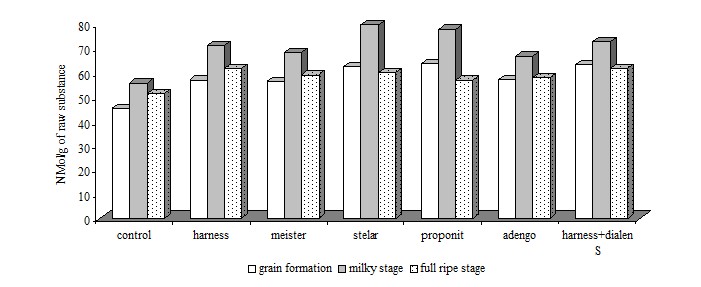
Pic. 1. Effect of herbicidal agents on TBA product content in grain of Orzhytsa 237MV hybrid corn
Support of LPO process at the certain level is provided by enzymes of antioxidant protection [4]. Fluctuations in dynamics of SOD activity (Pic. 2) have been recorded in the ripening corn. During the phase of seed formation, under action of Harness and Meister agents the enzyme activity increased by 17–19 %, and under action of Adengo and Harness+Dialen S – by 31 and 38 %. At the milky stage, when synthetic processes are actively running in a single seed, and prior studies showed the accumulation of TBA-AP, increase in SOD activity has been recorded. Decreased activity of the enzyme has been found at full ripe stage; it is probably due to fading of oxidation processes and preparation of seeds for the deep rest.
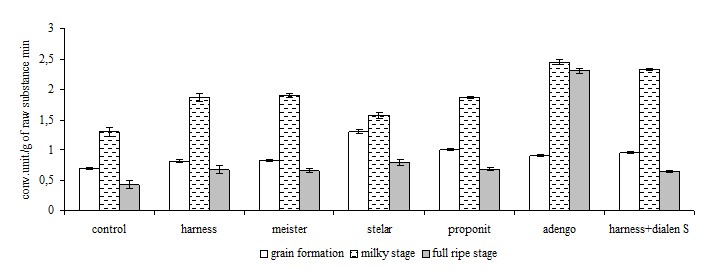
Pic. 2. Effect of herbicidal agents on SOD activity in grain of Orzhytsa 237MV hybrid corn
Correlation coefficient between the content of TBA-AP and SOD activity ranged from +0,92 to +0,98, р < 0,05.
It should be noted that no significant changes in the activity of enzyme (catalase) that neutralizes hydrogen peroxide are recorded. Probably, the above enzyme in these conditions does not participate in protection of tissues from the oxidative stress caused by herbicidal action. According to the results of study, this function is performed by peroxidase. For example, during the phase of seed formation increased enzyme activity has been recoded under action of all agents. Maximum peroxidase activity (105 %) has been established in the variant of action of Harness+Dialen S tank mixture. At the milky stage increase in this index ranged from 35 to 62 % above the control. Maximum values of peroxidase activity were recorded in the variant of action of Adengo and Harness+Dialen S tank mixture (89 and 107 %, accordingly). Lower peroxidase activity was recorded at full ripe stage (Pic. 3). Correlation coefficient between the content of TBA-AP and peroxidase activity ranged from +0,85 to +0,89, р < 0,05.
|
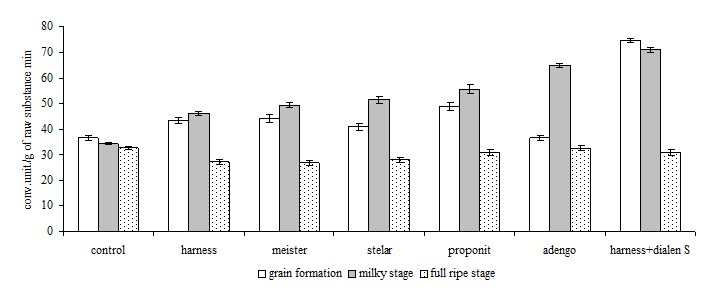
Pic. 3. Effect of herbicidal agents on peroxidase activity in grain of Orzhytsa 237MV hybrid corn
Conclusion. In the ripening corn seeds treated with herbicides, intensification of the course of reactions of lipid oxidation and functioning of antioxidant protection components (activity of SOD, peroxidase) of the varying degree, depending on the agent type, has been revealed. Slowed accumulation of peroxidation products recorded in ripe seeds is connected with high activity of superoxide dismutase, and stable functioning of catalase and peroxidase. The above leads to the conclusion that the action of herbicides on seeds of plants of Orzhytsa 237MV hybrid corn in their ripening process promotes the ability to proper activation of studied enzymatic protection systems and functioning thereof at the level which would ensure the restoration and maintenance of homeostasis.
BIBLIOGRAPHY
1. Бояркин определение активности пероксидазы / // Биохимия. – 1961. – Т. 16, №2. – С. 252–254.
2. Спецпрактикум з фізіології та біохімії рослин / [Вінниченко О. М., Більчук В. С., , Россихіна-, ]. – Дніпропетровськ : ФОП , 2014. – 224 с.
3. Обработка гербицидом Гранстар вызывает окислительный стресс в листьях злаковых / [, , и др.] // Физиология растений. − 2011. − Т. 58, №6. − С. 930–943.
4. Клеточные механизмы адаптации растений к неблагоприятным воздействиям экологических факторов в естественных условиях / [, , и др.]. – К. : Наукова думка, 2003. – 270 с.
5. Курганова окисление липидов и антиоксидантная система защиты в хлоропластах гороха при тепловом шоке / , , // Физиология растений. – 1997. – Т. 44, №5. – С. 725−730.
6. Зміни структури врожаю та якості зерна пшениці озимої за гербіцидної обробки / [, , Россихіна- та ін.] // Карантин та захист рослин. – 2012. – №12 (197). – С. 11−12.
7. Мордерер фитотоксичность гербицидов / . – К. : Логос, 2001. – 240 с.
8. Россихина-Галича ферментов антиоксидантной защиты растений кукурузы, произрастающих в условиях гербицидной обработки / -Галича, ,
// Экологический вестник Северного Кавказа. – 2014. – Т. 10, №4. – С. 30–34.
9. Переслегина антиоксидантных ферментов слюны здорових детей /
// Лабораторное дело. – 1989. – №11. – С. 20–23.
10. Прооксидантна реакція рослин гібриду кукурудзи Кадр 267МВ на сумісну дію гербіцидів та ґрунтової посухи / [Россихіна Г. С., Вінниченко О. М., та ін.] // Науковий вісник Національного аграрного ун-ту. – 2008. – Вип. 125. – С. 21–28.
11. Jung S. Expression Level of Specific Isozymes of Maize Catalase Mutants Influences Other Antioxidants on Norflurazon-Induced Oxidative Stress / S. Jung // Pest. Biochem. Physiol. − 2003. − Vol. 75. − P. 9–17.
