


Партнерка на США и Канаду по недвижимости, выплаты в крипто
- 30% recurring commission
- Выплаты в USDT
- Вывод каждую неделю
- Комиссия до 5 лет за каждого referral
ЗАДАНИЯ ДЛЯ СТУДЕНТОВ специальности 160100 НА VII СЕМЕСТР
Для сдачи зачёта (экзамена) студентам предлагается выполнение следующих заданий:
1) Перевод четырёх предлагаемых текстов с листа. (!!! Во время перевода тексов преподавателю можно пользоваться только списком слов с переводом.)
2) Контрольная работа №7 – первый текст не переводится - по тексту выполняются задания со II-VI, задание VII – грамматическое, письменный перевод текста в задании VIII.
3) Тема: “Materials for Aircraft Construction” – “Материалы в Авиастроении”
4) Перевод текста, предлагаемого экзаменатором.
Защита контрольных работ и перевода технических текстов проводится по расписанию во время сессии, а также в течение семестра по четвергам с 17.05 - 20.00. Тексты переводятся с листа: a) Вы читаете текст на английском языке, затем его переводите, глядя на английский вариант текста. Разрешается пользоваться, составленным вами словарем по предложенным текстам.
N. B. Просьба распечатать контрольные работы и тексты и принести их на зачет.
1) 4 текста на перевод с листа:
TEXT 1
Modern Trends in Design of Aircraft Structures
Modern aircrafts must undergo severe conditions such as differences in atmospheric pressure and temperature, or heavy structural load applied upon vehicle components. The current generations of civil transport aircraft were designed for at least 20 to 25 years and up to 90,000 flights. Consequently, they are usually products of complex synthesis of various technologies and sciences, including developing new design methods, preparing advanced materials.
Future aircraft types are designed for the same goals, but structure with higher fatigue life (endurance), higher damage tolerance capability and higher corrosion resistance are required to minimize the maintenance costs and to comply with the requirements of the operator and the enhanced airworthiness regulations.
During the design of aircraft structures several aspects have to be considered to reach sufficient static strength as well as sufficient fatigue and damage tolerance behavior. The result of iterative calculations is an optimized design regarding weight, costs and aircraft performance. An evaluation of the strength, detailed design, and fabrication must show that a catastrophic failure due to fatigue, corrosion, or accidental damage, will be avoided throughout the operational life of the airplane. The ultimate purpose of the damage tolerance evaluation is the development of a recommended structural inspection program considering probable damage locations, crack initiation mechanisms, crack growth time histories and crack detectability. The damage tolerance design principle comprises two categories which are ''single load path'' and ''multiple load path'' structure. Single load path is where the applied loads are eventually distributed through a single member within an assembly, the failure of which would result in the loss of the structural integrity of the component involved. Multiple load path is identified with redundant structures in which (with the failure of individual elements) the applied loads would be safely distributed to other load carrying members.
Innovative materials research and engineering are essential to get the high-strength, heat-resistant, lightweight structures required in advanced subsonic and supersonic aircraft. General and specific research opportunities were determined for the civil aircraft industry using the HSCT (high-speed civil transport) as a basis for analysis.
The designer of the craft must also consider the man-hours required to supply and maintain the vehicle, as well as the training required for maintenance crews. Maintenance costs and training are also considerations in the design of civil aircraft. The length of runways and their load-bearing weight may influence the proposed gross weight of the plane, the design of its wings, and the configuration of its landing gear.
Vocabulary
1. structures(зд.) - устройства, аппараты
2. fatigue - тяжёлая работа, усталость
ply with the requirements - соблюдать требования
4. airworthiness - годность к полётам
5. load paths - путь нагружения (мех.)
6. static strength – прочность при статической нагрузке
7. damage tolerance behavior – режим работы при допустимых повреждениях
8. delectability – обнаруружительная способность
9. structural integrity – конструктивная целостность
10. redundant structure – 1)статистически неопределимая конструкция
11. load carrying member - механизм, подвергаемый нагрузке
12. landing gear – шасси
TEXT 2
Composite materials in the construction of modern aircraft
Part1
One of the important applications of technological progress to modern aircraft is the use of composite materials in their construction. Moulded into an epoxy resin matrix, they have produced extremely tough and stable materials that are replacing aluminum and aluminum alloys.
Advances in technology have had an enormous impact on the shape, performance, reliability and composition of modern aircraft and fly-by-wire flight control systems (FCS). Propulsion systems also have improved and advances in structural technology have influenced the way aircraft are designed, produced and maintained.
Until the late 1960s, almost all tactical aircraft were composed primarily of aluminum and its alloys. High-speed aircraft used a sizeable amount of titanium, but high cost and the demanding production requirements of this material limited it to moderately high temperature applications. Consequently the latest tactical aircraft incorporate many non-metallic composite materials. Sixteen per cent of the structural weight of the Boeing F/A-18E/F and Lockheed F/A-22 are made up of about 20 per cent of composite material. Future military aircraft such as the F-35 joint strike fighter are expected to have a composite content of at least 35 per cent.
Composite material is made up of two or more separate components that when combined result in property changes that differ from the original posites most widely used in combat aircraft are composed of high-strength fibres of glass, boron, plastic or carbon that are embedded in an epoxy resin matrix. The fibres have very high strength, a uniform structure and lack flaws. The epoxy resin bonds with the fibres in the curing process to produce an extremely tough and stable material.
Vocabulary
1. resin [`rezйn] - смола, канифоль
2. fly-by-wire flight control systems - системы дистанционного управления полётами
3. рropulsion systems - движительная система, силовая установка
4. embed - заделывать, заливать
5. spar - (авиац.) лонжерон
6. rib - (авиац.) нервюра
7. ally[`жlaй] - друг, помощник
TEXT 3
Composite materials in the construction of modern aircraft
Part2
The most widely used composite material in tactical aircraft is a carbon fibre/epoxy mix. Carbon epoxy has eclipsed boron-based composites because it is much cheaper to produce, easier to machine and drill, and can be formed into complex shapes to produce structural members such as spars and ribs. Other fibres typified by Dupont's Kevlar also are being used in aircraft production. Kevlar is less dense than carbon fibres but has inferior mechanical properties. It is used in pressure vessels, for ballistic protection and as lightweight fibreglass non-structural parts.
Big advantage of composites is that they are relatively insensitive to flaws. Fatigue testing of composite structures demonstrated their high resistance to cracking and that fractures generally do not posite materials are very stable and so are not subject to corrosion as are metallic structures. However, in the design process, careful attention must be paid to composite/metal interaction because through galvanic action some metals will corrode when in contact with carbon fibre/resin laminate.
However, composites do require new skills. Design, production and quality-control personnel have had to adjust to the way they operate in order to take full advantage of the potential of these materials and to produce it economically. The computer has been a major ally in the move to puter-aided design (CAD) has made it much easier to develop composite structures and to understand their relationship with other elements of an aircraft more thoroughly.
Composites have already had a major impact on military aircraft design and manufacture concepts and also have been used extensively in the latest generation of commercial aircraft. As this technology continues to expand its applications metal aircraft and missiles will be seen as a throwback to an earlier era. New techniques call for new skills and computer and materials science now lead the way in aerodynamics. Just as metal planes replaced wire and wood, designers are adjusting to the new realities and possibilities available with computers and composite materials.
Vocabulary
1. resin [`rezйn] - смола, канифоль
2. fly-by-wire flight control systems - системы дистанционного управления полётами
3. рropulsion systems - движительная система, силовая установка
4. embed - заделывать, заливать
5. spar - (авиац.) лонжерон
6. rib - (авиац.) нервюра
7. ally[`жlaй] - друг, помощник
TEXT 4
Aerospace Coatings: Benefits of Nanocoatings
Research and development for aerospace materials, including aerospace coatings, is driven towards finding lighter materials for construction and engines with better efficiency. The goal is generally the reduction of fuel consumption and in turn, less carbon emissions brought about by air travel and cargo movement. Many applications of nanoengineering and nanomaterials, including nanotechnology coatings, present great potential to take the aerospace industry closer to this goal. It’s no wonder why the technology receives significant interest today. Through the development and continuous research for nanocoatings and nanotechnology in general, many benefits are being found. What makes nanotechnology ideal for aircraft coatings and other applications? Here are some of the nanotechnology materials that are already in use today and how they help in the aerospace industry.
Today, bulk metals that possess some nanoscale structure already enjoy wide usage within aircraft manufacturing. Metals with nanostructure are widely known to have significantly better properties than those that have larger grain structure. Mainly, this is seen in properties that are critical for aircraft construction materials. The most prominent are yield strength, corrosion resistance, tensile strength, and low density. They make for a strong but lighter material. With a lighter construction, an aircraft would consume less fuel. Thus, it would also emit less carbon footprint. But with the strength of nanostructured metals, the durability is not sacrificed. Different nanomaterials have been utilized to serve as filler materials for the enhancement of the properties for both structural and non-structural polymers. The most common materials in use for this purpose are nanoclays, nanofibers, graphene, and carbon nanotubes. Particularly, carbon nanotubes present considerable advantages as filler in many polymers. They are exceptionally stiff, tough, and possess outstanding electrical properties. Nanocomposites generally have excellent weight-to-strength ratios. Moreover, they have enhanced vibration and fire resistance. Thus, they are ideal for aviation use. Nanofillers have properties that turn them into potentially multifunctional materials. For example, nanotubes have high conductivity. Nanomaterial filler-enhanced polymers have properties that more than adequately meet aircraft manufacturing requirements. They are now used as replacement for some metals used in airframes. This makes for considerable weight savings, as well as cost savings.
Vocabulary
1. bulk metals - простой металл
2. enhancement- модернизация
3. structural polymer - конструкционный полимер
4. non-structural polymer – неструктурные полимеры
5. nanofiller - нанонаполнитель
Контрольная работа № 7
по английскому языку для студентов специальности 160100(самолёто-, вертолётостроение) заочного отделения
VII семестр
Прочитайте и переведите текст (устно).
Aerospace components with enhanced performance characteristics
Drivers for the aerospace industry for exploiting new technologies include:
- Increased safety Reduced emissions Reduced noise Increased capacity Increased mobility
Due to the risks involved in flying, aircraft manufacturers strive to make the aerospace components stronger, tougher, and last longer. One of the key properties required of the aircraft components is the fatigue strength, which decreases with the component’s making the components out of stronger materials, the life of the aircraft is greatly increased. The fatigue strength increases with a reduction in the grain size of the material. Nano-materials provide such a significant reduction in the grain size over conventional materials so that the fatigue life is increased by an average of 200-300%. Composite materials with improved fatigue life, damping properties and higher damage tolerance properties due to CNT inclusions, are vastly investigated in the last years.
Nanotubes are described as ‘the most important material in nanotechnology today’. These materials have a remarkable tensile strength. Indeed, taking current technical barriers into account, nanotube-based material is anticipated to become 50–100 times stronger than steel at one-sixth of the weight. This development would dwarf the improvements that carbon fibres brought to composites.
A lot of effort is also invested in developing functionalized-carbon-nanotubes (FCNT), as it will provide materials that can enable new technologies in aircraft platforms performance, ballistic protection and conductive fibres.
Also high performance nano-composite materials which are combination of polymers, metals and ceramics, can be used for tribological coatings of aircraft platforms operated at higher temperatures.
Furthermore, components made of nano-structured materials that are perhaps much lighter than conventional materials of equivalent strength are possible, so an aircrafts can fly faster and more efficiently (for the same amount of aviation fuel).
Fig. 1 shows the possibility of reducing the weight of aircraft components using composite materials reinforced with carbon-nanotubes (CNT).
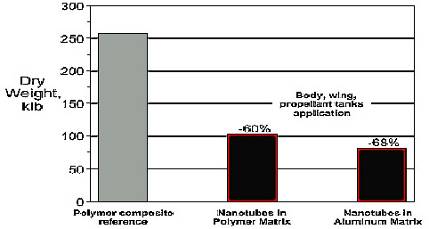
Fig 1. Nanotube-Reinforced Polymer (CNTFRP) and Nanotube-Reinforced Aluminum (CNT/Al) Composites compared to an advanced carbon fiber reinforced polymer (IM7 CFRP) composite.
II. Выберите правильный вариант ответа на вопросы к тексту.
What is one of the key properties required of the aircraft components?a)speed limit;
b) fatigue strength;
c) water resistance.
What is the average increase of the fatigue life, which nano-materials provide by reduction in the grain size over conventional materials?
a) 110-120% ; b) 20-30%; c) 200-300%. | b) 25 – 30 |
3. What material is the most important material in nanotechnology today?
a) nanowires ;
b) nanotubes;
c) nanoparticles.
III. Закончите предложения по содержанию прочитанного текста.
posite materials with improved fatigue life, damping properties and higher damage tolerance properties due to... inclusions, is vastly investigated in the last years.
a) carbon-nanotubes;
b) classical nucleation theory;
c) celestial navigation trainer.
5. Drivers for the aerospace industry for exploiting new technologies include also: ...
... increased safety and reduced emissions; ... reduced safety and increased emissions; … increased safety and increased emissions.
6. CNT have a ... tensile strength
a) … remarkable... ;
b) … poor …;
c) …low ….
IV. Подберите эквивалент к данному русскому слову или словосочетанию.
7 . стараться
a) intend | b) strive | c) describe |
8. гранула, текстура
a)light | b) grain | c) side |
9. защита от неуправляемых a) ballistic protection | поражающих средств b) aircraft platforms performance | c) damping properties |
10. топливо
a) coal | b) pace | c) fuel |
11. керамика
a) glass | b) ceramics | c) cereal |
12. волокно
a) fibre | b) cell | c) marble |
13. выброс, отдача, выхлоп
a) capacity | b) mobilitу | c) emission |
V. Выберите соответствующее определение данным словам из текста.
| complex mixture; b) buzz ; c) cover ; d) expand ; e) strengthen ; f) lessen ; g) hard ; h)deterioration. |
14. reduce
15. increase
16. noise
17. tough
18. damage
posite
20. coating
21. reinforce
VI. Прочитайте предложения и укажите соответствует ли данное утверждение действительности: если соответствует напишите после предложения T - true, если не соответствует то F-false, при этом письменно подтвердите ваш ответ примером из текста.
22. A lot of effort is also invested in developing functionalized-carbon-nanotubes.
23. High performance nano-composite materials are combination of polymers, metals and ceramics.
24. Nanotube-based material is anticipated to become 50–100 times stronger than steel at one-tenth of the weight.
VII. Выберите правильную видовременную форму глагола.
25. Due to the risks involved in flying, aircraft manufacturers to make the aerospace components stronger, tougher, and last longer
a) strive | b) strives | c) strived |
26. The life of the aircraft due to making its components out of stronger materials.
a) had increased | b) is increased | c) have increased |
27. Composite materials in the last years.
a) investigated | b) is investigated | c) are investigated |
28. High performance nano-composite materials can for tribological coatings of aircraft platforms operated at higher temperatures.
a) be used | b) is used | c) will use |
ch development would the improvements that carbon fibres brought to composites.
a) dwarfing | b) be dwarf | c) dwarf |
30. The picture shows the possibility of reducing the weight of aircraft components _______
composite materials reinforced with carbon-nanotubes.
a) are using b) will be using c) using
VIII. Переведите текст письменно:
For many years, aircraft designers could propose theoretical designs that they could not build because the materials needed to construct them did not exist. The term "unobtainium" (анабтаниум, несуществующий гипотетически воображаемый материал) is sometimes used to identify materials that are desired but not yet available.) For instance, large spaceplanes like the Space Shuttle would have proven extremely difficult, if not impossible, to build without heat-resistant ceramic tiles to protect them during re-entry. And high-speed forward-swept-wing airplanes like Grumman's experimental X-29 or the Russian Sukhoi S-27 Berkut would not have been possible without the development of composite materials to keep their wings from bending out of shape.
Composites are the most important materials to be adapted for aviation since the use of aluminium in the posites are materials that are combinations of two or more organic or inorganic components. One material serves as a "matrix," which is the material that holds everything together, while the other material serves as a reinforcement, in the form of fibres embedded in the matrix. Until recently, the most common matrix materials were "thermosetting" materials such as epoxy, bismaleimide, or polyimide. The reinforcing materials can be glass fibre, boron fibre, carbon fibre, or other more exotic mixtures.
