


Партнерка на США и Канаду по недвижимости, выплаты в крипто
- 30% recurring commission
- Выплаты в USDT
- Вывод каждую неделю
- Комиссия до 5 лет за каждого referral
UNITED NATIONS DEVELOPMENT PROGRAMME
Uzbekistan
Budget System Reform in Uzbekistan Project Evaluation
Report
Arkadi Toritsyn, Ph. D.
December 2015
Acknowledgements
The evaluator gratefully acknowledges the support of many people, without whom the evaluation would not have been possible. The evaluator would like to express his sincere gratitude to Mr. Farid Garakhanov, UNDP Deputy Resident Representative in Uzbekistan, for his strategic guidance. Special thanks are due to Sherzod Akbarov, Program Head of Economic Governance Unit and Zarif Jumaev, Economic Governance Unit Program Coordinator, UNDP Uzbekistan, for their extensive support, sharing all the required documentation and promptly responding to evaluator’s questions.
The consultant is grateful to Fayzulla Salakhuddinov, Project Manager, for providing contextual information and addressing numerous consultant’s information requests. The evaluator conducted a number of in-depth meetings with Victoria Anoshkina and Sandjar Babaev exploring the Project’s achievements, lessons learned and potential areas of future UNDP support and greatly appreciates their important contributions to the evaluation process. Saidbek Djurabekov’s administrative assistance is greatly appreciated.
The consultant is thankful to Mr. Bakhrom Ashrafkhanov, Deputy Minister of Finance, Head of the Treasury, National Project Coordinator for sharing his views on the Project’s role and impact and discussing potential areas of UNDP support of public finance management reforms in Uzbekistan. His strong commitment to Project’s objectives was instrumental to its success.
The evaluator hopes that this evaluation and its recommendations will further strengthen UNDP contribution to advancing public finance management reforms in Uzbekistan.
The views expressed here do not necessarily reflect those of the UNDP Uzbekistan. The consultant remains solely responsible for any errors that may remain in this report.
Table of Contents
1. BACKGROUND 5
1.1 Country and Project context 5
1.2 Purpose of the Project Evaluation 7
2. EVALUATION APPROACH AND METHODOLOGY 8
3. EVALUATION FINDINGS 12
3.1 General findings 12
3.2 Component 1: Improved budget legislation, policies and practices 14
3.3 Component 2: Improved public procurement legislation, policies and practices 17
3.4 Component 3: Strengthened capacities of MoF management and staff 20
4. CONCLUSIONS 21
4.1 Lessons Learned 21
4.2 Key limitations 23
5. RECOMMENDATIONS 23
5.1 Recommendations for the MoF and UNDP 24
5.2 Recommendations to UNDP 29
6. ANNEXES 31
6.1 Questionnaire for semi-structured interviewees 31
6.2 A list of documents reviewed by the consultant 34
6.3 Mission Program 41
6.4 Terms of References 43
ABBREVIATIONS AND ACRONYMS | |
ADB | Asian Development Bank |
Adetef | Assistance au Dйveloppement des Йchanges en Technologies Йconomiques et Financiиres |
CIS | Commonwealth of Independent States |
CO | Country Office |
GDP | Gross Domestic Product |
ICT | Information Technology |
IPSAS | International Public Sector Accounting Standards Board |
HDI | Human Development Index |
MDGs | Millennium Development Goals |
M&E | Monitoring and Evaluation |
MoF | Ministry of Finance |
NGO | Non-Government Organization |
NPSAS | National Public Sector Accounting Standards |
PBB | Performance-Based Budgeting |
PFM | Public Finance Management |
PR | Public Relations |
TOT | Train the Trainer |
TOR | Terms of Reference |
RBM | Results Based Management |
UNCITRAL | United Nations Commission on International Trade Law |
UNCT | United Nations Country Team |
UNDAF | UN Development Assistance Framework |
UNDP | United Nations Development Programme |
WB | World Bank |
1. BACKGROUND
1.1 Country and Project context
Since the mid-2000s, Uzbekistan has enjoyed robust GDP growth, due to favourable trade terms for its key export commodities like copper, gold, natural gas, cotton, the government’s macro-economic management, and limited exposure to international financial markets that protected it from the economic downturn.1 From 2005 to 2014, for example, annual growth rates in industrial
output ranged from 6.6 to 12.7 percent, with those in agriculture reaching from 4.5 to 7 percent.2
Uzbekistan demonstrated significant achievements in the area of human development over the last eight years that can be attributed mostly to its economic growth. Uzbekistan’s human development index (HDI) which is a summary measure for assessing long-term progress in three basic dimensions of human development: a long and healthy life, access to knowledge and a decent standard of living was 0.675 in 2014 — which put the country in the medium human development
category—positioning it at 114 out of 188 countries and territories. Between 2000 and 2014, Uzbekistan’s HDI value increased from 0.594 to 0.675, an increase of 13.7 percent or an average annual increase of about 0.92 percent.3
Implementation of prudent economic policies by the Government of Uzbekistan over the last several years has significantly contributed to the achievement of financial and macroeconomic stability in the country. Within the reform program that is currently under implementation, the Government of the Republic of Uzbekistan has set itself all-encompassing goals for the achievement of structural and institutional changes that require significant financial resources, on the one hand, and efficient system of distribution and use, on the other. Efficient and transparent management of the budget system becomes an important tool to address these problems in this context.
A number of transformations in the Public Finance Management (PFM) in Uzbekistan have been implemented within the course of liberalization policy and intensification of economic reforms. Key public finance reform focus areas, targets and sequencing have been set forth in the Public Finance Management Strategy for the period 2007- 2018, developed by the Ministry of Finance of the Republic of Uzbekistan jointly with IMF’s Fiscal Policy Department. Major changes were associated with a phased transition to the treasury-based budget execution, improving the regulatory framework of budget preparation and increasing the effectiveness of control over budget expenditures.
Since 2007 UNDP has been supporting the Government of the Republic of Uzbekistan in promotion of PFM reforms with ultimate goal of improving the welfare of the population. The current joint initiative of UNDP and the Ministry of Finance “Budget System Reform (BSR) in Uzbekistan” Project which is under implementation since July 2010 had an objective to support and enhance capacity of the Government in managing the budget system with particular focus on achieving greater effectiveness, accountability, and transparency of the budget process and capacity building of the MoF management and staff. BSR Project’s work is aligned with the objectives of MoF Public Finance Management Strategy for the period 2007-2018.
During Phase I (2010-2013) the Project had five Components:
Legislative framework is developed to facilitate the reforms on introduction of medium-term budget planning and Performance based budgeting (PBB) Piloting of PBB is expanded, methodology for its full-scale implementation and transition to medium-term budget planning developed Legislative, normative and regulatory framework is enhanced to improve the efficiency and transparency of public procurement Methodology for inter-budgetary adjustment of revenues and expenditures is developed. Capacity of civil servants involved in budget reform is enhanced, and training capacity of the Training Center under the MoF strengthenedDuring the Phase II the Project continued with Components 1, 3 and 5.
A simplified Project’s theory of change is presented below:
Figure 1: The BSR Project Theory of Change
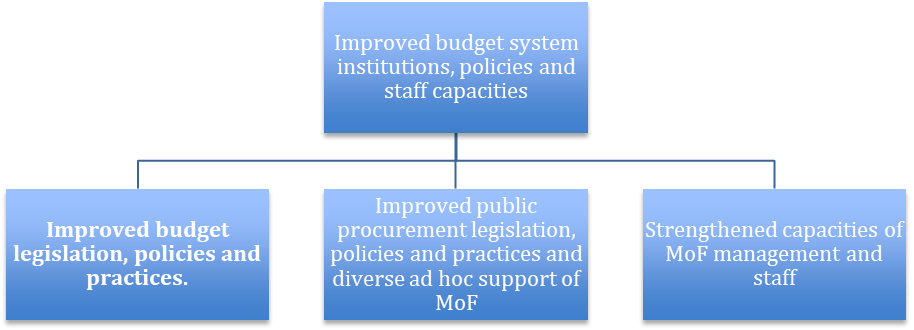
To achieve a first objective “improved budget legislation, policies, and practices”, the Project was planning to develop a Concept note and Draft Budget Code and widely discuss it. Given complexity of the Code, the Project document included the Code practical approbation for 2 years followed by additional rounds of discussions, consolidation and finalization. To support the Budget Code implementation, an extensive awareness and training campaign involving members of the Parliament, civil servants and civil society representatives was designed.

|
Из за большого объема этот материал размещен на нескольких страницах:
1 2 3 4 5 6 7 8 9 10 11 12 |
