


Партнерка на США и Канаду по недвижимости, выплаты в крипто
- 30% recurring commission
- Выплаты в USDT
- Вывод каждую неделю
- Комиссия до 5 лет за каждого referral
Unit Ten
Text: Using Computer
Dialogue
Предтекстовые упражнения
The exercises to be done before reading the text
Упражнение 1. Прочтите слова и словосочетания и запомните их русские эквиваленты.
invent — изобретать
a breaker point ignition — прерывистое зажигание
advanced — усовершенствованный
fire the spark plug – воспламенять свечой зажигания
meet emission control levels — отвечать требованиям по ограничению уровня вредных компонентов в выхлопных газах gas mileage - пробег в милях на галлон топлива
smooth operation — плавная работа
provide – обеспечить
onboard computer system – бортовой компьютер
hardware - аппаратная часть компьютера
software - программное обеспечение
CPU — Central Processing Unit - центральный процессор
integrated circuit — интегральная схема
semiconductor — полупроводник
silicon — кремний
until - пока не
specific sequence — специальная последовательность
permanent memory — постоянная память
ROM — read only memory — постоянная память, постоянное запоминающее устройство, ПЗУ
RAM - random access memory - оперативная память, оперативное запоминающее устройство, ОЗУ
PROM — programmable read only memory - программируемое постоянное запоминающее устройство, ППЗУ
trouble code — неисправный код
expensive — дорогостоящий
adaptive memory — адаптивная память
Упражнение 2. Прочтите слова и сопоставьте их с русскими значениями.
transform, battery, voltage, regulation, system, computer, microprocessor, transistor, diod, chip, material, electricity, magnetic, program, defective, limit, compensate, variation, code.
Упражнение 3*. Переведите слова, обращая внимание на суффиксы и префиксы.
ignite — ignition, transform — transformation, regulate — regula - tion, break — breaker, conduct — conductor, process — processor, specify - specific, adapt — adapter — adaptive, expense - expensive, adjust — adjustment, connect — disconnect, learn - relearn.
Прочтите и переведите текст, а затем выполните следующие за ним упражнения.
TEXT
Using Computer
Ever since the car was first invented, a breaker point ignition has been used to transform battery voltage into 20,000 volts to fire the spark plugs. With government intervention and regulation, more advanced system was needed. This system had to meet emission control levels, gas mileage, and provide a smooth and continuous operation. The answer was found in an on-board computer system. The computer mounted on modern cars has two components. One is the hardware and the other is the software.
The computer hardware on an automobile uses a Central Processing Unit (CPU), which, when made in an integrated circuit, is referred I о as a microprocessor. The integrated circuit (IС) combines transistors, diodes, and capacitors, which are placed on a tiny chip of semiconductor material that is smaller and thinner that an eraser on a pencil. The material used most of the time is silicon. Silicon, like any semiconductor, does not conduct electricity until either voltage, a magnetic field, heat, or light is directed to the semiconductor. A program instructs the microprocessor what to do.
The computer software on a car carries a program. The program (ells the computer what to do, and when to do it in a specific sequence. The program is stored in a permanent memory, which is referred to as Read Only Memory (ROM).The computer knows only what is placed in its memory.
There is another variation, which is called the Programmable Read Only Memory (PROM), which can be readily removed und replaced, while the ROM cannot. This makes it less expensive if the memory becomes defective. Only the PROM has to be replaced, not the entire microprocessor. The microprocessor contains a ROM (or PROM) and a RAM. RAM stands for Randon Access Memory, which can be accessed without going through a specific sequence. The technician interfaces with the RAM whenever trouble codes are accessed. Not all computerized ignition systems have trouble codes, however. Some computers have the ability to learn. This is referred to as an adaptive memory. When a value falls outside of a specified limit, due to engine wear, the adaptive memory makes a slight adjustment in the program to compensate. The car must be driven from 20 to 30 miles, as it takes the computer this long to learn. Any time that power is disconnected from the computer, it will have to relearn everything.
Послетекстовые упражнения
The exercises to be done after reading the text
Упражнение 4. Найдите в тексте ответы на вопросы.
1.How many components has the computer on modern cars? What are they?
2.How do we call the computer hardware on the automobile?
3.What does an integrated circuit combine?
4.What material is used in the integrated circuit? Why?
5.What does the computer software do?
6.Why is the computer used on board the car?
7.What does the program tell to the computer?
8.Where is the program stored?
9.What is ROM?
10.What is PROM?
11.What is RAM?
Упражнение 5. Переведите на английский язык.
1.Многие современные автомобили оборудованы бортовыми компьютерными системами для лучшей работы автомобиля.
2.Программа такого компьютера имеет только два запоминающих устройства: постоянную память (ПЗУ) и оперативную память (ОЗУ).
3.Компьютерная программа сообщает компьютеру, что надо делать и когда необходимо выполнить данное действие в соответствующей последовательности.
4.Программа хранится в постоянной памяти компьютера.
5.Микропроцессор содержит в себе постоянную и оперативную память.
6. Некоторые компьютеры обладают способностью запоминать (заучивать). Это относится к адаптивной памяти.
Упражнение 6. Прочтите диалог, а затем выполните следующие за ним упражнения.
DIALOGUE
Anton: What is the purpose of using computers on board the car?
Vlad: You see. As I know computer is used to advance the engine operation as well as the performance of other units.
A.: What components does the on-board computer consist of?
V.: It consists of two components. One is the hardware and the other is the software.
A.: What is hardware?
V.: The computer hardware uses a Central Processing Unit (CPU) which is referred to as a microprocessor.
A.: What is software?
V.: The computer software on a car carries a program. The program tells the computer what to do and when to do it.
A.: And where is the program stored?
V.: It is stored in a permanent memory which is called Read Only Memory (ROM).
A.: And what is Programmable Read Only Memory (PROM)? What is the difference between ROM and PROM?
V.: In case the memory becomes defective PROM can be readily removed and replaced, while ROM cannot.
A.: And what is RAM?
V.: RAM is Random Access Memory (main memory), which can be accessed without going through a specific sequence. The technician interfaces with RAM whenever trouble codes are accessed.
A.: Thanks a lot for your explanation.
V.: You are welcome. See you later.
A.: Goodbye.
Упражнение7.. Запишите на аудиокассету реплики Антона и повторяйте в паузах реплики Влада.
Упражнение 8. Запишите на аудиокассету реплики Влада и повторяйте в паузах реплики Антона.
Упражнение 9. Разыграйте диалог в паре.
СЛОВАРЬ УРОКА
access — 1. поступать 2. доступ
adaptive memory - адаптивная память
adjustment - регулировка
breaker - прерыватель
breaker point ignition — прерывистое зажигание
capacitor — конденсатор
carry a program — выполнять программу
defective — дефектный, неисправный
due to — из-за, благодаря
engine wear — износ двигателя
eraser — ластик
expensive — дорогостоящий
fall — падать
fire the spark plug – воспламенять свечой зажигания
gas mileage — пробег в милях на галлон топлива
hardware — программная часть компьютера
heat — тепло
however — однако
ignition – зажигание
integrated circuit – интегральная схема
invent — изобретать
light — свет (фары)
meet emission control levels — отвечать требованиям по ограничению уровня вредных компонентов в выхлопных газах
on-board computer system – бортовой компьютер
permanent memory — постоянная память
PROM - Programmable Read Only Memory - программируемое постоянное запоминающее устройство, ППЗУ
RAM — Random Access Memory — оперативная память, оперативное запоминающее устройство, ОЗУ
ROM - Read Only Memory - постоянная память, постоянное запоминающее устройство, ПЗУ
semiconductor — полупроводник
Sentral Processing Unit (SPU) - центральный процессорный узел
silicon — кремний
since — с тех пор
spark plugs — запальные свечи
specific sequence - определенная последовательность действий
the ability to learn — способность запоминать (заучивать)
tiny chip — маленький чип
trouble codes — коды, сообщающие о неисправности
PART II
Упражнения для развития навыков устной речи
Упражнение 1. Найдите на рис. 5 местоположение перечисленных ниже г нов и запишите их в тетрадь под обозначенным номером. Затем выпишите английские названия этих узлов.
Двигатель, сцепление, коробка передач, карданный вал, задний мост, главная передача, дифференциал, рессоры, колеса, система рулевого управления, тормоза.
Engine, clutch, gearbox, propeller shaft, rear axle, final drive, differential, springs, wheels, steering system, brakes.
Упражнение 2. Прочтите диалог, а затем разыграйте его, используя рис. 5 в качестве опоры.
Teacher: Can you tell me English equivalents to: двигатель, сцепление, коробка передач, тормоза и ручное управление?
Student: Yes, I can. They are the engine, clutch, gearbox, brakes and steering system.
Т.: Do you know what main units the automobile consists of?
S.: Yes, I do. They are the chassis, the body and the engine.
T.: What is the source of power?
S.: The engine is. It makes the car wheels rotate and the car move.
Т.: What unit of the car carries the power to the wheels?
S.: The transmission does.
T.: What mechanisms does the transmission consist of?
S.: It consists of the clutch, gearbox, propeller shaft, rear axle, final drive and differential. It also includes brakes and steering system.
Т.: And what is the clutch used for?
S.: It is used for disengaging the engine from the car wheels.
Т.: What is the function of the brakes?
S.: They are necessary to slow or stop the car.
Т.: And what about the steering system?
S.: It is used to turn the car in the direction the driver wants to go.
T.: That is right. You know the subject very well.
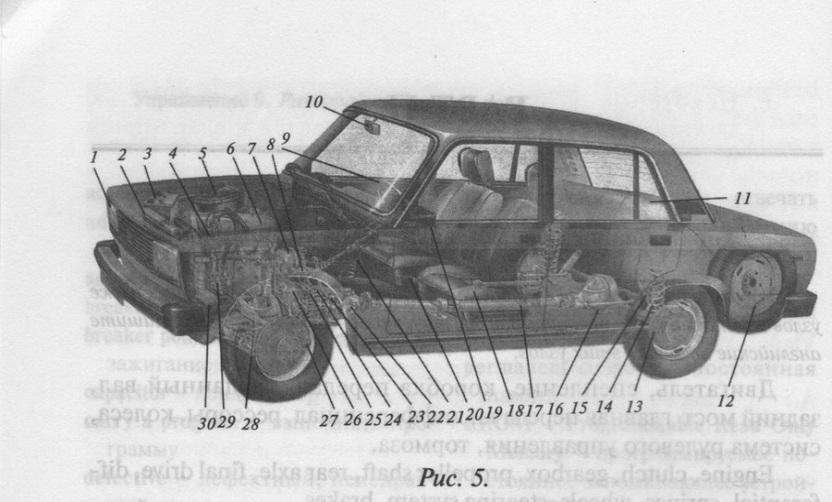
1. фара, сблокированная с указателем поворота;
2. радиатор системы охлаждения;
4. распределитель зажигания;
5. воздушный фильтр;
6. двигатель;
7. вакуумный усилитель с главным цилиндром гидропривода тормозов;
8. главный цилиндр гидропривода выключения сцепления;
9. рулевое колесо;
10. внутреннее зеркало заднего вида;
11. заднее сиденье;
12. запасное колесо;
13. задний тормоз;
14. пружина задней подвески;
15. амортизатор задней подвески;
16. задний мост;
17. карданная передача;
18. переднее сиденье;
19. наружное зеркало заднего вида;
20. рычаг стояночного тормоза;
21. рычаг переключения передач;
22. коробка передач;
23. педаль гидропривода сцепления;
24. педаль гидропривода тормозов;
25. педаль акселератора;
26. рулевой механизм;
27. передний тормоз;
28. пружина передней подвески с амортизатором;
29. топливный насос;
30. масляный фильтр.
1. cornering lamp; 2. cooling system radiator; 3. accumulator battery;
4. ignition distributor; 5. air filter; 6. engine; 7. vacuum-power with master cylinder of hydraulic drive brakes; 8. master cylinder of hydraulic drive of clutch disengagement; 9. steering wheel; 10. inside (interior) mirror; 11. back seat;
12. spare wheel; 13. rear wheel brakes; 14. rear suspension spring;
15. rear suspension shock absorber; 16. rear axle; 17. cardan shaft;
18. front seat; 19. outside mirror; 20. parking brake lever; 21.gear change lever;
22. gearbox; 23. clutch pedal; 24. brake pedal; 25. accelerator pedal;
26. steering mechanism; 27. front wheel brake; 28. front suspension spring with shock absorber; 29. fuel pump; 30. oil filter.
Упражнение 3. Глядя на рис. 5 и используя подрисуночные подписи, выпишите названия агрегатов, узлов и механизмов автомобиля на русском и английском языках.
Упражнение 4. Закончите предложения, используя слова и словосочетания, данные ниже.
1.The automobile is made up of....
2.The engine is....
3.The chassis consists of....
4.The transmission carries the power from....
5.The transmission consists of....
6.The body has...
a. engine, chassis, body.
b. hood, fenders and accessories.
c. the engine to the wheels.
d. clutch, gearbox, propeller shaft, rear axle, final drive and differential.
e. the source of power.
f. transmission and running gear (frame, wheeels and springs).
Упражнение 5. Прочтите текст, а затем, глядя на рис. 5, ответьте на ттросы, приведенные ниже.
The automobile is made up of three basic parts: the engine, the body and the chassis. The engine is the source of power and makes the car move.
The chassis consists of the transmission and running gear (frame, springs and wheels). The transmission carries the power from the engine to the wheels. It consists of the clutch, gearbox, propeller shaft, rear axle, final drive and differential. The transmission also includes the steering system and brakes.
The body has the hood, fenders, the heater and so on.
1.What main components is the automobile made up of?
2.What is the source of power?
3.What units does the chassis include?
4.What duty is performed by the frame?
5.What does the transmission do?
6.What mechanisms does the transmission consist of?
7.What is the function of the steering system?
8.Why are brakes necessary?
9.What is the function of the clutch?
10.What is the function of the gearbox?
11.What types of gearboxes do you know?
12.What is the function of a differential?
13.What purposes do brakes serve?
14.What parts has the body?
15.How is the car body attached to the frame?
Упражнение 6. Найдите в тексте эквиваленты следующих предложений.
1.Автомобиль состоит из трех основных частей: двигателя, шасси и кузова.
2.Двигатель — источник энергии.
3.Шасси состоит из трансмиссии и ходовой части.
4.Трансмиссия передает энергию от двигателя к колесам автомобиля.
5.Она состоит из сцепления, коробки передач, карданного вала, заднего моста, главной передачи и дифференциала.
6.Кузов имеет капот, крылья, отопитель и т. д.
