


Партнерка на США и Канаду по недвижимости, выплаты в крипто
- 30% recurring commission
- Выплаты в USDT
- Вывод каждую неделю
- Комиссия до 5 лет за каждого referral
Наличие в смеси дополнительного источника пероксидов – пероксида водорода, приводит к тому, что существенно ускоряются процесс ПОЛ в присутствии свободного железа, тогда как в присутствии комплекса этот процесс к 24 часу инкубации снижается до контрольной отметки.
Таблица 5. Концентрация МДА (% от контроля) образующегося при инкубации раствора лецитина в различных условиях в присутствии дигидрокверцетина, сульфата железа (II) и комплекса ДГК-Fe2+
Инкубация раствора липида при 37оС и pH 8 в присутствии ингибитора/катализатора ПОЛ | ||||||
Время инкубации | 1 час инкубации | 24 часа инкубации | ||||
Концентрация ингибитора/ катализатора ПОЛ | Fe2+ | ДГК-Fe2+ | ДГК | Fe2+ | ДГК-Fe2+ | ДГК |
5мМ | 104±13 | 124±12 | 72±9 | 124±16 | 91±8 | 86±8 |
10мМ | 110±17 | 105±14 | 116±13 | 205±17 | 120±15 | 80±5 |
Инкубация раствора липида при 37оС и pH 4 в присутствии ингибитора/катализатора ПОЛ | ||||||
5мМ | 117±14 | 106±12 | 40±4 | 519±37 | 241±18 | 49±4 |
10мМ | 120±14 | 82±8 | 12±2 | 745±54 | 329±24 | 50±4 |
Инкубация раствора липида при 37оС и pH 8 в присутствии ингибитора/катализатора ПОЛ и 10 мМ пероксида водорода | ||||||
5мМ | 1098±140 | 339±27 | 662±33 | 1309±152 | 107±11 | 68±7 |
10мМ | 1109±78 | 450±54 | 169±15 | 515±42 | 124±9 | 79±8 |
Инкубация раствора липида при 37оС и pH 4 в присутствии ингибитора/катализатора ПОЛ и 10 мМ пероксида водорода | ||||||
5мМ | 521±37 | 424±70 | 147±12 | 454±36 | 338±31 | 34±2 |
10мМ | 850±55 | 478±49 | 117±11 | 445±48 | 472±45 | 30±2 |
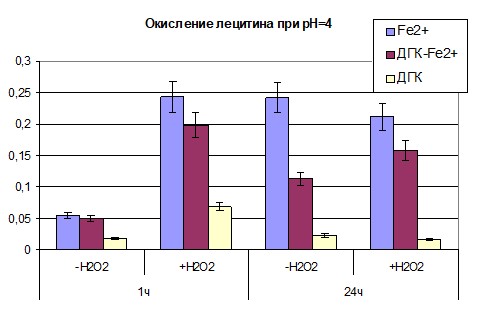
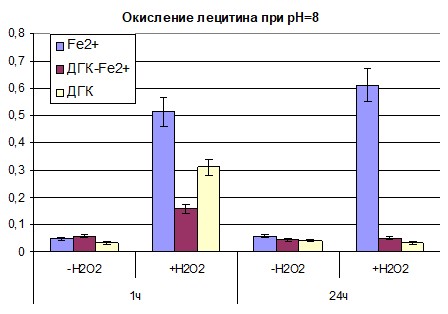
а b
Рис. 18 Окисление лецитина в различных условиях (а. значение рН 4; b. значение рН 8)
Эффективность ДГК в присутствии неорганического пероксида сохраняется и к 24 часу инкубации смеси активность ДГК даже превосходит аналогичный эффект в отсутствии пероксидов. Тем не менее, при pH 8 (рис 18b), к 1-му часу инкубации смеси, в присутствии 5 мМ ДГК, концентрация МДА соответствует эффекту 5 мМ Fe (II) при pH 4 (рис 18a), что говорит о наличии явного прооксидантного эффекта.
Таким образом, наличие прооксидантной активности ДГК можно ожидать в условиях высоких значений pH, а так же в присутствии металлов переменной валентности, но уже в кислых растворах.
ВЫВОДЫ
1. Исследованы антиоксидантные свойства дигидрокверцетина на модельных биохимических и клеточных системах. Показано, что дигидрокверцетин проявляет антиоксидантную активность в концентрационном диапазоне (C50%) от 3,3х10-5М до 2,0х10-7М.
2. Впервые показана прооксидантная активность комплекса ДГК-Fe(III) на модельных биохимической и клеточной системах и определены оптимальные концентрационные границы проявления данного эффекта.
3. На модели перекисного окисления липида (лецитина) обнаружено наличие прооксидантного эффекта у дигидрокверцетина и его комплекса ДГК/железо(II). Впервые показано, что оптимальными условиями проявления дигидрокверцетином антиоксидантных свойств являются низкие значения pH среды, тогда как для комплекса необходимо наличие нейтральных или щелочных значений pH.
4. Впервые обнаружено, что зависимость накопления малонового диальдегида в присутствии ДГК от времени имеет “седловидную” форму, что подтверждает наличие прооксидантного эффекта ДГК при определенных концентрациях и, по-видимому, наличие как минимум 2-х механизмов прооксиданого действия флавоноида в растворе.
ЛИТЕРАТУРА
Afanas'ev I. B., Ostrachovich E. A., Korkina L. G. Effect of rutin and its copper complex on superoxide formation and lipid peroxidation in rat liver microsomes // FEBS Lett. 1998. V. 425. № 2. P. 256–8. Akiyama T., Ishida J., Nakagawa S., Ogawara H., Watanabe S., Itoh N., Shibuya M., Fukami Y. Genistein, a specific inhibitor of tyrosine specific protein kinases // J. Biol. Chem. 1987. V. 262. V. 5592–5. Areias F. M., Rego A. C., Oliveira C. R., Seabra R. M. Antioxidant effect of flavonoids after ascor-bate/Fe2+-induced oxidative stress in cultured retinal cells // Biochem. Pharmacol,- 2001,- Vol. 62.-P. 111-118. Arora A., Byrem T. M., Nair M. G., Strasburg G. M. Modulation of liposomal membrane fluidity by flavonoids and isoflavonoids // Arch. Biochem. Biophys.- 2000.- Vol. 373.- P. 102-109. Arora A., Nair M. G., Strasburg G. M. Structure-activity relationships for antioxidant activities of a series of flavonoids in a liposomal system // Free Radic. Biol. Med.- 1998.- Vol. 24,- P. 1355— 1363. Aucamp J., Gaspar A., Hara Y., Apostolides Z. Inhibition of xanthine oxidase by catechins from tea (Camellia sinensis) // Anticancer Res.- 1997.- Vol. 17.- P. 4381-4385. Barinaga M. Forging a path to cell death // Science. 1996. V. 273. P. 735–7. Bertorello A. M., Aperia A., Walaas S. I., Nairn A. C., Greengard P. Phosphorylation of the catalytic subunit of Na+/K+-ATPase inhibits the activity of the enzyme // Proc. Natl. Acad. Sci. USA 1991. V. 88. P. 11359–62. Beyer G., Melzig M. F. Effects of selected flavonoids and caffeic acid derivatives on hypoxanthine-xanthine oxidase-induced toxicity in cultivated human cells // Planta Med.- 2003- Vol. 69- P. 1125-1129. Bors W., Heller W., Michel C, Saran M. Flavonoids as antioxidants: determination of radical-scavenging efficiencies // Methods Enzymol.- 1990.- Vol. 186,- P. 343-355. Bors W., Michel С Antioxidant capacity of flavanols and gallate esters: Pulse radiolysis studies // Free Radic. Biol. Med.- 1999.- Vol. 27.- P. 1413-1426. Brown J. E., Khodr H., Hider R. C., Rice-Evans C. A. Structural dependence of flavonoid interactions with Cu2+ ions: implications for their antioxidant properties // Biochem. J.- 1998.- Vol. 330.-P. 1173-1178. Cao G., Sofic E., Prior R. L. Antioxidant and prooxidant behavior of flavonoids: structure-activity relationships // Free Radic. Biol. Med.- 1997.- Vol. 22.- P. 749-760. Chedeville O., Tosun-Bayraktar A., Porte C. Modeling of fenton reaction for the oxidation of phenol in water // J. Autom. Methods Manag. Chem. 2005. V. 2005. P. 31–6. Chen Z. Y., Chan P. T., Ho K. Y. et al. The antioxidant activity of natural flavonoids in governed by number and location of their aromatic hydroxyl groups // Chem. Phys. Lipids - 1996.- Vol. 79.- P. 157-163. Cheng I. F., Breen K. On the ability of four flavonoids, baicalein, luteolin, naringenin, and quercetin, to suppress the Fenton reaction of the iron-ATP complex // BioMetals.- 2000.- Vol. 13.-P. 77-83. Choi J. S., Chung H. Y., Kang S. S. et al. The structure-activity relationship of flavonoids as scavengers of peroxynitrite // Phytother. Res,- 2002.- Vol. 16.- P. 232-235. Cortell J. M., Halbleib M., Gallagher A. V., Righetti T. L., Kennedy J. A. Influence of vine vigor on grape (Vitis vinifera L. Cv. Pinot Noir) and wine proanthocyanidins // J. Agric. Food. Chem. 2005. V. 53. № 14. P. 5798–808. Cotelle N., Bernier J. L., Catteau J. P. et al. Antioxidant properties of hydroxy-flavones // Free Radic. Biol. Med.- 1996.- Vol. 20.- P. 35-43. 425. Davies S. P., Reddy H., Caivano M., Cohen P. Specificity and mechanism of action of some commonly used protein kinase inhibitors // Biochem. J.- Vol. 351.- P. 95-105. Decker E. A. Phenolics: prooxidants or antioxidants? // Nutr. Rev.- 1997- Vol. 55.- P. 396-407. Deng W., Fang X., Wu J. Flavonoids function as antioxidants: by scavenging reactive oxygen species or by chelating iron? // Radiat. Phys. Chem. 1997.- Vol. 50.- P. 271-276. Fang N., Casida J. E. Anticancer action of cube insecticide: correlation for rotenoid constituents between inhibition of NADH:ubiquinone oxidoreductase and induced ornithine decarboxylase activities // Proc. Natl. Acad. Sci. USA. 1998. V. 95. P. 3380–3384. Ferguson P. J., Kurowska E. M., Freeman D. J., Chambers A. F., Koropatnick J. In vivo inhibition of growth of human tumor lines by flavonoid fractions from cranberry extract // Nutr. Cancer. 2006. V. 56. № 1. P. 86–94. Ferriola P. C., Cody V., Middleton E. Protein kinase C inhibition by plant flavonoids. Kinetic mechanisms and structure-activity relationships // Biochem. Pharmacol. 1989. V. 38. P. 1617–24. Gansauge S., Gansauge F., Gause H., Poch B., Schoenberg M. H., Berger H. G. Induction of apoptosis in proliferating, human fibroblasts by oxygen radicals is associated with a p53 and p21waf [CIC] induction // FEBS Lett. 1997. V. 404. 6–10. Gao Z., Huang K., Xu H. Protective effects of flavonoids in the roots of Scutellaria baicalensis Georgi agaist hydrogen peroxide-induced oxidative stress in HS-SYSY cells // Pharmacol. Res.-2001.- Vol. 43.- P. 173-178. Gerritsen, M. E. Flavonoids: inhibitors of cytokine induced gene expression // Adv. Exp. Med. Biol. 1998. V. 439. P. 183–190. Grunberger D., Banerjee R., Eisunger K., Oltz E. M., Efros L., Caldwell M., Estevez V., Nakanishi K. Preferential cytotoxicity on tumor cells by caffeic acid phenylethyl ester isolated from propolis // Experientia. 1988. V. 44. P. 230–2. Habtemariam S. Flavonoids as inhibitors or enhancers of the cytotoxicity of tumor necrosis factor-alpha in L-929 tumor cells // J. Nat. Prod. 1997. V. 60. P.775–8. Harbome J. B., Williams C. A. Advances in flavonoid research since 1992 // Phytochemistry.-2000.- Vol. 55.- P. 481-504. Havsteen B. Flavonoids, a class of natural products of high pharmacological potency // Biochem. Pharmacol. 1983. V. 32. № 7. P. 1141–8. Hockenbery D. M., Oltvai Z. N., Yin X.-M., Milliman C. L., Korsmeyer S. J. Bcl 2 functions in an antioxidant pathway to prevent apoptosis // Cell. 1993. V. 75. P. 241–51. Hodnick W. F., Kung F. S., Roettger W. J. et al. Inhibition of mitochondrial respiration and production of toxic oxygen radicals by flavonoids. A structure-activity study // Biochem Pharmacol.-1986.- Vol. 35.- P. 2345-2357. Horisberger J.-D., Jannin P., Reuben M. A., Lasater L. S., Chow D. C., Forte J. G., Sachs G., Rossier B. C., Geering K. The H+-ATPase b-subunit can act as a surrogate for the b-subunit of Na+/K+-pumps // J. Biol. Chem. 1991. V. 266. P. 19131–4. Hosokawa N., Hirayoshi K., Kudo H., Takechi H., Aoike A., Kawai K., Nagata K. Inhibition of the activation of heat shock factor in vivo and in vitro by flavonoids // Mol. Cell Biol. 1992. V. 12. P. 3490–98. Hume D. A., Weidemann M. J., Ferber E. Preferential inhibition by quercetin of mitogen-stimulated thymocyte glucose transport // Natl. Cancer Inst. 1979. V. 62. P. 1243–6. Jager W., Zembsch B., Wolschann P., Pittenauer E., Senderowicz A. M., Sausville E. A., Sedlacek H. H., Graf J., Thalhammer T. Metabolism of the anticancer drug flavopiridol, a new inhibitor of cyclin dependent kinases, in rat liver // Life Sci. 1998. V. 62. P.1861–73. Janoutova J., Buckiova D., Jelinek R. Interaction between quercetin and heat shock. A preliminary study on the chick embryo. // Folia Biol. Prague 1996. V. 42. P. 231–4. Jung H. A., Jung M. J., Kim J. Y. et al. Inhibitory activity of flavonoids from Prunus davidiana and other flavonoids on total ROS and hydroxyl radical generation // Arch. Pharm. Res.- 2003- Vol. 26.-P. 809-815. Kandaswami C., Perkins E., Solonink D. S., Drzewiecki G., Middleton E. Antiproliferative effects of citrus flavonoids on a human squamous cell carcinoma in vitro // Cancer Lett. V. 56. P. 147–152. Kaneko Т., Matsuo M., Baba N. Inhibition of linoleic acid hydroperoxide-induced toxicity in cultured human umbilical vein endothelial cells by catechins // Chem. Biol. Intern.- 1998.- Vol. 114.-P. 109-119. Kim D. O., Lee C. prehensive study on vitamin С equivalent antioxidant capacity (VCEAC) of various polyphenolics in scavenging a free radical and its structural relationship // Crit. Rev. Food Sci. Nutr.- 2004.- Vol. 44.- P. 253-273. Knight J. A., Pieper R. K., McClellan L. Specificity of the thiobarbituric acid reaction: its use in studies of lipid peroxidation // Clin. Chem. 1988. V. 34. № 12. P. 2433–8. Kostyuk V. A., Potapovich A. I., Kostyuk T. V., Cherian M. G. Metal complexes of dietary flavonoids: evaluation of radical scavenger properties and protective activity against oxidative stress in vivo // Cell. Mol. Biol. (Noisy-le-grand). 2007. V. 53. № 1. P. 62–9. Kosugi H., Kikugawa K. Reaction of thiobarbituric acid with saturated aldehydes // Lipids. 1986. V. 21. № 9. P. 537–42. Kudo M., Naito Z., Yokoyama M., Asano G. Effects of quercetin and sunphenon on responses of cancer cells to heat shock damage // Exp. Mol. Pathol. 1999. V. 66. P. 66–75. Kuriki Y., Racker E. Inhibition of (Na+, K+) adenosine triphosphatase and its partial reactions with quercetin // Biochem. J. 1976. V. 15. P. 4951–6. Laughton M. J., Evans P. J., Moroney M. A. et al. Inhibition of mammalian 5-lipoxygenase and cyclooxygenase by flavonoids and phenolic dietary additives. Relationship to antioxidant activity and to iron ion-reducing ability // Вiochem. Pharmacol.- 1991.-Vol. 42.-P. 1673-1681. Lien E. J., Ren S., Bui H. H., Wang R. Quantitative structure-activity relationship analysis of phenolic antioxidants // Free Radic. Biol. Med.- 1999.- Vol. 26.- P. 285-294. MacGregor J. T., Jurd L. Mutagenicity of plant flavonoids: structural requirements for mutagenic activity in S. typhimurium // Mutat. Res.- 1978.- Vol. 54.- P. 297-309. Markaverich B. M., Gregory R. R., Alejandro M. A., Kittrell F. S., Medina D., Clark J. H., Varma M., Varma R. S. Methyl p-hydroxyphenyllactate and nuclear type II binding sites in malignant cells: metabolic fate and mammary tumor growth // Cancer Res. 1990. V. 50. P. 1470–78. Metodiewa D., Jaiswal A. K, Cenas N. et al. Quercetin may act as a cytotoxic prooxidant after its metabolic activation to semiquinone and quinoidal product // Free Radic. Biol. Med.- 1999.- Vol. 26.-P. 107-116. Moskaug J. O., Carlsen H., Myhrstad M., Blomhoff R. Molecular imaging of the biological effects of quercetin and quercetin-rich foods // Mech. Ageing Dev.- 2004.- Vol. 125.- P. 315-324. Mutoh M., Takahashi M., Fukuda K. et ppression by flavonoids of cyclooxygenase-2 promoter-dependent transcriptional activity in colon cancer cells: structure-activity relationship // Jpn. J. Cancer Res.- 2000.- Vol. 91.- P. 686-691. Nijveldt R. J., van Nood E., van Hoorn D. E. et al. Flavonoids: a review of probable mechanisms of action and potential applications// Am. J. Clin. Nutr - 2001- Vol. 74- P. 418-425. Osada H., Magae J., Watanabe C., Isono K. Rapid screening method for inhibitors of protein kinase C // J. Antibiot. 1988. V. 41. P. 925–31. Piller, N. B. The induction of controlled proteolysis in high protein oedemas by coumarin // Z. Lymphol. 1979. V. 3. P. 110–3. Price B. D., Calderwood S. K. Ca2+ is essential for multistep activation of the heat shock factor in permeabilized cells // Mol. Cell Biol. 1991. V. 11. P. 3365–8. Rice-Evans C. A., Miller N. J., Paganga G. Antioxidant properties of phenolic compounds // Trends Plant Sci.- 1997.- Vol. 2.-P. 152-159. Robak J., Duniec Z., Rzadkowska-Bodalska H. et al. The effect of some flavonoids on non-enzymatic lipid oxidation and enzymatic oxidation of arachidonic acid // Pol. J. Pharmacol. Pharm.- 1986.- Vol. 38.- P. 483-491. Robak J., Shridi F., Wolbis M., Krolikowska M. Screening of the influence of flavonoids on lipoxygenase and cyclooxygenase activity, as well as on nonenzymic lipid oxidation // Pol. J. Pharmacol. Pharm.- 1988.- Vol. 40.-P. 451-458. Sahu S. C, Gray G. C. Lipid peroxidation and DNA damage induced by morin and naringenin in isolated rat liver nuclei // Food Chem. Toxicol - 1997- Vol. 35.- P. 443-447. Sahu S. C, Gray G. C. Pro-oxidant activity of flavonoids: effects on glutathione and glutathione S-transferase in isolated rat liver nuclei // Cancer Lett.- 1996.- Vol. 104.- P. 193-196. Salter D. W., Custead-Jones S., Cook J. S. Quercetin inhibits hexose transport in a human diploid fibroblast // J. Membr. Biol. 1978. V. 40. P. 67–76. Salter D. W., Kimmich G. A., Randles J. Phloretin-like action of bioflavonoids on sugar accumulation capability of isolated intestinal cells // Membr. Biochem. 1978. V. 1. P. 221–37. Santos A. C., Uyemura S. A., Lopes J. L. et al. Effect of naturally occurring flavonoids on lipid peroxidation and membrane permeability transition in mitochondria // Free Radic. Biol. Med.- 1998.-Vol. 24.-P. 1455-1461. Scambia G., Ranelletti F. O., Benedetti Panici P., Piantelli M., Bonanno G., De Vincenzo R., Ferrandina G., Maggiano N., Capelli A., Mancuso S. Inhibitory effect of quercetin on primary ovarian and endometrial cancers and synergistic activity with cis-diamminedichloroplatinum (II) // Gynecol. Oncol. 1992. V. 45. P. 13–9. Sichel G., Corsaro C, Scalia M. et al. In vitro scavenger activity of some flavonoids and melanins againstOj //FreeRadic. Biol. Med.- 1991.-Vol. 11.-P. 1-8. Spector M., O’Neal S., Racker E. Phosphorylation of the beta subunit of Na +K+ - ATPase in Ehrlich ascites tumor by a membranebound protein kinase // J. Biol. Chem. 1980b. V. 255. P. 8370–3. Spector M., O’Neal S., Racker E. Reconstitution of the Na +K+ pump of Ehrlich ascites tumor and enhancement of efficiency by quercetin // J. Biol. Chem. 1980a. V. 255. P. 5504–gihara N., Arakawa T., Ohnishi M., Furuno K. Anti - and pro-oxidative effects of flavonoids on metal-induced lipid hydroperoxide-dependent lipid peroxidation in cultured hepatocytes loaded with alpha-linolenic acid // Free Radic. Biol. Med. 1999. V. 27. № 11–12. P. 1313–gihara N., Arakawa Т., Ohnishi M., Furuno K. Anti - and pro-oxidative effects of flavonoids on metal-induced lipid hydroperoxide-dependent lipid peroxidation in cultured hepatocytes loaded with a-linolenic acid // Free Radic. Biol. Med.- 1999.- Vol. 27.- P. 1313-1323. Umarova F. T., Khushbactova Z. A., Batirov E. H., Mekler V. M. Inhibition of Na + ,K( + )-ATPase by flavonoids and their inotropic effect. Investigation of the structure-activity relationship. // Membr. Cell Biol. 1998. V. 12. P. 27–40. van Acker S. A., van Balen G. P., van den Berg D. J., Bast A., van der Vijgh W. J. Influence of iron chelation on the antioxidant activity of flavonoids // Biochem Pharmacol. 1998. V. 56. № 8. P. 935–43. Van Acker S. A., de Groot M. J., van den Berg D.-J. et al. A quantum chemical explanation of the antioxidant activity of flavonoids // Chem. Res. Toxicol.- 1996.- Vol. 9.- P. 1305-1312. Van Jaarsveld H., Kuyl J. M., Schulenburg D. H., Wiid N. M. Effect of flavonoids on the outcome of myocardial mitochondrial ischemia/reperfusion injury // mun. Mol. Pathol. Pharmacol.-1996.-Vol.91.-P.65-75. Wei Y. Q., Zhao X., Kariya Y., Fukata H., Teshigawara K., Uchida A. Induction of apoptosis by quercetin: involvement of heat shock protein // Cancer Res. 1994. V. 54. P. 4952–7. Zeng L. H., Wu J., Fung B. et parative protection against oxyradicals by three flavonoids on cultured endothelial cells // Biochem. Cell Biol.- 1997.- Vol. 75.- P. 717-720. Zhu B. T., Liehr J. G. Quercetin increases the severity of estradiol-induced tumorigenesis in hamster kidney // Toxicol. Appl. Pharmacol. 1994. V. 125. P. 149–158. , , Азимбаев антиокислительной и антирадикальной активности веществ и биологических объектов с помощью железоинициированной хелмилюминесценции // Биофизика. 1992. №37. С.1041–1047. , , Оленников накопления флавонойидов в надземной части ортилии однобокой (orthilia secunda (L.) house) // Химия растительного сырья. 2008. №3. С.83-88 , , Поцелуева характеристика антиоксидантных свойств гипоксена и дурохинона методом хемилюминесценции // Биофизика. 2008. Т. 53, № 1. С.100-106

|
Из за большого объема этот материал размещен на нескольких страницах:
1 2 3 4 5 6 7 |
