

Партнерка на США и Канаду по недвижимости, выплаты в крипто
- 30% recurring commission
- Выплаты в USDT
- Вывод каждую неделю
- Комиссия до 5 лет за каждого referral
THE IMPACT OF LANDFILL SITES IN ACCRA-GHANA ON THE SURROUNDING ENVIRONMENT
Doris Baah1, M. Kharlamova2
1 Postgraduate student of the Department of Monitoring and Forecasting of the Ecological faculty
Peoples` Friendship University of Russia, Moscow
Ghana
*****@***ru
2PhD in chemistry, Head of the Department of Monitoring and Forecasting
People’s Friendship University of Russia
Abstract: The most widely used method of disposal of waste is the landfill which is not a surprise considering it is the cheapest option. Indiscriminate disposal practices have led to adverse impacts on all components of environment, community health, and social-economic development. One major issue of critical concern is that, the cities landfills are not well located as it is close to a residential areas, schools and or farmlands. Therefore, this article which is taken from an ongoing research aims to provide a complete picture of the potential risks of the landfill site for the environment (including noise, odor, soil, water and emissions) including an analysis on the appropriateness of the location and operation of these landfills.
Keywords: Municipal solid waste, landfill, open dumpsite, impact analysis.
Introduction: Accra, the capital of Ghana, has over 2 million inhabitants, more than one?quarter of whom are living below the poverty line. Accra generates nearly 900,000 metric tons of solid waste per year, 1 approximately 67% of which is organic matter 2. The rate of waste generation is approximately 0.5 kilograms per person per day.1 Solid waste collection in Accra is mostly privatized with 10 waste collection firms that are responsible for collection and disposal. Most of the efforts being made by the government have focused mainly on the collection and disposal of solid waste which does not cover the entire functional elements of solid waste management. The elements include; generation, onsite storage, collection, transfer and transport, disposal, processing and recovery of solid waste. All sites have no engineered containment of leachate. Accra metropolitan assembly (AMA), the body responsible for the collection and disposal of waste in the municipality, is only able to compact the waste to guarantee some level of proper dumping and hence “this site is considered a controlled dump rather than a properly engineered landfill”3.
This article seeks to report on an ongoing case study by highlighting of the potential risks of the landfill site for the environment and impact of the location of these landfills.
Research design and methodology: This research is basically a case study which also uses survey and a lot of observation from the author. Visits were made to randomly selected sites to check the suitability of the landfill site for human settlement and water resources. Residents close to the landfill site were interviewed to check impacts.
Analysis of results:
Overview of Current Status of Selected landfill sites in Accra: In the Accra metropolis, for example, landfill sites receive the over 55% of all solid waste generated that the Metropolitan Assembly (AMA) collect. All the sites can be categorized as open dumps.. Kpone Landfill dumpsite is located approximately 15km from the Tema town center o. It has a size of about 10 acres and capacity of 2500 tonnes of waste a day. It was shut down recently and a new site has been commissioned in Nsawam with a capacity of 1000 tonnes of garbage waste a day. The “Oblogo landfill site”, 17 km West of Accra, an average of 1,250 tonnes of solid waste is collected daily and deposited on this site. This facility is an abandoned stone quarry and it began to be used in early 2002. Before its use, there was an installation of clay lining.
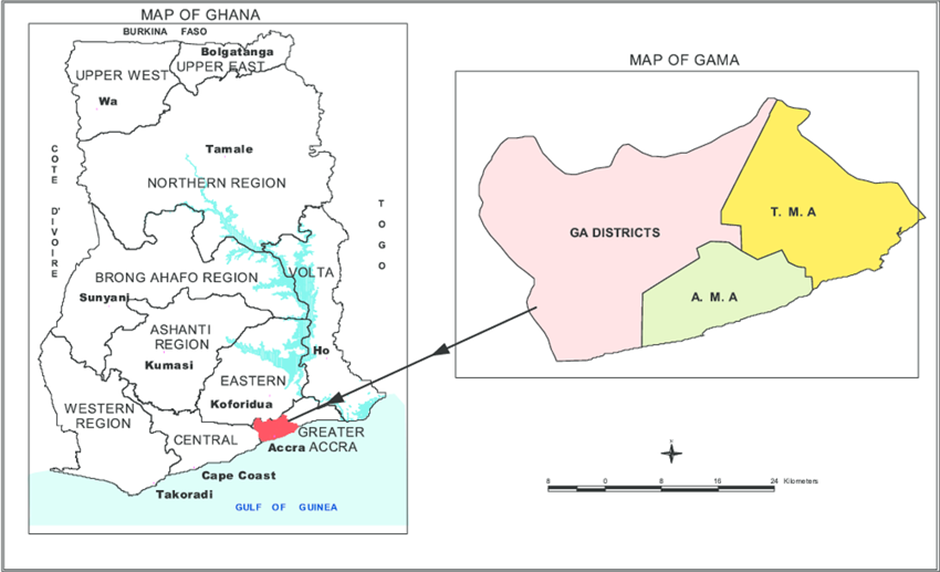
Fig 1. Map of Ghana showing two landfill sites in Greater Accra Region
Kpone Landfill site Sarbah Landfill site
Environmental risks and hazards: Improperly managed landfills can have significant effects on the surrounding environment such as groundwater pollution, soil contamination, fauna and flora and human health risks. Results from the GPS data indicate that all the dumpsites are located within the catchment of a river, farmland or resident which poses risks to the munities surrounding the rivers which are close to these landfills abstract water from the river for human and animal consumption. Challenges such as noise from vehicles carrying waste, unhealthy odour emanating from decaying garbage, vermin infestation, mosquitoes, houseflies and scattering of garbage by bird affect residents.
Pollution of surface and ground water occurs when leachate seeps through the bottom of unlined landfill sites. All the sites under consideration are not well engineered hence leachate may seep into surrounding water bodies contaminating them. A research conducted by Lyndon Nii Adjiri Sackey and Kojo Meizah on the Sarbah landfill sites showed that on average the leachate contained high turbidity (840 NTU), color (4,000 Hz), suspended solids (493 mg/l) and total dissolved solids (16725 mg/l), but no dissolved oxygen, thereby indicating the possibility of leachate contamination of nearby water body.
Close proximity of these landfill sites to humans and animals is also a cause for concern. For instance the figures below shows the sarbah dumpsite located at Weija have settlements that are less than 200 meters away from homes and businesses is harmful to human settlements highlighting the proximity to adverse risk such as cholera and malaria.
[a] [b]
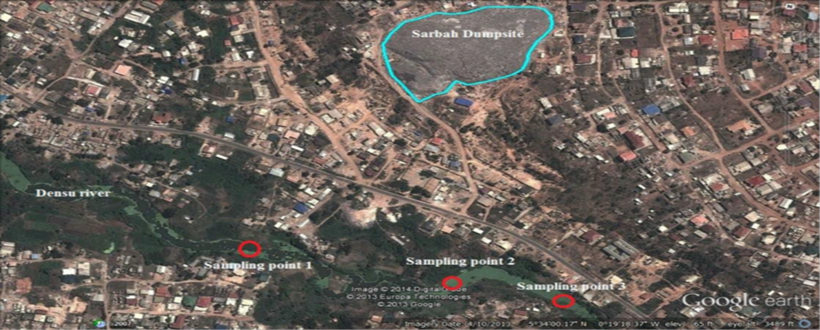

Fig2. Sarbah Dumpsite located at Weija: [a] Satellite map on goggle earth [b]picture by Adzokatsey, K and Norman, I. D. (2013)
Odor in dump sites come from a number of different sources and some of these are gases, fresh refuse, malodorous chemicals, agricultural and sewage sludge (Adu-Boahen, 2012). Odorous emissions are usually accompanied by reports of ill-health from communities. At the various landfills, individuals reported a wide range of non-specific health symptoms, attributing these to odor exposure, including nausea, headaches, drowsiness, fatigue and respiratory problems.5
The table below summarizes the percentage of various impacts that living in close proximity to the various dumpsites has on residents. This information was obtained by interviewing random people across the study area. Most of the residents complained about the odor being the prevalent challenge when it comes to living closer to dumpsite (80%), followed by pests like flies, mosquitoes which make malaria and cholera very much a problem in such areas. The least challenge was the noise coming from the vehicles responsible for disposing off the waste with a percentage of 20% because they were more worried about their health than the noise.
Table 1. various effects of living around the dumpsite ( Mean percentages)
Effects/ Impact | High(%) | Medium(%) | Low(%) |
Noise from the landfill | 20 | 55 | 25 |
Odor from the site | 86 | 10 | 4 |
Pest (flies, vermin etc.) | 70 | 25 | 5 |
Fire and Smoke | 65 | 26 | 9 |
Dust | 20 | 70 | 10 |
Source: Authors interview 2016
Conclusions and recommendations: The present state in which landfills are sited and operated in Accra and elsewhere in Ghana leaves much to be desired.
Majority of the location of landfills are inappropriate because most of them are near an ecologically important wetland or in an area with conflicting land-uses. Improperly managed landfills can have significant effects on the surrounding environment such as groundwater pollution, soil contamination, fauna and flora and human health risk. Residence around the dump site have the risk of the following diseases; malaria, intestinal worms, upper respiratory infections, typhoid fever, dysentery, salmonellosis, cholera and gastroenteritis.
It is therefore recommended that the Ghana Environmental Protection Agency (EPA) should exercise its monitoring and sanctioning roles adequately by putting in place a systematic process of checking, observing, inspecting, regulating or otherwise controlling activities at the dumpsite. Also it is necessary to upgrade the existing open dumping sites and unsanitary landfills to sanitary landfill in a phased manner. Landfill should be restricted to non-biodegradable, inert waste and other waste that are not suitable either for recycling or for biological processing. The concept of landfill recovery gas from sites is highly recommended if the sites are upgraded to engineered landfills.
REFERENCES
Climate and Clean Air Coalition Municipal Solid Waste Initiative (CACC): Solid Waste Management in Accra. www. unep. org/ccacMillennium Cities Initiative, 2010. (http://mci. ei. columbia. edu/files/2013/03/Accra?MCI?solid?waste?report?FINAL?DRAFT?2010.pdf)
Anomanyo, E. D., 2004. Integration of municipal solid waste management in Accra (Ghana): Bioreactor treatment technology as an integral part of the management process. M. Sc. Thesis, Lund University, Lund, Sweden.
Environmental Protection Agency (EPA Ghana), “Manual for the Preparation of District Waste Management Plans in Ghana, Best Practice Environmental Guidelines,” Series No. 3, EPA, Accra, 2002.
Owusu-Sekyere E, Osumanu, IK and Abdul - Kadri Y (2013a). An Analysis of the Plastic Waste Collection and Wealth Linkages in Ghana. International Journal of Current Research 5(1), 205- 209.
Дорис Баах1, М. Харламова2
ВОЗДЕЙСТВИЕ СВАЛКИ В АККРЕ-ГАНА НА ОКРУЖАЮЩУЮ СРЕДУ
1аспирантка кафедры мониторинга и прогнозирования экологического факультета
Российский университет дружбы народов, Москва
Гана
*****@***ru
2Кандидат химических наук, заведующий кафедрой мониторинга и прогнозирования
Российский университет дружбы народов
Аннотация: наиболее широко используемый метод утилизации отходов является полигон это и не удивительно, учитывая, что это самый дешевый вариант. Беспорядочная утилизация привели к негативному воздействию на все компоненты окружающей среды, здоровье населения и социально-экономического развития. Одним из основных вопросов, важных проблем является то, что свалки города не хорошо расположен, как это близко к жилым кварталам, школам и или полосе. Поэтому, в этой статье, которая берется из текущих исследовательских целей позволяет представить полную картину потенциальных рисков территории полигона на окружающую среду (включая шум, запах, почвы, воды и выбросы), включая анализ целесообразности размещения и эксплуатации этих полигонов.
Ключевые слова: твердые бытовые отходы, свалки, открытые свалки, анализ последствий.
