

Партнерка на США и Канаду по недвижимости, выплаты в крипто
- 30% recurring commission
- Выплаты в USDT
- Вывод каждую неделю
- Комиссия до 5 лет за каждого referral
, МБНОУ «Городской классический лицей»,
г. Кемерово, учитель английского языка
Разработка урока, посвященного Дню Святого Патрика
Целевая аудитория: 10-11 класс
Актуальность и ожидаемые результаты:
Данный урок посвящен знакомству учащихся с праздником «День Святого Патрика» и позволяет углубить и расширить знания учащихся по предмету "иностранный язык", а также способствует расширению культурного кругозора, эрудиции школьников, развитию их творческой активности, мыслительной деятельности и, как следствие, повышает мотивацию к изучению языка и культуры других стран.
Цель: приобщение к общеевропейскому поликультурному пространству; знакомство с обычаями и традициями англоязычных стран; повышение мотивации к изучению иностранных языков.
Задачи:
Учебные: совершенствовать речевые и языковые компетенции; актуализировать навыки иноязычного общения.
Образовательная: формировать социокультурную компетенцию учащихся через расширение лингвострановедческого кругозора; развивать речевые, социокультурные и учебно-познавательные компетенции учащихся.
Развивающая: развивать коммуникативные навыки и познавательные способности учащихся, способности к анализу, сравнению, формулированию выводов из полученной информации.
Воспитательная: воспитывать уважительное отношения к европейским культурам, активность, инициативность и сознательность учащихся, умение работать в группе; прививать интерес учащихся к культуре народов стран изучаемого языка.
Форма проведения: урок-викторина
Оборудование: компьютер, мультимедийный проектор, презентация Power Point.
St. Patrick's Day
St. Patrick's Day is here, you see.
We'll pick some shamrocks, one, two, three.
We'll count the leaves and look them over,
And maybe find a four-leafed clover.
I'll sew green buttons on my vest,
Green for St. Patrick is the best.
I'll wear a green hat, very high,
And dance a jig - at least I'll try!
People all over the world celebrate the 17th day of March in honor of St. Patrick, the patron saint of Ireland. One of the greatest Irish festivals, St. Patrick's Day or Paddy's Day commemorates the death of St. Patrick. A festive day for the Irish people St. Patrick's Day is a festive public holiday in the Republic of Ireland and also celebrated with much enthusiasm in places such as Canada, Great Britain, Australia, the United States and New mptuous feasts, green clothes, frothy delights, joyous merrymaking with friends and family - all are parts of this grand occasion.
With the origin being Ireland it is obvious that the Day is also holiday there, as it is in the US. But in Ireland it is more of a religious holiday similar to Christmas and Easter. With grand parades, community feasts, charity show, the mass, St Patrick's Day is celebrated in Ireland. The parades, shamrocks and green beer are provided primarily for tourists. In fact, it has turned out to be one of the most celebrated events in Ireland and a major tourist attraction. However, not everyone may know who St. Patrick is.
Facts about Saint Patrick
Saint Patrick is traditionally thought to have lived between 432-461 AD, but more recent scholarship moves the dates up a bit. At the age of sixteen he was kidnapped from his native land of the Roman British Isles by a band pirates and sold into slavery in Ireland. Saint Patrick worked as a shepherd and turned to religion for solace. After six years of slavery he escaped to the Irish coast and fled home to Britain.
While back in his homeland, Patrick decided to become a priest and then to return to Ireland after dreaming that the voices of the Irish people were calling him to convert them to Christianity.
After studying and preparing for several years, Patrick travelled back to Ireland as a Christian missionary. Although there were already some Christians living in Ireland, St. Patrick was able to bring upon a massive religious shift to Christianity by converting people of power.
Saint Patrick is also credited with bringing written word to Ireland through the promotion of the study of legal texts and the Bible. Previous to Patrick, storytelling and history were reliant on memory and orally passing down stories. Patrick's mission in Ireland is said to have lasted for thirty years. It is believed he died in the 5th century on March 17, which is the day St. Patrick's Day commemorated each year.
Saint Patrick’s Day in the world
The early Irish immigrants like the English, Dutch, German, French and the likes, brought their traditions in the United States. But it was not until 1737 that the immigrants really celebrated the Day. And it was in Boston where the Day was first celebrated in a public way. Gradually other states took it up. And it was New York that took out the largest ever St Patrick' s Day parade. Nearly 200 years later, the first St. Patrick's Day parade in the Irish Free State was held in Dublin in 1931. During the mid 90's the Irish government also began a campaign to promote tourism in Ireland on March 17th.
Meanwhile the city of Chicago has developed a unique tradition of coloring the river water green. It started in 1962 when 100 pounds of green vegetable dye were added to its river, enough to keep it green for a week. The tradition has continued till date. Now, 40 pounds of a green food coloring keep the river green for only a few hours.
Despite all these varieties, all are driven by a unique theme: be an Irish day. It's a celebration for being Irish and enjoying things Irish. While it reminds people of St Patrick. It also says to be Irish. With shamrocks and the leprechaun. As it says to cook and feast the Irish way. To laugh away all worries with Irish jokes. Dance to the tunes of the Irish bands. Try out the Irish words. And with all these the Day let everybody know the real fun of being Irish.
Facts about St. Patrick's Day Holiday
- St. Patrick’s Day is observed on March 17 because that is the feast day of St. Patrick, the patron saint of Ireland. It is believed that he died on March 17 in the year 461 AD. It is also a worldwide celebration of Irish culture and history. St. Patrick’s Day is a national holiday in Ireland, and a provincial holiday in the Canadian province of Newfoundland and Labrador.
- For 2008 the Catholic Church has officially moved St. Patrick's Day to Saturday, March 15th to avoid a conflict with the Holy Week leading up to Easter Sunday. Most secular establishments in the US and Canada, such as restaurants and bars, will continue to celebrate the holiday on March 17th, and the 17th will remain a national day off from work in Ireland.
- In Ireland on St. Patrick’s Day, people traditionally wear a small bunch of shamrocks on their jackets or caps. Children wear orange, white and green badges, and women and girls wear green ribbons in their hair.
- Many cities have a St. Patrick’s Day parade. Dublin, the capital of Ireland, has a huge St. Patrick’s Day festival from March 15-19, that features a parade, family carnivals, treasure hunt, dance, theatre and more. In North American, parades are often held on the Sunday before March 17. Some paint the yellow street lines green for the day! In Chicago, the Chicago River is dyed green with a special dye that only lasts a few hours. There has been a St. Patrick’s Day parade in Boston, Massachusetts since 1737. Montreal is home to Canada’s longest running St. Patrick’s Day parade, which began in 1824.
Facts about the Irish
34 million Americans have Irish ancestry, according to the 2003 US Census. That’s almost nine times the population of Ireland, which has 4.1 million people.
- Some American towns have “Irish” names. You could visit: Mount Gay-Shamrock, West Virginia; Shamrock Lakes, Indiana; Shamrock, Oklahoma; Shamrock, Texas; Dublin, California and Dublin, Ohio.
The harp is the symbol of Ireland. The color green is also commonly associated with Ireland, also known as “the Emerald Isle.”
- The Irish flag is green, white and orange. The green symbolizes the people of the south, and orange, the people of the north. White represents the peace that brings them together as a nation.
The name “lephrechaun” has several origins. It could be from the Irish Gaelic word “leipreachan” which means “a kind of aqueous sprite.” Or it could be from “leathbhrogan,” which means “shoemaker.”
Facts about Clovers
According to the Guinness Book of World Records, the highest number of leaves found on a clover is 14!
One estimate suggests that there are about 10 000 regular three-leaf clovers for every lucky four-leaf clover.
Legend says that each leaf of the clover means something: the first is for hope, the second for faith, the third for love and the fourth for luck.
Ten things you didn't know about Ireland's patron saint - St. Patrick
1. In days gone by, shamrock was worn only by those of modest means. Those who could afford to, wore home made crosses fashioned from expensive lace and ribbons.
2. Corned beef and cabbage was not a regular dish in Ireland until the 17th century and didn't become a popular March 17 dish in the US until the end of the 19th century.
3. There is considerable doubt over whether Ireland was ever home to snakes, but legend has it that St Patrick bade them all gather on Croagh Patrick mountain in Co Mayo from where he banished them to their death in the Atlantic Ocean.
4. In none of the many manuscripts that relate details of St Patrick's life is there a mention of a shamrock.
5. It's thought there was but one martyrdom during St Patrick's mission, and it was that of St Odhran, Patrick's charioteer. Upon hearing of a plot by a local chieftain, Berraidh to assassinate Patrick, and without explaining why, Odhran persuaded Patrick to take the reins of the chariot as they approached Berraidh's encampment. Swallowing the bait, Berraidh attacked, but it was Odhran who was killed.
6. St Patrick carried a bell to drive demons away. Having completed a vigil on Croagh Patrick, an angel came to Patrick and instructed him to ring his bell loudly. This conferred upon Patrick the right to be the judge of Irish people on the Day of Doom.
7. Until the 1970's, Ireland was dry on St Patrick's day, ie no pubs were allowed to open on March 17th. The only place where a person could legally acquire alcohol was on a train, or at the annual dog show in Dublin's RDS.
8. St Patrick was not Irish, but was actually born in Britain - probably Wales.
9. The first St Patrick's day parade was held not in Ireland, but in Boston MA in 1737.
10. In all probability, Patrick did not die on March 17. Recording practices in the fifth century were not sufficiently advanced to enable us to determine the exact dates of such events.
Приложение 1 ‘Wordsearch’
| |
fairy, green, Ireland, Irish, leprechaun, lucky, March, miracles, mischief, parade, pinch, pot of gold, rainbow, Saint Patrick, shamrock, shoemaker, snakes, sneaky, St. Patrick's Day, tricky, vanish | (1) Find the words below in the grid to the left. (2) Write an L beside the words that are related to Leprechauns.
|



Приложение 2
| |||||||||
Find rhyming words that match the clues: (1) A month that rhymes with parch. (2) A holy person that rhymes with paint. (3) A person with wings that rhymes with pull. (4) A mischief-maker that rhymes with lawn. (5) An old, old story that rhymes with send. (6) A scaly animal that rhymes with rake. |
| ||||||||
(7) A St. Patrick’s Day color that rhymes with seen. (9) A celebration on the street that rhymes with made. (10) The people of Ireland who rhyme with wish. (11) What carries the gold and rhymes with hot. (12) What a four-leaf clover brings that rhymes with puck. (13) It causes pain and rhymes with inch. (14) A three-leafed plant that rhymes with lock. (15) A green jewel that rhymes with pulled. (16) A leprechaun’s job that rhymes with faker.
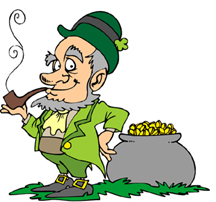
They wore fine clothes, liked to play tricks, and made shoes for a living. The modern image to the left is nothing like the images of leprechauns found in old stories. | |||||||||
G |
|




Helpful sources:
http://familyfun. /st-patricks-day/st-patricks-day-history-971546/
http://www. /patrick/
http://holidays. /saint-patricks-day/
http://www. /stpatrick/life/10things. asp
http://www. /hol/stpsong. html
www.
