

Партнерка на США и Канаду по недвижимости, выплаты в крипто
- 30% recurring commission
- Выплаты в USDT
- Вывод каждую неделю
- Комиссия до 5 лет за каждого referral
Лекционные занятия № 1 2 ч.
Тема: «Languages of the British Isles»
1. Вводная беседа о задачах на семестр.
2. Речевая зарядка.
3. Предъявление лексики по теме: About English language
Languages of the British Isles
It may surprise you to know that until a few centuries ago there were natives of the British Isles, who did not speak English. The Western land of Wales spoke Welsh; in the farthest north and the islands of Scotland the language was Gaelic; and in Ireland people spoke a similar language, Irish Gaelic; Manx was the language of the Isle of Man, and Cornish was the language of the south-western tip of Britain.
We’re not talking about dialects – localized versions of a language – which often contain alternative words or phrases for certain things; but which are forms of English. Welsh, Gaelic, Manx and Cornish are complete languages with their own grammar, poetry and stories – all that we call a culture.
Strangely enough, there’s a strong revival of interest in them. In Scotland Gaelic Language Society has existed for eighty years. It’s dedicated to preserving the traditions of the Gaelic songs, verse and prose. And more and more people in the Lowland areas of Scotland, as well as the islands, where Gaelic is still spoken, now want to learn the language.
Since the early 1970s, more and more people are learning Gaelic and go to evening classes. Now people in schools can choose to take Gaelic for their final exams. In Wales the Welsh language Society was formed in 1962 and it has been fighting to restore Welsh to an equal place with English. In 1967 they won an important victory: Welsh was recognized as being equally valid for use in law courts, either written or spoken. In Wales some of the programmes of the fourth channel are broadcast in Welsh.
4. Грамматический материал.
1.5.3.The Possessive Case (Притяжательный падеж в английском языке)
При помощи существительного в притяжательном падеже мы выражаем принадлежность предмета, так как оно отвечает на вопрос чей - whose?
Правила образования притяжательного падежа
Если в предложении в притяжательном падеже употребляется существительное в единственном числе, то оно образуется при помощи окончания -'s. Существительное в притяжательном падеже необходимо ставить перед существительным, с которым оно выступает в роли определения. В русском языке он соответствует родительному падежу.
E. g. Mary's car - машина Марии
the girl's book - книга девочки.
Если в предложении в притяжательном падеже употребляется существительное во множественном числе, то оно образуется при помощи прибавления апострофа.
E. g. the doctors' tools - инструменты докторов
the classmates' laptops - ноутбуки одноклассников.
But: the children's tickets - билеты детей
the businessmen's cars - машины бизнесменов.
Если существительное сложное, то -'s прибавляется к последнему слову, входящему в его состав.
E. g. his sister-in-law's dress - платье его невестки.
Если в предложении имеется два лица, которым принадлежит один и тот же предмет, то последнее существительное имеет форму притяжательного падежа.
E. g. My mother and father's car is black - Машина моей мамы и папы черная.
Если существительное определяется не только существительным в притяжательном падеже, но и какими-либо другими определениями, то существительное в притяжательном падеже ставится на первом месте.
E. g. the surgeon's big operating coat - большой халат хирурга
John's old friends - старые друзья Джона.
The Genitive Case. (Случаи употребления притяжательного падежа с неодушевленными предметами)
Помимо постановки -'s к существительным, существует еще один способ выражения принадлежности в английском языке - предлог of. Предлог of употребляется с неодушевленными предметами. В русском языке он соответствует родительному падежу.
E. g. the roof of the building - крыша здания (а не the building's roof).
the beginning of the concert - начало концерта.
Pay attention!
E. g. Mary is the sister of my brother's wife - Мария - сестра жены моего брата.
Mary is my brother's wife's sister - неверный вариант.
В некоторых случаях уместно использование как of, так и -'s:
E. g. the owner of the shop или the shop's owner.
of и -'s уместны, когда существительное представляет группу людей или организацию:
E. g. the company's growth или the growth of the company.
Но в некоторых случаях притяжательный падеж с неодушевленными существительными всё-таки употребляется. Форму притяжательного падежа могут принимать:
Слова (мир) world, (страна) country, (город) city, (провинциальный городок) town, (океан) ocean, (река) river, (корабль) ship:(устье реки) the riverʼs mouth
(театры Бостона) Bostonʼs theatres
(экипаж корабля) the shipʼs crew.
(завтрашний концерт) tomorrowʼs concert
(сегодняшние новости) todayʼs news.
(чья-то книга) someone’s book
(никому не принадлежащая ручка) nobody’s pen
(лучи солнца) the Sun’s rays
(лунное затмение) the Moon’s eclipse
(у бабушки) at Granny’s (house)
(у дантиста) at the dentist’s (office)
(в булочной) at the baker’s (shop)
(Давай встретимся в Макдоналдсе.) Let’s meet at McDonald’s.
Ещё притяжательный падеж существительных в английском языке употребляется в некоторых устойчивых выражениях:(Я живу в двух шагах от нашего института.) I live at a stone’s throw of our institute.
7. Имена существительные времени и расстояния:
(У нас были недельные каникулы в прошлом месяце) We had weekʼs holiday last month.
(Моя тётя живет в километре от вашего дома) My aunt lives at a kilometer’s distance from your house.
Exercise 1. Connect nouns using 's, (' ) or... of …
Example: The door/the room the door of the room
The mother/Ann Ann's mother
1. the camera/Ben __________________________________________________
2. the eyes/the cat___________________________________________________
3. the top/the page__________________________________________________
4. the daughter/Charles ______________________________________________
5. the newspaper/today ______________________________________________
6. the toys/the children_______________________________________________
7. the name/your wife________________________________________________
8. the name/this street________________________________________________
9. the name/the man I saw yesterday _____________________________________
10. the new manager/the company ________________________________________
11. the result/the football match ____________________________________________
12. the car/Mike parents __________________________________________________
13. the garden/our neighbors_______________________________________________
14. the children/Don and Mary_____________________________________________
Exercise 2. Choose the right variant.
1. My... parents have recently decided to move to the country.
a. sister’s-in-law
b. sister-in-law’s
c. sister-in-laws’
d. sister’s-in-laws
2. Next Tuesday we’ll mark my... wedding anniversary.
a. sister’s and brother’s-in law
b. sister and brother-in-law’s
c. sister and brother’s-in-law
d. sister’s and brother-in-law’s
3. It was... idea to celebrate Christmas together with our classmates.
a. Nick’s and Andy
b. Nick and Andy’s
c. Nick and Andy
d. Nick’s and Andy’s
4. I send you many thanks and the very best wishes on this... Day.
a. Mother
b. Mother’s
c. Mothers’
d. Mothers’s
5. They say that... milk is very useful.
a. goats
b. goat’s
c. goats’
d. goat
6. The painting disappeared from the... house yesterday evening.
a. owner
b. owners
c. owner’s
d. owners’s
7. All my... bicycles are better than mine.
a. friends
b. friends’
c. friend’s
d. friend
8. The... department is upstairs, on the third floor.
a. mens’
b. men
c. men’s
d. man’s
9. The... area is run by experienced stuff.
a. child’s
b. children’s
c. childrens’
d. children
Exercise 3. Look at the family tree
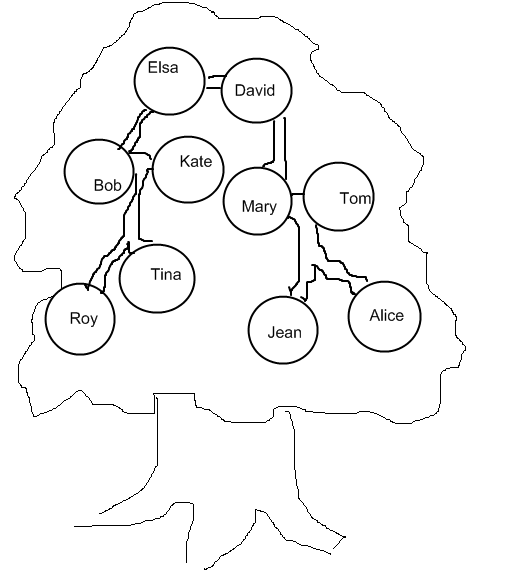
I’m Tina. Elsa is my grandma and David is my grandpa. Bob is my father and Kate is my mother. Roy is my brother. I am his sister. Mary is my aunt and Tom is my uncle. Jean and Alice are my cousins. Jean and Alice are sisters. They are Tom and Mary’s daughter. Roy is Bob and Kate’s son. Elsa is David’s wife and David is Elsa’s husband. Roy, Jean, Alice and I are Elsa and David’s grandchildren.
1) Look at the family tree and fill in the missing words.
Alice is Jean’s sister. Elsa is her _______
And David is her ________ . Mary is Tom’s _________ . Bob is Mary’s ________ . Jean is Roy’s ________ . Kate is Jean’s ________ and Bob is Jean’s ________ . Alice is Tom’s _________ .
Bob is Elsa’s ________ . Jean and Alice are Elsa’s _________ . Tom is Jean’s ________ .
2)Fill in the missing names in the possessive case.
Mary is Tom’s wife. David is ________ husband. Tom is ________ and _________
father. Roy is _________ brother. David is _________ grandpa. Bob is ________ son
and Mary is _______ daughter.
Методические рекомендации для проведения занятия
Формы и методы проведения занятия.
На занятии используются коммуникативно-ориентированные методы: лингвосоциокультурный метод, коммуникативный подход, интенсивная методика, интерактивные методы
Литература:
1., , Reading book for students: Philology Учебно-методическое пособие для студентов высших учебных заведений. – Армавир: РИЦ АЛСИ, 2011. – 58 с.
2. , , The World of English: first year: Учебно-методическое пособие для студентов 1 курса неязыковых факультетов высших учебных заведений. – Армавир: РИЦ АЛСИ, 2012. – 230 с.
3. Английский язык для общения: Интенсивный курс: Учеб. – 2-е изд. – М.: Издат. дом «РТ-Пресс», 2002. – 416 с.
Задания для СРС
Составить презентацию по теме «Languages of the British Isles»
