


Партнерка на США и Канаду по недвижимости, выплаты в крипто
- 30% recurring commission
- Выплаты в USDT
- Вывод каждую неделю
- Комиссия до 5 лет за каждого referral
O. Bazaluk
Аннотация.
О. Базалук «Вселенная в теоретической модели «Эволюционирующая материя»». В статье критически рассматривается построенная усилиями группы ученых (математиков, физиков и космологов) из ведущих мировых университетов (Оксфорда, Кембриджа, Йельского, Колумбия, Нью-Йоркского, Rutgers и Калифорнийского университета в Санта-Круз) современная модель эволюции Вселенной. Автор отмечает её сильные стороны, но так же указывает на недостатки. По мнению автора в указанной модели не учитываются важнейшие достижения в области биохимии и биологии (молекулярной, физической, эволюционной и т. п.), а также нейронауках и психологии. По мнению автора, с большими оговорками, но в построении моделей эволюции Вселенной ученые должны учитывать фактор влияния на космические процессы систем живой и разумной материи. Как пример, автор приводит разрабатываемую им теоретическую модель «Эволюционирующая материя». В этой модели показана не только общая зависимость космических процессов от взаимодействия косной, живой и разумной материи, но и сделана попытка показать прямое влияние систем живой и разумной материи на ускорение расширения Вселенной.
Ключевые слова: Вселенная, живая материя, разумная материя, ускорение расширения Вселенной, теория эволюции.
Abstract
The article critically examines modern model of the Universe evolution constructed by efforts of a group of scientists (mathematicians, physicists and cosmologists) from the world's leading universities (Oxford and Cambridge Universities, Yale, Columbia, New York, Rutgers and the UC Santa Cruz). The author notes its strengths, but also points to shortcomings. Author believes that this model does not take into account the most important achievements in the field of biochemistry and biology (molecular, physical, developmental, etc.), as well as neuroscience and psychology. Author believes that in the construction of model of the Universe evolution, scientists must take into account (with great reservations) the impact of living and intelligent matter on space processes. As an example, the author gives his theoretical model "Evolving matter". In this model, he shows not only the general dependence of the interaction of cosmic processes with inert, living and intelligent matter, but also he attempts to show the direct influence of systems of living and intelligent matter on the acceleration of the Universe's expansion
Keywords: Universe, living matter, intelligent matter, the acceleration of the Universe's expansion, the evolution theory.
Universe in the theoretical model "Evolving matter"
The site http://www. philosophy-of-cosmology. ox. ac. uk/cosmos. html contains current understanding of the evolution of the Universe.

Thanks to the efforts of the Oxford and Cambridge Universities (UK), as well as the following Universities in the United States of America: Yale, Columbia, New York, Rutgers and the UC Santa Cruz, the small group of scientists was created in 2009 with the financial support of the John Templeton Foundation in order to elaborate the modern model of the Universe evolution. The co-operation between physicists, mathematicians and philosophers in order to identify and explore fundamental issues in cosmology (in the framework of the philosophy of cosmology) resulted in the image of the Universe evolution model, which is represented in the picture. It demonstrates the modern understanding of the main stages of formation and development of our Universe.
Acknowledging the achievements of the predecessors, as well as accumulating efforts of the above mentioned group of scientists: J. Barbour, J. Barrow, H. Brown and some other (http://www. philosophy-of-cosmology. ox. ac. uk/people. html) I would like to note that the model does not take into account two important cosmic phenomena: the influence of life (living material in terms of V. Vernadsky) and mind (intelligent substance in the terminology of O. Bazaluk) on the expansion of the Universe. Since 2000 O. Bazaluk has been developing the cosmological model "Evolving material", which shows the importance of the influence of the living and intelligent material on the stages of the Universe deployment and on accelerating the Universe expansion.
As it follows from our research in the unfolding (expanding) material (discrete and continuous) structure of the Universe (the inert matter system) the complex molecular structures were formed on some material objects with certain physical characteristics about 3 billion years after the Big-Bang. First, A. Oparin and then John Haldane experimentally demonstrated the possibility of such molecular structures creation in the primary physical and chemical conditions, which were on the Earth about 4 – 3.5 billion years ago. They were called "coacervate drops". Currently the coacervate theory is being developed by the International Society for the Study of the Origin of Life) [8http://issol. org/]. In this regard, significant researches were made by Stanley Miller and Harold Urey (Miller-Urey experiment), by Sidney W. Fox about the micro-spheres, which are called protobionts, as well as by some other scientists.
All those researches confirm the natural character of emergence of the structures of life (living matter) in certain physical conditions of an object in the cosmic space. And it is not related only to the Earth, as the natural emergence of the alive organisms (from the simplest protocells to the modern bodies) is possible in any other material object with the relevant physical and chemical characteristics. According to BBC journalist J. Palmer the total number of the planets, which are similar to the Earth in our galaxy could be around 17 billion [7].
In the early twentieth century Vladimir Vernadsky on a huge research material created the doctrine of the biosphere. In 1926 in the book «The Biosphere» on the basis of geological, biological and biochemical studies of that time period Vernadsky attempted to reveal the content of life - living matter. In his further studies V. Vernadsky developed the basic tenets of the doctrine of the biosphere, one of which is the concept of "life pressure," which is achieved by reproduction [6]. Much later (in 1979) on the basis of the new research material the "biosphere doctrine" of V. Vernadsky was developed by J. Lovelock in his "Gaia Hypothesis".
Currently the substantial material of the researches suggests that the living matter system of the Earth is not only naturally formed and developed from the inert (non-living) matter and has not only a significant impact on the energy and material exchange in the framework of a space object, but also represents a certain space force, which affects the physical characteristics of the solar system [5]. In the model of the "evolving matter" it is assumed that approximately 6.5 billion years after the Big-Bang the total system capacity of the cosmic space's living matter the individual objects in the Universe achieved the level of the unified (integrated) cosmic force, which started to accelerate the Universe expansion due to their additional energy.
Even the greater energy potential was concluded in the deployment of the intelligent matter, which is third state of the matter. Edouard Le Roy, Teilhard de Chardin and Vladimir Vernadsky were the first scientists to understand that issue. They created the theory of the noosphere. O. Bazaluk in his researches revealed the main stages of transition of the living matter through the bio-intelligent state into the intelligent matter [5]. Based on advances in neuroscience and psychology O. Bazaluk researched main stages of transformation of cellular structures into neurons, then neurons into the neural system and after that by the deployment of neural systems in neural subconscious (several million years ago), and then consciousness (about 50 thousand years ago). It was a gradual transition of the subconscious neural ensemble into consciousness. The formation of the highly developed psyche resulted in the creative conscious activity of the mankind. Further continuous development of the conscious neural ensemble (with a possible transition into the higher quality level of the neuro-physiological organization) provides transition of the intelligent matter from the planetary force into the cosmic one.
According to the theoretical model "Evolving matter" directed and consistent evolution of the neural networks of the human brain (highly psyche) leads to the continuous development of intelligent substance on the space objects with the relevant physico-chemical and biochemical characteristics. As follows from the model, about 8-9 billion years after the Big-Bang total planetary potential of the intelligent substance had integrated and developed into a powerful cosmic force, which accelerated even more the Universe expansion.
Thus, the model of the evolving Universe (see it on the site http://www. philosophy-of-cosmology. ox. ac. uk/index. html) demonstrates the features of the inert matter's deployment (in the terminology of V. Vernadsky). It does not consider the significant influence of the living systems and intelligent matter, which in the period of respectively 5-6 billion years and 8-9 billion years ago (at the interval of about 3 billion years) reached the level of the cosmic forces. At present they still have a direct influence on the development of our Universe, including the acceleration of the Universe's expansion. From our point of view, in order to consider the main stages of the Universe deployment it is better to look at the model "Evolving matter" (see the figure 1 below) [4].
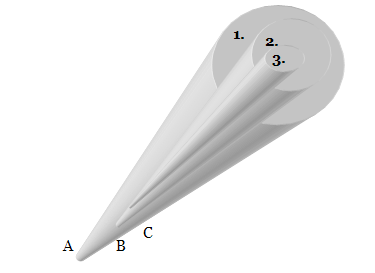
Figure 1. Schematic image of the sequent deployment of the matter states during the Universe evolution, which are known to the modern science existence. Numbers designate the space-time of the: 1 – inert matter; 2 – living matter; 3 – intelligent matter. Letters A, B, C are the singularity points of the inert matter, living matter and intelligent matter.
Bazaluk O. A. "Universe: Living and Intelligent Matter" (The historical-philosophical and natural-science analysis on basis of the new cosmological concept). - Dnepropetrovsk: Porogi, 2005. - 412 p. Bazaluk O. A. "World existence and "Evolving Matter" as its modern model" – "Philosophy & Cosmology 2009" - Poltava: Poltavskiy literator, 2009. - Р. 3-37. Bazaluk Oleg "The New Model of the Universe" – "Intercultural Communications" / International scientific periodical edition / № 12 – Tbilisi, 2010. - P. 150-162. Bazaluk O. A. "Philosophy of education on basis of the new cosmological concept". Textbook. - Kiev: Condor, 2010. - 458 p. Bazaluk O. A. "Space travel - traveling mentality": the course of lectures. - Kiev: KNT, 2012. - 424 p. Vernadskiy V. I. "Khimicheskoye stroyeniye biosfery Zemli i yeye okruzheniya". [Chemical structure of the Earth's biosphere and its environment] / Vladimir Ivanovich Vernadskiy. - M.: Nauka, 1987. - 339 s. Jason Palmer. "Astronomers: Earth-like planets may be billions" -http://www. bbc. co. uk/russian/science/2013/01/130108_earth_size_planets. shtml International Society for the Study of the Origin of Life - http://issol. org/
