


Партнерка на США и Канаду по недвижимости, выплаты в крипто
- 30% recurring commission
- Выплаты в USDT
- Вывод каждую неделю
- Комиссия до 5 лет за каждого referral
1. Каждый имеет право на жизнь.
2. Смертная казнь впредь до ее отмены может устанавливаться федеральным законом в качестве исключительной меры наказания за особо тяжкие преступления против жизни при предоставлении обвиняемому права на рассмотрение его дела судом с участием присяжных заседателей.
Capital punishment in Russia
From Wikipedia, the free encyclopedia
Jump to: navigation, search
Both the legal and moral status of Capital punishment in Russia are currently controversial. There exists both an implicit moratorium established by the President and an explicit one, established by the nation's highest court; however, the latter is due to expire early in *****ssia has not executed anyone since 1996, and the regulations of the Council of Europe prohibit it from doing so at any time in future. However, the death penalty still remains codified. Recently President Vladimir Putin said Russia will retain its moratorium.
Contents [hide] · 1 History · 1.1 Russian Empire · 1.2 Soviet Union · 2 Current status · 2.1 Statute limitations · 2.2 Popular view · 2.3 Moratorium · 3 References · 3.1 Among the entries above |
[edit] History
[edit] Russian Empire
The Russian Empire practiced the death penalty extensively, as did almost all countries before the 20th century. One of the first legal documents resembling a modern penal code was enacted in 1398, which mentioned a single capital crime: a theft performed after two prior convictions (an early precursor to the current Three-strikes laws existing in several U. S. states). The Pskov Code of 1497 extends this list significantly, mentioning three specialized theft instances (committed in a church, stealing a horse, or, as before, with two prior "strikes") as well as arson and treason. The trend to increase the number of capital crimes continued: in 1649, this list included 63 crimes, a figure that was nearly doubled during the reign of Tsar Peter I (Peter the Great). The methods of execution were extremely cruel by modern standards (but fully consistent with the standards of the time), and included drowning, burying alive, and forcing liquid metal into the throat.[1].
/wiki/Image:Surikov_streltsi. jpg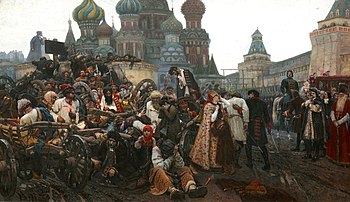
/wiki/Image:Surikov_streltsi. jpg
/wiki/Image:Surikov_streltsi. jpg
/wiki/Image:Surikov_streltsi. jpg"The morning of the Streltsy execution" by Vasily Ivanovich Surikov.
Some executions gained considerable fame both inside the country and in the outside world. Perhaps the most famous instances are the mass execution of Streltsy (Стрельцы) by Peter the Great, and the execution of five Decembrists by Nicholas I, both of which were the direct result of failed uprisings.
Elizabeth did not share her father's views on the death penalty, and officially suspended it in 1744, effectively enacting a moratorium. This lasted for 11 years, at which point the death penalty was permitted again, after considerable opposition to the moratorium from both the nobility and, in part, the Empress herself. [1]
Perhaps the first public statement on the matter to be both serious and strong came from Catherine II (Catherine the Great), whose liberal views were consistent with her acceptance of the Enlightenment. In her Nakaz, the empress expressed a disdain for the death penalty, considering it to be improper, and adding that "in the usual state of the society, death penalty is neither useful nor needed." However, an explicit exception was still allowed for the case of someone who, even while convicted and incarcerated, "still has the means and the might to ignite public unrest." [2].
Consistent with Catherine's stance, the next several decades marked a shift of public perception against the death penalty. In 1824, the very existence of such a punishment was among the reasons for legislature's refusal to approve a new version of the Penal Code. Just one year later, the Decembrist revolt failed and a court sentenced 36 of the rebels to death.[1] Nicholas I's decision to commute all but five of the sentences was highly unusual for the time, especially taking into account that revolts against the monarchy had almost universally resulted in an automatic death sentence, and was perhaps due to society's changing views of the death penalty.
[edit] Soviet Union
The death penalty was officially outlawed shortly after the February Revolution of 1917. The provisional government enacted the prohibition on March 12, but (exactly two months later) somewhat weakened it by allowing the death penalty for soldiers on the front.[3] The government itself lasted less than a year, however.
The Soviet government confirmed the abolition almost immediately after assuming power, but restored it for some crimes very soon. Over the next several decades, the death penalty was alternately permitted and prohibited, sometimes in very quick succession. The list of capital crimes likewise underwent several changes.
Under the rule of Joseph Stalin, many were executed during the Great Purge, sometimes without a trial and in many instances after a speedy trial. Many of the death sentences were pronounced by a specially appointed triple-person commission of officials, the NKVD troika, who were not judges in any reasonable sense of the word; according even to a pro-Stalinist source,[4] this was done in the majority of the cases. The exact number of executions is debated, with archival research suggesting it to be around 700-800 thousand, while some estimates are as high as tens of millions. (See also: Stalin#Number of victims)
After World War II, the death penalty was again outlawed and substituted with imprisonment for 25 years, but soon restored again: first for treason and espionage, and then for aggravated murder.[1] [3] The Penal Code of 1960 significantly extended the list of capital crimes, but the practical rarity of the death penalty's application was not changed. In most cases (96 percent according to 1987 statistics), only murders of several people, of children, or those committed in an especially cruel manner were punished by death. According to statistics, the death penalty accounted for less than 1 in 2000 sentences. [1]
[edit] Current status
[edit] Statute limitations
Article 20 of the Russian Constitution states that everyone has the right to life, and that "until its abolition, death penalty may only be passed for the most serious crimes against human life." Additionally, all such sentences require jury trial. [5] The inclusion of the abolition wording has been interpreted by some[3] as a requirement that the death penalty be abolished at some point in the future.
The current Penal Code[6] permits death penalty for five crimes:
· murder, with certain aggravating circumstances (section 105.2)
· attempted murder of a government or public official (section 277),
· attempted murder of a person carrying out justice or a preliminary investigation (section 295),
· attempted murder of a law enforcement officer (section 317),
· genocide (section 357).
No crime has a mandatory death sentence; each of the five sections mentioned above also permit a sentence of life imprisonment as well as a prison term of not less than eight or 12 (depending on crime) nor more than twenty, years. Moreover, men under the age of 18 or above the age of 65 as of the time crime was committed, and all women, are not eligible for a death sentence. [1]
[edit] Popular view
A majority of reported opinion polls agree that the death penalty enjoys popular support in Russia. Support is particularly high for the death penalty for terrorists.
One of the latest polls reported that around three-quarters of those participating "do not mind" the death penalty, and only 4 percent strongly feel against it. Those supporting the death penalty offer fairly common arguments in favor of their view: 44 percent argue that "death penalty is fair" and that "death should be caused for death," 9 percent believe that the death penalty will decrease the crime rate, and 5 percent oppose the economic impact of life imprisonment on the taxpayers. Slightly less common arguments have been offered by minorities of those in favor of the death penalty as well. 4 percent of them "see no sense in long imprisonment", whereas 3 percent are convinced that the death penalty is the only meaningful punishment so long as corruption results in the possibility of freedom for bribes, and 1 percent believe that the death penalty is ultimately more humane than continuous imprisonment.
Ironically, the latter is also the single most cited reason by those opposing death penalty, a view expressed by a quarter of poll participants. Four percent of them believe that death is too easy a punishment, evidently expressing their conviction in very low standards of life in current prisons. Three percent believe that human life cannot be touched but by God, and about 1 percent have favored rather unusual views that "there are already too few people" as well as more common ones that everyone deserves a chance, and that "let them live, they are humans".
The current moratorium, which has been in force for ten years, is opposed by 55 percent and supported by 28 percent. [7]
Several prominent politicians and administration leaders have publicly called to end the moratorium and resume the practice of the death penalty in the nation. Several others have at least expressed their views that the moratorium may legally be removed in the near future; included among them is Vladimir Kolesnikov, a former Deputy Prosecutor General of Russia. [8]
On the other hand, many prominent political and public figures argue for the complete abolition of the death penalty, primarily on moral grounds. Such arguments have diverse supporters, from human rights activists (such as Anatoliy Pristavkin) to former federal judge Sergey Pashin. [9] [10]
[edit] Moratorium
One of the absolute requirements of the Council of Europe for all members is that the death penalty cannot be carried out for any crime. While the preferred method is abolition, the Council has demonstrated that it would accept a moratorium, at least temporarily. Consistent with this rule, on January 25 of 1996, the Council required Russia to implement a moratorium immediately and fully abolish death penalty within three years, in order for its bid for inclusion in the organization be to be approved. In a little over a month, Russia agreed and became a member of the Council. [11]Whether the moratorium has actually happened as a matter of legal right is the subject of some controversy[12].
On May 16, 1996, then-President Boris Yeltsin issued a decree "for the stepwise reduction in application of the death penalty in conjunction with Russia's entry into the Council of Europe", which is widely cited as de-facto establishing such a moratorium. The decree called on the legislature to prepare a law which would abolish the death penalty, as well as a recommendation to decrease the number of capital crimes and require the authorities to treat those on the death row in a humane manner. [12] Although the order may be read as not specifically outlawing the death penalty, this was eventually the practical effect, and it was accepted as such by the Council of Europe as Russia was granted membership in the organization. However, since the executions continued in the first half of 1996 - that is, after Russia signed the agreement - the Council was not satisfied and presented Russia with several ultimatums, threatening to expel the country if the death penalty continues to be carried out. In response, several more laws and orders have been enacted, and Russia has not executed anyone since August 1996. [11]
On February 2, 1999, the Constitutional Court of Russia has issued a temporary stay on any executions for a rather technical reason, but nevertheless granting the moratorium an unquestionable legal status for the first time. According to the Constitution as quoted above, a death sentence may only be pronounced by a jury trial, which are not yet implemented in some regions of the country. The court found that such disparity makes death sentences illegal in any part of the country, even those that do have the process of trial by jury implemented. According to the ruling, no death sentence may be passed until all regions of country have jury trials, which may happen as early as 2007, at which point the legal status of the death penalty may again become questionable. [12]
On November 15, 2006, the Duma extended both the implementation of jury trials in the sole remaining region (Chechnya) and the moratorium on the death penalty by three years, until early 2010. [13]
The current form of execution in Russia is by shooting (firing a pistol bullet into the back of the head).
[edit] References
1. ^ a b c d e f http://www. /death. htm
2. ^ Екатерина II Великая: Статьи: Императрица Екатерина II и ее "Наказ"
3. ^ a b c http://www. krotov. info/1/1/1/11_ru. htm
4. ^ ***** - лучший платный хостинг в России
5. ^ Глава 2. Права и свободы человека и гражданина | Конституция Российской Федерации
6. ^ Уголовный кодекс Российской Федерации
7. ^ *****: В России: Три четверти россиян поддерживают смертную казнь
8. ^ *****: Кавказ: Замгенпрокурора Колесников призвал восстановить смертную казнь
9. ^ Àíàòîëèé Ïðèñòàâêèí: Êîìó íóæíà ñìåðòíàÿ êàçíü?
10. ^ Уетзек Рбыйо. П Ртйтпде Унетфопк Лбъой
11. ^ a b Смерть - Тайны Смерти :: Tanatos :: Дневники Живых - Мертвые И Призраки :: Жизнь После Смерти. Смертная Казнь
12. ^ a b c 7 МЕСЯЦЕВ ДО СМЕРТНОЙ КАЗНИ
13. ^ *****: Кавказ: Госдума отсрочила введение смертной казни в России
[edit] Among the entries above
· [1] "Pravoved", a site of a Russian law academic Aleksander Rusetskiy (in Russian).
· [2]: Penal Code of Russian Federation (in Russian)
· [3]: A newspaper article discussing the current situation with death penalty status and moratorium (in Russian).
v • d • eCapital punishment in Europe |
Три четверти россиян поддерживают смертную казнь
Опрос фонда "Общественное мнение" (ФОМ) показал, что три четверти россиян не возражают против применения смертной казни. Только четыре процента жителей России выступают за ее полную отмену, пишет в понедельник издание "Новые известия".
Сторонники смертной казни приводят несколько доводов в поддержку своего мнения. 44 процента считают, что смертная казнь - это справедливо (аргумент звучал как "всегда в России было: смерть за смерть"). Девять процентов опрошенных полагают, что введение смертной казни поможет снизить уровень преступности. Еще пять процентов против возложения заботы о жизни осужденных на смерть на плечи налогоплательщиков.
Около четырех процентов сторонников смертной казни не видят смысла в длительном тюремном заключении. Еще три процента убеждены, что смерть - единственное действенное наказание в стране, где освобождают за взятки. Из проголосовавших за смертную казнь два процента не стали аргументировать свою позицию вообще. Один процент считает что "лучше убивать, чтобы не страдали".
Из противников смертной казни, составивших 25 процентов от числа опрошенных, четыре процента (а это наивысший показатель) руководствуются тем, что казнь - слишком легкая смерть. Три процента убеждены, что жизнь человека неприкосновенна и ей может распоряжаться только Бог.
Среди вариантов ответов противников смертных приговоров были также "в России и так мало людей", "каждому надо дать шанс одуматься, исправиться" и "пусть живет, жалко человека" (на каждый вариант пришлось по одному проценту голосов).
Что касается отношения к мораторию на смертную казнь, то 55 процентов называют решение о его введении, принятое 10 лет назад, неправильным. "За" высказались 28 процентов населения - это в основном люди с высшим образованием (36 процента), среди них много также жителей крупных городов (35 процентов) и молодежи в возрасте до 35 лет (34 процента).
Напомним, запрет на казнь ввел своим указом президент в 1996 году. Мораторий был необходимым условием вступления в Совет Европы.
Ссылки по теме
- Мораторий на жалость - Новые Известия, 27.02.2006
- Россияне отмечают растущую враждебность в отношениях с Грузией - *****, 26.02.2006
- Россияне хотят жить под властью "сильной руки" - *****, 23.02.2006
- Составлен список самых стильных англичанок всех времен - *****, 22.02.2006
- Половина россиян не верит в военную угрозу извне - *****, 22.02.2006
- Сайт противников нового Джеймса Бонда призывает к его бойкоту - *****, 22.02.2006
Госдума отсрочила введение смертной казни в России
Госдума в среду еще на три года продлила мораторий на применение смертной казни в России, отсрочив на этот срок введение суда присяжных на территории Чечни, сообщает РИА Новости.
Напомним, что в 1999 году Конституционный суд жестко увязал возможность вынесения смертных приговоров в России с введением судов присяжных во всех регионах страны. Чечня - это единственный российский регион, где до сих пор нет судов присяжных.
Поправки в закон "О введении в действие УПК России", предусматривающие перенесение сроков ввода суда присяжных в Чечне с 1 января 2007 года на начало 2010 года, были приняты в первом чтении, их поддержали 349 депутатов.
Введение суда присяжных в Чечне было предложено отложить из-за того, что на территории республики до сих пор не сформированы исполнительно-распорядительные органы, которые, в соответствии с действующим законодательством, должны составлять списки кандидатов в присяжные заседатели. Кроме того, этому препятствует отсутствие установленной административной границы Чечни с сопредельными субъектами РФ, что делает невозможным определение границ муниципальных образований, в которых будут действовать суды присяжных.
Напомним, что суды присяжных действуют в России с 2003 года на всей территории, кроме Чечни, где их введение ранее уже было отложено до 2007 года.
Ссылки по теме
- Замгенпрокурора Колесников призвал восстановить смертную казнь - *****, 26.05.2006
- Госдума отказалась ограничить суды присяжных - *****, 19.05.2006
- Три четверти россиян поддерживают смертную казнь - *****, 27.02.2006
Сайты по теме
- Госдума РФ
Способ приведения смертного приговора в исполнение
Расстрел (Статья 186 Уголовно-исполнительного кодекса.)
Статистика
Количество вынесенных приговоров смертной казни
Ни одного
Количество приговоров, приведенных в исполнение
Ни одного
Соответствие международным стандартам
Беременные женщины и несовершеннолетние
Женщины и лица, которым на момент совершения преступления не исполнилось 18 лет, не могут быть приговорены к смертной казни. (Статья 59(2) Уголовного кодекса. Данная статья также оговаривает, что смертный приговор не может быть вынесен в отношении мужчин, которым на момент выненсения приговора исполнилось 65 лет.)
Право на помилование или смягчение меры наказания
Конституция страны предоставляет президенту право на помилование.(Статья 89 (в) Конституции)Смертная казнь может быть заменена на пожизненное заключение или на тюремное заключение сроком на 25 лет.(СтатьяУголовного кодекса) Комиссия по помилованиям, которая существует в каждом субъекте федерации, рассматривает прошения о помиловании и предоставляет рекомендации президенту. (Единственная Президентская Комиссия по помилованиям была заменена на региональные Комиссии по помилованиям в каждом субъекте федерации в соответствии с Указом Президента № 000 «О процедуре рассмотрения прошений о помиловании в Российской Федерации» от 01.01.01 года) Рассматриваются все дела по смертным приговорам, что представляет собой автоматическую процедуру, не зависящую от наличия ходатайства осужденного о помиловании. Смертная казнь не приводится в исполнение до вынесения решения о помиловании.(Статья 184 Уголовно-исполнительного кодекса)
Права родственников
Родственникам заранее не сообщается о дате казни. Тело казненного не возвращается родственникам, а о месте захоронения не сообщается.(Статья Уголовно-исполнительного кодекса)
Международные инструменты
Международные инструменты | Статус ратификации |
МПГПП | Ратифицирован |
Второй Факультативный протокол к МПГПП | Не подписан |
ЕКПЧ | Ратифицирована |
Протокол № 6 к ЕКПЧ | Подписан |
Протокол № 13 к ЕКПЧ | Не подписан |
Обноблённый: 2007 г
« Читать меньше
День 10 октября не стал для Евросоюза Днем против смертной казни. Во всяком случае, в этом году. Совместную резолюцию Европарламента и Еврокомиссии по этому поводу заблокировала Польша. Притом что в самой Польше палачи потеряли работу двадцать лет назад, а в 1997 году эту "высшую меру социальной защиты" в стране и вовсе вычеркнули из Уголовного кодекса.
Но тогда зачем Польше это вето. Ведь смертная казнь в государстве отменена, как и во всей Объединенной Европе. Я не спешил бы ставить какие-либо оценки этому шагу. А поверил бы экспертам, по мнению которых, польское руководство в этом случае точно следует воле народа. Возвращения смертной казни, по опросам, требуют от властей две трети поляков. А в Польше 21 октября - досрочные парламентские выборы.

|
Из за большого объема этот материал размещен на нескольких страницах:
1 2 3 |
