


Партнерка на США и Канаду по недвижимости, выплаты в крипто
- 30% recurring commission
- Выплаты в USDT
- Вывод каждую неделю
- Комиссия до 5 лет за каждого referral
III. Vocabulary Reinforcement
A. Vocabulary
Match these words with their definitions.
assets, n | real money spent for production of a good or a service |
curve, n | a number of smth |
equilibrium, n | worthiness |
facilitate, v | make smth smaller in size or number |
stock, n | to do smth at the biggest rate |
balance, n | the entire property belonging to a person, a corporation, or an estate |
value, n | the trace of a point whose direction of motion changes |
cost, n | a stable situation in which forces cancel one another, equality of distribution |
quantity, n | money at which a product is sold |
reduce, v | a supply of something available for future use |
maximize, v | an amount on the credit side of an account; harmonious arrangement of elements |
price, n | make easier |
B. Word Families
Complete the chart.
Verb | Adjective | Noun |
cost | ||
balance | ||
price | ||
decreased | ||
increase | ||
minimize | ||
maximum | ||
reduction | ||
rise |
C. Word Groups
1. Match the words having similar meanings.
fall | price |
raise | equilibrium |
cost | decrease |
balance | property |
value | increase |
assets | worthiness |
2. Match the words having opposite meanings.
fall | decrease |
maximize | worthless |
increase | minimize |
valuable | demand |
supply | consumer |
supplier | rise |
D. Word Fields
Which of the phrases below are associated with the following: 1) the increased demand, 2) an equilibrium market position?
The prices rise, production decreases, buyers pay more, more competitors appear on the market, the quantity of the goods rises, the quality of the goods rises, sales increase, imbalance, production exceeds sales, harmony of supply and demand, sales exceed production, consumers look for other suppliers, prices correspond to the quality and quantity of the product.
E. Word Usage
plete: use an appropriate preposition where necessary.
along, at, on, in(2), for, |
1. Not everyone can afford to buy a plasma TV-set … such a high price.
2. Economic papers report the market to have been travelling … the curve for 3 months without any results.
3. To predict a sudden increase … production is easy, it's much more difficult to achieve it.
4. No one is going to buy clothes produced by this company; they are out of fashion and not … demand any more.
5. It is unreasonable of you to reduce sales! There is a great demand … your product … the market.
2. Linking: match the first half of each sentence with the most appropriate second half.
1.If we raised the prices on their product all of a sudden, … | a) they are limited by the law of demand. |
2. As production (supply) of tractors increases, … | b) they would understand why governments and heads of producing companies in the world sometimes take unpopular measures. |
3. Even if the producers have no competitors, … | c) the market would be overstocked with our product. |
4. If ordinary people were aware of the principle of equilibrium in economy, … | d) they would cause a jump from one equilibrium position to another at once. |
5. Textile-producing companies would not benefit much raising the price as … | e) the company has to buy progressively more expensive materials or labour to keep the demand. |
Complete: choose the proper word from the box to complete the following sentences.
Quantity, quality, supply, demand, cost, maximize, value, price, assets, equilibrium, increase, fall. |
1.According to the law of supply, the … of goods supplied rises as the market … rises.
2.As a result of our favourable transactions, we can assign a numerical monetary … to a good, service or ….
3.… concerns the seller’s investment (e. g., manufacturing expense) in the product being exchanged with a buyer.
4.In developing countries people often prefer buying products of much worse … at a lower price.
5.Following market principles, our company manages to find “…” prices that balance the … of and … for goods and services.
6.If a manufacturing company … the supply without studying the demand, the sales will … .
7.The purpose of any business is to … profit.
2. Translate: give the English equivalents for the following word combinations.
Пользоваться спросом; сократить складские запасы; сбыт продукции; производственный процесс; сокращенная рабочая неделя; расширить рынки сбыта; увеличить экспорт на 2 %; неблагоприятная ситуация; поставить продукцию на рынок; рынки сбыта; увеличить объем продаж; падение рынка (спроса на рынке); повышенный спрос; продукция низкого качества; продавать товар в большом количестве.
3. Translate the following sentences into English.
1. Даже во времена кризиса производственное предприятие «Витязь» не переходило на сокращенную рабочую неделю, а продолжало искать выходы из неблагоприятной ситуации. В результате предприятию удалось не только сохранить спрос на свою продукцию, но и найти новые рынки сбыта, увеличить экспорт в Россию.
2. Продукция республиканского производственного предприятия «Витязь» всегда пользовалась большим спросом. За июль-август 2009 года предприятие сократило складские запасы на 9 миллиардов белорусских рублей. Это обеспечило и зарплату работникам, и инвестиции в развитие завода, и максимум прибыли, и новый виток производственного процесса.
3. Минский завод виноградных вин намерен поставить на рынок не мене 1/3 доли виноградного вина в Беларуси (с учетом импорта). Сейчас, несмотря на общее падение рынка, предприятие по-прежнему является лидером в своей отрасли и увеличивает объем продаж. В текущем году планируется увеличить выпуск продукции на 2 % по сравнению с 2008 годом до 12 млн. бутылок. Помимо количественных показателей, предприятие постоянно держит на контроле качество выпускаемых вин и следит за соблюдением технологии производства.
IV. Reading
A. Reading for the Main Idea
Read the text to understand the main idea of it and try the following tasks.
1. Choose the statement that best summarises the main idea of the text.
1. There is no law of supply in economics.
2. A market is regulated according to the law of supply through the price mechanism.
3. In real economic systems markets don't behave in an ideal way.
2. Answer the following questions.
1. What is said in the text about the basic economic laws?
2. According to the text, what is the difference between “price” and “cost”?
3. What is an equilibrium price?
4. Why does the quantity supplied rise as the price rises and fall as the price falls?
5. Do markets behave in an ideal way in real economic systems? Why?/ Why not?
B. Reading for Details
Read the text again to understand details and try the following tasks.
1. Understanding Expressions: give the best explanation for each of these phrases used in the text.
Markets overstocked with products; monetary value; manufacturing expense; financial gain; “demand curves” and “supply curves”; to charge higher prices; to cut production; to act rationally; to offset its rising unit costs; to rely on trial and error.
2. According to the text, mark these statements T (true) or F (false).
1. The law of supply states that the quantity of a good supplied falls as the market price rises, while the law of demand says that the quantity of a good demanded falls as the price rises.
2. It is the main function of a market to increase the production that balances the supplies of goods and services and demands for them.
3. An equilibrium price (also known as a “market-clearing” price) is set by the government.
4. Producers would always like to charge higher prices.
5. If ordinary people were aware of the principle of equilibrium in economy they would do without economists.
6. In real economic systems markets do not behave in an ideal way.
3. Say what the following economic terms mean.
The laws of supply and demand, “equilibrium” price, assets, cost, price, balance, a price mechanism, a numerical monetary value to a good, goods available for sale, a perfect economy, inflation, demand.
4. Choose the variants that best explain the ideas of the sentences below.
1. Economists do not really have a “law” of supply, though they talk and write as though they do.
a) Economists talk and write a lot about the law of supply because it is primary in economics.
b) The law of supply and the law of demand are the same things looked at from different view points.
c) Some economists are not very professional to explain the law of demand, so they talk and write about the law of supply.
2. In a perfect economy, any market should be able to move to the equilibrium position instantly without travelling along the curve.”
a) Ideally, any market should immediately find a balance between supply and demand.
b) In a perfect market economy a market should ignore the curve.
c) If a market is not able to travel along the curve, it is not a market.
ment on the following sentence from the point of view of the laws of supply and demand.
If all Belarusian companies producing TV-sets, for example, raised the prices on their product all of a sudden, it certainly means that the Belarusian market would be overstocked with domestic TV-sets of “Vityas” and “Horizont”.
6. Practise reading §§ 1 and 2. Translate them into Russian. Give a short summary of the passage.
plete the following sentences.
1. The law of supply states that…, while the law of demand says that …
2. Price in economics and business is …, whereas cost concerns …
3. An equilibrium price (also known as a “market-clearing” price) is …
4. Markets in which prices can move freely are …
5. In real economic systems markets …
C. How the text is organised
1. Match the following market changes with their consequences according to the text.
the market price rises | consumers will buy fewer units |
producers insist on a higher price | suppliers will produce less and some demand will go unsatisfied |
consumers successfully insist on paying less | consumers will buy fewer units than producers have available for sale |
the market for a good is already in equilibrium and producers raise prices | quantity supplied falls |
the market price falls | the quantity of a good supplied rises |
2 Find the paragraphs of the text dealing with the following concepts.
1) the concept of a price; 2) “demand curves” and “supply curves;” 3) the principles of equilibrium.
V. Speaking
A. Giving your opinion
Give your opinion on the following issue.
The sales of the clothes produced by the company have suddenly decreased on the market. What can possible reasons for it be?
B. Discussion
Work in pairs or small groups. Discuss your answers to the following questions.
1. All the companies producing TV sets for the domestic market have increased the prices on their product. What can all the consequences of this price rise be a) for customers? b) for producers? c) for competitors?
2. A company which manufactures furniture started buying progressively more expensive materials. What changes on the market could make them act like this? Is it going to affect the cost of the product in the nearest future?
3. The market for computers is already in equilibrium but the suppliers have decided to raise prices. Will it change the situation on the computer market? How?
C. Role play
Raising Sales
Prepare for a role play. Read the situation and the roles, and follow the procedure.
The situation
A company called “Super View” produces TV sets, mostly for a domestic market. Your main competitor is another domestic company called “Super Vision” producing TV sets of practically the same quality for the same customer. There are TV sets of some foreign producers on the market, too, but they are more expensive. Recently the demand for “Super View” company's product has decreased, and the sales have critically fallen. The Board of Directors are discussing all possible ways out of the situation.
The objective
Develop a complex plan aimed at overcoming difficulties and solving the problem.
The roles
General Director. You are the Chairman of the meeting. Explain the existing problem to the audience. Suggest all possible reasons for the situation that occurred. Give the floor to the staff and shareholders. Organize voting after discussing the proposals. Note down the most efficient ones. At the end of the meeting read out a complex plan, run the voting to approve it, thank the participants and close the meeting.
Managing Director. You keep to a customer oriented approach. Say what, in your opinion, should be done to increase the demand and raise sales. If possible, suggest several ways.
Financial Director. You are sure that if the company gets a bump order from the government the situation will be solved immediately. Give your proposals how to convince the government to make such orders for schools, universities, public agencies etc.
Production Manager. In your opinion, the company should look forward and enter the international market. Suggest what will happen if the company succeeds in it. Say what should be done to achieve this purpose.
Marketing Manager. You are a supporter of a product innovation approach. Express your own view on solving the problem. Give some examples of innovations (there may be even the most incredible ones, like a kind of a TV set with functions of a dishwasher, or special glasses for watching TV without a screen).
Sales Manager. You think that the best way is to unite with your competitors, “Super Vision”, creating a monopoly of domestic TV set suppliers. Give your arguments in favour of your plan.
Shareholders (the rest of the audience). Put questions to the speakers. Express your agreement or disagreement with the speakers' views. (You may suggest your own ways out of the situation as well). Try to predict the reaction of the market to this or that change in the company's strategy. Take part in the voting.
The procedure
1. The moderator opens the meeting.
2. The participants in turn take the floor and make their reports, expressing their views.
3. The moderator organizes the exchange of views and opinions.
4. The moderator organizes the voting to decide which decision to make.
5. The moderator closes the meeting.
After the role play the moderator evaluates the participants’ reports. The moderator's performance is evaluated by the group.
VI. Writing
Write an essay on one of the following topics.
1. Protectionism policies in stimulating the demand for domestic products and their impact on the market situation.
2. The society of consumption: true and false values.
3. Which is the lesser evil – lack of supply or lack of demand?
Unit 5. Marketing and Marketing Techniques. Business Ethics and Social Responsibility.
I. Anticipating the Issue
1. Discuss your answers to the following questions.
1. Is a good quality or an acceptable price enough to guarantee good sales of a product? If not, what else should be done to stimulate customers’ demand?
2. What marketing techniques do you know? Are they influential? Why? / Why not?
3. What do you think should dominate in running a business – profit at all costs or ethics? Are the two factors interdependent? How?
II. Background Reading
Read the following text. Focus on the meaning of the boldfaced words. Determine whether what you anticipated coincides with the information of the text.
Marketing. Marketing Techniques and Ethics
1. Someone produces the things you want because you are buying those things and paying a profitable price. You produce what others want because that's the way you get the money to buy what you want. So, just like that, the society chooses “what to produce”. The market answers the question automatically. But in order not to fail in the attempt “to guess” the needs of the others, something should be done. What's the use of producing things or services which are not going to be bought? Special efforts being made to study the market situation are known as marketing.
2. Marketing is defined by the American Marketing Association as the activity, set of institutions, and processes for creating, communicating, delivering, and exchanging offerings that have value for customers, clients, partners and society. Marketing practice tends to be seen as a creative industry, which includes advertising, distribution and selling. It is also concerned with anticipating the customers' future needs and wants, which are often discovered through market research. The objective of marketing is not only market studying but also influencing the market situation.
3. In the early 1960s, Professor Neil Borden identified a number of company performance actions that can influence the consumer decision to purchase goods or services. Borden suggested that all those actions of the company represented a “Marketing Mix”. Professor E. Jerome McCarthy, in the early 1960s suggested the Marketing Mix containing 4 elements and known as “4 P's”: product, price, place and promotion.
· The product aspects of marketing deal with the specifications of the actual goods or services, and how they relate to the end-user's needs and wants. The scope of a product generally includes supporting elements such as warranties, guarantees, and support.
· Pricing refers to the process of setting a price for a product, including discounts.
· Placement (or distribution) refers to how the product gets to the customer; for example, point-of-sale placement or retailing. This third P has also sometimes been called Place, referring to the channel by which a product or service is sold.
· Promotion includes advertising, sales promotion, publicity, and personal selling, branding.
4. There are distinct stages in converting strangers to customers that govern the communication medium that should be used.
· Advertising is a paid form of public presentation and expressive promotion of ideas aimed at masses. The main objectives of advertising are to maintain demand for well-known goods, to introduce new and unknown goods and to increase demand for well-known goods, products or services.
· Branding means creating reference of certain products in mind. A brand is a name, term, design, symbol, or other feature that distinguishes products and services from competitive offerings. A brand represents the consumers' experience with an organization, product, or service.
· Personal sales are oral presentations given by a salesman who approaches individuals or a group of potential customers. They pre-suppose live, interactive relationship, personal interest, attention and response.
· Sales promotions are short-term incentives to encourage buying of products: an example is coupons or a sale. People are given an incentive to buy, but this does guarantee that the customer is going to buy the customer's product in the future.
· Marketing Public Relations (MPR) stimulate demand through press release giving a favourable report to a product and secure a higher degree of credibility and, as a result, boost enterprise's image.
4. The point of special attraction even not only in the world of business but also among consumers has recently become ethics of sales and marketing. Marketing may seek to manipulate our values and behavior. To some extent society regards this as acceptable, but where is the ethical line to be drawn? It is considered unethical when a company makes use of price discrimination, anti-competitive practices, pyramid scheme, spam (electronic), marketing in schools, black or grey markets, false advertising. Ethics of production deals with the duties of a company to ensure that products and production processes do not cause harm. Its main issues are pollution, environmental ethics, genetically modified food, mobile phone radiation and health. Ethics of intellectual property states that knowledge and skills are valuable but not easily "ownable" as objects and focuses on the issues of patent, copyright and trademark infringement, biopiracy and industrial espionage. Ethics of accounting information regards misleading financial analysis, bribery, facilitation payments, accounting scandals and other criminal manipulation of the financial markets. Ethics of human resource management (HRM) covers ethical issues arising around the employer-employee relationship, such as the rights and duties owed between employer and employee: discrimination issues such as those on the basis of age (ageism), gender, race, religion, disabilities, occupational safety and health.
III. Vocabulary Reinforcement
A. Vocabulary
Match these words with their definitions.
accounting, n | kind, grade, or make, as indicated by a stamp, trademark |
performance, n | influence one’s mind for a profitable purpose |
warranty, n | the exclusive right granted by a government to an inventor to manufacture, use, or sell an invention |
brand, n | record of a company’s financial operations |
convert, v | a written guarantee given to the purchaser of a new appliance |
publicity, n | putting ideas into practice |
advertise, v | selling a product by separate sets or units |
retail, n | making information known to the public |
patent, n | the exclusive right to make copies exploit a literary, musical, or artistic work, audio, video, etc. |
copyright, n | transform, turn into |
infringe, v | break, violate a law, a responsibility or a promise |
trademark, n | the proportion of ingredients in a mixture; formula |
manipulate, v | make a product or a service known to the customer |
mix, n | any name, symbol, mark adopted and used to distinguish products from those made or sold by others. |
B. Word Families
Complete the chart:
Verb | Adjective | Noun |
manipulation | ||
convert | ||
accountable | ||
perform | ||
advertisement | ||
patent | ||
publicize | ||
mix | ||
priceless | ||
infringement |
*Remember: these two nouns have different meanings:
Patent is the exclusive right granted by a government to an inventor to manufacture, use, or sell an invention for a certain number of years or an invention or process protected by this right; an official document conferring such a right: You have no patent to produce this kind of mobile phones.
Copyright is the exclusive right to make copies, license, and otherwise exploit a literary, musical, or artistic work, whether printed, audio, video, etc.: The composer sold his copyright to perform this piece of music to several singers.
C. Word Groups
1. Match the words having similar meanings.
ethics | promotion |
distribution | predict |
advertising | damage |
harm | investigation |
anticipate | sales |
research | morals |
incentive | violation |
infringement | motive |
Match the words having opposite meanings.
publicity | violate |
wholesale | criminal |
obey | misleading |
legal | scandal |
true and correct | secret |
peace | decline |
boost | retail |
D. Word Fields
1. Which of the words and phrases below are associated with the following: 1) a “Marketing Mix”, 2) business crimes?
Boom; copyright and trademark infringement; to set a price, a discount; biopiracy; to distribute products; to manipulate people's values and behaviour; to sell on-line; to advertise products; publicity; to maintain consumers' demand; ethics of production; guarantees; stagnation; pricing; point-of-sale placement or retailing; unemployment; sales promotion; wages and incomes rise; branding; to prolong working hours; inflation; price rise; misleading financial analysis; stability; insufficiency of goods, ageism; industrial espionage; gender discrimination.
E. Word Usage
plete: use an appropriate preposition where necessary.
of(2), to(3), with (2), about, on, into |
1. The goal … our advertising campaign is to deliver all the necessary information … our product to the end-user.
2. Ethics … production deals … a company's duties to guarantee that its products wouldn't cause any harm … the buyers.
3. This brand tells me nothing as we have never had any experience … the producer.
4. We are concerned not only … a profit but also such issues as environmental pollution and genetically modified food.
5. I am not going to manipulate … your behaviour; I am just appealing … your common sense.
6. In his business ethics our boss has never focused … the issues of age and race as a non-European over his 40's has never applied … his company.
7. There is a number of company performance actions that can influence … customers' choice.
8. Advertising and branding can convert strangers … customers.
2. Linking: match the first half of each sentence with the most appropriate second half.
1. Many industrial enterprises are against putting their information on the Internet because they are afraid of … | a) patent, copyright and trademark infringement and industrial espionage. |
2. If a company refuses to employ you for the reason that you are over 40 it is called … | b) Marketing Mix. |
3. Advertising, branding, sales promotion and Public Relations are called … | c) illegal and unethical ways of promotion. |
4. Product, price, place and promotion make up a … | d) marketing techniques. |
5. Marketing in schools, black or grey markets and false advertising are considered to be … | e) are points of special attraction to tax and other inspections. |
6. Pollution, genetically modified food, mobile phone radiation cause a lot of … | f) health problems |
7. Illegal manipulation with finance, like misleading financial analysis, facilitation payments and false accounting … | g) manipulates our values and behaviour. |
8. Very often advertising not only introduces new goods but makes … | h) ageism. |
plete: use appropriate information from the text to finish the following sentences.
1. Marketing is necessary because …
2. A “Marketing Mix” consists of…, while marketing techniques include …
3. The pluses of marketing strategies are..., while their minuses are the following: …
4. A brand and a trademark are different things: …
5. The main issues of business ethics are as follows: …
6. Illegal business manipulations result in …
4. Translate: give the English equivalents for the following word combinations.
Предугадать запросы конечного потребителя; исследование рынка; повлиять на решение покупателя; установить цену на продукт; сохранять спрос на товар; различать продукт по бренду; манипулировать сознанием и поведением; загрязнение окружающей среды; наносить вред здоровью; торговая марка; ложный финансовый анализ; права и обязанности работодателя и сотрудника; расовая, половая и религиозная дискриминация.
5. Translate the following sentences into English.
1. Повлиять на решение покупателя при помощи правильно организованной маркетинговой стратегии было верным решением: продажи могли бы возрасти. Но как вы могли разместить рекламу, не исследовав рынок и не предугадав запросы конечного потребителя?
2. Не имеет смысла дополнительно рекламировать наш товар. На протяжении многих лет на него сохраняется спрос. Поскольку компания специализируется на долгосрочной продукции и дает гарантии качества своей продукции, нам ничего не остается, как искать покупателей среди людей, которые еще не знакомы с нашим товаром.
3. Некоторые компании пытаются заставить покупателя узнавать свою продукцию по бренду, внешне напоминающему известные мировые торговые марки. Они также хорошо владеют маркетинговыми стратегиями и технологиями и манипулируют сознанием и поведением покупателей. Их производства часто загрязняют окружающую среду, что наносит вред здоровью людей.
4. Патенты и торговые марки известных производителей используются нечестными производителями с целью сбыта своей продукции на так называемых «серых рынках». Поэтому контроль над Интернетом в РБ направлен как на предупреждение он-лайн преступности, так и защиту интеллектуальной собственности, включая авторское право.
IV. Reading
A. Reading for the Main Idea
Read the text to understand the main idea of it and try the following tasks.
1. Choose the statement that best summarises the main idea of the text.
1. Marketing is oriented towards promotion of goods and services, but its techniques are not always honest.
2. Marketing manipulates human values and behaviour and results in business crimes.
3. Marketing studies business ethics.
2. Answer the following questions.
1. According to the text, what is marketing? What are its main strategies?
2. What does a “Marketing Mix” consist of?
3. What are the main marketing strategies?
4. What issues does business ethics include?
B. Reading for Details
Read the text again to better understand details and try the following tasks.
1. Understanding Expressions: give the best explanation for each of these phrases used in the text.
Marketing strategies; marketing practice; supporting elements; “Marketing Mix”; retailing; end-user's needs and wants; point-of-sale placement or retailing; publicity; personal selling; to govern the communication medium.
2. According to the text, mark these statements T (true) or F (false).
1. Marketing is defined by the American Marketing Association as a paid form of public presentation and expressive promotion of ideas aimed at masses.
2. Marketing practice tends to be seen only as a creative industry, which includes advertising, distribution and selling.
3. Marketing Mix contains 4 “P”- elements: product, price, place and promotion.
4. The product aspects of marketing deal with setting a price for a product.
5. A brand is a name or symbol which makes an association with a product in customers' minds.
6. Marketing always seeks to manipulate our values and behaviour in a dishonest way.
7. Ethics of production deals with price discrimination, anti-competitive practices, pyramid scheme.
8. Relations between the employer and the employee are regulated by the ethics of human resource management.
3. Give the best definition for each of these economic terms.
Advertising, marketing, warranties, guarantees, pricing, branding, sales promotion, intellectual property, a trademark, industrial espionage, company's performance, a grey market, price discrimination, anticompetitive practice, patents.
4. Choose the variant that best explains the idea of the sentence below.
Marketing may seek to manipulate our values and behaviour. To some extent the society regards this as acceptable, but where is the ethical line to be drawn?
a) The society does not accept any manipulations with its citizens' values and behaviour.
b) The society accepts manipulations with its citizens' values and behaviour up to certain limits.
c) Any manipulations with human values and behaviour are acceptable.
5. Give profound answers to the following questions.
1. What is marketing? What is its objective? Its role and practice?
2. What is a “Marketing Mix”?
3. Why is the society concerned with business ethics?
4. What is branding?
5. What is trademark infringement?
6. Practise reading §5 and §6. Translate them into Russian. Give a short summary of the passage.
C. How the text is organised
1. What do these words refer to in the text?
1) you (§ 1); 2) others (§ 1); 3) it (§ 2); 4) this (§ 5); 5) that (§ 5).
3. Find the paragraphs of the text dealing with the following concepts.
1) 4 P's; 2) intellectual property; 3) PRM; 4) marketing techniques; 5) PR ethics; 5) Marketing Mix; 6) placement and promotion; 7) marketing practice; 8) business ethics.
V. Speaking
A. Discussion
Work in pairs or small groups. Discuss your answers to the following questions.
1. Is it necessary to promote every product manufactured by a company? What is an efficient promotion?
2. What is meant by advertising techniques? Are you easily influenced by advertising?
B. Giving your opinion
Give your opinion on the following questions.
1. What marketing strategies do you find the most efficient for selling a) a book of a young author; b) a new kind of yoghurt; c) a large amount of shampoo, d) TV-sets made by domestic producers, d) new software; e)a hairdresser's services. Explain your choice.
2. What issues of business ethics do you find a) the most - b) the least typical of this country?
3. Should business be socially responsible?
C. Role play
Introducing a New Product
Prepare for a role play. Read the situation and the roles, and follow the procedure.
The situation
A company which produces cosmetics is to promote a new line (creams, shampoos, lotions, after-shaves etc) but it has not been clinically tested.
The roles
1. Moderator (Production Manager). You run the flow of the meeting by setting the problem and giving the floor to the participants and organising a discussion. You may express your personal opinion as well.
2. The Boss. You are encouraging the management to hide the true information from the customers ensuring them that the product is not going to do any harm to people's health. Think of the arguments proving your point of view.
3. Marketing Manager. The only risks you worry about are profit risks. You have already made up a plan of promotion campaign. Deliver it to the audience.
4. Managing Director. You are quite loyal to your boss, but at the same time you do not want to tell lies to the consumers. You find it more honest to warn the consumer that the product has not been clinically tested.
5. Chief Technologist. You are scientifically literal, but you have little experimental experience. The new product is one of your first inventions. In theory, you suggest that the product is not going to do any harm. Prove why you think so.
6. Consultant, Doctor of Medicine. You are totally against letting the new product enter the market without clinical testing. Say what consequences it may cause to people's health (if not immediately, then in the future) and appeal to social responsibility of the company.
7. Chief Engineer. You explain to the audience that the process of manufacturing the new product is less energy consuming, the new package is made of ecologically recyclable materials etc (think of other advantages), and so in the end it is going to do more good than harm.
8. Expert in Chemistry. You say that while interacting with sun light, air and water the new product quickly and easily turns into absolutely safe chemical components, but in this connection you doubt its cosmetic effectiveness.
9. Secretary. You have been using the new cosmetics for a week and you are very satisfied. You are sure it is safe and effective (prove it).
10. Currier. You have washed your dog with the new shampoo, and now it seems to be losing its hair. Besides, it has changed the colouring. So you are not sure that the product is safe.
11. Shareholders (the rest of the audience). Listen to the speakers, put questions to them and express your own opinion.
The procedure
1. The moderator opens the meeting.
2. The participants in turn take the floor and make their reports, saying their opinion of what should be done with the new product.
3. The moderator organizes the exchange of views and opinions.
4. The moderator organizes the voting to decide which decision to make.
5. The moderator closes the meeting.
After the role play the moderator evaluates the participants’ reports. The moderator's performance is evaluated by the group.
VI. Writing
Write an essay on one of the following topics.
1. My views on social responsibility of business. Can marketing strategies be fully honest? Advertising: helping to choose or manipulating human values?
2. Business ethics in the Republic of Belarus.
Unit 6 Production Costs
I. Anticipating the Issue
Discuss your answers to the following questions.
1. Do you know what production costs mean?
2. Can you illustrate the concept of production costs on the examples of an enterprise, a shop, a farm?
3. What factors of production compose production costs?
II. Background Reading
Read the following text. Focus on the meaning of the boldfaced words. Determine whether what you anticipated coincides with the information of the text.
Production Costs
1. The goal of any business is to earn as much profit as possible. Profit is the money that businesses get from selling their products, once the money it costs to make those products has been subtracted. Businesses use several measures of costs to make sure that they are operating efficiently.
2. The cost that a business has to pay even if a factory is unused and output is zero is called fixed cost. Fixed cost includes such things as interest payments on debts, rents, and taxes. It also includes depreciation, which is a measurement of the decreasing value of capital goods, such as machinery, as they are used over and over again. Total fixed cost is called overhead.
3. Variable costs are production costs that change when the level of production changes. For example, labour costs change when workers work overtime or are laid off. Other examples include gasoline for delivery trucks and packaging supplies. Another example of a variable cost is the cost of the electric power to run machines. If the machines are not running, there is no cost for electricity. But when the machines are being used, the business has to pay for the electricity to run them. The sum of all fixed costs and variable costs is the total cost.
4. Businesses find that marginal cost is the most useful measure of cost. It is the extra cost of producing one additional unit of output. For example, if the addition of one worker yields a marginal product of 7 units and increases variable costs by $90, each additional unit of output has a marginal cost of $12.86, or $90 divided by 7. In this way, the marginal cost per unit can be found for each additional worker. As a result, a firm knows the cost of producing each new unit of output as variable costs rise.
5. Inputs affect production because different inputs have different costs, and inputs can be combined in different ways. For example, a gas station is likely to have large fixed costs, such as the cost of the lot and taxes. The variable costs are probably small, such as employee wages and the cost of electricity. Because of this, the owner might be able to keep the gas station open 24 hours a day for a fairly low cost. Since the variable costs are small, they may be covered by the profits of the extra sales.
6. Fixed and variable costs affect the way a business chooses to operate. For this reason, many stores are doing business on the Internet. Businesses engaged in e-commerce – an electronic business conducted over the Internet – reduce their fixed costs in many ways. They do not have to rent a building for their store(s) or hold inventory. For a fraction of a physical store’s cost, a virtual store can show their products, make transactions, and reach more markets.
7. When a business knows its total costs, it can determine how many goods and services it must produce for its total costs to equal its total revenue. This is called the break-even point. Most firms, however, want to earn a profit.
8. Businesses use two key measures to find the level of production that will generate the greatest profit – total revenue and marginal revenue. Total revenue is the total amount a firm earns. Put simply, total revenue is equal to the number of units sold multiplied by the average price per unit. For example, if 148 units of total output are sold for $15 each, total revenue is $2,220. Marginal revenue is the more important measure. It is the extra revenue from the sale of one additional unit of output. Businesses find their marginal revenue by dividing the change in total revenue by the marginal product.
9. Marginal analysis is a way to make an informed decision by comparing the extra costs of doing something to the benefits gained from it. Marginal analysis helps in finding the break-even point – the total product the business needs to sell in order to cover its costs. For businesses, this means gradually adding variable inputs (for example, workers) and then comparing the extra benefit (marginal revenue) to the extra cost (marginal cost). As long as marginal cost is less than marginal revenue, the business can continue to increase its variable inputs. Eventually, marginal cost and marginal revenue are equal, and the profit-maximizing quantity of input is reached. This means the firm has reached its greatest total profit. If marginal cost exceeds marginal revenue, profits will begin to fall.
III. Vocabulary Reinforcement
A. Vocabulary
Match the words with their definitions.
total, adj. | producing at a rate that barely covers production costs |
marginal, adj. | a decrease in price or value |
subtract, v | the sum of all fixed costs and variable costs |
break-even point, n | the gross income returned by an investment |
revenue, n | the final amount; everything taken together |
depreciation, n | the point at which revenue equals costs |
overhead, n | having lost the job |
laid-off, adj | to make an arithmetic operation in which the difference between two numbers is calculated |
B. Word Families
Complete the chart.
Verb | Adjective | Noun |
subtract | ||
margin | ||
fix | ||
sale | ||
analysis | ||
produced | ||
pay | ||
beneficial | ||
profit |
C. Word Groups
1. Match the words having similar meanings.
gain | employee |
benefit | earn |
operate | quantity |
decrease | profit |
worker | reduce |
amount | run |
2. Match the words having opposite meanings.
increase | output |
input | variable |
subtract | cost |
fixed | fall |
rise | decrease |
revenue | add |
E. Word Fields
Which of the cost items offered below are: 1)fixed costs, 2) variable costs?
Raw material to be processed; energy; personnel; amortisation of capital goods; plant space (if rented); plant space (if in ownership); advertising; R&D (research and development).
E. Word Usage
plete: use an appropriate preposition where necessary.
of (5), for (2), since, on, by(2), to, per, as |
1. … a result, a firm knows the cost … producing each new unit … output as variable costs rise.
2. Because … this, the owner might be able to keep the gas station open 24 hours a day … a fairly low cost.
3. … the variable costs are small, they may be covered … the profits … the extra sales.
4. … this reason, many stores are doing business … the Internet.
5. Total revenue is equal … the number … units sold multiplied … the average price … unit.
2. Linking: match the first half of each sentence with the most appropriate second half.
1. The goal of any business is … | a) is called overhead. |
2. Total fixed cost … | b) because different inputs have different costs |
3. Fixed and variable costs affect the way … | c) is the most useful measure of cost. |
4. Businesses find that marginal cost … | d) a business chooses to operate. |
5. Profit is the money … | e) reduce their fixed costs in many ways. |
6. Businesses engaged in e-commerce … | f) there is no cost for electricity. |
7. If the machines are not running, … | g) to earn as much profit as possible. |
8. Inputs affect production … | h) that businesses get from selling their products |
plete: use appropriate information from the text to finish the following sentences.
1. Marginal analysis is the decision made … .
2. Fixed cost includes such things as… .
3. Variable costs are production costs that … . For example, … .
4. The profit-maximising quantity of input is reached when … .
5. When a business knows its total costs, it … .
6. Businesses use two key measures … .
7. Businesses find their marginal value by … .
4. Translate: give the English equivalents for the following word combinations.
Издержки производства; постоянные затраты (издержки); переменные затраты; предельные затраты; полная себестоимость; накладные затраты; приносить прибыль; приносить убыток; порог (точка) рентабельности; работать сверхурочно; быть уволенным; маржинальный анализ (анализ по предельным показателям); работать эффективно; покрывать расходы; максимизация прибыли; процентные платежи по долгам и аренде; снижающаяся ценность средств производства.
5. Translate the following sentences into English.
1. Главная цель деятельности любой фирмы в рыночных условиях - максимизация прибыли.
2. При выпуске продукции одни издержки фирмы носят постоянный характер, другие - переменный. Постоянные издержки - это затраты на содержание зданий, аренду земли, амортизацию, оплату обслуживающего персонала, страхование, рекламу, платежи за кредит и т. д. Переменные издержки - это издержки, которые изменяются в зависимости от увеличения или уменьшения объема производства. К переменным издержкам относятся затраты на сырье, электроэнергию, оплату труда и т. п.
3. Категория предельных издержек имеет важное значение, поскольку позволяет показать те издержки, которые придется понести фирме в случае производства еще одной единицы продукции или сэкономить в случае сокращения производства на эту единицу.
4. Крупнейший производитель грузовых машин в мире сокращает производственные издержки за счет закрытия предприятий и увольнения сотрудников.
5. Чтобы получать прибыль, фирма должна производить такое количество продукта и иметь такой объем деятельности, которые превышали бы величину, соответствующую точке рентабельности. Если же эти показатели ниже показателя, соответствующего этой точке, деятельность становится убыточной.
IV. Reading
A. Reading for the Main Idea
Read the text to understand the main idea of it and answer the following questions.
1.What should a business do to operate efficiently?
2. Why are many stores doing their business on the Internet nowadays?
3. Do you share the opinion that inputs affect production? Why / Why not?
B. Reading for Details
Read the text again to understand details and try the following tasks.
1. Understanding Expressions: give the best explanation for each of these phrases used in the text.
To generate profit; to yield a product; to be laid-off; extra benefit; marginal analysis; average price; to affect production; profit-maximizing quantity of input.
2. According to the text, mark these statements T (true) or F (false).
1. The goal of every business is to make profit.
2. Fixed cost includes such things as interest payments on debts, rents, the cost of the electric power, etc.
3. The sum of all fixed costs and variable costs is the total cost.
4. Businesses find that the variable cost is the most useful measure of cost.
5. Many stores are doing businesses on the Internet because it has low fixed costs.
6. Marginal analysis is the decision made by examining extra costs and extra labour.
7. The break-even point is the total product the business needs to sell in order to cover its costs.
8. If marginal cost exceeds marginal revenue, profits will begin to rise.
9. When the profit-maximizing quantity of input is reached, it means that the firm has reached its greatest total profit.
10.As long as marginal cost is higher than marginal revenue, the business can continue to increase its variable inputs.
3. Give the best definition for the following economic terms.
Production costs, fixed cost, depreciation, variable cost, break-even point, interest payments on debts and rents, total cost, marginal cost, revenue, decreasing value of capital goods.
4. Choose the variants that best explain the ideas of the sentences below.
1. Profit is the money that businesses get from selling their products, once the money it costs to make those products has been subtracted.
a) Profit generally is the making of gain in business activity for the benefit of the owners of the business.
b) The positive gain from an investment or business operation after subtracting of all expenses.
c) This is the money gained in business or trade.
2. When a business knows its total costs, it can determine how many goods and services it must produce for its total costs to equal its total revenue.
a) It means the price where the investor has neither a gain nor a loss from the transaction.
b) This implies the point when expenses match income.
c)The point where total costs equal total sales revenue and the company neither makes a profit nor suffers a loss.
5. Give profound answers to the following questions.
1. What is the goal of any business?
2. What is the difference between fixed and variable costs?
3. Why is marginal cost considered to be the most useful measure of cost?
4. How do fixed and variable costs affect the way the business operates?
5. Why is it worthwhile to keep a gas station open 24 hours a day?
6. What is break-even point?
7. Why is labour an important variable cost for most businesses?
8. What happens when marginal cost of producing a product continues to be greater than marginal revenue of a product?
9. At which stage of production is the profit-maximizing quantity of input most likely to be reached?
6. Practise reading §§ 2 and 3. Translate them into Russian. Give a short summary of the passage.
C. How the text is organised
1. What do these words refer to in the text?
1) that (§1); 2) it (§1); 3) they (§2); 4) them (§3); 5) it (§7); 6) its (§7).
2. Find the paragraphs of the text dealing with the following concepts.
1) the measure of marginal revenue; 2) the reasons for business on the Internet; 3) the measures used for calculating the greatest profit; 4) marginal revenue and marginal cost interconnection; 5) the concept of marginal analysis; 6) the objective of any business; 7) the concept of fixed cost; 8) the break-even point of business; 9) interconnection between input and production; 10) the concept of variable costs.
V. Speaking
A. Discussion
Work in pairs or groups. Discuss your answers to the following questions.
1. A farmer has to pay rent for a warehouse in which to store peaches that have just been picked. He has to pay this rent even during the winter, when there are no peaches in the warehouse. Is the rent a fixed cost or a variable cost? Explain.
2. Suppose a business pays its workers a total of $10,000 a year. Last year, the business earned $9,765. Has the business reached the break-even point? Explain.
B. Giving Your Opinion
Comment on the following statement.
E-commerce booksellers have lower fixed costs than bookstores located in shopping centres.
C. The Debate
Divide into two teams (A and B) for a debate.
The debate will focus on the problem of how to reduce high production costs and improve the whole situation in the company.
The Teams:
Team A will argue in the necessity of reducing production costs.
Team B will argue against it.
Prepare your arguments. Appoint a moderator to lead the debate.
The Procedure:
1. Team A and Team B prepare their arguments in small groups, citing evidence from the text.
2. Teams A and B face each other for a debate.
3. Team A begins with a one-minute presentation.
2. Team B responds in one minute or less.
3. Continue in this fashion. A member of a team is not allowed to speak until someone from the opposite team has made a counterargument.
After the debate the moderator evaluates the strength of both arguments.
VI. Writing
Write an essay on the following topic.
Think of a task, such as washing a car or cooking a meal, which you have completed by yourself. Describe the task and the main steps you took to complete it. Consider how the marginal product would change if you had the help of one more person, two more people, and three more people.
Unit 7 Employment and Unemployment
I. Anticipating the Issue
Discuss your answers to the following questions.
1. What is employment? What is unemployment? Are there any countries with full employment?
2. What does high unemployment level indicate?
3. How does unemployment affect the country’s economy? Individuals?
II. Background Reading
Read the following text. Focus on the meaning of the boldfaced words. Determine whether what you anticipated coincides with the information of the text.
Employment and Unemployment
1. Types of Unemployment: After the Great Depression (1929-33), two major economic problems that world economies have been facing are Unemployment and Inflation. Expert economists advise government officials about the causes and cures of economic problems. One statistic they consider is the unemployment rate. This is the percentage of the civilian labour force without jobs but actively looking for work. High unemployment indicates that the economy is not doing well and human resources are being wasted. Therefore, low unemployment is a major goal in stabilizing the economy.
2. The public authority of any nation today has the primary responsibility of minimizing the level of unemployment and aiming for the full employment condition. This requires large-scale public spending on employment promotion schemes and on the payment of unemployment doles. So that this function can be performed promptly and satisfactorily, it is important that the information about unemployment conditions should be quickly available.
3. For most of the twentieth century, people often thought of “a job” (or at least a good job) as something you typically did Monday through Friday, 40 hours a week, for a wage or salary and benefits (such as health insurance and pension plans). People often expected to stay in the same job for years, or even decades. In recent years, it has become popular to talk about how employment is becoming more flexible.
4. Despite its name, full employment does not mean a zero unemployment rate. Instead, it means a level of unemployment in which none of the unemployment is caused by a decreased economic activity. Economists generally believe that full employment exists when unemployment rate is below 5 percent. Even in a healthy economy there is always some level of unemployment. Sometimes people become unemployed when they relocate or when they leave one job to try to find another job that suits them better. Sometimes the available jobs do not match up with the skills of the available workers. In other words, some amount of unemployment is inevitable.
5. Economists pay attention not only to the unemployment statistics, but also to the reasons for unemployment. Economists recognize the following main types of unemployment:
6. Frictional unemployment, temporary unemployment experienced by people changing jobs. It is a reflection of workers’ freedom to find the work best suited for them at the highest possible wage. Economists consider frictional unemployment normal and not a threat to economic stability.
7.Seasonal unemployment, unemployment linked to seasonal work. Demand for some jobs changes dramatically from season to season, resulting in seasonal unemployment.
8.Structural unemployment, a situation where jobs exist but workers looking for work do not have the necessary skills for these jobs. A dynamic economy will often create structural unemployment as businesses become more efficient and require fewer workers to create the same amount of output. There are a number of possible triggers for structural unemployment. New technology can replace human workers or require workers to retrain. New industries requiring specialized education can leave less well-educated workers out of work. A change in consumer demand can shift the type of workers needed. Offshore outsourcing – the contracting of work to suppliers in other countries – is another source of structural unemployment.
9.Cyclical unemployment, unemployment caused by a part of the business cycle with a decreased economic activity. It results when the economy hits a low point in the business cycle and employers decide to lay off workers. Workers who lose their jobs during a recession can have trouble finding new jobs because the economy as a whole is scaling back, and the demand for labour declines. When the economy picks up again, many workers are again able to find jobs.
10.Disguised Unemployment, a situation under which productivity of the working force is very low. This is because an excessive number of workers are employed than what is optimally desirable.
11. The duration of unemployment in these types ranges widely, but the average duration of unemployment is relatively short.
12. The impact of unemployment: Although some unemployment is unavoidable, excessive or persistent unemployment hurts the economy in several ways. It reduces efficiency, it hurts the least economically secure, it damages workers’ self-confidence.
Efficiency. Unemployment is inefficient. It wastes human resources, one of the key factors of economic growth.
Inequality. Unemployment does not follow equal opportunity rules. In an economic slowdown, those with the least experience lose their jobs first. Also, with fewer jobs available, people on the lower rungs of the employment ladder have less opportunity to advance.
Discouraged Workers. People who are unemployed – or underemployed – for long periods of time may begin to lose faith in their abilities to get a job that suits their skills. Potentially productive workers may give up their search for work. If they are underemployed, they may not be motivated to do their work best.
13. Whether an economy is able to generate and sustain “good jobs” depends on the whole institutional structure and dynamics of the national economy. The actions of business, governmental units, nonprofits (including unions, industry associations, and universities) and households all work together to determine the numbers and types of jobs that are generated, the number of workers in the labor force, and the skills with which workers are equipped. The responses of a country’s business leaders, policy makers, workers and consumers to natural resource constraints and to the challenges and opportunities offered by participation in global markets for goods, services, and finance have a further significant impact on the employment situation.
III. Vocabulary Reinforcement
A. Vocabulary
1. Match the following nouns with their definitions.
unemployment, n | something that tests strength, skill, or ability |
the unemployed, n | the possibility that something very bad will happen |
threat, n | the effect or influence that an event, situation etc has on someone or something |
constraint, n | out of work, the jobless |
challenge, n | something that limits your freedom to do what you want |
impact, n | the number of people in a particular country or area who cannot get a job |
2. Match the following verbs with their definitions.
affect | have a bad effect on something or somebody, especially by making them less successful or powerful |
cause | hide a fact so that people will not notice it |
waste | improve a bad situation |
hurt (the economy) | make something continue to exist or happen for a period of time |
outsource | show or be a sign of a particular situation or feeling |
cure | use more money, time, energy etc than it is useful or sensible |
sustain | do something that produces an effect or change in something |
reflect | get external companies to do work for your company. |
disguise | make something happen |
B. Word Families
Complete the chart.
Verb | Adjective | Noun |
reduce | ||
stable | ||
lose | ||
employment | ||
create | ||
reflect | ||
impact | ||
sustain | ||
constraint | ||
rate |
C. Word Groups
1. Match the words having similar meanings.
unemployed | unavoidable |
level of unemployment | influence |
unemployment doles | danger |
lay off (workers) | decreased economic activity |
inevitable | diminish, decrease |
impact | hidden |
persistent | jobless |
economic slowdown | generate |
decline | dismiss, discharge |
threat | unemployment rate |
disguised | constant |
create (new jobs) | unemployment benefit |
2. Match the words having opposite meanings.
be employed | raise |
recession | minimize |
pick up | permanent, persistent |
economic growth | be laid off |
temporary | recovery |
reduce | scale back |
maximize | downturn |
C. Word Fields
1. Which of the words and phrases below are associated with unemployment?
To waste human resources; decreased economic activity; the economy picks up; economic slowdown; the economy scales back; to lay off workers; natural resources constraints; available jobs; a threat to economic stability; a wealthy economy.
2. Which of the words below can make word partnerships with the word economic?
Boom; stagnation; workers; recession; unemployment; downturn; inflation; stability; businesses; the unemployed; decline; trigger; owner; development.
D. Word Usage
plete: use an appropriate preposition where necessary.
to (2), for (4), in (2), at, from |
1. Low unemployment is a major goal … stabilizing the economy.
2. Economists pay attention … the reasons … unemployment.
3. People used to stay … the same job … years, or even decades.
4. People try to find the work best suited … them … the highest possible wage.
5. Demand … some jobs changes dramatically … season … season.
2. Linking: match the first half of each sentence with the most appropriate second half.
1. Two major economic problems are … | a) a level of unemployment in which none of the unemployment is caused by decreased economic activity. |
2. Low unemployment … | b) to minimize the level of unemployment. |
3. The public authority of any nation today is … | c) the whole institutional structure and dynamics of the national economy. |
4. Full employment is … | d) normal and not a threat to economic stability. |
5. Excessive or persistent unemployment hurts … | e) stabilizes the economy. |
6. Frictional unemployment is … 7. The ability of an economy to create new jobs depends on … | f) unemployment and inflation. g) the least economically secure. |
3.Complete: choose the words from the box that best complete the following sentences. Not all the words will be used.
cyclical unemployment, seasonal unemployment, frictional unemployment, structural unemployment, full employment, disguised unemployment, work force, unemployment rate |
There are different types of unemployment. 1 represents workers changing jobs to increase their working satisfaction or to accommodate a move to another region. 2 results from significant changes in the economy and in the way work is done. Even during periods of 3 about four to six percent of the 4 is still unemployed.
plete: use appropriate information from the text to finish the following sentences.
1. Expert economists advise government officials … .
2. The unemployment rate is … .
3. Cyclical unemployment is caused by …, while seasonal unemployment is determined by … .
4. A dynamic economy will often create structural unemployment because … .
5. Unemployment is inefficient because … .
5. Translate: give the English equivalents for the following word combinations.
Уровень безработицы; полная занятость; фрикционная безработица; сезонная занятость; динамично развивающаяся экономика; спад экономической активности; работники, занятые неполный рабочий день или месяц, (частично безработные); создавать новые рабочие места; выплата пособий по безработице; неизбежные траты; угрожать экономической стабильности государства; имеющиеся вакансии.
6. Translate the following sentences into English.
1. Вынужденная безработица возникает, когда работник может и хочет работать при данном уровне заработной платы, но не может найти работу.
2. Добровольная безработица связана с нежеланием людей работать, например, в условиях понижения заработной платы. Она усиливается во время экономического бума и снижается при спаде экономики; ее масштабы и продолжительность различны у лиц разных профессий, уровня квалификации, а также у различных социально-демографических групп населения.
3. Сезонная безработица зависит от колебаний в уровне экономической активности в течение года, характерных для некоторых отраслей экономики; структурная же безработица обусловлена изменениями в структуре спроса на труд, когда образуется структурное несовпадение между квалификацией безработных и требованием свободных рабочих мест.
4. Раньше люди предпочитали работать на одном месте всю жизнь, теперь ситуация изменилась. Иногда люди становятся безработными, когда они меняют место жительства. Создание новых рабочих мест, возможно, снизит уровень безработицы.
5. Считается, что фрикционная безработица не является угрозой экономической стабильности.
6. Известно, что во время депрессии снижаются занятость, зарплата, цены.
IV. Reading
A. Reading for the Main Idea
Read the text to understand the main idea of it and try the following tasks.
1. Choose the statement that best summarises the main idea of the text.
1. Expert economists advise government officials about the causes and cures of economic problems, unemployment being one of them.
2. Unemployment is unavoidable, inefficient and discouraging.
3. Paying attention to both the unemployment statistics and the reasons for unemployment economists recognize several main types of unemployment which hurt the economy.
2. Answer the following questions.
1.What main statistics related to economic problems do economists consider?
2.What main types of unemployment are recognized by economists?
3.What are the main impacts of unemployment?
B. Reading for Details
Read the text again to understand details and try the following tasks.
1. Understanding Expressions: give the best explanation for each of these phrases used in the text.
Unemployment rate; unemployment dole; employment is becoming more flexible; causes and cures of economic problems; high and low unemployment; the economy scales back; the economy picks up; some amount of unemployment is inevitable; natural resource constraints; to sustain jobs.
2. Understanding Expressions: match these words as they occur in the text and give the best explanation for each of these phrases.
1. large-scale a) growth
2. economic b) promotion schemes
3. decreased economic c) ladder
4. lay off d) activity
5. economic e) statistics
6. employment f) human resources
7. economic g) public spending
8. employment h) slowdown
9. waste i) stability
10. unemployment j)workers
3. According to the text, mark these statements T (true) or F (false):
1. Full employment means a zero unemployment rate.
2. Some amount of unemployment is inevitable in any economy.
3. Frictional unemployment is a threat to economic stability.
4. Unemployment wastes human resources.
5. The whole institutional structure and dynamics of the national economy influence the ability of an economy to generate and sustain jobs.
4. Explain the relationship between the terms in each of these pairs.
1) frictional unemployment – structural unemployment; 2) seasonal unemployment – cyclical unemployment; 3) economy is scaling back – economy is picking up; 4) to employ – to lay off, 5) unemployed people – underemployed people.
5. Give the best definition for each of these economic terms.
Employment promotion schemes, full employment, a healthy economy, a dynamic economy, offshore outsourcing, households, available jobs, a threat to economy.
6. Choose the variants that best explain the ideas of the sentences below.
1. Full employment does not mean a zero unemployment rate.
a) Some unemployment is inevitable.
b) Full employment is unavoidable.
c) Full unemployment cannot be avoided.
2. The public authority of any nation today has the primary responsibility of minimizing the level of unemployment and aiming for the full employment condition.
a) The public authority should create new jobs.
b) The public authority should do their best to try and cope with unemployment.
c) The public authority should seek to achieve full employment.
ment on the following sentences.
1. Unemployment does not follow equal opportunity rules.
2. There are a number of possible triggers for structural unemployment.
8. Give profound answers to the following questions.
1. Why is it difficult to measure unemployment? What measures are required to eliminate unemployment?
2. What is full employment? Is it a myth or reality?
3. What type of unemployment depends on business cycles and what type of unemployment is caused by changes in the economy such as technology or prices of resources?
4. How does unemployment affect the country’s economy and individuals?
5. What factors affect the employment situation in a country?
9. Practise reading §8 of the text. Translate it into Russian. Give a short summary of it.
C. How the text is organised
1. What do these words refer to in the text?
1) this (§ 2); 2) it (§ 9); 3) what (§ 10); 4) those(§ 12).
2. Find the paragraphs of the text dealing with the following concepts.
1) workers who do not have the necessary skills for the available jobs;
2) the impact of unemployment on the country’s economy and individuals; 3) unemployment experienced by people changing jobs; 4) the information about unemployment conditions; 5) the ways unemployment hurts the economy; 6) there is always some level of unemployment; 7) the primary responsibility of the public authority; 8) the reasons for unemployment.
V. Speaking
A. Giving your opinion
1.Explain how you understand the following sayings.
1. To help the unemployed is not the same thing as dealing with unemployment.
2. It’s a recession when your neighbour loses his job; it’s a depression when you lose yours.
3. One man’s wage rise is another man’s price increase.
1. Give your opinion on the following issues.
Young people are two to three times more likely than older people to be unemployed. Why? Read the following descriptions of unemployment scenarios. Decide which of the four types of unemployment each scenario describes.- Because of reduced demand, a shoe making company temporarily closes one of its factories and lays off workers. In September, a part-time student at the University loses his job at a discount supermarket. A newspaper journalist leaves his job to make a switch into television journalism. He has been looking for a new job for several months. A local travel agency has to close down because of the widespread availability of direct online booking options.
B. Discussion
Work in pairs or groups. Discuss your answers to the following questions.
1. Think about the type of career you hope to start when you graduate from the Academy. Do you think it is more likely or less likely than other careers to be affected by each of the various types of unemployment? Explain each of your answers.
2. Are there any jobs that can never be affected by unemployment? Why?
VI. Writing
Write a cause-and-effect essay that predicts what would happen if the minimum wage were greatly increased nationwide.
Unit 8 Finance. Financial System
I. Anticipating the Issue
Discuss your answers to the following questions.
1. What is finance?
2. What types of finance do you know?
II. Background Reading
Read the following text. Focus on the meaning of the boldfaced words. Determine whether what you anticipated coincides with the information of the text.
Finance. Financial System.
1. Do you have a savings account? If so, you play a very important role in our economy. Your savings – what you gave up to get those assets – will be borrowed and invested by businesses and the government to build factories, offices, roads, and so on. The jobs and new products and services created by these investments, in turn, further help to fuel the nation’s economy.
2. There are two things you can do with your money – spend it or save it. Savings is income not used for consumption, in other words, not spent on immediate wants. Savings that are put to use are investments. In general, investment is the use of income today in a way that allows for a future benefit. More specifically, economic investment refers to money lent to businesses. Personal investment refers to the act of individuals putting their savings into financial assets, i. e. the written confirmation of the transaction. By saving, you make funds available for the bank to lend. Borrowers use these funds for many purposes, such as investing in new businesses or in new equipment for established businesses. The financial system, which consists of institutions such as banks, insurance markets, bond markets, and stock markets, allows for this transfer of funds between savers and investors.
3. Consumers, business firms, and governments often do not have the funds available to make expenditures, pay their debts, or complete other transactions and must borrow or sell equity to obtain the money they need to conduct their operations. Savers and investors, on the other hand, accumulate funds which could earn interest or dividends if put to productive use. These savings may accumulate in the form of savings deposits, savings and loan shares, or pension and insurance claims; when loaned out at interest or invested in equity shares, they provide a source of investment funds. Finance is the process of channeling these funds in the form of credit, loans, or invested capital to those economic entities that most need them or can put them to the most productive use. The institutions that channel funds from savers to users are called financial intermediaries. They include commercial banks, savings banks, savings and loan associations, and such nonbank institutions as credit unions, insurance companies, pension funds, investment companies, and finance companies.
4. Three broad areas in finance have developed specialized institutions, procedures, standards, and goals: business finance, personal finance, and public finance. In developed nations, an elaborate structure of financial markets and institutions exists to serve the needs of these areas jointly and separately.
5. Business finance is a form of applied economics that uses the quantitative data provided by accounting, the tools of statistics, and economic theory in an effort to optimize the goals of a corporation or other business entity. The basic financial decisions involved include an estimate of future asset requirements and the optimum combination of funds needed to obtain those assets. Business financing makes use of short-term credit in the form of trade credit, bank loans, and commercial paper. Long-term funds are obtained by the sale of securities (stocks and bonds) to a variety of financial institutions and individuals through the operations of national and international capital markets.
6. Personal finance deals primarily with family budgets, the investment of personal savings, and the use of consumer credit. Individuals typically obtain mortgages from commercial banks and savings and loan associations to purchase their homes, while financing for the purchase of consumer durable goods (automobiles, appliances) can be obtained from banks and finance companies. Charge accounts and credit cards are other important means by which banks and businesses extend short-term credit to consumers. If individuals need to consolidate their debts or borrow cash in an emergency, small cash loans can be obtained at banks, credit unions, or finance companies.
7. The level and importance of public, or government, finance has increased sharply in Western countries since the Great Depression of the 1930s. As a result, taxation, public expenditures, and the nature of the public debt now typically exert a much greater effect on a nation's economy than previously. Governments finance their expenditures through a number of different methods, by far the most important of which is taxes. Government budgets seldom balance, however, and in order to finance their deficits governments must borrow, which in turn creates public debt. Most public debt consists of marketable securities issued by a government, which must make specified payments at designated times to the holders of its securities.
III. Vocabulary Reinforcement
A. Vocabulary
Match the words with their definitions.
savings, n | the money that you earn from your work |
investment, n | the commercial activity of providing funds and capital |
income, n | money paid to you by a bank or financial institution when you keep money in an account there |
mortgage, n | an agreement with a company in which you pay them money and they pay the costs if something bad happens |
entity, n | the difference between the market value of a property and the claims held against it |
funds, n | a fund of money put by as a reserve |
transaction, n | the total amount of money that an organization, or person spends during a particular period of time |
expenditure, n | a person or an organization that tries to help two other people or groups to agree with each other |
interest, n | a legal agreement by which you borrow money from a bank in order to buy a house |
finance, n | something that exists as a single and complete unit |
insurance, n | a business deal or action, such as buying or selling smth |
intermediary, n | the use of money to get a profit or to make a business activity successful |
equity, n | assets in the form of money |
A. Word Families
Complete the chart.
Verb | Adjective | Noun |
finance | ||
debt | ||
insure | ||
account | ||
expend | ||
safe | ||
dividend | ||
tax | ||
invest |
C. Word Groups
1. Match the words having similar meanings.
save (money) | deal |
expend | get |
effect | go-between |
transaction | spend |
intermediary | put aside |
obtain | influence |
2. Match the words having opposite meanings.
borrow | purchase |
save | loss |
short-term | lend |
sale | spend |
benefit | long-term |
D. Word Fields
Which of the words and phrases below are associated with the following: 1) the financial system, 2) what you can do with your money?
Public debt, savings and investment, a wealthy society, insurance markets, bond markets, wages and incomes, stock markets, financial intermediaries, capital, revenue, assets, marginal costs, depreciation, interest payments, extra benefit, to spend, to save, to grow, to borrow, to do, to lend, to earn, to owe, to hoard, to lose, to repay, to waste, to rise, to collect, to purchase, to invest, to decrease, to make, to store, to put aside, to withdraw, to boost, to charge.
E. Word Usage
1. Cross out the verb in column A that cannot be used with the corresponding noun in column B.
A B
dominate / enter / decline / break into a market
make / run / go into / do (a) business
make / earn / boost / do profits
complete / make / conduct / carry out transactions
obtain / acquire / receive / rise assets
consolidate / collect / create / earn debts
reduce / make / do / increase expenditure
have / exert / go down / put into (an) effect
do / invest / spend / accumulate savings
issue / hold / drop / purchase securities
have / assess / cause / consider an impact
plete: use an appropriate preposition where necessary.
for, by (3), on (2), in, of (3), to |
1. The increased revenue was achieved only … heavy expenditure … promotion.
2. The interest rate … the loan was twelve percent.
3. Investment is the use … income today … a way that allows … a future benefit.
4. Most public debt consists … marketable securities issued … a government.
5. Long-term funds are obtained … the sale … securities … a variety of financial institutions and individuals.
3. Linking: match the first half of each sentence with the most appropriate second half.
1. The two things you can do with your money are to … | a) income not used for consumption. |
2. Savings is … | b) savings that are put to use. |
3. Investments are … | c) spend it or save it. |
4. The financial system allows for … | d) trade credit, bank loans, and commercial paper. |
5. When loaned out at interest or invested in equity shares, … | e) business finance, personal finance, and public finance. |
6. Financial intermediaries include … | f) savings provide a source of investment funds. |
7. Three broad areas in finance are … | g) the transfer of funds between savers and investors. |
8. Short-term credit is in the form of … | h) commercial banks, savings banks, savings and loan associations, etc. |
plete: use appropriate information from the text to finish the following sentences.
1. The financial system consists … .
2. Financial intermediaries are … .
3. Business finance is … , while personal finance deals … .
4. Investments are savings … .
5. Finance is the process of … .
6. Public debt is created because … .
5. Translate: give the English equivalents for the following word combinations.
Страховой рынок; требования по гарантии, претензии по гарантии; сберегательный вклад; обыкновенные акции, акции с нефиксированными дивидендами; личные инвестиции; фондовая биржа; аккумулировать средства; сберегательный банк; страховая компания; долгосрочный кредит; приобретать средства, имущество, фонды; потребительский кредит; получить закладную, ипотеку; потребительские товары длительного пользования; государственный долг.
6. Translate the following sentences into English.
1. Финансовая деятельность государства – это осуществление им функций по планомерному образованию, распределению и использованию денежных фондов (финансовых ресурсов).
2. Можно говорить о таких результатах действия финансов, как аккумулирование, распределение, стимулирование, регулирование, планирование и контроль. Подобные роли присущи как государственным финансам, так и финансам предприятий.
3. В процессе воспроизводства на разных уровнях, начиная с предприятия и кончая национальной экономикой в целом, образуются и используются фонды денежных средств.
4. В условиях возникновения рыночных отношений государство при управлении обществом активно использует такие экономические рычаги, как финансы, деньги, кредит, налоги и т. д. Получая кредит, следует оговорить все ключевые моменты: сроки, процентную ставку, схему платежей и многое другое.
5. Центральное место в финансовой системе Республики Беларусь принадлежит бюджетной системе, с помощью которой образуются фонды денежных средств соответствующих государственных и административно-территориальных образований.
IV. Reading
A. Reading for the Main Idea
Read the text to understand the main idea of it and try the following tasks.
1. Choose the statement that best summarises the main idea of the text.
1. The text deals with the problem of saving money.
2. The text deals with public expenditures.
3. The text deals with different types of finance and financial institutions.
2. Answer the following questions.
1. What is economic investment?
2. What is finance and what are its three broad areas?
3. What is a financial system?
B. Reading for Details
Read the text again to understand details and try the following tasks.
1. Understanding Expressions: give the best explanation for each of these phrases used in the text.
A savings account; to fuel the nation’s economy; the transfer of funds between savers and investors; to accumulate funds; savings deposits; savings and loan shares; pension and insurance claims; to be loaned out at interest; an estimate of future asset requirements; in an emergency; at designated times.
2. According to the text, mark these statements T (true) or F (false).
1. Your savings are borrowed and invested by businesses and the government to build factories, offices, roads, etc.
2. Savings is income used for consumption.
saving, you make funds available for the bank to lend.
4. Financial intermediaries are institutions that channel funds from users to savers.
5. Governments finance their expenditures through taxes.
3. Give the best definition for each of these economic terms.
Financial system, securities, economic investment, personal investment, business finance, personal finance, public finance, financial intermediaries, immediate wants, public debt, credit, loan, tax, a short-term credit, assets.
4. Choose the variant that best explains the idea of the sentence below.
By saving, you make funds available for the bank to lend.
a) When you put money aside, the bank has an opportunity to give credits.
b) When you borrow money, you let the bank lend.
c) When you accumulate funds, the bank has an opportunity to borrow.
5. Give profound answers to the following questions.
1. How are savings and investment related?
2. What is the purpose of the financial system?
3. What is the role of financial intermediaries in the circular flow of the financial system?
4. Why do businesses and governments often have to borrow or sell equity?
5. What is business finance / personal finance / public finance?
6. What creates public debt?
6. Practise reading §3 of the text. Translate it into Russian. Give a short summary of it.
C. How the text is organised
1. What do these words refer to in the text?
1) these (§3); 2) they (§3); 3) their (§6); 4) which (§7).
2. Find the paragraphs of the text dealing with the following concepts.
1) main areas of finance; 2) the difference between savings and investment; 3) the difference between public and personal finance. 4) finance and financial intermediaries; 5) economic investment and personal investment; 6) finance dealing with family budgets.
V. Speaking
A. Giving your opinion
Explain how you understand the following proverbs.
1. A penny saved is a penny earned.
2. Lend only that which you can afford to lose.
What other proverbs and sayings related to the topic do you know? Share them with your fellow students.
B. Discussion
Work in pairs or groups. Discuss your answers to the following questions.
1. What different spheres do business and public finance operate in?
2. What is taxation? How does it work?
3. Why should consumers compare finance charges and interest rates offered by different financial institutions?
4. Do you agree that people with overdrafts are bad money managers? Why / Why not?
VI. Writing
Write an essay on the following topic.
Compare and contrast factors that consumers should consider when choosing credit lenders for buying clothes versus choosing credit lenders for buying a house or a car. Consider types of credit as well as types of financial institutions.
Unit 9 MONEY
I. Anticipating the Issue
Discuss your answers to the following questions.
1. What is money to your mind?
2. What were the last economic transactions you completed using money? Tuition at the university? A bus fare? A cup of coffee at a cafe?
II. Background Reading
Read the following text. Focus on the meaning of the boldfaced words. Determine whether what you anticipated coincides with the information of the text.
Money
1. What do the following things have in common: cattle, corn, rice, salt, copper, gold, silver, seashells, stones, and whale teeth? At different times and in different places, they have all been used as money. In fact, money is anything that people will accept as payment for goods and services. Whatever it is that people choose to use as money, it should perform four important functions. Therefore money is commonly defined in terms of its functions. Professor Walker’s simple definition clearly brings out these functions:
"Money is a matter of functions four,
Medium, Measure, Standard, Store."
Another definition based on its functions can be stated as, 'Money is what money does.'
2. Let’s have a closer look at money in terms of its functions.
Money must serve as a medium of exchange, or the means through which goods and services can be exchanged. Without money, economic transactions must be made through barter – exchanging goods and services for other goods and services. Barter is cumbersome and inefficient because two people who want to barter must at the same time want what the other has to offer. Money allows for the precise and flexible pricing of goods and services, making any economic transaction convenient.
3. Money acts as a common measure of values of all goods and services. In this form money acts as a unit of account. Money also serves as a standard of value, i. e. it determines the economic worth in the exchange process. Finally, money acts as a store of value, i. e. something that holds its value over time. People, therefore, do not need to spend all their money at once and in one place; they can put it aside for later use. They know that it will be accepted wherever and whenever it is presented to purchase goods and services.
4. One situation where money does not function well as a store of value is when the economy experiences significant inflation. Useful money must have the following economic properties:
1. Stability of Value. Money’s purchasing power, or value, should be relatively stable. Rapid changes in money’s purchasing power would mean that money would not successfully serve as a store of value.
2. Scarcity. Money must be scarce to have any value. When the supply of a product outstrips demand, there is a surplus and prices for that product fall. Similarly, when the supply of money outstrips demand, money loses value, or purchasing power.
3. Acceptability. People who use the money must agree that it is acceptable – that it is a valid medium of exchange. In other words, they will accept money in payment for goods and services because others will also accept it as payment.
5. Types of money. Money draws its value from three possible sources. Commodity money derives its value from the type of material which it is made from. Over the course of history gold, silver, precious stones, salt, olive oil, spices and rice have all been valued enough for their scarcity or for their usefulness to be used as money. One problem with commodity money is that if the item becomes too valuable, people will hoard it rather than circulate it, hoping it will become more valuable in the future. Representative money is paper money backed by something tangible – such as silver or gold – that gives its value. One problem with representative money is that its value fluctuates with the supply and price of gold or silver, which can cause problems of inflation and deflation. Fiat money has no tangible backing; it has value only because the government has issued a fiat, an order, saying that this is the case. Fiat money has value because the government says it can be used as money and because people accept that it will fulfill all the functions of legal tender.
III. Vocabulary Reinforcement
A. Vocabulary
Match the words with their definitions.
medium, n | to move around or through something, or to make something move |
purchase, n | to give support to someone or something with money or words |
surplus, n | a method or way of expressing something |
commodity, n | to change or vary |
circulate, v | (an amount which is) more than is needed |
back, v | to be or become greater in amount, degree or success |
outstrip, v | something that you buy |
measure, n | to gather or accumulate |
store, n | a supply or stock of something |
tangible, adj | quantity, amount, or degree of something |
money, n | a product that can be traded, bought or sold |
hoard, v | having a physical existence |
fluctuate, v | a medium of exchange that functions as legal tender |
B. Word Families
Complete the chart.
verb | adjective | noun |
accept | ||
representative | ||
value | ||
fluctuation | ||
purchase | ||
measurable | ||
scarce | ||
store | ||
tangibility |
C. Word Groups
1. Match the words having similar meanings.
goods | exchange |
standard | worth |
value | commodity |
fiat | medium |
means | order |
barter | measure |
2. Match the words having opposite meanings.
to spend | to lose |
to hoard | to demand |
to outstrip | to circulate |
to supply | to put aside |
3. Match the following word partnerships as they appear in the text.
to accept as | demand |
to outstrip | money |
purchasing | payment |
fiat | backing |
economic | power |
tangible | transactions |
D. Word Fields
Which of the words and phrases below are associated with the following: 1) commodity money, 2) representative money, 3) fiat money?
To issue a fiat; gold; salt; olive oil; spices; to share; to circulate; paper money; to store; silver; precious stones; to be backed by smth tangible; to fluctuate; inflation; deflation; government.
E. Word Usage
plete: use an appropriate preposition where necessary.
on, in(3), of(2), for(2), through, as |
1. A market economy is based … voluntary exchange.
2. Money is a medium … exchange because the seller will accept it … exchange … good or service.
3. … the past governments used paper money … the form of gold or silver certificates to issue representative money.
4. The value of money is set …a government fiat or order. Money has value because the government has ordered that it should be acceptable … payment … dept.
5. When there is rapid and unpredictable inflation, money’s ability to act … a store of value decreases.
2. Linking: match the first half of each sentence with the most appropriate second half.
1. Money should perform the role as general purchasing power and | a) it must be universally acceptable. |
2. Paper currency has been increasingly | b) using as a means or medium in buying and selling activities. |
3. Over the history, for example, gold silver, precious stones, olive oil, salt, rice | c) commodity money. |
4. A crucial role of the government in maintaining the value of fiat money is controlling its supply, in other words, | d) have been valued enough for their scarcity. |
5. Money is not normally demanded for itself but for | e) i. e. activities which include the transfer of goods or services from one person or organization to another |
6. Metallic money or coins is called | f) to act as a common measure of values of all goods and services. |
7. Money is today popularly used in performing almost all economic transactions | g) issued and circulated in the present century |
8. The second important function that money performs is | h) maintaining its scarcity |
4. Translate: give the English equivalents for the following word combinations.
Tоварные деньги (деньги, представленные каким-л. товаром и имеющие реальную внутреннюю стоимость), бумажные деньги, полностью обеспеченные золотом или серебром; бумажные деньги (не обеспеченные золотом); бартер, средство обращения; мера стоимости; масштаб цен; средство сбережения.
5. Translate the following sentences into English.
1. До появления денег люди пользовались бартером, обменивая товар на товар.
2. Решить проблемы прошлого были призваны товарные деньги, которые являлись своего рода валютой, основанной на ценности основного товара.
3. Бумажные деньги были введены ввиду того, что золото становилось дефицитом, и экономические системы не могли обеспечить им рынки в необходимом количестве.
4. В свое время колонисты, к примеру, использовали шкурки бобров и сушеное зерно для проведения сделок. Выбор этих предметов был обусловлен рядом причин, важнейшими из которых являлись портативность, долговечность и легкость в хранении.
5. В случае необходимости, правительство может выпускать в обращение больше валюты до тех пор, пока люди доверяют ему.
6. Чрезмерный выпуск может привести к обесцениванию как самих денег, так и товаров и услуг, имеющих больше предложения, чем спроса.
7. Выпуск денег необходимо сохранять в рамках потребностей национальной экономики.
IV. Reading
A. Reading for the Main Idea
Read the text to understand the main idea of it and try the following tasks.
1. Choose the statement that best summarises the main idea of the text.
1. At different times and places people accepted cattle, corn, gold, seashells, stones, and whale teeth as payment for goods and services.
2. Money with its economic properties is defined in terms of four functions: a medium of exchange, measure of values, a standard of value and a store of value.
3. There are three main types of money: commodity money, representative money and fiat money.
B. Reading for Details
Read the text again to understand details and try the following tasks.
1. Understanding Expressions: give the best explanation for each of these phrases used in the text.
Flexible pricing of goods; to experience significant inflation; to put money aside; purchasing power; barter; acceptability of money; to outstrip demand; to fulfill the functions of legal tender; to be backed by something tangible.
2. Answer the following questions.
1. What types of money are discussed in the text? How do they differ?
2. Explain how money serves, acts, circulates and works.
3. What economic properties of money do you know?
3. According to the text, mark these statements T (true) or F (false).
1. Money has always served as a medium of exchange.
2. Being easy and efficient, barter makes any economic transaction convenient.
3. Money determines the economic worth in the exchange process.
4. Money serves as a standard of value, something that holds its value over time.
5. Money allows for the precise and flexible pricing of goods and services.
4. Give the best definition for the following economic terms.
Money, commodity money, fiat money, representative money, surplus, a unit of account, a medium of exchange, a measure of values, a standard of value, a store of value.
5. Explain the difference between the terms in each of these pairs.
1) To hoard money – to circulate money; 2) to store money – to hoard money; 3) barter – financial transaction; 4) to outstrip the demand – to satisfy the demand; 5) to put money aside – to spend money; 6) inflation – deflation.
6. Say how you understand the sentence “Money is what money does”.
7. Give profound answers to the following questions.
1. Is each of the following items as easy to use as money? Diamonds? Salt? Whale teeth? Why/ Why not?
2. Why are economic transactions easier with money than with barter?
3. Why is it important for money to be divisible?
4. How are the economic properties of money related to its functions?
5. What is fiat money? Why is fiat money said to have no tangible backing?
6. Must money be scarce? Why/ Why not?
8. Practise reading §5 of the text. Translate it into Russian. Give a short summary of it.
C. How the text is organized
1. What do these words refer to in the text?
1) that (§1); 2) it (§1); 3) its (§2); 4) They (§3); 5) It (§5); 6) it (§5).
2. Find the paragraphs of the text dealing with the following concepts.
1) means through which goods and services can be exchanged; 2) money that acts as a unit of account; 3) the economic worth in the exchange process; 4) money that holds its value over time; 5) money that derives its value from the type of material from which it is made; 6) paper money backed by something tangible; 7) value that can be used as money according to the government decree.
3. Based on the text, fill in these gaps related to money:
I FUNCTIONS: ...; II PROPERTIES: ...; III TYPES: ... .
V. Speaking
A. Giving your opinion
Explain how you understand the following sayings.
1. Money talks.
2. The love of money is the root of all evil.
B: Discussion
Work in pairs or groups. Discuss your views on the following issues.
1. The way the Belarusian currency serves each of the three properties of money.
2. If you were in business, what type of economic transactions would you prefer? With money or with barter? Why?
C. Role play
Prepare for a role play. Read the situation and the roles, and follow the procedure.
The situation
“The EURO as a common currency”
On January1, 2002 a new currency – the euro – was put into full use in 12 European countries, each a member of the European Union (EU). Today, there are 27 countries in the European Union. Each country that adopted the euro gave up its national currency. Great Britain, Norway, Denmark and Sweden refused to give up their currencies, though they adopted the euro. Finland is the only country in Scandinavia where the euro is characterized as fiat money.
The roles:
Representatives: Students choose a country they would represent (Austria, Denmark, Belgium, the Netherlands, France, Finland, the U. K, Iceland, Spain, Norway, Italy, Greece, and Germany) to participate in the summit: “The EURO expansion”. Students choose one of the following issues and get ready to make a report on one of the following topics. The issues of this summit are:
Ø Economic and political integration of European countries
Ø The euro as a common currency
Ø Easy and cheap trade among the nations
Ø Meeting specific economic standards
Ø Control of the supply of Euros
Moderator: The moderator gives the floor to the representatives, asks questions, and evaluates the summit.
The Procedure:
1. Make a careful study of the situation.
2. Appoint the moderator and representatives.
3. Hold the summit “The EURO expansion”.
4. The moderator evaluates the participants’ performance.
VI. Writing
Write an essay on the following topic.
Write a letter to the editor of a local newspaper opposing the plan of some chief executives of the local administration that your region should issue its own money. Give valid reasons supporting your point of view.
Unit 10 Inflation
I. Anticipating the Issue
Discuss your answers to the following questions.
1. What is inflation? How does inflation affect people’s income and wealth?
2. Why should inflation cause concern of the government?
II. Background Reading
Read the following text. Focus on the meaning of the boldfaced words. Determine whether what you anticipated coincides with the information of the text.
Inflation
1. Economists measure inflation through a price index, which measures changes in the price level over time. Inflation occurs when the general level of prices of goods and services increases, while deflation occurs when the price level decreases. The most popular measure is the consumer price index (CPI). In order to compile a CPI, first select a market basket that represents commonly purchased goods and services. Then, find the average price of each item and select a base year from which to compare all other years. Finally, convert the currency cost of the market basket into an index value by dividing the cost of every market basket by the base-year market basket cost.
2. To measure inflation, divide the change in the CPI by the beginning value of the CPI. Today many developed countries have creeping inflation —low inflation in the range of 1 to 3 percent. Sometimes inflation can soar, causing hyperinflation in the range of 500 percent or more a year. A period of slow economic growth and inflation is called stagflation.
3. Economists also use the producer price index (PPI) – to measure prices domestic producers receive – and the implicit GDP price deflator –to measure price changes in the GDP.
4. Almost every period of inflation is caused by either one or a combination of the following: a demand-pull inflation, cost-push inflation, wage-price spiral, and/or excessive money growth. According to the demand-pull inflation theory, prices rise because all sectors of the economy try to buy more goods and services than the economy can produce. Excessive demand creates shortages that pull up prices. The cost-push inflation theory claims that rising input costs, especially energy and organised labour, drive up the prices of products. This leads manufacturers to recover increased costs by raising prices. The wage-price spiral, on the other hand, explains that rising prices do not result from a particular group or event but is instead a self-maintaining spiral of wages and prices that is difficult to stop. The spiral may begin when higher prices make workers demand higher wages, which leads to producers trying to recover that cost with higher prices. Excessive monetary growth—when the money supply grows faster than real GDP – is the most popular explanation for inflation. A demand-pull effect that drives up prices occurs when people spend the additional money created by the Federal Reserve System. Advocates of this explanation believe that a growing money supply maintains inflation.
5. High inflation can reduce purchasing power, distort spending, encourage speculation, and affect the distribution of income. Inflation reduces consumers’ purchasing power because the currency buys less as prices rise. In this way, the dollar loses value over time. The reduced purchasing power of the dollar is especially hard for people with fixed incomes, such as retirees.
6. When prices rise, distorted spending patterns emerge because people use their money differently. For example, when there has been a rise in interest rates in the past, spending on durable goods has fallen dramatically. Inflation also encourages speculation. People may try to take advantage of rising prices by investing in ventures with higher risks. However, such investments can lose money, and the average consumer usually can’t absorb heavy losses. Finally, inflation can distort the distribution of income. During periods of long inflation, a creditor, a person or institution who lends money, is generally hurt more, because the debtor, a person who borrows and therefore owes money, pays the earlier loan back with currencies that buy less.
III. Vocabulary Reinforcement
A. Vocabulary
Match the words with their definitions.
occur, v | put together out of existing material or data |
compile, v | implied though not directly expressed |
creeping, adj | beyond normal limits |
soar, v | a person who pleads for an idea |
implicit, adj | come into being or existence |
deflator, n | moving slowly |
excessive, adj | be sufficient to meet the charge or cost of something |
advocate, n | a statistical factor designed to remove the effect of inflation |
distort, v | rise rapidly |
emerge, v | cause the failure or ruin of |
absorb, v | happen, or be the case in the course of events or by chance |
B. Word Families
Complete the chart.
Verb | Adjective | Noun |
emergence | ||
excessive | ||
creeping | ||
recover | ||
absorb | ||
compile | ||
advocate | ||
occurrence | ||
soar | ||
distortion | ||
deflator |
C. Word Groups
1. Match the words having similar meanings.
creeping | drive up |
pull up | slow |
soar | happen |
occur | begin |
emerge | decrease |
reduce | rise |
2. Match the words having opposite meanings.
stop | fall |
creeping | deflation |
grow (prices/inflation) | borrow |
creditor | emerge |
lend | debtor |
inflation | high |
D. Word Fields
1. Which of the words and phrases below are associated with the measures of inflation?
Price index, consumer price index, interest rate, wage-price spiral, market basket, a debtor, durable goods, base year, price deflator, input costs.
2. Find the words and phrases in the text associated with high inflation.
E. Word Usage
plete: use an appropriate preposition where necessary.
for, up, to, from, through, by, with (2), in (3), of (2) |
1. Inflation is measured … two indexes. One index measures how pricing is affecting consumers, or buyers. The other index measures how pricing is affecting producers, or suppliers and vendors.
2. Inflation concerns are likely to continue to drive … commodity prices.
3. For people … a low fixed income life can be hard as there are many expenses and not enough money to pay … them all.
4. According … the latest statistics a rise … interest rates has discouraged a mortgage refinancing boom.
5. People who invest... start-up companies … big risks hope to get high returns … a period... time.
6. The Philippines is in a good position to take advantage … rising metal prices encouraged … huge demand … China.
plete: use appropriate information from the text to finish the following sentences.
1. As a rule, inflation is a common phenomenon and is happening when …
2. Economists offer the following causes of inflation: … .
3. When discussing a country’s high inflation, we at once think of … .
4. The reduced purchasing power of money can lead to … .
5. If economists want to measure inflation, they … .
6. During periods of long inflation … .
3. Translate: give the English equivalents for the following word combinations.
Инфляция, стагфляция, гиперинфляция, цены растут, инфляция спроса, инфляция издержек, бурный рост, потребительская корзина, исходный (базисный) год, дефлятор цен, индекс потребительской корзины, индекс цен на потребительские товары, товары долговременного пользования.
4. Translate the following sentences into English.
1. Стагфляцией называют ситуацию, когда инфляция сопровождается падением производства (стагнацией).
2. Наиболее распространенным методом измерения инфляции является индекс потребительских цен, который рассчитывается по отношению к базовому году.
3. Инфляция издержек есть один из видов инфляции, проявляющийся в росте цен на ресурсы, факторы производства, вследствие чего растут издержки производства, а также цены на выпускаемую продукцию.
4. Гиперинфляция есть исключительно высокая инфляция, когда цены растут настолько быстро, что деньги в значительной степени теряют свою функцию средства обращения. В условиях гиперинфляции субъекты теряют доверие к национальной валюте, стараются как можно скорее избавиться от обесценивающейся наличности и сбережений.
5. Инфляция спроса характеризуется следующей фразой: «Слишком много денег охотится за слишком малым количеством товаров».
IV. Reading
A. Reading for the Main Idea
Read the text to understand the main idea of it and answer the following questions.
1. What types of inflation are mentioned in the text? How do they differ?
2. What is the difference between “inflation” and “deflation”?
B. Reading for Details
Read the text again to understand details and try the following tasks.
1. Understanding Expressions: give the best explanation for each of these phrases used in the text.
To measure inflation; to maintain inflation; consumers’ purchasing power; a market basket; a base year; a price index; a rise in interest rate; to lose value (about money); fixed incomes; durable goods.
2. According to the text, mark these statements T (true) or F (false).
1. Inflation occurs when the general level of prices of goods and services increases.
2. Sometimes inflation can soar, causing hyperinflation.
3. The cost-push inflation theory claims that prices rise because all sectors of the economy try to buy more goods and services than the economy can produce.
4. Excessive monetary growth happens when real GDP grows faster than the money supply.
5. Inflation reduces consumers’ purchasing power because the currency buys less as prices rise.
6. The reduced purchasing power of the currency is especially hard for people with fixed incomes.
7. Inflation discourages speculation.
8. People may try to take advantage of rising prices by investing in ventures with higher risks.
3. Illustrate the consequences of high inflation using the information from the text.
4. Give the best definition for the following economic terms.
Inflation, hyperinflation, stagflation, deflation, cost-push inflation, demand-pull inflation, wage-price spiral.
5. Choose the variant that best explains the idea of the sentence below.
In this way, the dollar loses value over time.
a) The dollar declines when it loses value in relationship to foreign currencies.
b) A weak dollar influences whether Americans can afford a trip overseas and how much they spend in a foreign country.
c) The U. S. dollar has decreased in value against the world's major foreign currencies, more than 22% since early 2002.
6. Explain the relationship between the terms in each of these pairs.
1) Consumer price index – producer price index; 2) demand-pull inflation – cost-push inflation; 3) hyperinflation – deflation; 4) to reduce consumers’ purchasing power – to increase consumers’ purchasing power.
7. Comment on the sentence “Inflation also encourages speculation”.
8. Give profound answers to the following questions:
1. Why does inflation occur? What does inflation affect? How?
2. How is a CPI compiled?
3. Why might a person who is working cope with inflation better than a retired person?
4. How are cost-push inflation and demand-pull inflation alike and how are they different?
5. What does the wage-price spiral explain?
6. How can inflation distort the distribution of income?
7. Who do you think loses from inflation? Who wins from it?
8. Why is stagflation considered to be the result of cost-push inflation but not demand-pull inflation?
C. How the text is organised
1. What do these words refer to in the text?
1) which (§1); 2) that (§4); 3) this (§4); 4) that (§4); 5) that (§6).
2. Find the paragraphs of the text dealing with.
1) the demand-pull and cost-push inflation theories; 2) the concept of a market basket; 3) the concept of CPI; 4) the period of long inflation; 5) consequences of high inflation; 6) the way economists measure inflation; 7) inflation mechanism in economy; 8) basic causes of inflation.
V. Speaking |
A. Giving your opinion
Express your opinion on the following statements.
1. Too much money chases too few goods.
2. If everyone expects inflation to occur, it will.
B. Discussion
Work in pairs or groups. Discuss your views on the following issues.
1. Who would be the first to experience inflation, producers or customers?
2. Suppose you live in a country that is experiencing a period of hyperinflation. Imagine a scene at a town market where you are making purchases to meet your basic needs.
3. If you were a business owner, what decisions might you make on the news of a steady rise in inflation?
C. Project Work
Use the diagram below to reveal causes and effects of inflation. Present your information to the group. Be ready to answer your fellow students’ questions.
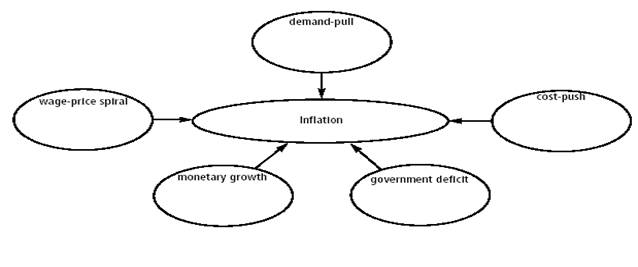
D. Case Study
Read the text and do the tasks given below.
The Effects of Inflation in the 1970s
Background Periods of high inflation can lead to the destruction of a country’s economy. In the 1970s, for example, the United States experienced the biggest and most sustained period of inflation in the country’s 1979, inflation had risen into the “double digits,” that is, to 10 percent per year or higher. The prices of consumer goods – everything from food and gas to cars and houses – rose dramatically. Those on fixed incomes were particularly hard-hit, because as prices rose their limited budgets bought less.
What’s the issue? How did inflation affect people and businesses in the 1970s? Study the sources given below to discover what it was like to live with a high rate of inflation.
How inflation affected the U. S. economy
For the years 1967 through 1978, the U. S. inflation rate averaged 6.1 per cent a year, compared with an average of 2 per cent for the years 1952 through 1967. Even during the 1973–74 recession, unlike most previous recessions, the inflation rate continued at a relatively high rate. In the late 1970s inflation speeded up again, reaching unprecedented levels. Inflation would not be so bad, in the opinion of some economists, if it were accompanied by substantial increases in output and employment. But economic growth in the United States slowed during the high inflation 1970s, bringing on a condition that economists describe as “stagflation.” Another measure of economic health – productivity, or output per worker – also slowed dramatically in [those] years throughout the industrialised world,
and in the United States and Great Britain for a time failed to increase at all. For the United States, a country long accustomed to ever-increasing material wealth, the fall-off in economic growth and the constantly eroding value of the dollar were traumatic developments. If the trends continued, the average American could no longer anticipate a constantly rising standard of living.
Consumers grew impatient with the government’s inability to control
inflation.
Here we are, spending more and getting less, but the [government] economists are optimistic. What makes them so happy? The rate of inflation may have dropped 1 per cent. Just suppose the rate of inflation had gone down from 5 per cent to 4 per cent. To me this is another increase of four cents, and a further shrinkage of my dollar.
Obviously this type of economics is good for someone. It certainly isn’t good for me, or my friends, or my relatives. Everyone is complaining, but the experts are satisfied.
I have a family of meat eaters. Long ago I discovered a marvelous cut of meat called skirt steak. It used to cost 89 cents a pound. It has inched its way up and has recently taken a leap to $1.59 and overtaken sirloin steak. Chopped meat is now where my skirt steak used to be. Even the lowly onion is no longer cheap. A weekly trip to the supermarket, which in 1969 cost $50, now costs $70.
Thinking Economically
1. Explain how the effects of inflation might be offset by increases in output and employment.
2. Why might a small decrease in a large rate of inflation satisfy government economists but upset consumers?
VI. Writing
Write an essay on the following topic.
According to opinion polls, most Americans think inflation is a more serious problem than unemployment. Write a paragraph stating your view on which is more serious. Use convincing reasons and examples.

|
Из за большого объема этот материал размещен на нескольких страницах:
1 2 |
