

Партнерка на США и Канаду по недвижимости, выплаты в крипто
- 30% recurring commission
- Выплаты в USDT
- Вывод каждую неделю
- Комиссия до 5 лет за каждого referral
Note: U. S. exports that benefit from FTA preferences cannot be determined with the data available.
Source: WTO Secretariat, based on U. S. International Trade Commission (USITC), Trade Data Web.
(ii) Unilateral preferences
18. The United States has a long history of providing non-reciprocal preferential trade treatment to developing countries in order to promote economic growth and development. The preference programmes are either global, i. e. the Generalized System of Preferences, or regional, where the five main preference programmes are the Andean Trade Preference Act (ATPA), the Caribbean Basin Economic Recovery Act (CBERA), the Caribbean Trade Partnership Act (CBTPA), the African Growth and Opportunity Act (AGOA), and the Haitian Opportunity through Partnership Encouragement (HOPE) Act. In addition, the United States gives unilateral preferential treatment to imports from: U. S. insular possessions (U. S. Virgin Islands, Guam, American Samoa, Wake Island, Midway Islands, Johnston Atoll, and the Commonwealth of the Northern Mariana Islands); those with Compacts of Free Association (Republic of the Marshall Islands, the Federated States of Micronesia, and the Republic of Palau); and from the West Bank and the Gaza Strip.[7] In order to receive benefits under one or more of the preference programmes, countries have to meet eligibility criteria, which vary by programme, but may include meeting international commitments in worker rights and investment practices, as well as foreign policy objectives such as having an extradition treaty or combating trade in illegal drugs, and other technical criteria such as adhering to rules of origin (Chapter III(1)(iii)(b)).
19. The U. S. Congress sets the statutory guidelines for unilateral preference programmes and is responsible for initiating and passing legislation to amend or re-authorize these programmes. During the past two years Congress has held significant policy discussions on prospective reform of some of these programmes, though they have not yet led to any major changes. The legal authority for the GSP and ATPA programmes lapsed on 31 December 2010 and 12 February 2011, respectively. In October 2011, legislation was enacted re‑authorizing the two programmes until 31 July 2013.[8] Congress may consider changes or reforms in the GSP and ATPA programmes when it next takes up renewal of these two programmes, probably in the first half of 2013. According to the President's Trade Policy Agenda, the growing competitiveness of many emerging‑market GSP beneficiaries may prompt review and reform of the GSP programme.[9]
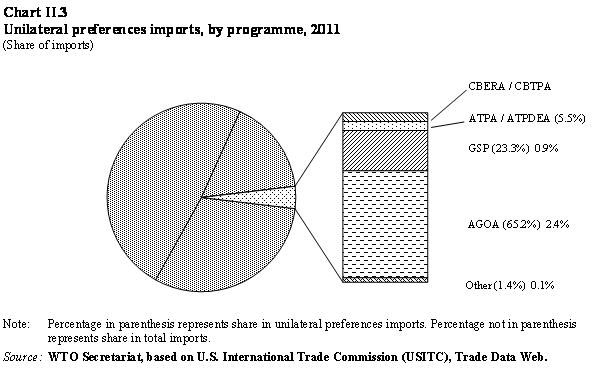
20. U. S. preference programmes taken together accounted for 3.7% of U. S. imports in 2011 (Chart II.3), with AGOA accounting for the largest part, at 2.4% of total imports or 65.2% of unilateral preferential imports, followed by GSP with 0.9% of total imports or 23.3% of unilateral preferential imports.[10] The CBERA/CBTPA and ATPA programmes are very small in terms of trade, accounting for 0.2% of total U. S. imports each (Chart II.3). Imports under the GSP and ATPA declined in 2011 compared to 2010, while those under the AGOA and CBERA increased. The decline in ATPA imports can be attributed to the declining number of participants while the decline in GSP appears to be due primarily to the graduation of Equatorial Guinea from GSP and the shifting of imports from one preference programme to another, i. e. imports from Angola moving from GSP to AGOA preferences. In terms of the products benefiting from unilateral preferences, crude petroleum far outpaced any other product in 2010 and 2011, accounting for over two thirds (68% and 66% by value) of all unilateral preferential imports, respectively. Other main imports under the preference programmes were chemical/fuel products and textiles and clothing.
(a) Generalized System of Preferences
21. In 2011, the Administration worked with Congress to restore authorisation for the GSP programme. In October 2011, the President signed legislation extending GSP until 31 July 2013, with retroactive effect from 1 January 2011 (Table II.4). Due to the lapse of the programme in 2011, the review of petitions seeking waivers of competitive needs limitations (CNLs)[11] was suspended and no actions were taken in 2011 to exclude products from GSP eligibility based on CNLs.[12] USTR launched the 2011 GSP annual review in November 2011. During such annual reviews, USTR and the TPSC consider petitions from interested parties to modify the status of certain GSP beneficiary countries and modify the list of GSP eligible products.[13]
Table II.4
Overview of GSP
Entry into force | 1 January 1976 | ||
Expiry | 31 July 2013 | ||
Beneficiaries | Independent countries: Afghanistan, Albania, Algeria, Angola, Armenia, Azerbaijan, Bangladesh, Belize, Benin, Bhutan, Plurilateral State of Bolivia, Bosnia and Herzegovina, Botswana, Brazil, Burkina Faso, Burundi, Cambodia, Cameroon, Cape Verde, Central African Republic, Chad, Comoros, Congo (Brazzaville), Congo (Kinshasa), Côte d'Ivoire, Djibouti, Dominica, East Timor, Ecuador, Egypt, Eritrea, Ethiopia, Fiji, Gabon, Gambia, The Georgia, Ghana, Grenada, Guinea, Guinea-Bissau, Guyana, Haiti, India, Indonesia, Iraq, Jamaica, Jordan, Kazakhstan, Kenya, Kiribati, Kosovo, Kyrgyzstan, Lebanon, Lesotho, Liberia, Former Yugoslav Republic of Macedonia, Madagascar, Malawi, Maldives, Mali, Mauritania, Mauritius, Moldova, Mongolia, Montenegro, Mozambique, Namibia, Nepal, Niger, Nigeria, Pakistan, Panama, Papua New Guinea, Paraguay, Philippines, Russia, Rwanda, St. Kitts and Nevis, Saint Lucia, Saint Vincent and the Grenadines, Samoa, Sao Tomé and Principe, Senegal, Serbia, Seychelles, Sierra Leone, Solomon Islands, Somalia, South Africa, South Sudan, Sri Lanka, Suriname, Swaziland, Tanzania, Thailand, Togo, Tonga, Tunisia, Turkey, Tuvalu, Uganda, Ukraine, Uruguay, Uzbekistan, Vanuatu, Bolivarian Republic of Venezuela, Yemen, Zambia, Zimbabwe; | ||
Benefits | GSP provides duty-free treatment for 3,509 eight-digit tariff lines for GSP beneficiaries. An additional 1,463 tariff lines are eligible for duty-free treatment when imported from least-developed beneficiary developing countries. Thus, GSP‑eligible tariff lines are 51.3% of dutiable MFN tariff lines, or 72.7% when including GSP LDC tariff lines | ||
Exclusions | Many agricultural, textile and apparel, and other import sensitive products are excluded | ||
Top 3 | 2010 imports (US$ million) | Top 3 | 2011 imports (US$ million) |
By country | By country | ||
Total | 22,554 | Total | 18,539 |
Thailand | 3,612 | India | 3,736 |
Angola | 3,544 | Thailand | 3,720 |
India | 3,482 | Brazil | 2,059 |
Table II.4 (cont'd)
By product | By product | ||
Total | 22,554 | Total | 18,539 |
Crude petroleum | 5,433 | Silver jewellery | 695 |
Silver jewellery | 655 | Aluminium alloy plate/sheet/strip | 493 |
Rubber automotive tyres | 506 | Crude petroleum | 481 |
Note: Trade import data used: "imports for consumption", "customs value", and HTSUS six-digit basis. Beneficiaries as at 30 June 2012.
Source: WTO Secretariat, based on data compiled from USITC DataWeb. Viewed at: http://dataweb. usitc. gov; Harmonized Tariff Schedule of the United States (HTSUS) Revision 3, February 2012; USTR (2012) U. S. Generalized System of Preferences: Guidebook, April. Viewed at: http://www. ustr. gov/webfm_send/2880; and USTR online information, "GSP by the Numbers". Viewed at: http://www. ustr. gov/webfm_send/3017.
22. In 2011 and continuing into 2012, USTR and the TPSC were reviewing the GSP eligibility of Bangladesh, Georgia, Niger, the Philippines, Sri Lanka, and Uzbekistan, based on issues related to worker rights. A worker rights petition from 2008 concerning Iraq remains pending. Country practices petitions on Lebanon, Russia, and Uzbekistan for IPR issues also remained under review in early 2012. Pursuant to Presidential Proclamation 8788 of 26 March 2012, Argentina's status as a beneficiary under the GSP was suspended for failure to act in good faith in enforcing arbitral awards in favour of U. S. corporations, and the Republic of South Sudan was added as a least-developed beneficiary developing country.[14]
23. The United States-Colombia Trade Promotion Agreement entered into force on 15 May 2012. At that time, Colombia ceased to be a GSP beneficiary. Similarly, when the United States‑Panama Trade Promotion Agreement enters into force, Panama will cease to be a GSP beneficiary.
(b) African Growth and Opportunity Act (AGOA)
24. By Presidential Proclamation on 28 October 2011, Côte d'Ivoire, Guinea, and Niger were designated as beneficiary sub-Saharan African countries under the AGOA (Table II.5).[15] Furthermore, they were deemed to satisfy the criterion of "lesser developed beneficiary sub-Saharan African country", and thus receive additional benefits under section 112 (c) of AGOA. On 1 January 2011, also by Presidential Proclamation, the Democratic Republic of Congo was removed as a beneficiary.[16]
Table II.5
Overview of the AGOA
Entry into force | 1 October 2000 |
Expiry | 30 September 2015 |
Beneficiaries | Republic of Angola, Republic of Benin, Republic of Botswana, Burkina Faso, Republic of Burundi, Republic of Cape Verde, Republic of Cameroon, Republic of Chad, Union of the Comoros, Republic of Congo, Republic of Côte d'Ivoire, Republic of Djibouti, Ethiopia, Gabonese Republic, Republic of The Gambia, Republic of Ghana, Republic of Guinea, Republic of Guinea-Bissau, Republic of Kenya, Kingdom of Lesotho, Republic of Liberia, Republic of Malawi, Republic of Mali, Islamic Republic of Mauritania, Republic of Mauritius, Republic of Mozambique, Republic of Namibia, Republic of Niger, Federal Republic of Nigeria, Republic of Rwanda, Democratic Republic of Sao Tome and Principe, Republic of Senegal, Republic of Seychelles, Republic of Sierra Leone, Republic of South Africa, Kingdom of Swaziland, United Republic of Tanzania, Republic of Togo, Republic of Uganda, Republic of Zambia |
Benefits | AGOA provides duty-free treatment for 1,738 eight-digit tariff lines, i. e. 25.4% of MFN dutiable tariff lines (exclusive of GSP lines) |
Table II.5 (cont'd)
Exclusions | Import sensitive products subject to TRQs, certain agriculture, flat goods, and iron and steel products | ||
Top 3 | 2010 imports (US$ million) | Top 3 | 2011 imports (US$ million) |
By country | By country | ||
Total | 38,665 | Total | 51,883 |
Nigeria | 25,154 | Nigeria | 31,004 |
Angola | 6,294 | Angola | 11,534 |
Congo (Republic of) | 1,936 | Chad | 2,991 |
By product | By product | ||
Total | 38,665 | Total | 51,883 |
Crude petroleum | 35,360 | Crude petroleum | 47,434 |
Certain motor vehicles | 1,471 | Certain motor vehicles | 1,995 |
Light petroleum oils | 519 | Light petroleum oils | 801 |
Note: Trade import data used: "imports for consumption", "customs value", and HTSUS six-digit basis.
Source: WTO Secretariat, based on data compiled from USITC DataWeb. Viewed at: http://dataweb. usitc. gov; Harmonized Tariff Schedule of the United States (HTSUS) Revision 3, February 2012; and USTR online information, "Fact Sheet on AGOA". Viewed at: http://www. ustr. gov/sites/default/files/AGOA%20Fact%20
Sheet%202010.pdf.
25. The AGOA third-country fabric provision, seen as successful in promoting the textile and apparel industry in Africa as well as supporting many jobs, is set to expire on 30 September 2012. The U. S. Congress has introduced legislation in this regard, but it has not been enacted into law at this time.
(c) Caribbean Basin Economic Recovery Act (CBERA) and U. S.-Caribbean Basin Trade Partnership Act (CBTPA), including the HOPE and HELP amendments
26. The HOPE amendments to the CBERA agreement, in 2006 and 2008, provided additional duty-free provisions for Haiti, in particular apparel products. A further amendment in January 2010, known as the HELP amendment further extended more flexible and generous tariff preferences to Haiti by allowing third-country inputs to be used as inputs for Haitian exports under the programme.[17] Upon entry into force of the free‑trade agreement with Panama, Panama will cease to be a CBERA/CBTPA beneficiary (Tables II.6 and II.7).
Table II.6
Overview of CBERA
Entry into force | 1 January 1984 | ||
Expiry | No statutory expiry | ||
Beneficiaries | Antigua and Barbuda, Aruba, Bahamas, Barbados, Belize, Dominica, Grenada, Guyana, Haiti, Jamaica, Montserrat, Panama, St. Kitts and Nevis, Saint Lucia, Saint Vincent and the Grenadines, Trinidad and Tobago, British Virgin Islands | ||
Benefits | CBERA provides preferential or duty-free treatment for 5,498 eight-digit tariff lines, i. e. 80.4% of MFN dutiable tariff lines | ||
Exclusions | Most textiles and apparel, leather, canned tuna, petroleum and derivatives, certain footwear, certain watches, and over-TRQ agricultural goods | ||
Top 3 | 2010 imports (US$ million) | Top 3 | 2011 imports (US$ million) |
By country | By country | ||
Total | 1,219 | Total | 1,739 |
Trinidad and Tobago | 930 | Trinidad and Tobago | 1,290 |
Bahamas | 99 | Jamaica | 179 |
Jamaica | 84 | Bahamas | 124 |
Table II.6 (cont'd)

|
Из за большого объема этот материал размещен на нескольких страницах:
1 2 3 |
