

Партнерка на США и Канаду по недвижимости, выплаты в крипто
- 30% recurring commission
- Выплаты в USDT
- Вывод каждую неделю
- Комиссия до 5 лет за каждого referral
II. TRADE policy and investment REGIMEs
(1) Trade Policy Formulation and Framework
1. The U. S. Constitution grants Congress the power to regulate foreign commerce and authority to establish rates of duty. The Executive branch under the President also has certain roles in trade policy. These may include periodic delegation of authority and negotiation of trade agreements, i. e. under special fast‑track procedures, which include intensive consultations, followed by eventual approval and implementation by Congress. Thus, both the Congress and the President have roles in developing U. S. trade policy (Chart II.1).
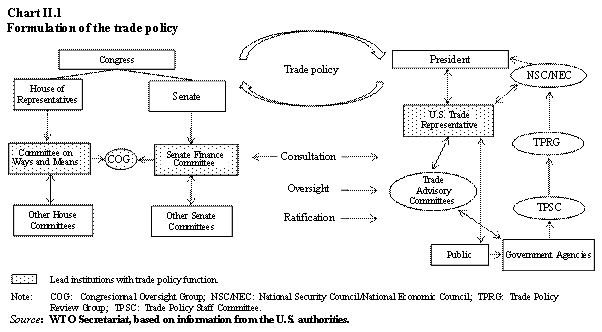
2. On the Congressional side, a number of Congressional bodies or groups have specific trade policy functions. The Trade Act of 2002 established the Congressional Oversight Group (COG), which is authorized to provide advice to the President and USTR on a variety of trade policy matters. For example, it provides direction with respect to negotiating strategies and positions, the development of trade agreements, and compliance and enforcement aspects of trade agreements. Also, the Trade Act of 1974 provides for the House Committee on Ways and Means and the Senate Finance Committee to designate five members each to advise on trade policy and negotiations.[1]
3. USTR has primary responsibility for coordinating and developing trade policy for the Executive branch. Under the Trade Expansion Act of 1962, Congress established an interagency trade policy mechanism to assist USTR with the implementation of these responsibilities. The mechanism has three tiers: the National Economic Council located in the White House, the Trade Policy Review Group (TPRG), and the Trade Policy Staff Committee (TPSC), the latter two chaired by USTR. The TPSC and TPRG are composed of 21 members from various government Departments, Councils, Offices, or Agencies, and USTR can invite participation of others when appropriate. The NEC, at the highest level, is chaired by the President and has cabinet level representation.[2]
4. As part of the reporting and consulting process with Congress, the President is mandated through the Trade Act of 1974 to report annually on the operation of the trade agreements program and the national trade policy agenda. The President's annual Trade Policy Agenda, prepared by USTR, typically sets out the Administration's trade policy priorities for the year. On a broader level, U. S. trade policy is informed by U. S. economic and foreign policies and as such its objective is to enhance national economic welfare.
5. Trade legislation is enacted in the same manner as other laws, through passage by both houses of Congress and approval by the President. For example, the United States implemented the Marrakesh Agreement through the Uruguay Round Agreements Act (URAA) under this procedure.[3] During certain periods since 1974, Congress has put in place special "fast track" or "trade promotion authority" procedures under which the Congress commits to vote on trade agreement implementing legislation within a fixed period, and without amendment, once the President submits an implementing bill. The most recent set of these procedures covered trade agreements signed between 2002 and mid-2007.
(2) Participation in the World Trade Organization
6. According to the U. S. Trade Policy Agenda, the United States is "committed to preserving and enhancing the WTO's irreplaceable role as the primary forum for multilateral trade liberalization, for the development and enforcement of global trade rules, and as a key bulwark against protectionism".[4] The United States continues to support, participate and pursue trade initiatives and further liberalization through the WTO's multilateral trade framework. Furthermore, the United States is committed to contributing constructively and creatively to the functioning of the WTO, in particular, acknowledging that the WTO Doha Round is at an impasse, it is committed to fresh and credible approaches to new market-opening trade initiatives.[5]
7. As an original Member of the WTO, the United States adheres to all the multilateral agreements and disciplines, and participates in several plurilateral agreements, i. e. the Agreement on Civil Aircraft, Agreement on Government Procurement, and the Information Technology Agreement. The United States has further liberalized certain goods and services sectors, participating in the pharmaceuticals initiative, Uruguay Round zero-for-zero sectorals, and additional commitments on telecommunications and financial services.
8. The United States is active in all aspects of WTO work, including the on-going negotiations, regular Committee work, reporting and monitoring, development aspects, accessions, and in the dispute settlement arena. During 1 January 2010 to 30 June 2012, the United States submitted 22 proposals or communications to the negotiating groups; the majority of these concerned the Negotiating Group on Market Access. During the same period, the United States was a respondent in eight dispute settlement cases, was a complainant in seven cases, and participated as a third party in seven panel proceedings. The United States was involved in seven appeals processes and involved in three implementation or arbitration matters (Table AII.1).
9. The United States also contributes to improving the transparency of the WTO, its trade rules, and creating a clear and effective system by providing information through the WTO notification process and promoting the use of open and transparent meetings and hearings. Of the 11 panels that have permitted open hearings at the request of the parties to the dispute, the United States was involved as a complainant or respondent in 9. Similarly, the United States was an appellant or appellee in 7 of the 8 public hearings that have been held by the Appellate Body. In addition, the United States was a party in both instances where an Arbitrator held open hearings.
10. The United States has made new or updated notifications during the period under review covering a diverse range of WTO disciplines (Table AII.2). However, it appears that some changes or updates to U. S. trade laws or procedures would require updated or amended WTO notifications. In particular, as noted in other parts of this report or in previous Reviews, new notifications are likely necessary in the areas of rectifications and modifications of schedules, preferential rules of origin, quantitative restrictions, and with respect to preference programmes like the GSP.
(3) Preferential Trade Agreements and Arrangements
11. Since its last Trade Policy Review, the United States has moved ahead with the legislative approval of three free‑trade agreements and the extension of two lapsed preference programmes. To date it has put into effect its trade agreements with the Republic of Korea and Colombia, and is working with Panama to put that agreement into effect. The United States has also extended two preference programmes (Generalized System of Preferences and the Andean Trade Preferences Act that had lapsed). Furthermore, as part of the President's 2012 Trade Policy Agenda, important priorities were announced with respect to concluding a bold and ambitious Trans-Pacific Partnership agreement and building better export markets through regional economic integration.[6]
12. Preferential trade accounts for an important and growing part of U. S. trade. In 2011, 20.1% of U. S. imports were under preferential regimes, reciprocal preferences accounted for 16.4% and unilateral preferences for 3.7% (Chart II.2). While imports under unilateral preference programmes remained flat, at US$80 billion in 2011 compared to 2010, in part due to the lapse of the GSP and ATPA programmes, reciprocal FTA imports increased 15% in pared to similar figures for 2008, a peak year for U. S. trade, FTA preferential imports were 15.8% of the overall import share compared to 16.4% in 2011.

(i) Reciprocal trade agreements
(a) New agreements with Colombia, the Republic of Korea, and Panama
13. Legislation approving the free-trade agreements with Colombia, the Republic of Korea, and Panama, negotiated and signed during the previous Administration, was enacted by the U. S. Congress and signed into law by the President in October 2011. The United States-Republic of Korea FTA entered into force on 15 March 2012, and the U. S.-Colombia FTA entered into force on 15 May 2012. As of July 2012, the agreement with Panama is not yet in force. As Congress and the current Administration had a number of concerns regarding the agreements, thus the U. S. Administration did not send the agreements to Congress for approval until it considered that the concerns had been adequately addressed. Thus, certain changes or additions have been agreed in the interim, resulting in amendments or new exchanges of letters.
14. The free‑trade agreement with Korea is expected have a substantial impact on trade, and longer term impact on GDP and investment, as Korea is the United States' seventh largest trading partner (Table II.1). The effects of the agreements with Colombia and Panama are expected to be much smaller. Most imports from Colombia and Panama already benefit from unilateral preference programmes or MFN duty-free entry, and they rank 25th and 52nd as trading partners. In terms of trade, the Republic of Korea is expected to quickly become the United States' second largest FTA partner after NAFTA.
Table II.1
Economic impact and predictions for the new free-trade agreements
FTA partner | Impact on U. S. merchandise exports to partner | Impact on U. S. merchandise imports from partner | Impact on U. S. services' exports to partner | Impact on U. S. services' imports from partner | Impact on U. S. GDP | Impact on U. S. investment in partner |
Colombia | +US$1.1 billion | + US$487 million | Small increase | No measurable effect | + US$2.5 billion | Small positive effect |
Korea | + US$9.7 billion to US$10.9 billion | + US$6.4 billion to US$6.9 billion | Increase | No substantial impact | + US$10.1billion to 11.9 billion | Could increase substantially |
Panama | Small but positive | No significant growth | Small increase | No significant effect | Small | Possible medium and long-term effect |
Source: USITC (2006), U. S.-Colombia Trade Promotion Agreement: Potential Economy-wide and Selected Sectoral Effects, Publication 3896, December. Viewed at: http://www. usitc. gov/publications/332/pub3896.pdf; USITC (2007), U. S.-Korea Free Trade Agreement: Potential Economy-wide and Selected Sectoral Effects, Publication 3949, September. Viewed at: http://www. usitc. gov/publications/pub3949.pdf; and USITC (2007), U. S.-Panama Trade Promotion Agreement: Potential Economy-wide and Selected Sectoral Effects, Publication 3948, September. Viewed at: http://www. usitc. gov/publications/pub3949.pdf.
15. Detailed analysis of the three new agreements is beyond the scope of this report, but a few prominent points are summarized in Table II.2.
Table II.2
Overview of the new U. S. FTAs, 1 January 2010-30 June 2012
United States and Colombia | |
Passage of U. S. legislation / entry into force | 21.10.2011 / 15.05.12 |
Transition to full implementation | Agriculture product tariffs phased out over 15 years |
Main products excluded from liberalization | TRQ on sugar; exemption from national treatment and exception of the export restriction rules for logs |
Other measures | Textile safeguard measure; agriculture safeguard measure; sugar compensation mechanism |
Table II.2 (cont'd)
U. S. merchandise trade (2011) | Imports: US$22,390 million, 1% of total U. S. imports |
of which preferential imports | US$3,059 million or 14% |
of which MFN duty-free importsa | US$9,150 million or 41% |
U. mercial services trade (2010) | .. |
WTO document series | WT/REG314 |
United States and the Republic of Korea | |
Passage of U. S. legislation / entry into force | 21.10.2011 / 15.03.2012 |
Transition to full implementation | Agriculture product tariffs phased out over 23 years |
Main products excluded from liberalization | TRQs on most products retained; exemption from national treatment and exception of the export restriction rules for logs |
Other measures | Motor vehicle safeguard measure; agriculture safeguard measure; exclusion of imports of the other party when invoking a global safeguard measure |
U. S. merchandise trade (2011) | Imports: US$56,006 million, 2.6% of total U. S. imports |
of which preferential imports | 0 |
of which MFN duty-free importsa | US$29,552 million or 53% |
U. mercial services trade (2011) | Imports: US$8,377 million, 2.1% of total U. S. imports |
WTO document series | WT/REG311 |
United States and Panama | |
Passage of U. S. legislation / entry into force | 21.10.2011 / not yet entered into force |
Transition to full implementation | Agriculture product tariffs phased out over 15 years |
Main products excluded from liberalization | TRQ on sugar; exemption from national treatment and exception of the export restriction rules for logs |
Other measures | Textile safeguard measure; agriculture safeguard measure; sugar compensation mechanism |
U. S. merchandise trade (2011) | Imports: US$388 million, 0.02% of total U. S. imports |
of which preferential imports | US$56 million or 14% |
of which MFN duty-free importsa | US$322 million or 83% |
U. mercial services trade (2010) | .. |
WTO document series | Not yet notified |
.. Not available.
a MFN duty free and other duty free, including product‑specific and unilateral preferences.
Source: USTR online information, "Free Trade Agreements". Viewed at: http://www. ustr. gov/trade-agreements/free-trade-agreements; WTO documents; and USITC Data Web.
(b) Overview of the other free‑trade agreements
16. At the end of 2011, the United States had 11 bilateral or regional free‑trade agreements in force with 17 countries, which accounted for 16.4% of total U. S. imports. However, this figure may underestimate the trade, as it only provides for trade that would otherwise be dutiable, it does not account for all imports from the partner country, as MFN duty-free trade is not included. As MFN duty-free trade accounts for nearly 50% of U. S. imports (Chart II.2), it may also be important to analyse these two types of imports in tandem (Table II.3). Clearly the majority of imports from FTA partners receive benefits, with 90% or more of trade entering duty free from partner countries, with the exception of the two most recent free-trade agreements, with Oman and Peru, which entered into force in 2009.
17. United States' FTA trade is dominated by NAFTA partners, which accounted for 91% of total imports under FTAs, and 77% of exports to FTA partners in 2011. For the first time, in 2011, Mexican imports under NAFTA preferences surpassed Canadian imports. Crude petroleum and passenger motor vehicles were the top imported products from NAFTA partners in 2010 and 2011. The United States maintains a positive trade balance for 8 of its 11 free‑trade agreements, although it maintains a significant trade deficit with the NAFTA countries (Table II.3). CAFTA-DR partner countries (Costa Rica, the Dominican Republic, El Salvador, Guatemala, Honduras, and Nicaragua) and Chile are the next most significant import suppliers, although they account for only 3.3% and 1.6% of preferential imports in 2011 (Table II.3).
Table II.3
Trade under reciprocal trade agreements, 2011
(US$ million, unless otherwise indicated)
FTA partner(s) | Imports under FTA preferences | Other duty‑free imports (MFN duty free, etc.)a | % of imports entering duty‑free | Total imports from FTA partner(s) | Total exports to FTA partner(s) | Trade balance |
Australia | 3,034 | 6,668 | 95 | 10,173 | 25,491 | 15,318 |
Bahrain | 326 | 180 | 98 | 518 | 1,166 | 648 |
Chile | 5,706 | 3,299 | 98 | 9,170 | 14,498 | 5,328 |
Israel | 2,661 | 19,810 | 98 | 23,018 | 8,084 | -14,934 |
Jordan | 870 | 181 | 99 | 1,060 | 1,410 | 350 |
Morocco | 201 | 694 | 90 | 991 | 2,842 | 1,851 |
Oman | 1,526 | 224 | 80 | 2,184 | 1,369 | -815 |
Peru | 3,079 | 2,213 | 87 | 6,059 | 7,412 | 1,353 |
Singapore | 1,138 | 16,952 | 95 | 18,982 | 28,224 | 9,242 |
NAFTA | 326,548 | 216,285 | 94 | 578,891 | 393,684 | -185,207 |
Canada | 162,733 | 126,742 | 92 | 316,257 | 233,774 | -82,483 |
Mexico | 163,815 | 89,543 | 96 | 262,634 | 159,910 | -102,724 |
DR-CAFTA | 11,912 | 14,651 | 95 | 27,932 | 28,403 | 471 |
Costa Rica | 1,367 | 8,501 | 98 | 10,111 | 5,565 | -4,546 |
Dominican Rep. | 2,251 | 1,727 | 96 | 4,152 | 6,963 | 2,811 |
El Salvador | 1,913 | 458 | 96 | 2,479 | 3,167 | 688 |
Guatemala | 1,829 | 1,842 | 89 | 4,129 | 5,857 | 1,728 |
Honduras | 3,270 | 1,046 | 97 | 4,457 | 5,851 | 1,394 |
Nicaragua | 1,282 | 1,077 | 91 | 2,604 | 1,000 | -1,604 |
a MFN duty free and other duty free, including product‑specific and unilateral preferences.

|
Из за большого объема этот материал размещен на нескольких страницах:
1 2 3 |
