

Партнерка на США и Канаду по недвижимости, выплаты в крипто
- 30% recurring commission
- Выплаты в USDT
- Вывод каждую неделю
- Комиссия до 5 лет за каждого referral
One of the principle goals of the Standard introduction is the increase of the managing ability, transparency and economic efficiency of IT-servicing due to the structuring of IT management processes.
3.2. The scope of the Standard
The given Standard cover all the departments of OJSC “MOESK” and determines interaction rules with outer organizations taking part in the provision of IT-services as to the requirements to these organizations on part of OJSC “MOESK”.
3.3. The information technologies
In the framework of the given Standard the following information technologies relate to the sphere of activity of OJSC “MOESK”:
Factory automation control systems (FACS), application software, business-enclosures.
IT-infrastructure and its elements.
Networked infrastructure and services.
The connection, telemechanics, the systems of dispatching and technological management (SDTM).
Systems and technique security tools.
The industrial automation, automated process control system (APCS).
4. The business model of the interaction
In OJSC “MOESK” a mixed interaction model pursuant to Standard 1, p. 12, point 2.4.3 is used.
A mixed model is based on an Outsourcing and Insourcing simultaneously used in OJSC “MOESK” in the course of IT structuring.
A maintenance department of IT being an inner department of OJSC “MOESK” renders a part of IT services for OJSC “MOESK” in a mixed model and a special Service Organization (or a series of organizations) being separate legal persons not managed by OJSC “MOESK” renders a part of IT services. A mixed model is shown is shown at picture 1.
Contracts for IT services (both inner and outer) are concluded at a tender basis.

Pic 1. A mixed model
Two management verticals are to be established in OJSC “MOESK” as to IT:
IT Director is the Customer Office playing a role of a customer as to IT-services;
A chief of MDIT is Maintenance department of IT rendering IT services;
Contracts for IT services and projects are concluded at a tender basis.
IT Director (a strategic management level) and the Customer Office (a tactical and operational management level) are responsible for IT management in OJSC “MOESK”.
CO is responsible for IT-needs satisfaction of business departments of OJSC “MOESK” and controls on part of OJSC “MOESK” the contracts fulfillment for IT-services.
A maintenance department of IT submits administratively neither to an IT Director nor to a Customer Office. A Maintenance department by IT submits to a Chief of MDIT.
IT personnel rendering IT-services belong to an inner IT Maintenance department.
A Customer Office manages the IT budget in OJSC “MOESK”, the contracts conclusion with MD;
Services for services rendering are rendered at a basis of contracts:
legal contracts concluded with a Maintenance organization which is an outer legal person.
inner contracts concluded with IT Maintenance department.
CO has a right in the framework of an IT-budget to attract additional third off-site organizations to fulfill IT projects.
5. The Customer Office
5.1. The destination
The Customer Office (hereinafter referred to as CO) is an organizational structure included in OJSC “MOESK” and is (in terms of GOST R ISO/MEK 12207):
A Supplier of IT-services for business departments (Functional Customers) of OJSC “MOESK”.
A Customer for IT-services suppliers being outer and inner in respect to OJSC “MOESK”.
5.2. Responsibility limits
In organizational structures a Customer Office is a supplier of IT-services for all the business departments and departments of business support included in OJSC “MOESK”.
In geographical borders a Customer Office is a supplier of IT-services at all the work facilities of OJSC “MOESK” employees where a provision of corresponding services is necessary.
In services a Customer Office is a supplier of services which are related by OJSC “MOESK” to IT services and integrated in an “IT services catalogue» of OJSC “MOESK”.
In assets a Customer Office is responsible for an efficient use of all the assets in terms of technological systems as to IT, used for services rendering. The services are property of OJSC “MOESK”, rent by OJSC “MOESK”, given for the usage of OJSC “MOESK”.
5.3. Solvable objectives
Objectives solved by CO are distributed by following directions:
The control of a Customer’s satisfaction:
CO is must understand needs of FC and give him IT – decisions necessary for FZ pursuant to an after-sales service contract and a service level agreement (SLA).
The control of MD:
A constant control and audit of MD activity related to IT-services rendering. The establishment of stable partner relationships with MD which will make it possible to supply FC with the best IT-services.
The IT-budget management:
The planning and management of IT-budget.
The management of technologies and innovations:
The provision of IT development subject to recent technologies pursuant to Standards of ME.
The management of projects and programs of high importance for business:
The planning, organizations of work by the implementation, the implementation management.
The management of IT costs:
The main activity of CO must provide a maximally efficient management of IT costs. The activity of CO is concentrated on control and management of a Service Structure.
5.4. The organizational structure
CO is a unique service satisfying all the needs of ME as to IT. The Customer Office submits to an IT Director who in his/her turn submits directly to a chief of OJSC “MOESK”.
The duties of the IT Director are:
· The management of CO.
· The management of IT Budget.
· The establishment of IT-strategy and provision of its fulfillment.
· The development and support of an adequate organizational structure providing a satisfaction of information/transaction needs of Business by means of a rational and economically efficient It-policy.
· The implementation of a general organization management by means of relationships with MD.
· The management by means of negotiations with MD by all the aspects of the interaction.
· The control of work figures of MD.
· The control over execution of contractual obligations between MD and ME.
· A decision making about penalties to MD. If services are rendered by an inner IT-service then penalties are not applied but penalties are administratively imposed my means of an appeal toward the governing board of OJSC “MOESK”.
· A quantitative number and a detailed organizational structure of the Customer Office are determined by the Director of OJSC “MOESK” by a representation of IT Director. The structure of the departments of the Customer Office in OJSC “MOESK” is determined by following documents:
· An instruction about an appointment of an IT director;
· The organizational structure and the personnel arrangements defined in OJSC “MOESK” and developed at the basis of OJSC “MOESK” Standard and a table of the roles combination.
Thereby while establishing a structure and provisions about departments of the Customer Office they must be formed pursuant to Standard 1, p. 19, point 3.6.
5.5. The Budget of the Customer’s Office
The budget of the Customer’s Office is integral part of the Customer’s IT-budget and is composed of the following articles of expenditures:
· The costs for keeping of a full-day staff:
o A salary of personnel
o Taxes by personnel’s salary
o Premiums of the personnel
o Taxes by premiums
o Teaching and certification
o Material aid to employees
o Insurance costs for the personnel
o Corporate arrangements
o Other costs for the personnel
· Expenditures for keeping of outsourced employees
· Communication services and post
The given line doesn’t take into account costs communication services and dataware for one’s own needs of the Customer Office
o Communication services - Internet
o Communication services - telephone
o Post services, courier
o Subscription for and dataware
· Travel costs
· Costs for a building rent
· Transport costs
A recommended planning period is 1 year.
6. The Service Structure (IT Maintenance Department)
6.1. The destination
IT Maintenance Department (hereinafter referred to as MDIT) is an organizational structure included in OJSC “MOESK”:
· A supplier of IT-services to end consumers of OJSC “MOESK”.
· A supplier of solutions to IT Customer Office (hereinafter referred to as CO).
· A developer of solutions as to IT for CO.
· A maintainability personnel of IT systems.
· A personnel operating IT systems.
A customer for MDIT is a Customer Office of OJSC “MOESK”.
6.2. Responsibility limits
In organizational structures IT Maintenance Department is a supplier of IT-services for all the users of business departments and business support departments included in OJSC “MOESK” which are indicated in Contracts (enclosures, appendixes to contracts).
In geographical borders IT Maintenance Department is a supplier of IT-services to users at all the work facilities of OJSC “MOESK” employees who are indicated in Contracts (enclosures, appendixes to contracts).
In services IT Maintenance Department is a supplier of services to users who are related in OJSC “MOESK” to IT services (voice network, networked services, file-oriented services, post services, print services, enclosures etc.) and are integrated in “IT services Catalogue) of OJSC “MOESK” included in Contracts.
In assets IT Maintenance Department is responsible for an accounting and efficient usage of all the assets in the framework of technological systems used to render services, transmitted for operation and maintainability of MD pursuant to Contracts and Agreements (OLA).
6.3. Solvable objectives
The given Document enumerates objectives which must be solved by MDIT for OJSC “MOESK” and for the sake of OJSC “MOESK” interests.
Objectives solvable by MDIT are distributed by following directions:
· The provision of FC’s satisfaction
A volume of services rendered, their quality and timeliness must satisfy needs of business departments (FC). The objective demands a personal attention on part of the governing board of the Department by work with the Customer and Managers by rendering services and includes the joint with CO development of plans on how to render It-services and control the satisfaction of the Customer. The plans of satisfaction control are meant to reveal would-be problems and arrangements fulfillment by problems elimination and situation melioration.
· The costs management
The goal of the given group’s tasks fulfilling is a constant and efficient costs management and their optimization in terms of preservation of guaranteed quality of services. The development and fulfillment of a set of plans on how to optimize a costs structure (the plans by an introduction of recent technologies on how to render It-services, the plans by MD management perfection etc.).
The activity reformation by services rendering
The goals are a costs decrease for IT. The constant activity perfection by services rendering and a development of the best technical solutions aimed at increasing of services quality and decreasing a cost per point of IT-services.
· The accounting and management of IT assets
The provision of authentic information of planning and costs control processes, book-keeping and management accounts in OJSC “MOESK”, the solution of objectives of a proactive control of IT infrastructure, the provision of objective data for the control of service levels.
· The management of the personnel
The provision of an optimal balance of an efficient governance, motivation and development of the personnel and a competence of services rendered.
6.4. The organizational structure
MDIT submits to a Director of MDIT who in his turn submits to IT Director.
Pursuant to Standard 1 two department must be established in MDIT:
· A department by work with a Customer (DWC).
· A Production Center (PC).
If necessary a third department can be established in MDIT – an expertise Center.
The department by the work with the Customer is a structural unit of MDIT which is the main partner and the unique interaction point for the Customer Office by all the issues as to IT.
A Production Center is a structural unit of MDIT producing and representing Customer IT-services of a needed quality corresponding to the services catalogue.
An expertise Center is a structural unit of MDIT making expertise (a human resource involvement) needed to implement IT projects.
A staff composition of the Service Structure is determined by requirements to functionality, Standard of OJSC “MOESK”.
6.5. The department by work with the Customer
The department by work with the Customer is Customer-oriented in its work (in person of CO). DWC is responsible for:
· Rendering within deadlines of qualitative services satisfying Business needs pursuant to concluded Contracts.
· The management of all the complex of service level Agreements, the support of a client’s satisfaction and the optimization of the current costs.
· Giving of recommendations and Consulting of the Customer Office by any issues as to IT.
· Giving information about technologies and innovations.
· Determining a structure of expenses for IT-services, prices for IT-services. DWC agrees a price for IT-services with CO.
Tasks of the Department by work with the Customer are grouped by following fields:
· A provision of a Customer’s satisfaction:
The task includes a constant activity implementation by a reveal and establishment of a Customer’s needs, the planning and control of arrangements by representing necessary services to a Customer, the control of risks and problems which appear (including an organization and a timely arrangements fulfillment by risks minimization and problems solution for the sake of a Customer’s interests).
· The costs management:
The price calculation for services and products for the Customer.
· The provision of a high quality of services:
The control of PC’s activity as to a provision of qualitative services.
· The personnel management:
A certification support and necessary personnel quantity of DWC.
6.6. The organizational structure of DWC
DWC submits to a Chief of DWC who in his/her turn submits directly to a chief of MDIT.
A chief of DWC is mainly responsible for the work with Functional Customers. His duties are the following: the relationships managements between CO and FC, the provision of FC’s satisfaction, the problems solution of FC represented by a governing board and the reveal of new possibilities for the expansion of MD business.
In the course of DWC establishment beside a Chief of DWC the following functional and role structures can be formed pursuant to Standard 1:
· Helpers of the department’s chief.
· Business office.
· A department by control of services provision.
6.7. The production Center
The production center is a structural unit of MDIT producing and providing IT-services to ME users pursuant to a services catalogue and having a standard management system for regionally distributed services.
The production center is responsible for:
· IT-services production;
· A provision of a needed level of services quality;
· An efficient IT resources usage OJSC “MOESK”;
· A proactive IT resources management of OJSC “MOESK”;
· An efficient distribution of own resources;
· An optimization of operating costs.
The objectives of the Production Center are grouped by the following fields:
· The provision of FC satisfaction
A provision of optimal services pursuant to a service level fixed in Service Level Agreements (SLA).
· The costs management
A development of a set of plans securing an optimization of costs’ structure.
· The activity reformation by services provision
The introduction of new IT-instruments and technologies by IT-services provision.
· The personnel management
The balance support between efficient governance and proper employees’ motivation.
6.8. The organizational structure of PC
PC submits to a PC Chief who in his/her turn submits directly to a Chief of MDIT.
In the course of PC establishment beside a Chief of PC Competence Centers must be established pursuant to Standard 1. The number and types of competence Centers are defined by a quantity and type of services which are necessary for OJSC “MOESK”. The quantity is regulated by Standard 1.
6.9. The establishment of MDIT
A quantitative number and detailed organizational structure is determined by the Director General of OJSC “MOESK” on submission of a MDIT Chief or IT Director. The structure of MDIT departments in OJSC “MOESK” is defined by following documents:
· Instructions about appointments of a MDIT Chief, DWC Chief and PC Chief;
· The organizational structure and the personnel arrangements approved by OJSC “MOESK”.
Thereby in the course of the structure establishment and provisions about MDIT departments they must be established pursuant to Standard 1.
6.10. The budget of MDIT
The given section of the Standard defines a budget structure of the Maintenance Department (MDIT)
The budget of MDIT (the budget template of MDIT is given in Standard 2) is composed of the following articles:
· The implementation of services
The given article includes the cost of services planned for the implementation at the basis of a Production program agreed with CO.
· Operating costs
The article includes the following points:
o The prime cost of spare parts and accessories
§ The purchase value of spare parts and accessories
§ The transportation of spare parts and accessories
o The prime cost of the operating supply
§ The purchase value of the operating supply
§ The transportation of the operating supply
· The expenses for the production personnel
o The salary of the production personnel
o Taxes by salaries of the production personnel
o Premiums of the production personnel
o Taxes by premiums of the production personnel
o A teaching and certification
o A material aid to employees
o Expenses for the insurance of the personnel
o Corporate arrangements
o Other expenses for the personnel
· Travel costs
· Transport costs
· The rent of buildings
· Communication services and post (for own needs)
o Communication services – Internet
o Communication services – Telephone
o Post services, a courier
o A subscription for the information provision
The recommended planning period is 1 year.
7. The services management.
7.1. Services
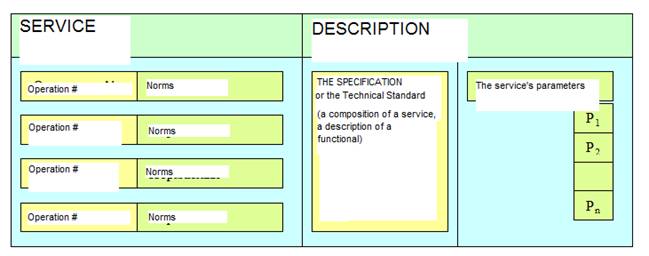
A service (IT-service) is a formalized activity made for the sake and by an instruction of a Customer and having controllable parameters.
The service is described by a name, destination, composition (a set of operations and works made), norms for the fulfillment of operations and works, the functional represented, limiting values of controllable parameters.
The service is formed as a set of normalized (parameterized) operations made in order to provide a declared functional.
Thereby the composition of a service, the represented functional and controllable parameters of a service are fully described in the data sheet (or in the Specification of a Service)
Pic.2 A service
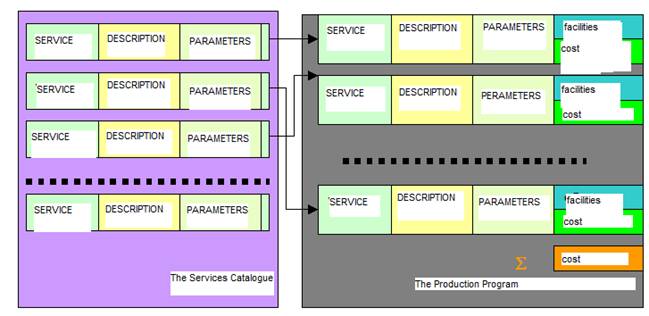
Pic.3 Production programs
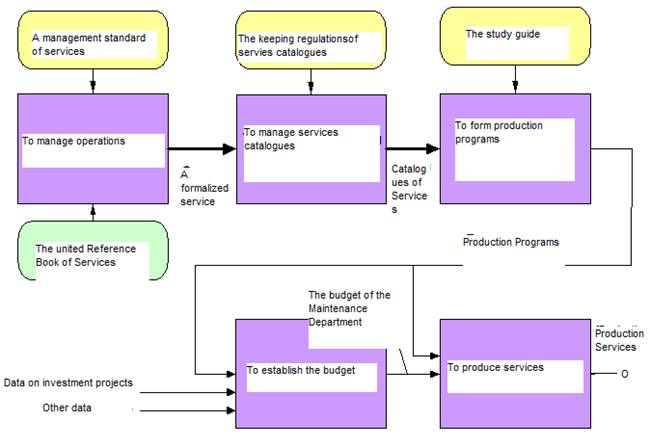
In the framework of services management process the following sub-processes are implemented:
· The service establishment (the operations management)
· The management of services’ catalogues (the management of services portfolio)
· The establishment of the production program
· The establishment of the IT-budget.
 Pic. 4 Sub-processes of services management
The following instruments for services management are used:
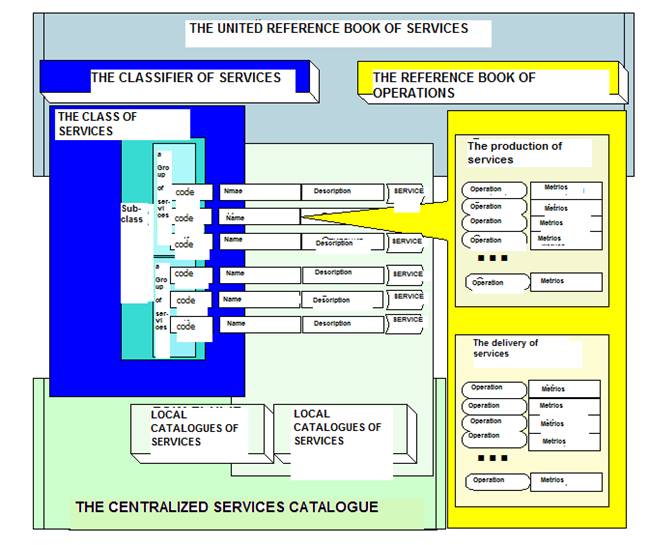
· A united services reference book (USRB)
o A classifier of services (CS)
o A reference book of operations (RBO)
· Catalogues of services
o A centralized services catalogue
o Local catalogues of services
· Calculating flow sheets (CFS)
· Standard forms of the Production Program
· Standard forms of budgets
The classifier of services sets principles of services classification, comprises the main classes and subclasses of services which aren’t subject to change and also rules on how to include new established services in the classifier.
The reference book of operations comprises the classifier of operations and works made by way of the services provision. Thereby a set of metrics is juxtaposed to each operation. The metrics characterize parameters of a service provision (including time rates for the operations fulfillment).
The order of services is made by the Catalogue of Services (the Centralized or local catalogue).
The catalogues of services are a written description of a full set of IT-services which can be demanded by the Functional Customer (FC) and include quality parameters of servicing by way of service levels and the cost for each service level. The Centralized services catalogue and Local services catalogues are used.
The Local Services Catalogues include services which the given Functional Customer needs; thereby the parameters of services and norms of operations can be exclusive for the given Customer. It’s established by the Customer Office of OJSC “MOESK”/ME.
The Centralized Services Catalogue includes services which can be demanded by the Functional Customer (FC) for each service level, for all the organizations interacting with OJSC “MOESK” as to IT service.
The approval procedure of reference books is defined by the governing board of OJSC “MOESK”.
Pic.5 The United Services Reference Book and Catalogues of Services
7.2. The operations management
The reference book of operations (RBO) comprises a list of operations necessary and desired to provide a concrete service. The fulfillment parameters are set for each operation in particular temporary norms (the average time of the operations fulfillment the average frequency of the operations fulfillment), the criticality (obligatoriness) of the operation.
The description of an operation consists of the following fields:
· The code of the operation (pursuant to USRB)
· The name of the operation (pursuant to the Classifier of Operations)
· The classes of serviced facilities (pursuant to the Classifier of Objects)
· The average durability of the operation (in hours)
· The resource used (a rating of a specialist)
· The number of resources (specialists) for one serviced facility
· The fulfillment frequency of the given operation in average, in a month (operations in a month)
· The criticality of the given operation for a service provision (a number which is less or equal to 1, thereby 1 means that the given operation is a must, 0 means that the operation’s criticality isn’t defined)
The Centralized Services Catalogue comprises the recommended norms (parameters) of the operations fulfillment.
Local Catalogues of services comprise norms (parameters) of the operations fulfillment agreed by the Market Entity (the Customer Office).
The operations represented in the Reference book (RBO) are used to establish services.
New operations are introduced in RBO pursuant to the Regulation on how to conduct the United Reference Book of Services.
7.3. General principles of a service establishment
From the point of view of an executor a service is a set technology including sets of operations and works and also the resources used. Besides that in the course of a service establishment and provision the services of third organizations can be used (subcontractors). The Customer can also be given different material subjects (devices, systems, components, the operating supply etc.).
In the establishment course of a principally new service the information included in USRB is insufficient and a project by a service development is initiated.
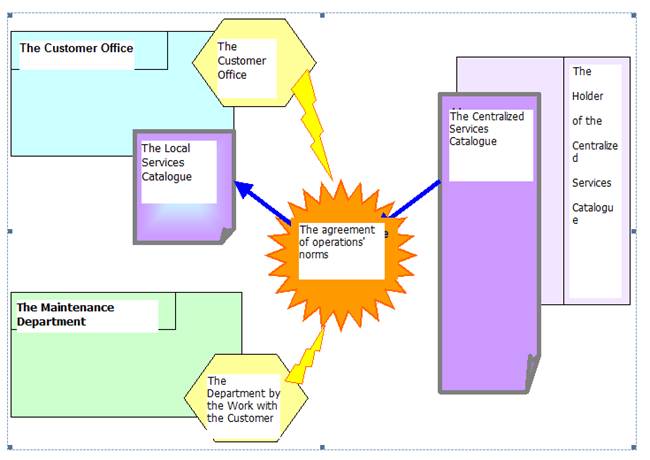
Pic. 6 The usage of the centralized services Catalogue for the establishment of the local catalogue
7.4. The adaptation of the existing service
Services included in the Centralized services Catalogue can be adapted specified by local conditions and introduced in the corresponding local Services Catalogue.
The works by the services adaptation are made by CO together with a supplier of services.
A proprietor of the local services Catalogue is CO of OJSC “MOESK”
The actions which are described in detail in section “Stages of a service establishment” of the given Standard are made to adapt a service.
To adapt a service specified by local conditions the parameters of a service provision are changed in the following ways:
· Own rating of specialists is set (point 6.6, table 2)
· A set of operations is amended. Thereby a set of operations made cannot exclude operations and groups of operations defined by the Reference Book of Operations as obligatory. The introduction of additional operations not stipulated by the Reference Book of Operations is possible if such additional operations don’t result in the change of the represented functional and the service’s essence.
· Temporary norms of operations fulfillment are amended. Time rates (the average durability frequency of the operation fulfillment) are formed subject to the values set in the Centralized Catalogue of services and subject to the conditions of the service provision, the composition of serviced facilities etc.
7.5. The establishment of a new service
From the point of view of the establishment order there are three variants of a new service establishment:
· The establishment of a new service as a changed and simplified variant of the existing service.
· The establishment of a new service from the group of the existing services.
· The establishment of a principally new service.
7.6. The stages of the service establishment
The service is fully defined by following parameters:
· The description of the functional (possibilities given to a service’s user).
· The list of controllable parameters (controllable quality parameters).
· The cost.
· The list of operations and works made (with the set time parameters).
· The list of used resources and a resource plan.
· The list of serviced (operated) facilities (classes of facilities).
The stages of a service establishment stated below are applied both in the course of a new service establishment and in terms of the adaptation (change) of the existing service.
Ø The formation of the operations list.
The list of operations made in the rendering course of a new or a changed service is formed by CO together with MDIT.
The basis for the establishment of an operations and services list is the services Classifier and the Reference book of operations (RBO).
The composition of operations is determined subject to the needed service functional.
Ø The calculation of the resources cost
To calculate the cost (prime cost) of services a conditional division of specialists into five groups is used, thereby the Maintenance Department of IT sets the cost of a person/hour of the specialist (a resource cost pursuant to the rating) for each group.
The results of the cost calculation of resources are used in the course of making calculation and technological maps and the definition of the services cost.
Table 1 An approximate correspondence of a rating and appointments of specialists
Rating | The description, certified requirements | General resources | IT specialists | Specialists of communication |
1 | Working appointments; appointments not demanding a special education | An photocopier operator, a driver, a battery attendant, a technician | An operator | An operator, a 2nd – 3d grade electrician, a telephone operator, a driver, a battery attendant |
2 | Linear specialists (engineers, technicians) having a necessary certification and work, a special education | A technician, a head technician, an engineer | A technician, a 4-5th grade electrician, a 4-5-6th grade cableman-welder, an engineer, an engineer-electronics specialist | |
3 | Specialist with a special certification, significant work experience | An engineer, a head engineer, a system administrator, a specialist, a 3d category specialist, a 2nd category specialist, a head specialist | A specialist, an engineer, an engineer-electronics specialist, a head engineer, a head electronic engineer | |
4 | Certified specialists with a special certification, a significant work experience who exercise control over an area of work or a group of employees or who are busy with a trend of works by themselves | A 1st category specialist, a key specialist | A 1st category specialist, a key specialist, a shiftman, a foreman | |
5 | Head specialist with a special education, a significant work experience and having unique skills and exercising control over an area of works or a group of employees or who are busy with a trend of works by themselves | A head specialist, a key specialist, a head of a group/sector | A foreman, a chief foreman, a key specialist, a section foremaster |
The cost of work of a corresponding rating specialist (further referred to as a rating of a specialist) is calculated at the basis of the following data:

|
Из за большого объема этот материал размещен на нескольких страницах:
1 2 3 |
