

Партнерка на США и Канаду по недвижимости, выплаты в крипто
- 30% recurring commission
- Выплаты в USDT
- Вывод каждую неделю
- Комиссия до 5 лет за каждого referral
· The remuneration of labour fund (RLF) of a specialist (including premiums and other payouts);
· Tax deductions;
· The social package cost of an employee;
· The cost of keeping of a working place of a specialist.
An approximate norm for the control of the rating calculation is determined as
NRATING = (RLF х NK) / TWm | (4.1) |
where
NRATING – is the cost of works of a given rating specialist, in RUR for a person/hour;
RLF – is the remuneration of labour fund of a given rating specialist, in RUR in a month;
TWm – a number of working hours in a month (in average for 1 year in terms of a normalized 8-hour working day);
NK – is a normalized non-sized coefficient in a range from 2, 7 to 3, 1.
The cost of specialists pursuant to the rating is calculated for one year-term (at the basis of IT-budget of the preceding year) by the following method:
The normative coefficient is calсulated:
NК = 2, 7, if А gives a sum which is less or equal to 0, 1 of RLFyear+P+SPC +TAX
NК = 3, 1, if А is more than 0, 1 of RLFyear +P+SPC +TAX
where
RLFyear – is the remuneration of labour fund of a specialist for one year
P – is a premium part of a specialist’s emoluments
SPC – the social package cost of an employee, RUR in a year
TAX – is tax deductions from a specialist’s emoluments - deductions in the pension fund, the insurance fund, in the labour union, the single social tax)
C- keeping cost of a working place, RUR in a year
А – the rent cost of buildings used for IT, RUR in a year
The cost for keeping IT specialists is calculated SSsum
SSsum =(RLFyear+P+C)*NK+TAX | (4.2) |
The costs for keeping one specialist are calculated, in average – for a year SSaverage
SSaverage = SSsum / N | (4.3) |
where
N – is the total number of IT specialists
The average rating of specialists is calculated RAV
RAV = SSaverage / DAYyear / Qut / TWday | (4.4) |
Qut – the utilization coefficient of working time. It depends on a concrete activity and has a range for IT-service has a range 0, 67-0, 75 (in average - 0, 7). In the course of design work fulfillment the utilization coefficient is lower and is estimated by 0, 6
DAYyear – is a number of working days in a year
TWday – standard hours of a working day, hours (8 hours)
The rating of specialists (the cost of specialists by each rating level) is calculated
Table 2 Ratings of specialists
Rating | The cost of a person/hour |
1 | 0,60 * RAV |
2 | 0,80 * RAV |
3 | 1,00 * RAV |
4 | 1,20 * RAV |
5 | 1,34 * RAV |
The cost calculation of operations and works
The cost of operations and works made in the course of a service rendering is calculated by a normalization scheme.
A normalization scheme presupposes that temporary fulfillment parameters of works (the length of fulfillment and the fulfillment frequency) are defined (normalized) subject to statistics data. The corresponding norms and statistical figures are given in a Reference book of services.
The calculation cost of operations and works in terms of a normalization scheme are made by the following scheme:
I) The cost of a separate operation is calculated subject to a number of service facilities and a parallelism coefficient:
Soi = T*H*Q*NUM*QPL | (4.5) |
where
T – is an average fulfillment time of an operation (work), in hours, is defined by a Reference Book of Operations and Works subject to actual conditions of the works fulfillment;
H – is a cost of a resource (the cost of a person-hour), defined by a Reference Book of Resources;
Q – is a number of resources used in the course of an operation fulfillment at a service facility (the number of specialists who directly take part in an operation fulfillment). It’s defined by a Reference Book of Operations and Services subject to actual conditions of works fulfillment
NUM – is a number of service facilities (defined by clauses of a contract/agreement with a customer);
Q PL – is the parallelism coefficient of works fulfillment (equal to 1, if a specialist services simultaneously only one facility, and is equal to 1/N if N facilities are serviced simultaneously (in parallel).
II) The sum cost of operations SUMS is calculated, the operations being included in S service non-registering service coefficients, taxes and a margin:
SUMs = Si (Soi) | (4.6) |
where
Soi – is an isolated operation cost;
i - is an isolated operation.
III) The services cost of third of third organizations SUMSUB and the cost of operating supply and components SUMMAT are calculated.
· The final calculation of the prime cost. The consideration of the service level and service coefficients.
The final service cost (without taking into account of taxes) is calculated after a prime cost receipt of works made, the cost of materials and the services cost of third organizations and is defined as a sum of the included operations. In terms of insourcing a margin is understood as equal to one and service coefficients will define the resources reservation to achieve a needed service level.
SUMTOTAL = (SUMS * QSRV ) + SUMSUB + SUMMAT | (4.7) |
where
QSRV - is a service coefficient.
A service coefficient is defined as a complex of service level coefficients and a remoteness coefficient.
Qsrv = QL * Q SL | (4.8) |
where
QL – is a coefficient of a service level (defined by a Reference Book of Services);
QSL – is a remoteness coefficient.
The coefficient of a service level considers expenses which a Service structure bears in the course of services rendering with a high availability (in particular due to a reservation of the equipment and specialists).
The remoteness coefficient considers non-productive losses of a Service Structure in the course of servicing remote facilities (in particular due to time losses of specialists in the course of a transfer to service facilities).
8. The management of services catalogues
A services catalogue is a classified list of services which can be rendered a Customer thereby each service entered in the Catalogue is documented and corresponds to requirements made by the given Standard.
Services catalogues are divided to local ones formed and managed by Customer’s Offices of corresponding Market Entities and the Centralized services Catalogue which is united for all the branch.
Services Catalogues are an instrument of a choice for services needed by a Customer.
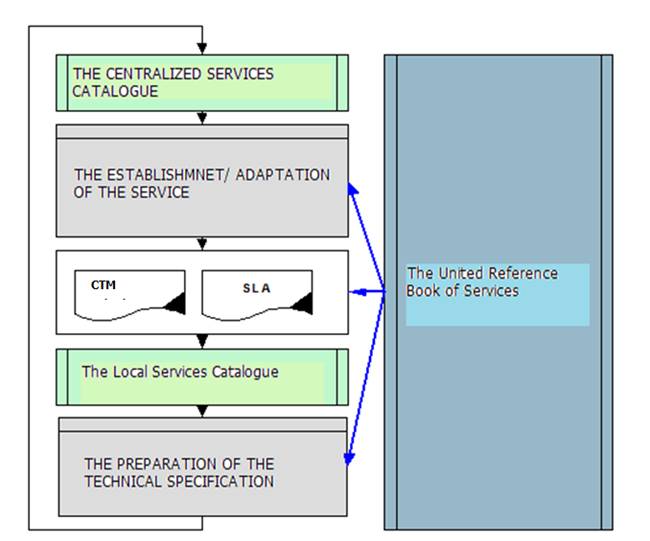
Pic.7 The establishment of services catalogues
8.1. The agreement of operations and their parameters
In the establishment course of a local services Catalogue a centralized services Catalogue is used.
The Customer Office forms a set of necessary operations for each service thereby agrees parameters of corresponding operations with an executor (service structure).
The basis for the parameters definition of operations in the local Catalogue are norms listed in the centralized services Catalogue.
8.2. The unique requirements to services
Services rendered in pursuance to the requirements of the given Standard and introduced in the centralized or local services Catalogue must satisfy the following requirements:
Ø The requirements to the set of services (which is rendered to a functional)
Services must have a clear and non-ambiguous description of the activity made and (or) a description of possibilities represented by a service (a service’s functional).
The activity/functional must be described in the Services Catalogue and also in one of the following documents:
· The technical specification[1] for a service (as to services for which a Technical Standards are worked out);
· In specifications for a service;
Ø The requirements by a provision of a service level and quality parameters
The following groups of controllable parameters are to be set for the rendered IT-services:
· Quality parameters the values of which are guaranteed in the course of a service rendering (the information by these parameters is represented to a Customer by way of reports);
· Technological parameters characterizing a state of services and systems providing a service product (the information by these parameters isn’t given to Customers of services).
Controllable quality parameters must be defined in the following documents:
· The technical specification (if Technical Standards are worked out for a service)
· A Service Level Agreement (SLA) (for all the services).
In the course of service rendering to a Customer pursuant to a Technical Standard values of controllable quality parameters defined by SLA must be no worse than parameters defined by Technical Specifications.
The values of controllable quality parameters in the course of a service rendering must not be lower than values defined in SLA.
Ø The requirements to the information value of services
A customer of a service must possess all the information about characteristics of a service before he/she starts to use it. If conditions of a service rendering are changed (in particular in case of force majeure circumstances) a notification of a Customer must be obligatory made.
Ø The requirements to the number of printed copies and reproducibility.
A service rendered to a Customer if resources and technical possibilities of an Executor are available must be given to another Customer at the same conditions and with the same parameters.
A type service rendered to a Customer if resources and technical possibilities of an Executor are available must be given to another Customer at the same or like conditions and with parameters defined by an agreement between an executor and a Customer.
Ø Requirements to technologies, expertise and competences.
The technologies of services provision for products must be alienable and made copies of. This requirement is achieved by the following:
· A documentation of used expertise;
· A planned actualization of expertise;
· A planned actualization and control of competences (teaching and testing of specialists).
The volume of the needed technical, technological and normative documentation for service products is defined in corresponding Technical Standards. The volume and contents of a technical and normative documentation must be sufficient for the production of a service product by a third party if such third party has necessary competences.
A technical (technological) documentation for a service product must exist by way and in a form which makes it possible to pass such documentation to the third parties.
An organization (department) rendering a service (a service product) must dispose of specialists with a necessary certification. The competence and certification of such specialists must be no lower than it’s needed by requirements defined by corresponding Technical Standards (as to services for which Technical Standards are developed) and by certified requirements.
Ø Requirements to legitimacy and legal correctness
· If a licensed production department is used in the course of a service rendering, corresponding licenses for production department must be obligatory received and properly documented.
· If a service (service product) or resources used in the course of its rendering are subject to state (federal, municipal or another) regulation, the corresponding licensing documents (licenses, accreditation, certificates) must be properly formed.
· In the course of services (service products) rendering the requirements of a copyright must be observed.
Ø Safety requirements
In the course of services rendering safety of a service’s consumers must be provided, in particular:
· The information privacy about a Customer and third parties if this information has become known to an executor in the process of services rendering;
· An Agreement on privacy must be concluded between a Service organization and Customer;
· The information safety of a user (in the framework of a contract’s clauses) must be provided, namely: the data protection against the destruction, non-authorized distribution, compromise.
· A physical safety of users is to be provided in the course of a service rendering.
Ø The requirements to the price policy
Clear and transparent rules of the price policy must exist for all the services. The rules make it possible to calculate a prime cost and cost of a service.
8.3. The documentation of services
A service is described by following documents:
· The technical specification for the a service rendering (for services included in the Centralized Services Catalogue);
· A standard Calculation and Technological Map (for all the services);
· A standard Service Level Agreement – SLA (for all the services);
· A specification for a service (for all the services)
· The Service Level Agreement (SLA)
The Service Level Agreement is an integral part of a Contract for services rendering and has the following obligatory sections:
· A description of a service
· A description of a represented functional
· A set of operations and works (produced actions)
· A set of IT-components used
· A description of a dependency and services interrelation
· A description of a service level and methods of a service level control
· Requirements to a service rendering
· Requirements to the accountability
· Contact persons and ways of communications
9. The choice of services provider.
A choice of a services’ provider (a service organization) as to IT must be made at the basis of an open tender.
A preparation to a tender organization is made by a Customer Office. The organization order of a tender, a valuation method of participants is defined by a corresponding service of a Market Entity at the basis of the standards’ system by a purchase activity organization of RAO UES (S-UES ZD 1 – 2004, S-UES ZD 2 – 2004, S-UES ZD 3 – 2004, S-UES ZD 4 – 2004, S-UES ZD 5 – 2004, S-UES ZD 6 – 2004, S-UES ZD 7 – 2004) and regulating documents of a Customer (OJSC “MOESK”).
10. The establishment of production programs
An establishment of a production program is made in order to plan works of a Service Structure (in terms of insourcing) and to plan expenses of a Customer for IT-services rendering.
A production Program is an annually made plan on services provision thereby the cost of each service, the number of service facilities and the cost per one service facility are to be pointed out.
The production program is used by CO as a planning instrument of OJSC “MOESK” needs in IT-services.
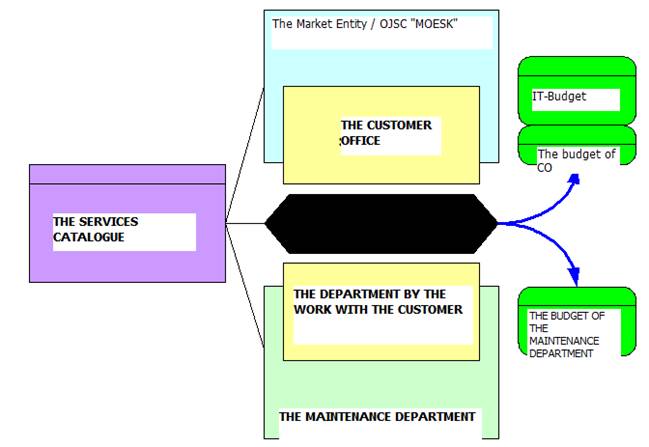
Pic.8 General establishment principles of the Production Program and IT-budgets
The establishment of the Production Program
A Production Program is formed by a Customer Office. Data for a Production Plan making are given by a Maintenance Department.
The establishment of a Production Program is composed of the following stages:
· The establishment of a list (registerа) of needed services (is formed by CO)
· The calculation of a cost basis of services (the cost basis is determined by CO)
· The decision making about a service model (insourcing or outsourcing)
· The collection and analysis of price offers
· The establishment of a Production Program draft
· The agreement of the Production Program
· Table 3. The Production Program Structure
The service code | The service name | The cost of services per month, without VAT | The cost of services per month, with VAT | The cost of service of one facility per month (without VAT) | The number of service facilities/ services volume | The unit of measure | The financing resource | The note |
The code in pursuance with a Classifier | The name in pursuance to the Classifier | RUR | RUR | RUR |
·
The establishment of a list (register) of services
The list of needed services is formed by CO subject to the requirements of the Functional Customer.
The services list is made pursuant to the Catalogue of services. If inquiries of a Functional Customer cannot be met by way of services rendering included in the services Catalogue, CO initiates a draft of a new service establishment pursuant to the requirements of the given Standard.
The cost basis calculation of services
The register of services being formed, CO calculates the cost basic of services.
The following items are calculated for each service present in the list:
· The service cost in a month, without VAT
· The service cost in a month, with VAT
· The cost of service of one facility per month, without VAT
The cost calculations are made at the basis of a Reference Book of Services and Calculation and Technological Maps (CTM).
All the calculations are made in RUR.
A draft establishment of the Production Program
After an establishment of a services list and the cost calculation CO (in a model of insourcing) values resources needed to render the listed services.
Necessary changes are made in Production Programs if necessary.
The production program agreement
The Production Program draft with the agreed services list and agreed cost is agreed by CO inside OJSC “MOESK” by rules determined in OJSC “MOESK”.
The agreed Production Program is a basic material for the preparation of a tender documentation by CO for IT-services rendering.
The purchase of services
The purchase of services determined in Production Program is made by regulated tender or other ways determined by corresponding normative documents of OJSC “MOESK”.
11. The budgeting
IT-budget is an instrument of the financial management of information technologies. Actually the budget is an instrument of drawing up an actions plan for a particular period.
The financial resource of the IT-budget is the common budget of OJSC “MOESK”.
In the framework of the given Standard the following budgets are considered:
· IT-budget of a Customer.
· The budget of the Customer Office.
· The budget of the Maintenance Department.
The purchases plan which is an integral part of IT-Budget is represented by way of a separate document.
Pursuant to Standard 2 the following item are to be established in the framework of IT-Budget:
· IT-Budget of a Customer.
· IT-Budget of a Customer Office.
· The budget of the Maintenance Department.
11.1. IT-budget of the Customer.
IT-budget of the Customer (IT-budget of OJSC “MOESK”) is a plan of expenses for information technologies divided into separate items.
IT-budget is formed subject to agreed Production Programs.
11.2. The items of the Customer’s IT-Budget
IT-Budget (a sample of IT-Budget is given in Standard 2) is composed of the following items, pursuant to Standard 2:
· Communication services and data transmission;
· The service and support of systems and devices of IT;
· Keeping systems and devices of IT;
· The purchase and support of tangible assets;
· Expenses for keeping of employees;
· Expenses by IT drafts.
Making and approval of the budget for the financial year
The establishment of the IT-budget of OJSC “MOESK” for the financial year is made by the Customer Office in the following order:
1. At the basis of Production Programs agreed in OJSC “MOESK” a consolidated Production Program is made.
2. Expenses by IT-services underlying in a Production Program are estimated.
3. An article of expenses by the service and support of IT systems and devices is formed.
4. The expenses of the preceding period (financial year) for communication services and data transmission are estimated.
5. The volume of expenses by keeping IT devices (repairs, spare parts and accessories, components etc.) for the preceding period is estimated.
6. The planned change of number of service facilities is estimated.
7. The frequency change of facilities due to their wear is estimated.
8. An article of expenses for IT devices keeping is formed.
9. An article of expenses by communication services and data transmission is formed.
10. An article of expenses for intangible assets is formed.
11. Expenses by made, initiated and planned projects are estimated.
12. An article of expenses by design works is formed.
13. An article of expenses for keeping of employees is formed.
14. The correctness of IT-budget drawing up is made.
15. It-budget is transmitted the Functional Customer for a preliminary agreement.
16. The correctness of IT-budget is made by results of a preliminary. Necessary changes are introduced in Production Programs.
17. The corrected IT-budget is given CO for the approval pursuant to the rules set in OJSC “MOESK”.
[1] A holder of Technical Specifications for services can come by an agreement or a Committee by IT-policy of RAO UES OF RUSSIA or a Department by Information technologies of RAO UES OF RUSSIA or a Department of the information and telecommunication of IDGC of Center and Ciscaucasia or another structure. The Technical Specifications are developed pursuant to GOST 2.114 and GOST R 1.5-2002 (General requirements to the construction, statement, execution, contents and marking).

|
Из за большого объема этот материал размещен на нескольких страницах:
1 2 3 |
