


Партнерка на США и Канаду по недвижимости, выплаты в крипто
- 30% recurring commission
- Выплаты в USDT
- Вывод каждую неделю
- Комиссия до 5 лет за каждого referral
APPROVED
Minutes of the General Shareholders Meeting of OJSC CHELINDBANK
No. _____ dd May, ___ 2009
JOINT-STOCK COMMERCIAL BANK “CHELINDBANK”
(open joint-stock company)
ANNUAL REPORT 2008
Preliminarily approved by the meeting of the Board of Directors of CHELINDBANK
Minutes No. 5 dd as of April 23, 2009
CHELYABINSK
2009
Contents
I. CHELINDBANK’S STANDING IN THE BANKING SECTOR.. 3
II. PRIORITIES IN CHELINDBANK’S PERFORMANCE.. 11
III. REPORT ON RESULTS OF DEVELOPMENT OF CHELINDBANK IN THE MAIN AREAS OF ITS PERFORMANCE 13
IV. PERSPECTIVES OF CHELINDBANK’S DEVELOPMENT.. 34
V. REPORT ON PAYMENT OF ANNOUNCED (ACCRUED) DIVIDENDS FOR SHARES OF CHELINDBANK..34
VI. LIST OF THE MAIN RISK FACTORS RELATED TO CHELINDBANK’S ACTIVITY.. 36
VII. LIST OF MAJOR TRANSACTIONS. 37
VIII. LIST OF MAJOR TRANSACTIONS……………………………………………………………………………...35
IX. MEMBERS OF THE BOARD OF DIRECTORS…………………………………………………………………...36
X. INFORMATION ABOUT THE BOARD OF THE BANK.. 36
XI. CRITERIA FOR DEFINITION AND TOTAL AMOUNT OF COMPENSATION PAID TO THE MEMBERS OF EXECUTIVE BODIES OF THE BANK.. 36
XII. INFORMATION ABOUT COMPLIANCE OF CHELINDBANK WITH CORPORATE GOVERNANCE CODE.. 36
I. CHELINDBANK’S STANDING IN THE BANKING SECTOR
In 2008 Chelindbank celebrated its 18th year of its performance in the Russian financial and lending market. During these years the Bank managed to keep stability, retain its permanent customers’ and gained reputation of one of the most reliable banks in the Urals region. CHELINDBANK is among top 100 major banks of Russia by the amount of its own capital. CHELINDBANK is positioned in the Urals federal district as a big regional universal bank. The Bank is included in the top 10 major lending companies of the Urals Federal district by main figures of its activity. The Bank takes first positions by the amount of assets, own capital, investments, attracted funds including individual deposits, by volumes of transactions (by number of documents), by general amount of operations done with the help of the banking cards among 11 banks of Chelyabinsk region.
Table 1.
Rating of the Banks of the Urals region by “Expert-Ural” magazine as of 01.01.2009
Name | Assets (TOP100) | Own funds (capital) (TOP 100) | Individual deposits | Corporate loans (without arrears) | Consumer loans (without arrears) |
CHELINDBANK | 7 | 5 | 7 | 7 | 8 |
Chelyabinvestbank | 8 | 9 | 9 | 9 | 15 |
KUB-Bank | 9 | 6 | 8 | 11 | 12 |
Uglemetbank | 19 | 37 | 28 | 16 | 55 |
Snezhinskiy | 25 | 21 | 22 | 20 | 21 |
Monetny dom | 26 | 17 | 18 | 38 | 18 |
URALLIGA | 45 | 53 | 51 | 35 | 60 |
Uralprombank | 47 | 39 | 40 | 36 | 48 |
NBK-bank | 52 | 64 | 89 | 65 | 52 |
Chelyabkomzembank | 54 | 66 | 55 | 54 | 39 |
Rezerv | 80 | 67 | 70 | 73 | 78 |
The performance of the Bank is rather diversified. Licenses and technologies applied by the Bank allow providing wide range of services to the Customers. There are 18.5 thousand corporate customers and sole traders and more than 550 thousand individuals for CHELINDBANK.
There are following priorities in the activity of the Bank: corporate lending, small and medium business lending, private lending; cash settlement services for corporate and private customers; private deposits; services for people including receipt of payments, money transfers; issue and maintenance of VISA international banking cards; transactions with securities; foreign exchange and currency conversion.
CHELINDBANK works in the whole territory of Chelyabinsk region. The Bank has 6 branches in Chelyabinsk and 22 branches in Chelyabinsk region, and representative office in Moscow. In 2005 the Bank opened the branch in Yekaterinburg. Besides, there are 18 subsidiary offices and 9 operational cash offices located outside the premises of the Bank. The total quantity of the structural divisions of the Bank constitutes 57 as of 01.01.2009. The Bank has the main profit from its performance in the territory of Chelyabinsk region.
2008 was the year to check the hardness of the banking system of Russia. Starting from September, 2008, due to considerable growth of the crisis in the world economy, the main trend for performance of all the Russian banks was to retain the stability of business.
2008 will be marked in the history as the year of global stresses in the world financial systems. The problems of large world leading banks have been intensified, first of all, investment banks: American – Goldman Sachs, Washington Mutual, Morgan Stanley, Wachovia Group, English Bradford & Bingley, German – Commerzbank, Hypo Real Estate. Being afraid of their own solvency, the banks have stopped providing loans. The issue of corporate bonds, short-term debt bonds and wide range of other financial services has been considerably reduced. Big western banks and hedge funds faced withdraw of the customers’ funds and to return money they had to sell almost all their assets like shares, bonds and other goods for any price. Overestimated appraisal of the assets and appearance of great number of “bad debts” resulted into liquidity shortage.
Economic activity funded by means of the loans was frozen in fact. At the end of October – beginning of November 2008 not only world financial sector, but also manufacturing industry have experienced big problems. Lacking borrowed funds led to drastic decrease of sales of real estate and industrial equipment. World commodity market faced excess of oil precious and non-precious metals, their prices started decreasing that resulted into panic sales and fall of rates of the shares of the companies that produce and sell these products.
In December OPEC members made a decision to reduce volumes of oil production. Besides, some of the countries, OPEC members, reduced volumes of oil production more than it was settled by OPEC norms. However Brent oil prices reduced by 54% and comprised 44 dollars per barrel in 2008. In comparison to maximum figures of the middle of the year (more than 147 dollars per barrel) the Brent oil rates were dropped almost by 70%. Prices for Russian oil of the Ural sort decreased by almost 60% during the year and comprised 38 dollars per barrel.
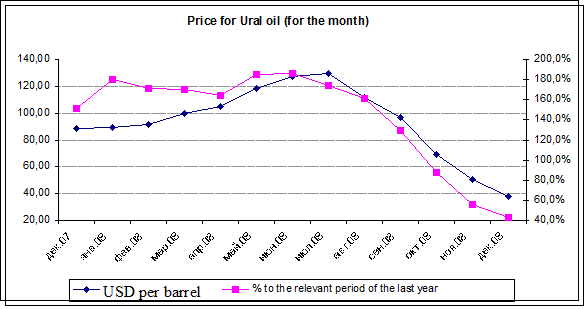 |
Рис.1
Due to serious situation government of the USA and EU countries, and world central banks made their mind to coordinate their efforts in struggle against the crisis. Money funds have been sent to financial markets all over the world, discount rates have been reduced several times both globally and individually of separate countries.
However despite all the measures taken the world and national economies continued to slow down the rate of development. Since the beginning of the financial crisis in 2007 losses and write-offs of financial institutions all over the world were equal to almost 1 trln dollars. Crisis led to recession economies of EU countries and Japan. The American economy has shown worst results for a quarter of century – in the 4th quarter of 2008 it decreased by 3.8% in the annual calculation. GDP of the eurozone in October-December fell by 1.5% after decrease by 0.2% in the previous two quarters. Implementation of anti-crisis programs led to the growth of the budget shortage. The most rapid growth of the budget shortage was shown by the USA: $485 bln – for the 1st quarter of 2009 financial year (October – December 2008).
It is worthy mentioning that by the end of the year anti-crisis programs of the western states that initially contained financial system recovery events have already included measures for support of the industry.
Russian economy had negative reaction for the change of foreign economic conditions. In the 4th quarter of 2008 the Russian Government for the first time openly admitted existence of crisis, and not only in the financial sector, but in the Russian economy in general. Decrease of oil and steel prices strongly impacted the key oil sector of Russia. Oil and metallurgic companies were forced to cut their production and investment programs. In the 4th quarter of 2008 Russia reduced its oil production for the first time during 10 years. The volumes of oil export were considerably decreased. Taking into account positive dynamics of the first half of 2008 the oil export reduced by 6.2% by the results of the year in comparison with the year end the Ural oil price comprised about 40 dollars per barrel that caused decrease of the profitability of the oil companies and reduction of the income part of the Russian state budget. To stimulate activity of the oil companies, besides the state aid and reduction of taxes, the export duty was decreased several times.
Decrease of prices for the main Russian export commodities led to fall of the stock market because of the exit of the foreign investors which share in the Russian market, according to analysts, was equal to 50-70%. Russian stock market continually faced new records of the intra-daily decrease in the 4th quarter of 2008. In the panic environment of the Russian market there were numerous cases when the trades for all securities were stopped (sometimes for days) till the special notice of the Federal Service for Financial Markets.
Dramatic devaluation of securities resulted into critical liquidity situation for some of the major banks – e. g. Svyaz-bank, CIT-Finance. In spite of the fact that the Russian Government provided significant financial aid to strategic banks for renewal of inter-banking lending, they failed to recover trust in the inter-banking market. The loan rates increased sharply.
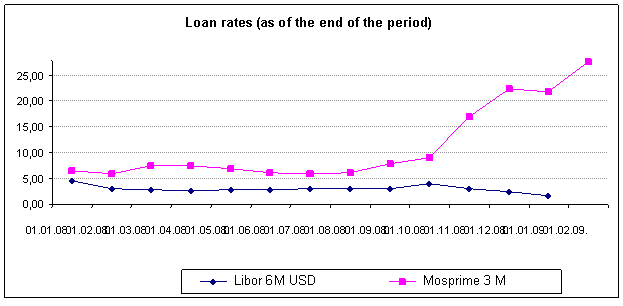

Рис.2
Besides, in October-November 2008 the churn of private deposits was intensified due to the lack of trust of people to banks – in total depositors have withdrawn 370 bln rubles from the Russian banks. In some of the banks withdrawing money by people was characterized by its massive nature. Thus, mentioned factors together with the decrease of the external borrowings led to the growth of the liquidity crisis of the banking system. October and November 2008 were the months when most of the banks were deprived of their licenses because of the loss of liquidity.
At the same period of time, because of the expansion of the list of participating banks that were allowed to take part in reorganization of problem banks, and because of simplification of reorganization process, merges and acquisitions started in the banking sector. During 2008 the Bank of Russia called off 33 banking licenses. There were 40 banks that experienced “vivid” problems. 21 banks were reorganized (volume of commitments – 774,4 mln RUR or a 3,7% share in the volume of banking system commitments), 19 banks were deprived of the licenses.
Besides, due to the measures taken by the Government of Russia together with the Bank of Russia and the Deposit Insurance Agency – increase of the amount of the insurance, creation of the list of socially valuable banks – by the end of 2008 they managed to recover the trust of people to the banking system, churn of deposits has been reduced.
In the 4th quarter of 2008 the banks considerably reduced their lending volumes both in terms of corporate and private lending, mortgage programs were almost stopped, interest rates for other type of loans increased by 3 interest points in average.
Dramatic decrease of demand for products led to problems in such fields of industry as pipes, machine building, chemical industry and construction panies of these fields were forced to cut production and sales volumes. In general in the 4th quarter of 2008 the Russian industry faced a fall of 8.2% in annual amount. As the result, in 2008 the industrial manufacturing grew by only 2% that is more than three times less than in 2007. With decrease of production and sales volumes many companies had to cut their staff. The unemployment rate in Russia reached the level of 7% by the end of the year.
Unstable economic standing of the enterprises and decrease of solvency of people resulted in the growth of the arrears of bank loans. Banks significantly increased their provisions for loans.
Russian ruble was continuously devalued by the Bank of Russia in the 4th quarter of 2008, the refinancing rate was twice increased – from 11 to 13%. Inflation rate upon the results of 2008 was equal to 13.3%. Huge investments into the markets, financial system and real sector of economy considerably reduced gold and currency reserves of Russia. In the 4th quarter of 2008 the country faced churn of its capital. Foreign investors continued to leave the Russian market. Thus, the net churn of the capital in the last quarter of the year reached the level of $130.5 bln rubles.
In November, international rating agencies Fitch, Standard&Poor’s (S&P), Moody’s decreased sovereign ratings of Russia and lowered forecasts due to the risks related to the dramatic reduction of the international reserves and investment flows that led to the growth of expenses and problems in raising funds required for satisfaction of external financing needs.
During 2008 the number of existing lending institutions in Russia was reduced by 28 and equaled 1108. The crisis contributed to considerable increase of assets concentration in the top 5 banks of Russia – from 42.3% as of the beginning of the year to 46.2% as of the end of 2008. The combined assets of the banking sector due to dynamic growth of the banking system during 3 quarters of 2008 increased by 39.2% per year and reached 28.0 trln rubles, that constitutes 67.5% of the GDP of Russia. The own capital of the banking system was equal to 3.8 trln rubles or 13.6% of liabilities. Capital adequacy comprised 16.8%. Loans to non-financial enterprises and individuals were equal to 16.5 trln rubles or 59% of the assets. The share of problem and hopeless loans was equal to 3.8% of the total volume of the loans having increased by 1.3 interest points with the level of reserves equal to 4.5%. Funds raised from corporate companies comprised 31.3% of the liabilities of the banking sector, private deposits – 21.1% or 5.9 bln rubles. The growth rates of private deposits were equal to 14.5% in 2008 that was 2.4 less than in 2007.
Assets and capital of banking sector of Russia
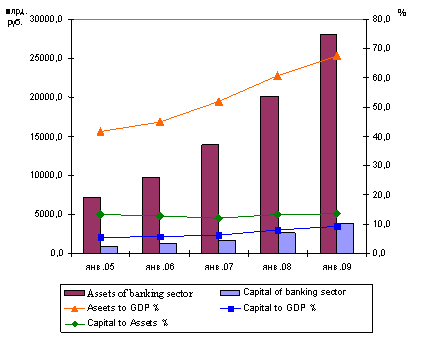

Рис.3
Consolidated financial result of the Russian banks for 2008 totaled 409.2 bln rubles or 80.6% in comparison with 2007. Profitability of assets was equal to 1.8%, profitability of capital – 13.3%.
CHELINDBANK managed to overcome impact of negative external conditions on the Bank’s performance in 2008 thanks to the following factors:
- to maintain current liquidity the Bank implemented almost all refinancing tools suggested by the Bank of Russia for regional banks including participation in the unsecured auctions;
- in accordance with investment policy of the Bank, more than 90% of the securities portfolio is included in the Lombard list of the Bank of Russia;
- taking into consideration economic environment, the Bank promptly revised terms and interest rates for private deposits, and continued traditional ads campaigns for the Bank’s depositors – such measures helped to avoid churn of the funds from the deposit accounts;
- conservative lending policy and significant intensification of credit risk controls in the second half of 2008 allowed the Bank avoiding considerable decrease of the quality of the loan portfolio; to minimize credit risks the Bank increased the amount of provisions for possible loan losses.
Besides, private loans volumes in CHELINDBANK is in accordance with social values criteria set by the Deposit Insurance Agency for banks.
On October 8, 2008 Fitch Ratings, the international rating agency, member of the top three rating agencies of the world gave CHELINDBANK a long-term rating (IDR) “B-“, and a long-term national rating “BB+ (rus)”, outlooks “Stable”. It must be mentioned that the rating was received by CHELINDBANK at the middle of financial crisis. The press-release distributed by the agency says that: “The Bank retain its stability in a unstable situations in the domestic and foreign financial markets”.
Thanks to the rating received by international rating agency Fitch Ratings CHELINDBANK became a participant of the unsecured auctions held by the Bank of Russia with a maturity term for attraction funds of 5 weeks.
The most important result of CHELINDBANK’s performance in 2008 is the following – the Bank managed to ensure absolute fulfillment of its obligations before Customers and partners, fulfillment of requirements of the Bank of Russia, ensure profitability of its business on the level that allows the Bank to develop in 2009. The profit before taxation in 2008 (including events after accounting date) comprised 514 mln rubles, that is 8.4% higher than the similar figure of 2007. In accordance with the methods of calculation of financial stability figures of deposit insurance system the profitability of assets comprised 2.5% in 2008, profitability of the own capital was equal to 15.2%.
In “Interfax-100. Banks of Russia” ranking as of the results of 2008 CHELINDBANK is ranked as:
- 98th by ownership capital;
- 92nd by profit before taxation;
- 52nd by volumes of individual deposits.
According to “RosBusinessConsulting” agency as of the results of 2008 among 100 Russian universal commercial banks CHELINDBANK is ranked as:
- 102nd by the amount of the net assets;
- 52nd by the amount of private funds;
- 69th by volume of individual loans;
- 99th by volume of corporate loans.
-
According to “Expert-Ural” magazine as of the results of 2008 among the banks of the Urals region CHELINDBANK is ranked as:
- 5th by own capital;
- 7th by assets, amount of the balance sheet profit, corporate loan portfolio and amount of private deposits;
- 8th by volume of consumer loans;
CHELINDBANK takes leading positions among 11 banks of Chelyabinsk region by the main areas of performance. There are 11 commercial banks, 59 branches of credit institutions from other regions, and 334 Sberbank offices including branches in Chelyabinsk region as of 01.01.2009. The following changes took place in the regional banking sector in 2008. Credit institutions which head offices are located outside the region opened 12 branches and 3 representative offices, and at the same time 6 branches and 7 representative offices were closed, 5 branches are currently being closed. The number of regional banks remained unchanged in 2008.
In 2008 the banking network expanded by means of opening internal structural offices by regional banks and credit institutions. The number of service points in the region increased by 74 (in 2007 – by 125) and equaled 883 including: regional banks – by 19 and comprised 238, credit institutions of other regions – by 55 and totaled 645, including offices of Sberbank of Russia – by 7 and was equal to 334.
The total balance sheet of the banking sector of Chelyabinsk region grew by 29.5% during the year and totaled 306.9 bln rubles. 30.6% of the balance sheet is concentrated in the regional banks, 32.2% - in the departments and offices of Sberbank, 37.2% - in the branches of the banks from other regions. The share of regional banks decreased by 4.2% in comparison with 2007.
Corporate customers opened about 146 thousand accounts in the credit institutions, private customers – more than 10.5 mln accounts. The gain by the beginning of 2008 comprised 10.4% and 8.9% correspondingly. We should point out the growth of the accounts with remote access by means of Internet or mobile phones.
Table 2
Customers network of credit institutions (branches) of Chelyabinsk region in 2008
N | Name of the figure | Total in the region | CHELINDBANK | Share of the Bank, % |
1. | Accounts opened for corporate customers and sole traders from which the funds were withdrawn during the year: | 18 802 | 17,4% | |
1.1. | With remote access: | 46 937 | 8 901 | 19,0% |
2. | Accounts opened for private customers from which the funds were withdrawn during the year. | 2 | 23,9% |
Volume of the customer funds on the settlement and other accounts in the region comprises 38.6 bln rubles. The annual growth rate comprised 7%. The share of CHELINDBANK in this sector is quite stable and is equal to about 11%. The volume of the market of the loans provided to non-financial institutions grew by 29% and totaled 140.3 bln rubles during the year. The share of CHELINDBANK in this market constitutes about 6%. In the market of loans provided to sole traders which volume exceeded 8 bln rubles as of 01.01.2009, the Bank’s share is significantly higher and is equal to more than 20%.

|
Из за большого объема этот материал размещен на нескольких страницах:
1 2 3 4 |
