

Партнерка на США и Канаду по недвижимости, выплаты в крипто
- 30% recurring commission
- Выплаты в USDT
- Вывод каждую неделю
- Комиссия до 5 лет за каждого referral
That is, the ordered triple (a, b, c) is the ordered pair whose first coordinate is (a, b) and whose second coordinate is c.
THEOREM If (a, b, c) = (p, q, r), then a = p, b = q, and c = r. Proof: If (a, b, c) = (p, q, r), then by the definition of ordered triple we see that ((o, b), c) = ((p, q), r). Applying the theorem on ordered pairs we infer that (a, b) = (p, q) and c = r, and applying the same theorem again, we see that a = p and b = q.
Again, if the student prefers to take the notion of ordered triple as undefined and assume this Theorem as an axiom, no harm is done.
Text 3
Before beginning the study of vector geometry we want to define one of the most important notions of mathematics, that of function, Intuitively, a function is supposed to be a correspondence which assigns to each object in a certain class, called the domain of the function, some corresponding object. For example, we may consider the correspondence that assigns to each person his mother; this correspondence is a function, the essential feature being that to each member of the domain, which in this case is the set of all people, there is assigned precisely one member of another set (in this case, the set of all mothers). Of course, several different people (brothers and sisters) may correspond to the same mother; in mathematical terms, this correspondence isn't one to one. But to each person, there corresponds just exactly one mother. Let us denote the correspondence by M, we emphasize that M is not the set of all persons, nor the set of all mothers,
but is the correspondence itself. If C is a member of the domain of M, that is, C is a person, then the mother of C is denoted by M(C). Thus, M(George VII) ^ Victoria and M(Elizabeth) = Ann Boleyn. In general, if f is a function and x is a member of the domain of f, then f (x) is that object that corresponds to x;. It is called the value of f at x.
A more mathematical example may be helpful. Consider the correspondence f which is pictured schematically in Figure I. The domain of f is supposed to consist of points a, b, c, d and the correspondence f sends a into a point p, b into a point q, c into r, and d into p; that is, f(a) = p, f(b) = q, f(c) = r, and f(d) = p.
Figure 1 [preview not available]
Before giving further examples of functions let us consider the major mathematical problem of the section. What are we going to define a function to be? The key to the definition is the fact that a correspondence is completely described if we know what object corresponds to each member of the domain. This suggests that if we know the set of all ordered pairs of the form (member of the domain, corresponding object), then the function should be completely described. In other words, the set of all pairs (x, f(x)) completely describes it. Thus the function / defined in the preceding paragraph is completely described by the set {(a, p), (b, q),{c, r), (d, p)}. If this seems confusing, don't worry. The intuitive notion of a function is just that of a correspondence, and the only facts about functions which we need are given in the single theorem of this section.
DEFINITION f is a function if and only if f is a set of ordered pairs, no two of which have the same first coordinate. More formally, f is a function if and only if f is a set, each member of f is an ordered pair, and if (a, y) and (x, z) belong to f, then y = z.
For example, {(0, 1), (1, 1)} is a function; but {(1,0), (1, 1)} is not a function.
We will use the terms 'function', 'correspondence', and 'map' or 'mapping', interchangeably.
A member of a function f is then a pair with first coordinate a member of the domain and second coordinate the object which corresponds to this member. The requirement that no two pairs belonging to f have the same first coordinate is just a way of ensuring that there is just one object corresponding to each member of the domain. We can define very easily the domain of a function, and the value of the function at a member of its domain.
DEFINITIONS The domain of a function f is the set of first coordinates of members of f. The value of/at a member x of its domain, denoted f(x), is the second coordinate of that member of whose first coordinate is x. The set of all second coordinates of members of f is the range of f.
Unit 4
Reading
I. Pre-reading questions:
1. What is a quadratic equation?
2. What is necessary to know for solving quadratic equations?
II. Read the text. Make a list of unknown words. Consult your dictionary for their meaning and pronunciation.
Text
It is natural after considering the solution or linear equations to attempt to solve quadratic equations. That is, we attempt to find for just what numbers x it is true that 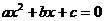 , where a, b, and c are numbers. If a is 0, then the equation to be solved is actually linear and we have already discussed this problem in detail; so we will always assume that the coefficient of x2 is not 0.
We will prove a single theorem and make a single application of the theorem. But it should be said that the main purpose of the section is not just to know and understand the theorem, but also to understand and be able to apply the process by which the theorem is proved. The student, in brief, should acquire some skill in solving quadratic equations, both by means of the theorem of this section, and by means of the procedure which underlies the theorem. It is to be regretted that acquiring skill is sometimes a little uninteresting; nevertheless, anyone interested in mathematics must learn to solve quadratic equations just as every child has to learn to tie shoelaces; otherwise one stumbles.
The single idea that underlies the solution of quadratic equations is this: it is easy to find the numbers x such that 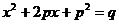 , if p and q are any numbers. The reason it is easy is that
  , and the numbers x such that
  can be classified as follows: if q is positive, then x + p must be either
  or
or  and x must be either
  or
or  , if q is negative there is no number x such that , and if q = 0 the only number such that
  is –p. The method of solving other quadratic equations is roughly this: we think fondly of the equation
  and attempt, without employing violence, to arrange the equation to be solved so that it resembles the preceding. Somewhat more precisely: we attempt to arrange the equation so there is a ‘perfect square’ on the left, and a number on the right.
III. In the text they say:
1. Anyone interested in mathematics must learn to solve quadratic equations, (line 14-15)
2. We attempt to arrange the equation so there is a 'perfect square' on the left and a number on the right, (line 29)
Comment on these statements.
IV. What do the italicized words refer to?
1. ... we have already discussed this problem in detail, (line 5)
2. ... otherwise one stumbles, (line 16)
3. The method of solving other quadratic equation is roughly this... (line 24)
4. ... so that ^resembles the preceding, (line 28)
Vocabulary
V. Give the Russian equivalents of the following:
it is natural; that is; in detail; in brief; by means of; underlies the theorem; it is to be regretted; as follows; anyone interested in; the only number; somewhat more precisely; on the left; on the right.
VI. Find words in the text that mean:
to think about; to find the answer to...; to try; to exchange ideas on; to believe before there is proof; to make practical use of; putting to a special or practical use; most important; intention; to gain by skill, ability or by one's own efforts; ability to do something well; to be sorry for; however; if not; single; to put into order; to be like.
VII. Supply these sentences with nouns instead of verbs in brackets.
1. It is natural after considering (to solve) of linear equation to attempt to solve quadratic equations.
2. We will make a single (to apply) of the theorem.
3. The student should acquire some skill in solving quadratic equations by (to mean) of this theorem and by (to mean) of (to proceed) which underlies the theorem.
Give nouns for these verbs:
to attempt | to acquire |
to discuss | to classify |
to assume | to employ |
to know | to arrange |
to prove | to solve |
VIII. What is the opposite of these adjectives? if necessary consult your dictionary:
interesting | possible |
expected | honest |
agreeable | thinkable |
legal | moral |
IX. In the text you have come across some paired conjunctions. This table shows how to use both... and; no only... but also; either... or; neither... nor .
(a) Both by brother and my sister are here. (b) Not only my mother but also my sister is here. (c) Not only my sister but also my parents are here. (d) Neither my mother nor my sister is there. (e) Neither my sister nor my patents are there. | Two subjects connected by both… and take a plural verb. When two subjects are connected by not only… but also, either… or, neither… nor the subject that is closer to the verb determines whether the verb is singular or plural. |
(f) The research project will take both time and money. (g) Yesterday is not only rained but also snowed. (h) I’ll take either chemistry or physics next quarter. (i) That book is neither interesting nor accurate. | Notice the parallel structure in the examples. The same grammatical form should follow each word of the pair. |
Supply is or are in the following.
1. Both the teacher and the student... here
2. Neither the teacher nor the student... here.
3. Not only the teacher but also the student... here.
4. Not only the teacher but also the students... here.
5. Either the students or the teacher... planning to come.
6. Either the teacher or the students... planning to come.
Complete these sentences with both... and; either... or; neither... nor.
1. The student should acquire some skill in solving quadratic equations — by means of this theorem — by means of the procedure which underlies the theorem.
2. If q is positive, then x + p must be either or and x must be either or .
3. This problem is — difficult — interesting.
4. We can — prove this theorem — apply it.
5. The city suffers from — air — water pollution.
6. I'm studying — math — chemistry.
7. Our country has — good schools — good universities.
8. The result was — good — bad.
9. — the library — the bookstore has the book I need.
10. — coal — oil are irreplaceable natural resources.
X. Suggest the meaning of the italicized words:
1. The student should acquire some skill in solving quadratic equations.
2. Nevertheless, anyone interested in mathematics must learn to solve quadratic equations just as every child has to learn to tie shoelaces.
3. It is easy to find the numbers x such that 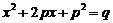 , if p and q are any numbers.
4. If q is negative there is no number x such that  .
.
Grammar
XI. Put questions to these sentences, either general or to the italicized words.
1. We have already discussed this problem in detail. (General)
2. We will always assume that the coefficient of x' is not 0.
3. The student should acquire some skill in solving quadratic equations.
4. Anyone interested in mathematics must learn to solve quadratic equations.
5. This idea underlies the solution of quadratic equations.
6. We attempt to arrange the equation. (General)
7. There is no number x such that  . (General)
XII. Note the use of the Infinitive in the following sentence:
If a is 0, then the equation to be solved is actually linear, (line 4)
The to-infinitive is often used after a noun to convey advice, purpose, etc. This construction is like a relative clause.
e. g. The person to ask is Mike (=the person whom you should ask). I've got an essay to write (=an essay which I must write)
Sometimes active and passive infinitives are interchangeable.
E. g. After the discussion, there was some work to do/ to be done.
When the subject of the sentence is the person who is to do the action described by the infinitive, we do not normally use the passive.
e. g. I have a report to prepare (Not 'to be prepared')
Now translate the sentences into Russian.
1. All the data to be presented here refer also to the above problems.
2. The explanation will probably be considerably modified in the years to come.
3. The method to be followed is based upon some peculiar properties of these rays.
4. Here are some more figures to be referred to later.
5. 5- This is the important question to be answered.
6. He was the first to note this phenomenon.
7. This theory will be adequate for practical applications through centuries to come.
XIII. Supply these sentences with modals. Then refer to the text. Alternatives are possible. In each case give a reason for your choice.
1. It—be said that the main purpose of the section is not just to know and understand the theorem, but also to understand and — to apply the process by which the theorem is proved.
2. The student — acquire some skill in solving quadratic equations.
3. It—to be regretted that acquiring skill is sometimes a little uninteresting.
4. Anyone interested in mathematics — learn to solve quadratic equations just as every child — to learn to tie shoelaces.
5. The numbers x such that (x + p)" = q—be classified as follows.
6. If q is positive, then x + p must be either or and x must be either or .
XIV. In the text we have sentences with so that, used to express purpose. It expresses the same meaning as in order to. The word that is often omitted, especially in speaking.
e. g. We attempt to arrange the equation to be solved so that it resembles the preceding, (line 27)
We attempt to arrange the equation so there is a 'perfect square' on the left, and a number on the right, (line 29)
Look at the examples with so that . Mind the tense of the verb in the adverb clause after it.
Please turn down the radio so (that) I can get to steep.
My wife turned down the radio so (that) I could get to sleep.
Put the milk in the refrigerator so (that) it won't (doesn't) spoil.
I put the milk in the refrigerator so (that) it wouldn't spoil.
Combine the ideas by using so (that) according to the patterns given above.
1. Please be quiet. I want to be able to hear what the teacher is saying.
2. I asked the students to be quiet. I wanted to be able to hear what the teacher was saying.
3. I am going to cash a check. I want to make sure that I will have (or have) enough money to go to the market.
4. I cashed a check yesterday. I wanted to make sure that I had enough money to go to the market.
5. I'm going to leave the party early. I want to be able to get a good night's sleep tonight.
6. It's a good idea for you to learn how to type. You'll be able to type your own papers when you go to the university.
7. I turned on the TV. I wanted to listen to the news while I was making dinner.
8. I unplugged the phone. I didn't want to be interrupted while I was working.
XV. Put the words in the right order to form sentences. Then check against the text.
1. to be, the, linear, is, actually, solved, equation
2. discussed, we, already, in, problem, this, have, detail
3. prove, theorem, a, of, will, single, make, application, theorem, we, a, and, single, the
4. should, skill, quadratic, student, some, solving, the, acquire, in, equations
5. in, learn, equations, interested, must, quadratic, anyone, mathematics, to solve
Writing
XVI. In the text below, the paragraphs are not in the correct order. Rearrange the paragraphs into what you consider to be a suitably coherent order.
1. In order to get the variable alone on one side of the equation, we must perform inverse operations to 'undo' the operations on that side. Remember, addition undoes subtraction (and vice-versa), and multiplication undoes division (and vice-versa).
2. In equations which contain only one variable, the highest power of the variable is called the equation's degree. For example,  is called a first degree, or linear equation;
  is called a second degree, or quadratic equation; and
  is called a third degree, or cubic equation.
3. Since we want the new, transformed equation to have the same roots as the given equation, we must follow the equivalence principle stated below
4. The particular method used to solve an equation depends upon the equation's degree. For first degree (linear) equations, we use the method of inverse operations. The idea behind this method is to transform the given equation into an equivalent equation ( an equation having the same roots) in which the variable appears alone on one side of the equation, and a number appears alone on the other. This number will be the root of the given equation???
5. Whenever a number is added to, subtracted from, multiplied by, or divided into one side of an equation, the same thing must be done on the other side of the equation ???
What is in your opinion the central idea of the text? Write it out in one sentence. Use: The main idea of the text under review is... The text is devoted to (deals with, is concerned with) ... etc.
Supplementary Texts Text I
We have come to the point where we shall introduce a formal description of the real number system R. Since we are more concerned in this text with the study of real functions than the development of the number system, we choose to introduce R as an Archimedean field which has one additional property.
The reader will recall that if F is an ordered field and if a, b belong to F and a < b, then the closed interval determined by a, b, which we shall denote by [a, b], consists of all elements x in F satisfying  . It will also be recalled that if x is any element of an Archimedean field F, then there is a nested sequence (In) of nonempty closed intervals whose only common point is x. However, it was seen that a nested sequence of closed intervals does not always have a common point in certain Archimedean fields (such as Q). It is this property that we now use to characterize the real number system among general Archimedean fields.
DEFINITION. An Archimedean field R is said to be complete if each sequence of nonempty closed intervals In = [an, bn], n belong to N, of R which is nested in the sense that  has an element which belongs to all of the intervals In.
ASSUMPTION. We shall assume that there exists a complete ordered field which we shall call the real number system and shall denote by R. An element of R will be called a real number.
We have introduced R axiomatically, in that we assume that it is a set which satisfies a certain list of properties. This approach raises the question as to whether such a set exists and to what extent it is uniquely determined. Since we shall not settle these questions, we have frankly identified as an assumption that there is a complete ordered field. However a few words supporting the reasonableness of this assumption are in order.
The existence of a set which is a complete ordered field can be demonstrated by actual construction. If one feels sufficiently familiar with the rational field Q, one can define real numbers to be special subsets of Q and define addition, multiplication, and order relations between these subsets in such a way as to obtain a complete ordered field. There are two standard procedures that are used in doing this: one is Dedekind's method of 'cuts' which is discussed in the books of *****din and E. Landau. The second way is Cantor's method of 'Cauchy sequences' which is discussed in the book of N. T. Hamilton and J. Landin.
In the last paragraph we have asserted that it is possible to construct a model of R from Q (in at least two different ways). It is also possible to construct a model of ffi from the set N of natural numbers and this is often taken as the starting point by those who, like Kronecker, regard the natural numbers as given by God. However, since even the set of natural numbers has its subtleties (such as the Well-ordering Property), we feel that the most satisfactory procedure is to go through the process of first constructing the set N from primitive set theoretic concepts, then developing the set Z of integers, next constructing the field Q of rationals, and finally the set R. This procedure is not particularly difficult to follow and it is edifying; however, it is rather lengthy. Since it is presented in detail in the book of N. T. Hamilton and J. Landin, it will not be given here.
From the remarks already made, it is clear that complete ordered fields can be constructed in different ways. Thus we cannot say that there is a unique complete ordered field. However, it is true that all of the methods of construction suggested above lead to complete ordered fields that are ‘isomorphic’. (This means that if R1 and R2 are complete ordered fields obtained by these constructions, then there exists a one – one mapping  of R1 onto R2 such that (I) sends a rational element of R1 into the corresponding rational element of R2, (II) sends a + b into
  , (III) sends ab into
  , and (IV) sends a positive element of R1 into a positive element of R2 Within naive set theory, we can provide an argument showing that any two complete ordered fields are isomorphic in the sense described. Whether this argument can be formalized within a given system of logic depends on the rules of inference employed in the system. Thus the question of the extent to which the real number system can be regarded as being uniquely determined is a rather delicate logical and philosophical issue. However, for our purposes this uniqueness (or lack of it) is not important, for we can choose any particular complete ordered field as our mode) for the real number system.
Text 2
This section begins the study of solution of equations. It will turn out that the linear equations whose solutions we discuss are closely connected with certain functions which we will also call linear. We discuss the geometry of linear functions briefly. The same sort of approach is used in the next sections in the discussion of quadratic equations and functions.
The basic problem is the following: given numbers m and b, we are required to find all numbers x such that mx + b = 0. Such numbers are called solutions of the equation: mx + b = 0; and the set of all solutions is called the solution set. Of course, this problem is entirely trivial, and the results may be summarized: if  , then –b/m is the only solution, if m = 0 and
  , then there is no solution; and if m ^ 0 and b == 0, then every number is a solution. In other words, in these three cases the solution set is, respectively, {– b/m}, the empty set, and the set of all numbers.
It is instructive, in considering the equation mx+b = 0, to consider simultaneously the function f whose value at x is mx + b. That is, the domain of f is the set of all numbers, and f(x) = mx + b for each number x, alternatively, the function f (or if you prefer, the graph of f) is {(a; ,mx +b) : x a number}. The solutions of the equation mx + b =: 0 are then just the numbers a; such that f{x) = 0, and the solution set is simply {x : f(x) = 0}. We digress to comment on the algebraic descriptions of sets. There are three very common ways of describing sets. Many sets can be described very naturally as the set of numbers, or pairs of numbers, satisfying certain inequalities; such sets are sometimes called solution sets of inequalities. Again, it is frequently convenient to describe a set as the range of a function, the most noteworthy example being a line. The line through A with direction number B is just the range of the function X, where X(t) = A + tB for all numbers t. Finally, as we have noticed, a set may sometimes be described as the set of points where a function f is equal to 0, or as the solution set of the equation f(x) = 0. The later work will display many more examples of this sort of description.
Unit 5
Reading
I. Pre-reading questions.'
1. What is a prime number?
2. Is 1 a prime number? If not, give your reasons.
3. Is there a point in the list of primes after which there are no more?
II. Now read the text. Check your answers to the questions above. How many of them did you answer correctly?
Text
Prime numbers are such integers as have only one and themselves for divisors, i. e., 2, 3, 5, 7, 11, 13, 17, 19, 23, 29, etc.
Most of these are odd numbers; in fact only one of them is even. However, this is not a very deep property, for actually only one prime is divisible by three, etc.
The number 1 is not considered as a prime number for it gives no additional information concerning the nature of a number when it is decomposed into prime factors, e. g.,  . In such multiplicative building up of numbers we construct (or decompose) a number from (into) prime factors. Of course our numbers can be built up in an additive manner e. g., 6 = 2+4 = 1+1+1+3 = 1+1+1+1+1+1. But reducing all numbers to a sum of units is of little interest.
At the very beginning of the list, the primes are quite dense; however, they become less dense as we proceed to higher numbers. This seems reasonable as we expect a high number to have a greater chance of being divisible by a prime number than a low one. Now, do the primes stop altogether? Is there a point in the list of primes after which there are no more? This question is posed and answered in the ‘Elements’ of Euclid (which contains much of number theory) in the following way. Euclid asserts that there can be no last prime number.
prehension check:
1. ‘However, this is not a very deep property’, (line 5) What is meant by this?
2. At the very beginning of the list, the primes are quite dense. What happens to their density as we proceed to higher numbers?
IV. What do the words in italics refer to? Check against the text and note them down.
1. Prime numbers are such integers as have only one and themselves for divisors, (line 1)
2. The number I is not considered as a prime number, for it gives no additional information concerning the nature of a number when it is decomposed into prime factors, (line 7)
3. This seems reasonable as we expect a high number to have a greater chance of being divisible by a prime number than a low one. (line 15)
4. This question is posed and answered in the Elements of Euclid (which contains much of number theory) in the following way. (line 19)
V. Join these notes to make sentences. Then check against the text.
1. Most — are — numbers — fact — one — even.
2. Of course — numbers — built — manner.
3. Now — the primes — altogether?
4. But reducing — a sum of units — interest.
Vocabulary
VI. Find words in the text that mean:
1. entirely, completely
2. and the reason is that; because
3. the number by which another number is divided
4. about, with regard to; in connection with
5. final
VII. Give the Russian equivalents of the following:
in fact; is divisible by; information concerning the nature of a number: in such multiplicative building up of numbers; a number is decomposed into prime factors; is of little interest; at the very beginning; this seems reasonable; the question is posed and answered; in the following way.
VIII. Match these abbreviations with their meanings:
I. e. and the rest and so on etc.
Etc. for example
e. g. that is
IX. The following words are in the text. Use your dictionary to find the other parts of speech. Check the pronunciation.
Noun | Adjective | Verb |
Divisor | Divisible | |
Multiplicative | ||
Reasonable | ||
Construct | ||
Additive | ||
Consider |
X. Pay attention to the meaning of for in the following sentences. Think of your own examples with for in different meanings.
1. Prime numbers are such integers as have only one and themselves for divisors.

|
Из за большого объема этот материал размещен на нескольких страницах:
1 2 3 4 |
