

Партнерка на США и Канаду по недвижимости, выплаты в крипто
- 30% recurring commission
- Выплаты в USDT
- Вывод каждую неделю
- Комиссия до 5 лет за каждого referral
2. This is not a very deep property, for actually only one prime is divisible by three.
3. The number I is not considered as a prime number, for it gives no additional information concerning the nature of a number when it is decomposed into prime factors.
XI. Supply the suitable prepositions. Then check against the text.
1. Most — these are odd numbers; — fact only one — them is even.
2. Only one prime is divisible — three.
3. … when it is decomposed — prime factors.
4. — such multiplicative building up — numbers we construct (or decompose) a number — (—) prime factors.
5. Of course our numbers can be built up — an additive manner.
6. Reducing all numbers — a sum — units is — little interest.
7. — the very beginning — the list, the primes are quite dense; however they become less dense as we proceed — higher numbers.
8. Is there a point — the list — primes — which there are no more?
9. This question is posed and answered — the Elements of Euclid (which contains much — number theory) — the following way.
XII. What does one mean in these sentences?
1. Prime numbers are such integers as have only one and themselves for divisors.
2. Most of these are odd numbers; in fact only one of them is even.
3. However, this is not a very deep property, for actually only one prime is divisible by three.
4. This seems reasonable as we expect a high number to have a greater chance of being divisible by a prime number than a low one.
Grammar
XIII. Themselves is a reflexive pronoun. What are the other forms of reflexive pronouns?
singular: 1 …2… 3a) … b)… c)…
plural: I…2…3…
Which reflexive pronoun form goes into the space?
1. I hurt -…
2. They fooled…
3. We saw … on television.
4. You … said so.
5. The little girl wrote the letter all by …
6. The government made … unpopular.
7. It is important to make a clear distinction between the function … and the values of the function.
8. The students … may discover shortcuts for solving the problem.
XIV. Give the proper form of the verb (Active or Passive).
1. The number I (not to consider) as a prime number, for it (to give) no additional information concerning the nature of a number when it (to decompose) into prime factors.
2. We (to construct) or (to decompose) a number from (into) prime factors.
3. Our numbers (can, to build up) in an additive manner.
4. The primes (to become) less dense as we (to proceed) to higher numbers.
5. This (to seem) rea-sonable as we (to expect) a high number to have a greater chance of being divisible by a prime number than a low one.
6. This question (to pose) and (to answer) in the Elements of Euclid.
7. It (to contain) much of number theory.
8. Euclid (to assert) that there (can, to be) no last prime number.
XV. Supply the comparative or superlative forms of the words in brackets.
1. (Many) of these are odd numbers.
2. They become (dense) as we proceed to (high) numbers.
3. We expect a high number to have a (great) chance of being divisible by a prime number than a low one.
4. Is there a point in the list of primes after which there are no (many)?
5. Since Euler's identity no (long) holds, we must seek a new relation.
6. Let? be the (large) prime (little) than 2^.
7. The next (large) class of numbers which we consider is the set of integers.
XVI. Put questions to the following sentences, either general or to the italicized words.
1. Most of these are odd numbers. (General)
2. Only one prime is divisible by three. 3: The number I is not considered as a prime number. (General)
3. It gives no additional information. (General)
4. We construct a number from prime factors.
5. Our numbers can be built up in an additive manner. (General)
6. They become less dense as we proceed to higher numbers. (General)
7. This seems reasonable. (General)
8. There are no more. (General)
9. There can be no last prime number. (General)
Writing
XVII. 1. The text under consideration deals with prime analogy with it write a definition of a composite number and explain why all even numbers greater than two are referred to as composite numbers. 2. Write each of the following composite numbers as a product of prime number factors: 60, 315, 176, 825.
Discussion
XVIII. The text says that reducing all numbers to a sum of units is of little interest. Why? Give your reasons.
Supplementary Texts
Text I
From the uniqueness of the factorization of a number into prime factors, it follows that any term on the left will be formed once and only once when this product is multiplied out. Thus, this is a formal identity. Now if  , we know that
  is divergent. But the identity must hold for all s—so there must be infinitely many factors on the right, if the identity is to hold.
depends only on s and when s is any complex number  ^(s), a meromorphic function with s = 1 as a pole, is known as the Riemann
  – function. It is of considerable importance in number theory and is so named after Riemann (), who discussed it in a famous paper published in 1860.
Euler's proof tacitly assumes that any number can be decomposed into prime factors and that this decomposition can be accomplished in just one way. This must be proved, but this we shall defer until the next section. A more serious objection is that we have used the notions of infinite series and products and the notion of a limit, none of which are elementary. Now let us seek a proof modeled on Euler's — one that is truly elementary.
To eliminate these notions, let us put s = I and replace the infinite series and product of Euler's identity by a finite sum and product. Since Euler's identity no longer holds, we must seek a new relation:
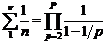 ,
,
where  and P are numbers to be chosen.
First let us choose a number N, preferably a large one, and form the sum  , i. e., choose
  . And then let P be the largest prime less than 2N which is surely composite, so that we consider the sequence of primes
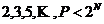 .
.
If we make N larger, and do so continuously, then we expect that the number of primes less than 2N will indeed increase, for if the set of all prime numbers were finite, then we could not increase the number of primes less than 2 by taking N larger and larger. This gives us the motivation for a proof: can we show that some strictly increasing function of N is always less than some function of the primes less than 2N?
Text 2
It is true that the product of two natural numbers is a natural number. Thus the set of natural numbers is closed under addition and multiplication. There is a natural number which is a multiplicative identity (namely 1), but no natural number is an additive identity (unless we remove the bar sinister from 0). The natural numbers are not closed with respect to subtraction or division, in the sense that the difference or quotient of two natural numbers may fail to be a natural number. For example, neither 1 – 2 nor 1/2 is a natural number.
The next larger class of numbers which we consider is the set of integers.
DEFINITION A number x is an integer if and only if x = m – n for some natural numbers m and n.
In other words, the integers are the differences of natural numbers. The integers satisfy all the axioms of addition (that is, the axioms with 'number' replaced by 'integer'), but not all integers have integral inverses with respect to multiplication.
The next larger class of numbers which we consider is called the set of rational numbers.
DEFINITION A number x is a rational number if and only if for some integer a and some natural number b it is true that x = a/b.
Alternatively, the rational numbers may be described as the quotients, with non-zero denominators, of integers. The rational numbers satisfy all of the axioms for numbers which have so far been listed. Only the continuity axiom for the numbers fails to be satisfied by the set of rational numbers. (Again, we mean the axioms, with 'number' replaced by 'rational number'.)
At this stage we cannot assert that there are numbers which are not rational numbers (that is, are irrational numbers). But, eventually, we shall attain that objective.
Unit 6
Reading
I. Pre-reading questions:
1. What are twin primes?
2. Is it true that every even number can be written as the sum of two primes?
II. Read the text. Try to guess the meaning of the words you don't know. Then consult your dictionary to check their meaning and pronunciation.
Text
Dirichlet proved that each simple arithmetic progression whose first term and difference are coprime contains an infinite number of primes. Now does the arithmetic progression of second order 
contain an infinite number of primes? No one knows. The answer seems to be beyond our present strength.
Another famous unsolved problem is: Are there an infinite number of twin primes, i. e., primes that differ by 2, e. g., 5 and 7, or 11 and 13? No one knows. Such twin primes are scarcer than prime numbers. The best result in this direction was obtained by a Norwegian mathematician, Viggo Brun. Curiously the fact that he was isolated from other mathematicians seems to have favored his work – for they, no doubt, would have convinced him that it would be useless to employ the Sieve of Eratosthenes to prove propositions on prime numbers. Using this outmoded device, he was able to show that the sum of the reciprocals of the twin primes converges, i. e., 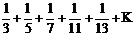 actually converges. This is surprising, for it can be shown that the sum of the reciprocals of all primes diverges. Thus Viggo Brun's result is an advance. If the number of twin primes is finite, then the sum of their reciprocals certainly converges. While if their number is infinite, it shows that we lose very many primes in extracting this convergent series from the divergent sum of the reciprocals of all primes, so that the twin primes are indeed scarce.
In addition Brun considered numbers that were not prime but consisted of at most 9 prime factors and succeeded in showing that among such numbers there are infinitely many twins, i. e., numbers differing by 2.
Since we know that the primes become less dense as we go to higher numbers and suspect that they appear again and again as twins, we expect that the prime numbers are very irregularly distributed. Are there arbitrarily large gaps in the sequence of primes? Yes. For example, consider M = 1000!: The numbers M+2, M +3, M +4, ..., M + 1000 are not prime, for M–2 is divisible by 2, M – 3 is divisible by 3, M – 1000 is divisible by 1000. Thus we construct 999 consecutive numbers no one of which is prime. The same result could be obtained from the product, N, of all the primes less than 1000. Adding 2,3,4,5, ... , 1000 successively to N, we would have again 999 consecutive non-prime numbers, e. g., N + 6 is divisible both by 2 and 3.
In a letter to Euler, a Russian named Goldbach asked if he could prove that every even number can be written as the sum of two primes. Mathematicians of the 18th century communicated their discoveries one to the other by letter, as there were few journals, so that their collected works consist in large part of correspondence. As a result of this fact, this unproved proposition is known as the Goldbach conjecture, though he is known for nothing else. However, the proposition is reasonable, for 4 = 2+2, 12 = 5+7, 6 = 3+3, 14 = 7+7 = 3+ll, 8 = 5+3, 16 = 5+11 = 3+13, 10 = 5+5 = 3+7, 18 = 7+11 = 5+13, and no one has ever found an even number contradicting the Goldbach conjecture. However, it is unproved. A major difficulty in proving this is the nature of prime numbers – they are made for multiplication, while the proposition is of an additive nature.
If the Goldbach conjecture were true, then adding 3 to every number we should have: Every odd number can be expressed as the sum of three primes. However, this weaker proposition does not imply the Goldbach conjecture — even if it were valid, still some even numbers might not be expressible as the sum of two primes. This has not been completely proved, but Vinogradov (1937), using ideas developed by Hardy and Littlewood in the early 1920's, succeeded in proving that from a certain number, M, onward, all odd numbers are the sum of three primes. Unfortunately his proof is an existence proof; it does not yield a method of estimating M. Nevertheless, the importance of this result is not to be underestimated.
Here we have a statement about all odd numbers greater than M — one we could never verify experimentally. A function of mathematics is to prove these things which are beyond experimental verification, and in large part, the importance and interest of mathematics lie in its 'infinite tail', in those propositions which are not experimentally verifiable. For example, 5 * 3 = 3 * 5 is mathematically dull, for we can check it; while ab = ba is fascinating, for it is a statement about all numbers.
We have noticed that the primes seem to be distributed irregularly. However, Bertrand observed that between a and 2a there always is a prime number. This is known as Bertrand's Postulate and has been proved by rather elementary paring the size of the interval, a < p < 2a, with the first number a, we have the relative length of the interval (2a — a)/o = 1. Thus the primes are regularly distributed in the sense that there is at least one in each interval of relative length I.
Now it would seem reasonable to ask if a smaller interval can be assigned in which we can always find at least one prime. For example, is the inequality  valid for all a? This yields 1 < 2.3 < 4.4 < 5.7 < 9, for a equal to 1 and 2. Here the relative length of the interval is

so that for large numbers the inequality, if valid, would assign a relative interval in which we could find a prime much smaller than that of Bertrand's Postulate. Unfortunately this is unproved.
III. Answer the questions:
1. What did Dirichlet prove concerning simple arithmetic progressions?
2. What result was obtained by V. Brun in this field?
3. Why do we expect that the prime numbers are very irregularly distributed?
4. What did Goldbach ask in his letter to Euler? What is he known for?
5. What was proved by Vinogradov?
6. What is an existence proof?
IV. What do the italicized words refer to? Check against the text.
1. Such twin pairs are scarcer than prime numbers, (line 9)
2. The best result in this direction was obtained by a Norwegian mathematician V. Brun. (line 9-10)
3. This is surprising, (line 17)
4. If their number is infinite, it shows that we lose very many primes in extracting this convergent series from the divergent sum of the reciprocals of all primes, (line 20)
5. The same result could be obtained from the product, N, of all the primes less than 1000. (line 39)
6. As a result of this fact, this unproved proposition is known as the Goldbach conjecture, (line 47)
7. This has not been completely proved, (line 63)
8. It does not yield a method of estimating M. (line 67)
9. Here we have a statement about all odd numbers greater than M — one we could never verify experimentally, (line 70)
10. This is known as Bertrand's Postulate, (line 80)
Vocabulary
V. Give the Russian equivalents of the following word combinations:
to be beyond; no doubt; outmoded device; in addition; at most; the same result; both ... and; one to the other; in large part; as a result; he is known for nothing else; in the early 1920's; from a certain number onward; in the sense that...; at least; it would seem reasonable; if valid.
VI. Find in the text the adverbs that end in - ly and adverbs that don't end in - ly. Think of some examples of such adverbs.
VII. Give antonyms of the following words:
finite, useless, to converge, regularly, reasonable, successful, known, divisible, addition, multiplication, to discover, to appear.
VIII. The following suffixes are used to form different parts of speech.
Nouns - ment - ness - sion - tion - ty - al
Adjectives: -ful - ic - able - ous - y - ive - al
Verbs: - ize/ise
The words below have all appeared in the text. Use your dictionary to find the other parts of speech, their translation and pronunciation. The above suffixes are used (but not always):
difference, to converge, to surprise, addition, to succeed, to construct, product, divisible, to prove, to communicate, to discover, correspondence, reasonable, to contradict, difficult, multiplication, to express, existence, statement, variable, important, equal.
IX. Use either among or between in these sentences: Note that we commonly use between to show a division between two people, things or times, e. g. 'Divide this between you both '. We use among to refer to a mass of people, things, etc., e. g. 'Were you among the people present?'
1. Brun succeeded in showing that — such numbers there are infinitely many twins.
2. Bertrand observed that — a and 2a there always is a prime number.
3. The lines were drawn — two corresponding dots to indicate the cancellation.
4. all the ordinary fractions there are many that are equal.
5. On closer examination of these two sequences we see that there is indeed a relation — them.
Grammar
X. Rewrite these questions with the words provided.
1. Does the arithmetic progression of second order contain an infinite number of primes? We want to know...
2. Are there an infinite number of twin primes? It is interesting to know...
3. Are there arbitrarily large gaps in the sequence of primes? Now we should answer the question...
4. Can he prove that every even number can be written as the sum of two primes? In a letter to Euler, a Russian named Goldbach asked...
5. Can a smaller interval be assigned in which we can always find at least one prime? it would seem reasonable to ask...
6. Is the inequality a" < p< (a + 1)' valid for all a? We would like to know...
XI. Supply comparative or superlative forms. Then check against the text.
1. Such twin primes are (scarce) than prime numbers.
2. The (good) result in this direction was obtained by V. Brun.
3. We know that the primes become (dense) as we go to (high) numbers.
4. The same result could be obtained from the product of all primes (little) than 1000.
5. This (weak) proposition does not imply the Goldbach conjecture.
6. Here we have a statement about all odd numbers (great) than M.
7. Now it would seem reasonable to ask if a (small) interval can be assigned.
XII. Rewrite the sentences using Subjunctive Mood.
1. They convinced him that it was useless to employ the Sieve of Eratosthenes to prove propositions on prime numbers.
2. The same result can be obtained from the product of all the primes less than 1000.
3. If we add 2,3,4,5,...,1000 successively to N, we will have again 999 consecutive non-prime numbers.
4. If the Goldbach conjecture is true, then adding 3 to every even number we have: Every odd number can be expressed as the sum of three primes.
5. Even if it is valid, still some even numbers may not be expressible as the sum of two primes.
6. It seems reasonable to ask if a smaller interval can be assigned in which we can always find at least one prime.
7. If for large numbers the inequality is valid it will assign a relative interval in which we can find a prime much smaller than that of Bertrand's Postulate.
XIII. Rewrite these sentences with suitable forms of seem.
1. The answer is beyond our present strength.
2. No one knows it.
3. The fact that he was isolated from other mathematicians favored his work.
4. This was not completely proved.
5. These things are beyond experimental verification.
6. We cannot check it.
7. The primes are distributed irregularly.
8. The essential idea was developed in Alexandria in the Third Century B. C.
XIV. Supply Present Perfect of the verbs given in brackets.
1. No one (ever to find) an even number contradicting the Goldbach conjecture.
2. This (not to prove) completely by anyone yet.
3. We (to notice) that the primes seem to be distributed irregularly.
4. This is known as Bertrand's Postulate and (to prove) by rather elementary means.
5. A more serious objection is that we (to use) the notions of infinite series and products and the notion of a limit, none of which are elementary.
6. So far we (to speak) only of finite sets.
7. We (already to set forth) a first axiom of the theory of probability, namely m{u) = p{u) = 1.
8. Thus we (to transform) the problem into the much simpler one.
Writing
XV. There are many different ways of expressing cause and effect, the text under consideration gives some of them. I Look through it again and pick out all the linking words used for these purposes. 2 Make a list of them and add some more examples. 3 Choose one of the theorems you know and prove it in writing, using linkers of the above type.
Supplementary Texts
Text I
Euler's proof of the infinity of primes provides the motivation for Dirichlet's proof of the theorem that in every arithmetic progression there is an infinity of primes. This last theorem is much too difficult to consider here.
Up to now everything has been proved before our eyes. A list of primes less than has been computed by D. N. Lehmer (1956). How are such lists prepared? The essential idea seems
to have been developed in Alexandria in the Third Century B. C., for it is attributed to Eratosthenes (ca. 250 B. C.) and does not appear in Euclid. Let us write down the list of integers:
1,2,3,4,5,6,7,8,9,10,11,12,13,14,15,16,17,....
First we cross out 2 and all its multiples. The first number, always excluding I, which is not hit is a prime, for it has no lower divisor. This is 3. So we strike out 3 and its multiples. The next uncancelled number, 5, is prime, having no smaller factor. Eliminating the multiples of 5, we find that 7 is a prime, etc. This purely mechanical method is known as the Sieve of Eratosthenes. It depends not upon the numbers themselves, but rather on their position in the sequence of the integers.
We may think of the row of equally spaced dots in Plate I as being continued indefinitely to the right. These we can number, calling the first one 0, the next, to the right, I, the next 2, etc. The method sketched above is applicable to these dots.
Plate 1 [preview not available]
Let us cross out every other dot, starting with 0 — a mechanical process. (In Plate I to avoid confusion this has been done in a second row and lines have been drawn between corresponding dots to indicate the cancellation.) Next we strike out the dots whose distance from the origin is a multiple of the distance of the first dot, excluding always, 0 and I, not previously cancelled. This yields line 3, and repeating the process gives line 5. Stepwise we eliminate all dots that are at multiples of the distance or some previous dot from the origin and find at the end of each step that the first uncancelled dot corresponds to a prime number. Thus it is clear that the Sieve of Eratosthenes depends upon the position of the integers in sequence rather than on the properties of the numbers themselves. This method was the basis on which Lehmer's list of primes was computed.

|
Из за большого объема этот материал размещен на нескольких страницах:
1 2 3 4 |
