

Партнерка на США и Канаду по недвижимости, выплаты в крипто
- 30% recurring commission
- Выплаты в USDT
- Вывод каждую неделю
- Комиссия до 5 лет за каждого referral
Unfortunately, the procedure cannot be explicitly generalized to the case of scalar-spinor fields interacting with electromagnetic or gravitational ones. This is obviously related to the loss of factorization property of the Klein-Gordon operator in these cases. However, many interesting consequences of the above construction can be preserved by consideration of the quadric Dirac equation (QDE) instead of ordinary linear Dirac equation (LDE) itself. In the case of a bispinor field interacting, say, with an electromagnetic one, the QDE operator is well known to factorize into a product of two canonical (i. e. with  ) Dirac equations. Moreover, in the case of a fixed external 4-potential
  the above scheme reproduces the results of orthodox relativistic quantum mechanics, e. g. in the problem of hydrogen atom spectrum etc. (for this, see below, Eq. (5)).
On the other hand, the interchange of LDE and QDE leads to a quite new theory in the general case of self-consistently interacting electromagnetic and bispinor fields. In the case of LDE one deals in fact with a classical analogue of the canonical system of equations (for corresponding field operators) accepted in quantum electrodynamics. Alternatively, in the case of QDE one comes to a principally novel system which can be set by the following Lagrangian:
 , (1)
, (1)
where  is the electromagnetic field strength tensor,
  the set of four Dirac matrices, and the last Pauli interaction term is necessary to guarantee the factorization property. System of field Eqs. corresponding to (1) takes the form:
 (2a)
(2a)
 (2b)
(2b)
and one more equation for the Dirac-conjugated bispinor  . Now it is a simple exercise to convince oneself that Eq.(2a) may be equivalently represented as
 (3)
(3)
i. e. in an ordinary factorized form. Then for a newly defined bispinor field
 (4)
(4)
the canonical Dirac linear equation will be fulfilled,
 (5)
(5)
Let us now notice some peculiarities of the above self-coordinated system of Eqs. (2a,2b). In the first place, one has to distinguish therein the Dirac current 4-vector  associated usually with positive definite probability density of a Dirac particle
  from the electromagnetic current 4-vector
  defined by Maxwell Eqs.(2b). First one is obviously conserved if it is defined via the auxiliary bispinor (4); second is conserved as a result of Maxwell Eqs.(2b) themselves. Thus one has more conserved quantities in the framework of the presented model than in the canonical case. Moreover, if one would attempt to substitute the quantum electrodynamics (operator) system for that given by Eqs.(2a),(2b), he is not obliged to introduce two independent bispinor fields – for electrons and positrons, respectively, but could hope to describe both particles by only one bispinor field satisfying the QDE and system (2a,2b) as a whole! This opportunity is just related to indefinite sign of the charge density
  in the r. h.s. of Eq.(2b).
We, however, are interested in a purely classical consideration of particle-like (``soliton-like’’) solutions to self-coordinated system of Eqs.(2a,2b). It is noteworthy to mention that such solutions have been studied for the case of the canonical Dirac-Maxwell system for minimally interacting fields in Refs.2-4 and others. Despite some interesting exact results, e. g. the obtained general relationship between admissible spin and charge of such soliton-like formations (Ref.2), conclusive status of the Dirac-Maxwell system of Eqs. can be considered as rather low. Indeed, the main difficulty for exact examination of such a model was the impossibility of separation of variables and isolation of individual spherical harmonics. As to (numerically) obtained properties of the Maxwell-Dirac solitons, all found representatives of these possess negative proper energy (as it was obtained previously in the model of interacting scalar and electromagnetic fields, Ref. 5).
For the model based on the QDE, the energy of solitons is not positively defined too. Nonetheless, a special investigation is needed to determine the true sign of the solitons’ rest energy. Search of solitons for the self-coordinated system of Eqs. (2a),(2b) is currently in process. Some preliminary results will be presented at the report.
References
1. Kassandrov V. V. // Gravit. and Cosmol, 14, No.1, 2008, p.53.
2. Kassandrov V. V., Terletskii Ya. P. // In: Problems in Quantum Physics, M., Peoples’ Friend. Univ. Press, 1977, p. 39 (in Russian).
3. Kassandrov V. V. // Vestnik Peoples’ Friend. *****ssia, Fizika, 3(1), 1995, p.168 (in Russian).
4. Wakano M. // Prog. Theor. Phys., 35, 1966, p. 1117.
5. Rosen N. // Phys. Rev., 55, 1939, p.94;
Menius A. C., Rosen N. // Phys. Rev., 62, 1942, p. 436.
Ricci scalar describes both particle and field densities
I. E. Bulyzhenkov
Lebedev Physics Institute RAS
*****@
Ricci scalar density can be used for geometrization of the extended radial particle together with geometrization of its radial field. The right hand side of the 1915 Einstein equation can be dropped for such continuous matter. Static metric solutions for nonempty (material) space are free from Schwarzschild singularities. General Relativity can be developed as a selfcontained theory by accepting quantitative equivalence of mass-energy densities associated with the inertial particle and with its gravitational field.
A new model of the Eath athmosphere with strong electric fields described by means of the Yang-Mills theory
A. S. Rabinowitch, S. Yu. Abakumov
Moscow State University of Instrument Construction and Information Sciences
20 Stromynka str., Moscow Russia
*****@***ru, *****@***ru
We study a model of the Earth atmosphere in which the influence of strong electric fields is taken into account. The model is a generalization of the standard one and can be described by the following equation of equilibrium of the atmosphere:
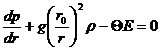 , (1)
, (1)
where  is the atmospheric pressure for a certain latitude and longitude,
  is a distance from the Earth center,
  is the Earth radius,
  is the atmospheric mass density,
  is the free fall acceleration at the Earth surface,
  is the Earth electric field and
  is the density of the atmospheric electric charge.
Eq. (1) without the electric field term corresponds to the standard atmospheric model. As follows from computations, this model is applicable for altitudes not more than 150 km. For higher altitudes its predictions substantially differ from experimental data. This shows the importance of the electric field term in Eq. (1). In order to describe strong electric fields in the atmosphere, we use a nonlinear generalization of the classical theory of electricity proposed in Refs. [1 – 3] which is based on the Yang-Mills equations with SU(2) symmetry.
To determine values of the parameters of the suggested model and then to compute solutions of Eq. (1) and compare them with experimental data, we use the empirical model MSIS-E-90 [4] based on data derived from spacecrafts.
Applying our model, we have computed the distributions of the atmospheric mass density and pressure for different geographic coordinates, dates and day times. The computations show that the obtained numerical results are in a good agreement with experimental data. This can be regarded as a serious argument in favor of our model.
References
1. Rabinowitch A. S. Bulletin of PFUR, ser. Phys., 2005, No. 13, pp. 68-77.
2. Rabinowitch A. *****ss. J. Math. Phys., 2008, Vol. 15, No. 3, pp. 389-394.
3. Rabinowitch A. S. Nonlinear Physical Fields and Anomalous Phenomena. New York, Nova
Science Publishers, 2009.
4. http://omniweb. gsfc. nasa. gov/vitmo/ .

Physics of rotating and expanding black hole universe
U. V. S. SESHAVATHARAM
DIP QA Engineer, Lanco Industries Ltd, Srikalahasti- A. P, India.
seshavatharam. *****@***com
Throughout its journey, universe follows strong gravity. Planck particle can be considered as the baby universe. A simple derivation is given for rotating black hole’s temperature. When the rotation speed approaches ‘light speed’, temperature approaches Hawking’s Black hole temperature. Appling this idea to the cosmic black hole, it is noticed that, there is ‘no cosmic temperature’ if there is ‘no cosmic rotation’. Starting from the Planck scale, it is assumed that - “universe is a ‘rotating and expanding’ black hole”. Another key assumption is that, “at any time, cosmic black hole rotates with light speed ”. For this cosmic sphere as a whole, while in light speed rotation, ‘rate of decrease’ in temperature or ‘rate of increase’ in cosmic red shift is a measure of ‘rate of cosmic expansion”. Measured isotropic CMBR temperature 2.7250 Kelvin indicates that, at present “rate of decrease” in temperature is practically ‘zero’ and ‘rate of expansion’ is practically ‘zero’. If present CMBR temperature is 2.725 degree Kelvin, present value of obtained angular velocity is 2.17 x 10⁻¹⁸ rad/sec = 67 Km/sec/Mpc. Present ‘cosmic mass density’ and ‘cosmic time’ are fitted with the natural logarithm of ratio of cosmic volume and planck particle’s volume.
Investigation of closed orbits of nucleons and antinucleons moving in nonlinear fields
A. S. Rabinowitch, M. A. Kramskoy
Moscow State University of Instrument Construction and Information Sciences
20 Stromynka str., Moscow Russia
*****@***ru, k. *****@***ru
We study movements of nucleons and antinucleons round nuclei under the action of their nuclear and electric fields. As is known, the classical Yukawa theory cannot describe nonlinear properties of nuclear forces [1]. That is why we use its nonlinear generalization proposed in Refs. [2 – 4]. In this nonlinear theory the relativistic movement of a hadron is described by the following equation:
 , (1)
, (1)
where  ,
,  is the nuclear potential,
  is the electromagnetic strengths,
  is the proton mass at rest,
  are the mass at rest and electric charge of the moving hadron, respectively,
  are its space-time coordinates of the Minkowski geometry, and
  .
.
We solve Eqs. (1) for moving nucleons and antinucleons round nuclei using the polar coordinates. Then these equations can be reduced to a system of two nonlinear differential equations of the second order for the radial coordinate and polar angle of a particle. Numerical computations for the system of equations are performed. They show that protons and neutrons can move in closed orbits round only light nuclei. At the same time antiprotons can move in closed orbits round also medium and heavy nuclei. Besides, such orbits can be sufficiently remote from nuclei. Then the annihilation is impossible and quasi-nuclei with rotating antiprotons can appear. The conditions of forming closed orbits and quasi-nuclei are investigated in both cases of non-relativistic and relativistic antiprotons.
References
1.Ericson T., Weise W. Pions and Nuclei. Oxford, Clarendon Press, 1988.
2. Rabinowitch A. S. Int. J. Theor. Phys., 1994, Vol. 33, No 10, pp. .
3. Rabinowitch A. S. Int. J. Theor. Phys., 1997, Vol. 36, No 2, pp. 533-544.
4. Rabinowitch A. S. Nonlinear Physical Fields and Anomalous Phenomena. New York,
Nova Science Publishers, 2009.
Avogadro's Strong Nuclear Gravity, Super Symmetry and grand unification
U. V. S. SESHAVATHARAM1 & Prof. S. LAKSHMINARAYANA2
1DIP QA Engineer, Lanco Industries Ltd, Srikalahasti- A. P, India.
Email: seshavatharam. *****@***com
2Department Of Nuclear Physics, Andhra University,
Visakhapatnam- AP, India.
*****@***com
It is suggested that ‘strong nuclear gravitational constant’  is (Avogadro number)2 times the ‘classical gravitational constant’
  . It can be suggested that is a consequence of the existence of . plays a vital role in the construction of atom, elementary particles and the charged nuclear space-time curvature. Based on ‘strong nuclear gravity’ and ‘super symmetry’ it is noticed that
  is a secondary physical constant. Previously proposed 2 strong interaction fermion rest masses revised to 105.3226825 MeV and 11460.81321 MeV. Super symmetric fermion-boson mass ratio is revised to 2.. Nuclear charge radius is fitted. Charged lepton rest masses fitted accurately and 4th heavy lepton is predicted at 42262 MeV. Up and down quark mass ratio is equal to
  . Quark masses, nucleons rest masses and nuclear binding energy constants are fitted accurately. QCD scale, strong coupling constant and Fermi's weak coupling constant are fitted. It can be suggested that top quark boson and electroweak
  boson both are same.
  boson constitutes 2 oppositely charged bosons. Finally it can be suggested that nuclear and particle physics can be studied in the view of `Avogadro’s strong nuclear gravity and super symmetry.
Thermal noise and coating optimization in multilayer dielectric mirrors
Nikita Kondratiev
MSU
*****@***ru
Optical multilayer coatings of high-reflective mirrors significantly determine properties of Fabry Perot resonators. Thermal (Brownian) noise in these coatings produce excess phase noise which can seriously degrade the sensitivity of high-precision measurements using these cavities. In particular it is one of the main limiting factors at the current stage in laser gravitational-wave detectors (for example project LIGO). We present a method to calculate this effect accurately and analyze different strategies to diminish it by optimizing the coating.
Traditionally the effect of the Brownian noise is calculated as if the beam is reflected from the very surface of the mirror's coating. However, the beam penetrates the coating and Brownian expansion of the layers leads to dephasing of interference in the coating and consequently to additional change in reflected amplitude and phase. Fluctuations in the thickness of a layer change the strain in the medium and hence, due to photoelastic effect, change the refractive index of this layer. This additional effect should also be considered. It is possible to reduce the noise by changing the total number and thicknesses of high and low refractive layers preserving the reflectivity. We show how an optimized coating may be constructed analytically rather than numerically as before. We also check the possibility to use internal resonant layers, optimized cap layer and double mirrors to decrease the thermal noise.
Neutrino Telescopes in ocean and in Antarctica
Vladimir A. Zhukov
Institute for Nuclear Research, RAS
*****@***ru
Significant progress was made in the field of neutrino physics in the last 30 years. Solved the problem of solar neutrinos, neutrino oscillations are found and registered neutrinos from supernova. There is a serious development of neutrino astronomy. Stage of prototype testing of deep neutrino telescope is completed. Methods of deployment at sea neutrino telescopes worked on pilot arrays in the Mediterranean (NESTOR, ANTARES), in Baikal (NT200) and in Antarctica (AMANDA). Construction of large-scale neutrino telescope with a working volume of 1 cubic km in the Mediterranean launched. Telescope of this size (ICE CUBE) has already been built in the ice of Antarctica. Upper limit in the flux of cosmic high energy neutrinos received.
Axially-Symmetric and Closed-String in the Skyrme Gauge Model
Yu. P. Rybakov, E. Benavente Ramirez
Department of Theoretical Physics,
Peoples Friendship University of Russia,
6, Miklukho - Maklaya str., Moscow, Russia
The structure of axially-symmetric fields in the gauge Skyrme SU(2) model is studied. The Hamiltonian and the topological charge are constructed for the corresponding invariant class. The internal discrete group of the model is found, thus impliying essential simplification of the energy functional. Within the scope of the Skyrme SU(2) gauge model we consider closed chiral strings (vortices), яthe closure radius  being supposed large with respect to the characteristic transversal scale determined by the model parameters. In this approximation the chiral and gauge fields inside the vortex, as well as its energy, can be estimated as functions of the topological charge Q.
Pairwise Interaction Potential Parameters of Alkali Halide Crystals I-Static Crystal Method
S. Sh. Soulayman*, J. Attiyah** and A. Molhem** , S. Yunusova ***
*) Higher Institute of Applied Sciences and Technology, Department of Applied Physics, Damascus, P. O. Box 31983, Syria
**) Al-Baath University, Faculty of Sciences, Department of Physics,
Homs, P. O.Box77, Syria
***) Department of Theoretical Physics, Peoples` Friendship University of Russia
6, Miklukho-Maklaya str., Moscow, Russia
*****@***edu. sy
In this work a methodology suitable for determination the parameters of the potential of pairwise interactions in the alkali halide crystals is presented. The method of static crystal was applied for several known forms of the potential. Different types of functions viz. Pauling, Born-Mayer-Huggins, Varshni-Shukla and Woodcock have been used for the Born repulsive part of energy. The Van der Waals energy due to the dipole-dipole and dipole-quadruple interactions are also considered. A comparison between the obtained results and those available in literature values is carried out.
Supersymmetry in Quantum Optics
V. A. Andreev
P. N. Lebedev Physical Institute, Moscow, Russia
The realization of Witten’s quantum mechanics superssymmetrical cheme in quantum optics is constructed. We consider the two-level systems interacting with one or two bosonic modes. They are described by the Jaynes-Cummings Hamiltonian and its generalizations. It is shown that some of such Hamiltonians form superssymmetrical pairs and can be considered as components of one superssymmetrical Hamiltonian.
Quantum description of complex systems and physical constructivism
Y. Ozhigov
MSU of M. V.Lomonosov, Russia
The core of quantum informatics is the theory and experiments on QuantumComputer. This still hypothetic device bears the outstanding role for theoretical physics, because it represents the most general model of a complex system on the quantum level that could include the more profound understanding of the life. We are standing at the beginning of new discipline: quantum physics of complex systems, in which it will be possible to understand how living things behave. But to analyze this topic we first of all must develop the new mathematical apparatus, because the traditional formalism of quantum mechanics fits only for the simple quantum effects like interference of one - two quantum particles. The only possibility to build this new apparatus is to use constructive mathematics that means to rest on algorithms instead of abstract algebra. We show how to include decoherence in the constructive model of quantum computer and how to represent the real evolutions in Hilbert space without addressing to hypothetic scalable quantum computer in sense of Deutsch and Di Vincenzo. We describe how computer programs look, which model quantum systems with many particles if to account as complex quantum entanglement as the limited classical memory can contain. Constructive rebuilding of quantum theory resolves some old problems, like the absence of "hidden variables" turning it to the exact theorem; it also puts in some order our representation of "quantum" and "classical" worlds that makes possible to focus on the practically important work - building of computer programs simulating real world on the quantum level.
Electron Trapping in Weakly Coupled Concentric Quantum Rings
I. Filikhin, S. G. Matinyan, J. Nimmo, and B. Vlahovic
North Carolina Central University, Durham, NC, USA
We are investigating electron wave function localization in double concentric quantum rings (DCQR)[1] when a perpendicular magnetic field is applied. In weakly coupled double quantum ring, a possible situation occurs when the single electron energy levels associated with different rings may cross. Degeneracy is avoided by anti-crossing of corresponding levels of DCQR. We show that in this DCQR the electron spatial transition between the rings occurs due to the electron level anti-crossing (see, for instant, [2]). The anti-crossing of the levels with different radial quantum numbers provides conditions for the electron tunneling between rings. DCQRs are composed of GaAs in an Al0.70Ga0.30As substrate [1]. To study electronic structure of DCQR, the single sub-band effective mass approach was used with energy dependence of the electron effective mass [3]. Results of numerical simulation for the electron transition are presented for the DCQR with the geometry parameters corresponding to experimentally fabricated DCQR in [1]. Estimation for energy gap between anti-crossing levels is performed to show the energy gap dependence on distance between rings and radial quantum numbers of the states. The last defines spreading of the electron wave function in DCQR. The adequacy of the model is confirmed by comparing obtained results with PL data. Effect of the trapping of an electron in the inner QR of the DCQR (or QD inside QR) may be interesting from the point of view of quantum computing.
This work is supported by the NSF (HRD) and NASA (NNX09AV07A).
References
[1] T. Mano at al. Nano Letters 5, 425, 2005; T. Kuroda et al. Phys. Rev. B 72, 2005.
[2] V. Arsoski, M. Tadic and F. M. Peeters, Acta Physica Polonica, 117, 733, 2010.
[3] I. Filikhin, V. M. Suslov and B. Vlahovic, Phys. Rev. B 73, 2006.
Novel Quantum Approach to the Heisenberg Uncertainty Principle
Itzhak Orion Ph. D. and Michael Laitman Ph. D.*
Ben-Gurion University of the Negev, POB 653, Beer-Sheva,84105 ISRAEL
* Ashlag Research Institute, POB 1552, Ramat-Gan 52115 ISRAEL
Quantum physics perception deals with three basic principles: particle-wave duality, the Heisenberg uncertainty and the wave function interpretation.
We present here a new approach for the uncertainty principle as an outcome of a different quantization order level. Particles and waves are represented the same in quantum physics. Therefore, the particle has to possess wave properties, which leads to the uncertainty problem. In our previous published paper, about particle-wave duality, we proposed that wave properties can be observed only if a bunch of particles are in a state of EoF (Equivalence of Form). Only under this condition the particles would be connected as a group (Kevutsa) holding wave properties.
The uncertainty principle is based on wave-package qualities, where frequency differences between the wave-envelope and its position is produced by a constant.
We claim in this paper that the particle is actualized out of the waves in a wave's dispersion process that gives the particle its’ properties from the wave- package for a certain energy (similar to photons). Other states, or other particles, are possible to be actualized due to the other information structures folded in the wave-package. The appearance of state levels in the atom follows an internal order (like quantum numbers in a range). In atomic or nuclear systems, the propagation operator is extracting the informatics of the wave-package that put into reality a process of photon absorption, from a previous state toward a new state population.
Behind the apparent uncertainty, there is organized information to be potentially expressed, as a particle or a state, with a probable intensity to be realized, while the whole picture of the quantum states for a system is complete.
We propose a new name to this approach: Informational Quantization.
Causality and probability in quantum mechanics
D. A. Slavnov
MSU
*****@***bog. *****
We discuss the causality problem in quantum theory. We show that there exists a formulation of quantum theory that, on one hand, preserves the mathematical apparatus of the standard quantum mechanics and, on the other hand, ensures the satisfaction of the causality condition for each individual event including the measurement procedure.
Accuracy features for quantum tomography
Yu. I. Bogdanov, I. D. Bukeev
Institute of Physics and Technology, Russian Academy of Sciences,
A throughout study of statistical characteristics of fidelity in different protocols of quantum tomography is given. We consider the protocols based on geometry of platonic solids and semiregular polyhedrons such as fullerene. Characteristics of fidelity in different protocols are compared to the theoretical level of the minimum possible level of fidelity loss. Tomography of pure and mixed states in Hilbert spaces of different dimension is studied.
Platonic solids are used to provide the most symmetrical and uniform distribution of quantum states on the Bloch sphere. States, which set projection quantum measurements, are defined by vectors directed from the center of Bloch sphere to corresponding centers of solid's faces. Therefore the number of solid's faces determines the number of quantum measurement protocol's rows and this number is respectively: 4 for tetrahedron, 6 for cube, 8 for octahedron, 12 for dodecahedron and 20 for icosahedron. Since these five described solids cover the whole set of platonic solids, search for quantum measurement protocols which possess high symmetry and number of rows more than 20 makes us to refer to semiregular polyhedrons which are called Archimedean polyhedrons. As examples of such polyhedrons were chosen fullerene (truncated icosahedron), which determines the quantum protocol with 32 measurements, and polyhedron dual to fullerene (Pentakis dodecahedron), which defines the quantum protocol with 60 rows (according to the number of it's faces or, what is actually the same, to the number of fullerene's vertices).
Fidelity comparison of considered protocols with maximum available fidelity shows that as the number of regular and semiregular polyhedrons' faces increases considered fidelity rapidly converges to the theoretical limit (in addition an uniformity of fidelity distribution on Bloch sphere increases fast). In this work is shown that accuracy of suggested protocols is much higher in comparison with
an accuracy, which provide protocols not possessing high symmetry.
Considered method is generalized on the case of multi-qubit state tomography and accepts the reconstruction of not only pure states but mixed states of arbitrary rank, too.
Developed method is addressed to increase the fidelity and efficiency of quantum tomography procedures. Results of this work could be used for control of states procedures' debugging in quantum cryptography and for the realization of quantum computer's logic gates.
Semiconductor quantum ring in strong lateral electrostatic fields
V. A.Harutyunyan
State Engineering University of Armenia, Gyumri Branch, 2 M. Mkrtchyan St., 3103 Gyumri, Republic of Armenia
*****@***ru
During two last decades electronic and optical properties of low-dimensional semiconductor structures have been studied both experimentally and theoretically. Along with long-known systems like quantum wells (quntum films), quantum wires, quantum dots and superlattices, the novel confined structures called quntum rings (QR’s) attract much attention [1].
In this report the specificity of single-particle states of charge carriers in semiconductor quantum ring in the presence of strong lateral homogeneous electrostatic field is examined theoretically. The finiteness of the ring thickness in both radial and perpendicular to the radial plane direction is taken into account. The explicit forms of wave functions and of energy spectrum of charge carriers in a quantum ring in the presence of strong uniform field are obtained.
It is shown, that a strong external field creates a new deep potential well; because of this, along with the quantum confinement in the radial direction, the charge carriers in the QR are additionally localized also along their angular motion. Instead of the rotation in the QR circle the particle under action of a strong external field vibrates now in a narrow angular cone of the azimuth variable. The localization cones of opposite charges are disposed at opposite edges of the QR’s diameter directed along the external homogeneous field.
As an example of application of these results we will consider the optical transitions in QR in the presence of external strong electrostatic field. Relevant characteristics for interband and intersubband electro-optical transitions in the ring are calculated analytically in this report. Particularly, it is shown that absorption intensities and threshold frequencies of electro-optical transitions depend explicitly on geometrical sizes of sample, on intensities of external fields and on effective masses of charge carriers. These theoretical results can be effectively used for the experimental observation of optical transitions in quantum ring, and for the controlled variation of electro-optical parameters of the sample.
References
1. T. Chacraborty, Adv. In Sol. St. Phys. 43,; T. Chacraborty and P. Pietilainen, Phys.
Rev. 50, 8; B. Szafran, Phys. Rev. B77, 205
Information Transfer Constraints in Quantum Measurements
S. Mayburov
Lebedev Institute of Physics
Moscow, Russia, RU – 117924
Any measurement process includes the transfer of information from the measured object S to the information system O, which stores and processes it; thus, any measuring system (MS) can be regarded as the information channel. It was found earlier that due to the severe constraints induced by Heisenberg commutation relations, the capacity of quantum channels channels is relatively small [1], so the resulting information losses in MS can be significant and influence the measurement outcome [1]. Here the influence of such constraints on the measurement outcomes will be studied for simple MS model [2].
To check their effect, we considered the model measurement of dichotomic S observable Λ performed by MS, which includes the detector D and O, both of them are regarded as the quantum objects [1]. The measurement of two S ensembles  is considered; E₁ includes the pure states which are the superposition of Λ eigenstates
  with amplitudes
  , another ensemble E₂ is the probabilistic mixture of such eigenstates with the same Λ. First, we analyze the information transfer during S, D and D, O interactions, neglecting D, O decoherence by their environement.
In this case Heisenberg constraints The comparison of final MS states for such ensembles demonstrates that the information about the purity of incoming S ensemble isn't transferred to O; for ensembles it is described by the expectation value of S observable Λ′, conjugated to Λ. As the result, O can't discriminate the pure and mixed S ensembles with the same Λ [3]. Apllying the quantum formalism of system self-descripiton [4], it is shown that such losses induce the appearance of randomness in the measurement of S pure ensemble E₁, so that in the individual events O would detect at random O 'pointer' values  , which correspond to the outcomes for O measurement of incoming [5]. Observed by O in the individual events, which correspond to the collapse of S pure state. For the start, the analysis of D, O decoherence effect by the environment was performed, neglecting the influence of Heisenberg constraints. Concerning the decogerence influence, it's shown that by itself, due to the unitarity of decoherence interactions, it can't result in the appearance of randomness in the measurement outcomes. However the account of the decoherence dynamics stabilizes the obtained MS states additionally.

|
Из за большого объема этот материал размещен на нескольких страницах:
1 2 3 |
