

Партнерка на США и Канаду по недвижимости, выплаты в крипто
- 30% recurring commission
- Выплаты в USDT
- Вывод каждую неделю
- Комиссия до 5 лет за каждого referral
International Conference on Theoretical Physics 2011
Moscow, Russia
20-23 of June 2011
Moscow State Open University
The entropy gain and the Choi-Jamiolkowski correspondence for infinite-dimensional quantum evolutions
A. S. Holevo
B. Steklov Mathematical Institute, Russia
*****@
In the first part of the talk we discuss the entropy gain for infinite-dimensional quantum evolutions. We show that unlike finite-dimensional case where the minimal entropy gain is always nonpositive, there are many channels with positive minimal entropy gain. We present the new lower bound and compute the minimal entropy gain for a broad class of Bosonic Gaussian channels by proving that the infimum is attained on the Gaussian states. The second part of the talk is devoted to the Choi-Jamiolkowski correspondence between channels and states in the infinite-dimensional case in the form close to one used in quantum information theory. In particular, we obtain explicit expression for the Choi-Jamiolkowski operator defining a general nondegenerate Bosonic Gaussian evolution and compute its norm.
On Superstitions and Errors in Understanding the Relativity Theory
Nikolai V. Mitskievich
Universidad de Guadalajara, Mexico
*****@***com
In this lecture, with strictly given proofs, we show that several basic axioms, including those used in generally accepted foundations of Special and General Relativity theory, do merely represent regrettable misunderstandings whose elimination by no means does falsify these theories, but it helps to understand more profoundly their contents and opens new horizons for the development of Theoretical Physics. This situation is illustrated by two examples which are accepted to be obvious truths from which were admittedly deduced both Special, as well as General Relativity Theories: in the first case it is shown that the so-called Galileo transformations have in fact the same contents as the Lorentz transformations, and in the second case that the Principle of Equivalence of Inertial and Gravitating Masses is not fulfilled in General Relativity Theory trivially yielding an unavoidable relativistic generalization of this Equivalence Principle which radically differs from the generally accepted formulation of this Principle, not reducing to addition of small corrections to this old and primitive formulation.
Quantum Effects in Photosynthesis and
Entropy Decreasing
Igor V. Volovich
Steklov Mathematical Institute
Russian Academy of Sciences
Gubkin St. 8, Moscow, Russia
email:*****@
Photosynthesis changes the energy from the sun into chemical energy and is vital for life on Earth. Study of photosynthesis is of a fundamental importance not only for pure science but also for applications. If researchers could learn how to move energy with such precision and efficiency over comparable distance as Nature does in photosynthesis, then enormous leaps in the development of cheap organic solar cell technology would ensue.
Previously the role of quantum effects in the photosynthesis at the room temperature was ruled out because of the quantum decoherence. However, a remarkable recent experiment (Scholes et al.) has shown that quantum mechanics might be involved in the process of photosynthesis in some marine algae even at the room temperature, see [1] for a discussion.
In this talk, based on [2], it will be suggested that the phenomenon of the enhancement of the transport of excitons in photosynthesis might be related with the decreasing (not increasing!) of entropy for the solutions of the master equation for some the complete positive trace-preserving noisy quantum channels. A constructive role of noise in quantum computations was mentioned earlier and a new paradigm for quantum computations which goes beyond the quantum Turing machine was suggested, see [1]. Note also that it was found by Caruso et al that the quantum capacity for a quantum channel in the quantum network dynamics can be enhanced by introducing dephasing noise.
References
[1] M. Ohya and I. Volovich, Mathematical Foundations of Quantum Information
and Computation and Its Applications to Nano- and Bio-systems, Springer, 2011.
[2] S. Iriyama, M. Ohya, K. Sato and I. Volovich, Photosynthetic anthenna and
entropy decreasing, TUS preprint, 2010 (to be published).
The mechanism of tunneling and formation of bound pairs of electrons
Martin Rivas
University of the Basque Country, Spain
martin. *****@***es
The classical description of elementary spinning particles shows that the center of mass and center of charge of an elementary particle are different points. This separation is half Compton's wave length and because of this the interaction of two electrons with their spins parallel can produce a bound pair provided the internal phase is opposite and the relative velocity of their centers of mass is below a certain limit. It is also this separation which justifies that an electron under a potential barrier can cross it with an energy below the top of the potential provided the spin is properly oriented and the barrier has a narrow range. This can justify the spin polarized tunneling effect.
References
1. M. Rivas Kinematical Theory of spinning particles, Classical and quantum mechanical formalism of elementary particles, Fundamental Theories of Physics Series, Vol 116, Kluwer Academic Publishers and Springer
2. author web-page:http://tp. lc. ehu. es/martin. htm
Soliton Configurations in Generalized Mie Electrodynamics
Yu. P. Rybakov
Peoples’ Friendship University
Department of Theoretical Physics
E-mail: *****@***ru
We consider the generalization of the G. Mie electrodynamics including 8-spinor field source and higher degrees of the Mie invariant . Peculiar topological properties of 8-spinors are distinguished and expressed via the existence of the remarkable 8-squares F. Brioschi identity permitting to obtain the natural 8-spinor unification of the Skyrme baryons model and the Faddeev leptons model, these particles being considered as the topological solitons. We construct the two types of the soliton-like configurations admitted by the model: charged static ones and luxons, i. e. neutral photon-like solitons.
Non-classical soliton structures in dynamics
M. A. Aguero
Department of Physics, Faculty of Science, Universidad Autonoma del Estado de Mexico, 50000 Toluca, Mexico,
*****@***mx
We have analyzed the improved Dauxoi-Peyrard-Bishop model that takes into consideration the inclusion of nonlinear interaction between adjacent pair of bases. The study of displacements along the Hydrogen bonds of DNA shows the appearance of nonlinear structures named crowdons, cuspons and peakons. These solutions exist in certain domain of the main parametric space of the model that determines a priori the velocity of the traveling structures. Nevertheless these structures would allow us to catch some peculiarities of the denaturation process. The crowdon perturbations should be considered the natural counterparts that cure the appearance of denaturation.
Are electrons pointlike or extended?
Alexander Burinskii, Moscow,
NSI Russian Academy of Sciences
*****@
We give a brief review of the old and recent models of the extended electron, in particular the toroidal ringlike (stringlike) models considered from diverse posits of view by many authors (Parson (1916), pton (1919-21), H. Hoenl 1938 and many others). After the great success of QED, and experiments on the deep inelastic scattering, these old models were considered as obsolete. Meanwhile, the QED does not take into account gravity, and moreover, there is great problem with its consistence with gravity. On the other hand, there are many evidences that black holes are akin to elementary particles (G. `t Hooft, A. Sen, F. Wilczek), and the Kerr-Newman solution has given new evidences in support of the old stringlike extended model of the electron. After Carter’s observation (1968) that the KN solution has g=2 as that of the Dirac electron there appears new activity on the model of spinning electron consistent with gravity. Singular ring of the KN solution takes the form of the lightlike circular string of the Compton size [1]. The KN model of an extended electron was started by W. Israel (1969), and from diverse point of view was considered by author in [2] as a model of a `microgeon with spin’. C. Lopez (1984) developed the Israel model (there were also the works by Arcos and Pereira (2004), T. Nieuwenhuizen (2006), Dymnikova (2006), and others, some of the refs. are given in [3].) In the paper [3] we showed that the regularization of the KN solution by the Higgs field leads to a model of the extended spinning electron consistent with gravitaty, and again there appeared a circular string of the Compton size on the border of the KN source, reproducing the old toroidal ring models. We show now that the lowest excitation of the KN soliton creates a singular node, which may be exhibited as a pointlike structure of the consistent with gravity extended KN electron.
References
[1] A. Burinskii, "Some Properties of the Kerr Solution to Low-energy String Theory," Phys. Rev. D[arXiv:hep-th/9504139].
[2] A. Ya. Burinskii, «Микрогеон со спином». ЖЭТФ, т11; translation in: Sov. Phys. JETP,
[3] A. Burinskii, “Regularized Kerr-Newman Solution as a Gravitating Soliton"J. Phys. A: Math. Theor.1, [arXiv: 1003.2928].
Mimicking the probability distribution of a two-dimensional Grover walk with a single-qubit coin
Carlo Di Franco
Physics Department, University College Cork, Ireland
*****@***ucc. ie
The two-dimensional Grover quantum walk has raised the interests of the scientific community, as it can be used in order to implement the two-dimensional Grover search algorithm [1]. During this talk, I will demonstrate that the non-localized case of the spatial density probability of the Grover walk can be obtained using only a two-dimensional coin space and a quantum walk in alternate directions [2]. To prove formally this equivalence, I will illustrate how the coefficients of the Grover walk in the non-localized case can be mapped to the coefficients of the alternate walk state for a particular instance of the coin initial conditions.
One of the key properties of quantum walks is their ability to evolve disentangled states into entangled ones and to efficiently generate entanglement in experimentally feasible systems [3]. Controlled entanglement generation has currently a place at the forefront of research, as it is a fundamental resource in quantum computation and cryptography and therefore a pre-requisite for the construction of reliable devices for quantum information processing [4]. I will present an analysis of the behavior of the coin-position as well as the x-y spatial entanglement in the proposed scheme with respect to the Grover one. I will show that this experimentally simpler scheme allows to entangle the two orthogonal directions of the walk more efficiently.
Finally, I will discuss a possible physical implementation of the proposed walk, along the lines of a recent experimental realization of a linear quantum walk of a single neutral atom in a spin-dependent one-dimensional optical lattice [5].
References
[1] N. Shenvi, J. Kempe, and K. B. Whaley, Phys. Rev. A 67, 052; A. Ambainis, J. Kempe, and A. Rivosh, in Proc. 16th ACM-SIAM SODA, Vancouver (SIAM, Philadelphia, USA, 2005), p. 1099; A. Tulsi, Phys. Rev. A 78, 012
[2] C. Di Franco, M. McGettrick, Th. Busch, arXiv:1010.2, accepted to be published on Phys. Rev. Lett.
[3] S. E. Venegas-Andraca and S. Bose, arXiv:0901.3; S. K. Goya and C. M. Chandrashekar, J. Phys. A 43, 235
[4] R. Horodecki, P. Horodecki, M. Horodecki and K. Horodecki, Rev. Mod. Phys. 81,
[5] M. Karski, L. Forster, J.-M. Choi, A. Steffen, W. Alt, D. Meschede and A. Widera, Science 325,
Densyty Matrices of the nuclear Shall Model
A. Deveikis
Vytautas Magnus University, Lithuania
a. *****@***vdu. lt
The initio no-core nuclear shell-model approach is based on calculation of wave functions for description of many particle systems [1]. However it is well known that long series expansion of exact wave function in shell model ones is plagued with a number of serious convergence problems. In the light of ever-increasing model space size, the more promising approach for calculation of identical particle systems may be based on translationally invariant density matrices instead of wave functions. The approach based on density matrices may considerably reduce the size of calculations and memory demand. Moreover the translationally invariant density matrices may be calculated in antisymmetric but not translationally basis, so the sophisticated calculation of translationally invariant coefficients of fractional parentage may be completely avoided.
The presented two-particle translationally invariant density matrices are defined as two-particle density matrices integrated over centre-of-mass position vector of two last particles and complemented with isospin variables [2]. The procedures for calculation of two-particle translationally invariant density matrices were developed and implemented in computer code. The theoretical formulation have been illustrated by calculation of translationally invariant density matrices for Ex=0,1,2,3,4 excitations in the case of A=6 and JT=21 nucleus.
References
[1] Navrátil P., Quaglioni S., Stetcu I., Barrett B. R. Recent developments in no-core shell-model calculations // J. Phys. G: Nucl. Part. Phys. 2009. V.36, P. 1–54.
[2] Deveikis A., Kamuntavicius G. P. Intrinsic density matrices of the nuclear shell model // Lithuanian J. Phys. 1996. V.36, No. 2, P. 83–95.
Darboux Transformations for Generalized SchrődingerEquations
A. A. Suzko and E. P. Velicheva (JINR)
*****@***ru
The generalized Darboux transformations are constructed for Schrődinger equations with a position-dependent effective mass and with linearly energy-dependent potentials.
The point canonical method and the intertwining relation technique are used to obtain a family of exact solutions for this type of equations. Some examples are given for different forms of mass functions.
The Smooth Skew Product in the Plane with Ramified Continuum as the Global Chaotic Attractor Containing Nonchaotic Invariant Subsets
L, S. Efremova
Nizhny Novgorod State University, Russia
*****@***com
Using the notions of the Ω-function and of functions suitable for the Ω-function [1], we construct the example of the C¹-smooth skew product in the closed unit square with the one-dimensional ramified continuum as the global attractor such that the following properties are valid:
(1) the set of ramification points of the global attractor  has continuum cardinality, and the order of any ramification point equals 3;
(2) the cardinality of the set of points of local connectedness of , just as the cardinality of the set of points which are not points of local connectedness of , equals continuum;
(3) although the topological entropy of the map on is positive (in this sense is a chaotic attractor), nevertheless contains invariant (under some iterations of the map) closed intervals with nonchaotic behavior of trajectories, where the topological entropy of the map equals zero [2], [3].
This research was supported in the part by the Federal Target Program "Scientific and Scientific-Pedagogical Personnel of Innovative Russia" (2of the Federal Education Agency (Project No. NK -13/9).
References
1. Efremova L. S., Space of C¹-smooth skew products of maps of an interval, Theor. and Math. Physics , no. 3, .
2. Efremova L. S, Example of the smooth skew product in the plane with the one-dimensional ramified continuum as the global attractor, ESAIM: PROCEEDINGS (2011).
3. Efremova L. S., Differential properties and attracting sets of a simplest skew product of interval maps, Sbornik: Mathematics , no. 6, 873-907.
Quantum Mechanics as Asymptotics of Classical Diffusion Processes for Waves in the Phase Space
E. M. Beniaminov
Moscow State Gumenitary University
*****@***ru
We consider the process of diffusion scattering of a wave function given on the phase space. In this process the heat diffusion is considered only along momenta. We write down the modified Kramers equation describing this situation. In this model, the usual quantum description arises as asymptotics of this process for large values of resistance of the medium per unit of mass of particle. It is shown that in this case the process passes several stages. During the first short stage, the wave function goes to one of ``stationary'' values. At the second long stage, the wave function varies in the subspace of``stationary'' states according to the Schrodinger equation. Further, dissipation of the process leads to decoherence, and any superposition of states goes to one of eigenstates of the Hamilton operator. At the last stage, the mixed state of heat equilibrium (the Gibbs state) arises due to the heat influence of the medium and the random transitions among the eigenstates of the Hamilton operator. Besides that, it is shown that, on the contrary, if the resistance of the medium per unit of mass of particleis small, then in the considered model, the density of distribution of probability satisfies the standard Liouville equation, as in classical statistical mechanics.
The dynamics of binary alternatives for a discrete pregeometry
Alexey L. Krugly
Scientific Research Institute for System Analysis of the Russian Academy of Science
*****@***ru
An example of a discrete pregeometry on a microscopic scale is introduced. The model is a directed dyadic acyclic graph. This is the particular case of a causal set. The causal set is a locally finite partially ordered set. The dynamics of this model is a stochastic sequential growth dynamics. New vertexes are added one by one. The probability of this addition of a new vertex depends on the structure of existed graph. The particular case of the dynamics is considered. This dynamics is based on binary alternatives. Each directed path is considered as a sequence of outcomes of binary alternatives. The probabilities of a stochastic sequential growth have quadratic dependence on these paths. There is a matrix form of the dynamics. A matrix of amplitudes of causal connection is introduced for the description of binary alternatives. We have linear equations for the matrix of amplitudes during sequential growth of a graph. These equations are represented by evolution operators. The probabilities of a stochastic sequential growth have quadratic dependence on the matrix of amplitudes.
Integral charge quark super symmetry
U. V. S. SESHAVATHARAM1 & Prof. S. LAKSHMINARAYANA2
1DIP QA Engineer, Lanco Industries Ltd, Srikalahasti- A. P, India.
seshavatharam. *****@***com
2Department Of Nuclear Physics, Andhra University,
Visakhapatnam- AP, India.
*****@***com
‘Quark flavor’ is a property of ‘strong interaction charge’ and nowhere connected with ‘fermions’ or ‘bosons’. There exists nature friendly ‘integral charge quark flavors’. If a ‘charged quark flavor’ rests in a ‘fermionic container’ it is a ‘quark fermion’. Similarly if a ‘charged quark flavor’ rests in a ‘bosonic container’ it is a ‘quark boson’. Strong interaction charge contains ‘multiple flavors’ and can be called as the ‘hybrid charge quark’. No 3 quark fermions couples together to form a baryon and no 2 quark fermions couples together to form a meson. In super symmetry, quark fermion and quark boson mass ratio is Si = 2. but not unity. Quark fermions convert into quark baryons and effective quark fermions convert into effective quark baryons. Similarly quark bosons convert into quark mesons. Effective quark baryons generates charged and unstable multi flavor baryons and light quark bosons couples with these charged baryons and generates doublets or triplets. Any two oppositely charged quark mesons generates neutral and unstable mesons.
Axiomatization of Mechanics
T. F. Kamalov
Physics Department, Moscow State Open University
*****@***com
The problem of axiomatization of physics formulated by Hilbert as early as 1900 and known as the Sixth Problem of Hilbert is nowadays even more topical than at the moment of its formulation. Axiomatic inconsistency of classic, quantum, and geometrized relativistic physics of the general relativistic theory does not in the least fade away, but on the contrary, becomes more pronounced each year. This naturally evokes the following questions: 1. Is it possible, without drastically changing the mathematics apparatus, to set up the axiomatics of physics so as to transform physics, being presently a multitude of unmatched theories with inconsistent axiomatics, into an integrated science? 2. Is it possible, maybe through expanding their scopes, to generalize of transform the existing axiomatics into an integral system of axioms in such a manner that existing axiomatics of inconsistent theories would follow there from as a particular case?
Dark energy: Astronomical aspects
A. D. Chernin
Sternberg Astronomical Institute, Moscow University, Russia
Dark energy is the mysterious form of cosmic energy that produces antigravity and accelerates the global expansion of the universe. It was first discovered in observations of the Hubble expansion flow with the use of type Ia supernovae at horizon-size distances of more than 1000 megaparsec (Mpc) (1 Mpc is equal to 3.26 million light-years). These and other studies, especially the observations of the cosmic microwave background (CMB) anisotropy, indicate that the global dark energy density is (0.75±0.05)×10⁻²⁶ kilograms per cubic meter (kg/m³). It contributes nearly 3/4 the total energy of the universe. According to the simplest, straightforward and quite likely interpretation, dark energy is described by the Einstein cosmological constant. If this is so, dark energy is the energy of the cosmic vacuum with the equation of state  . Here
  ,
, are the dark energy density and pressure which are both constant in time and uniform in space (the speed of light c=1). The interpretation implies that although dark energy betrayed it existence through its effect on the universe as a whole, it exists everywhere in space with the same density and pressure. We have found dynamical effects of dark energy in our closest galactic neighborhood using systematic observations of distances and motions of galaxies in the Local Group and in the flow around it carried out with the Hubble Space Telescope.
Kerr-Schild Way to Quantum Gravity
Alexander Burinskii
Moscow, NSI, Russian Academy of Sciences
*****@
Controversies between quantum theory and gravity are well known. It is expected that resolution of these controversies could bring to solution of the one of the principal problems of the modern theoretical physics – the unified theory of quantum gravity. The black holes (BH) are the most convenient objects for studying this inconsistency. One of the sources of the inconsistency is related with general covariance of General Relativity which conflicts with the Fourier transform. In this respect the Kerr-Schild (KS) form of the BH solutions represents exclusive interest. Being based on a congruence of twistor null lines in Minkowski space-time, the KS geometry is strongly linked to the Minkowski background [1], and the coordinate freedom of General Relativity turns out to be maximally suppressed in the KS representation. It allows one to use a special “twistor version” of the Fourier transform [2] in the curved KS space-time, which is necessary for Quantum treatments. In the work [3,4] we described a class of the exact Kerr-Schild (KS) solutions for electromagnetic (EM) excitations of the Kerr-Newman (KN) black hole and their back-reaction on the metric and horizon. It has been shown that there are no smooth harmonic excitations on the KS background, and the typical EM excitations of the KS geometry take the form singular beams which have very strong back-reaction on metric and the BH horizon. There were also obtained the fluctuating beamlike solutions, which deform the BH horizon topologically. The fluctuating KS geometry leads to a fluctuating horizon, which allows matter to escape the BH. The obtained KS geometry of fluctuating beams differs drastically from the usual smooth stationary gravity and was classified as a pre-quantum geometry [4]. Now we can specify the transfer to the usual classical gravity. It was shown in [4,5] that the beamlike solutions are determined by twistorial structure of the Kerr-Schild (KS) geometry which is built of a time-oriented congruence of the lightlike geodesics, forming a time-oriented vacuum (ket) state |in >. The congruences are determined by the Kerr Theorem via a special generating function F(T) of the projective twistor variables T=(Y, ζ-Yv, u+Y ζ*), and for the idealized KN background function F is quadratic in Y. We notice that any process of the measurement of a physical observable ‘G’ breaks this idealization, since the measurer breaks topology of the initial KN space-time. In accordance with the Kerr theorem [6], the measurer creates extra sheets of the space-time with an extra twistor structure which has an opposite-oriented congruence (directed from the measurer to BH) and may be identified with the dual (bra-) vacuum state <out| . The measurement is related with formation of an amplitude of probability < out| G |in > and involves the dual (bra-) state < out| which is complex conjugate to state |in > and described by a reverse time-evolution. Therefore, the obtained classical Kerr-Schild geometry of fluctuating twistor beams may be associated with a ket |in > pre-quantum vacuum state, while the transfer to the classical level of the real physical observables is related with an interplay with the dual (bra-) vacuum state <out| , in accordance with the known principles of quantum theory.
References
[1] G. C. Debney, R. P. Kerr and A. Schild, J. Math. Phys., 10, 1
[2] E. Witten, Comm. Math. Phys. 252,
[3] A. Burinskii, First Award of GRF 2009, Gen. Rel. Grav. 41, 2
[4] A. Burinskii, J. Phys.: Conf. Ser. 222, 012, arXiv:1001.0332[hep-th].
[5] A. Burinskii, Theor. Math. Phys. , 782-787, (2010), arXiv:1001.0332.
[6] A. Burinskii, Grav. Cosmol. 11, ;
On Quantization in Gravity Theory
M. L. Fil’chenkov, Yu. P. Laptev
Institute of Gravitation and Cosmology,
Peoples’ Friendship University of Russia
*****@***ru
Gravity theory is shown to be consistent with quantum theory. Gravitation is considered within the framework of General Relativity as well as Newtonian theory. Quantum theory is presented on the level of quantum mechanics and quantum field theory. Quantization is performed following perturbation theory for weak gravitational fields and by nonperturbative methods for strong ones.
It is widely believed that quantum gravity does not exist at all, which is correct if by this an impossibility is meant of constructing the theory by perturbative methods at high energies, because the gravitational field is not normalizable in this case. Since in the theories for other fields only perturbative methods are used, there arises an illusion about impossibility of quantizing the gravitational field, in principle.
We consider the levels of quantization as follows:
Quantization in a given gravitational field or a given Riemannian space-time including quantum mechanics and quantum field theory. Quantization of a curved space-time or a gravitational field including perturbative approaches, e. g. quantization of a weak gravitational field and superstring theory, as well as nonperturbative ones, e. g. quantum geometrodynamics and loop quantum gravity.In the framework of field-theoretic and geometric approaches a set of problems has been considered. Although a unified approach is not found, nevertheless it is possible to obtain some results for spherically symmetric and cosmological models being of interest for relativistic astrophysics and cosmology.
Dirac's scalar field as the metric tensor component and the cosmological constant problem
O. V. Babourova[1], B. N. Frolov[2]
Moscow State Pedagogical University
Department of Physics and Computer Technologies
In the Poincare−Weyl gauge theory of gravitation developed by the authors [1], additional scalar (Dirac) field  appears as an essential geometrical component of the metric tensor, and the spacetime has the geometrical structure of Weyl−Cartan space.
The Lagrange density  of the theory can be found in [2]. It includes Lagrangians quadratic in torsion and nonmetricity, and also a proper Lagrangian of , in which an effective cosmological constant determined by describes the energy of physical vacuum (the dark energy). It is accepted in modern cosmology that the dark energy (described by the cosmological constant) is of dominant importance in dynamics of the universe.
The major unsolved problem of modern fundamental physics is very large difference of around 120 orders of magnitude between a very small value of Einstein's cosmological constant , which can be estimated on the basis of modern observations in cosmology, and theoretical calculation in quantum field theory of quantum fluctuation contributions to the vacuum energy [3].
In homogeneous and isotropic spacetime for the spatially flat FRW metric and for the inflation stage (when the densities of ordinary matter and dark matter are very small), the field equations have the consequences
 (1)
(1)
where the coefficients  are calculated via the coupling constants of . In this case the theory becomes similar to the generalized Brans–Dicke theory with Dirac scalar field. Then the field equations lead to the system of equations, which has two families of solutions for the definite values of the couple constants of the .
The first one has exponential form and has been realized at the beginning of the universe evolution, when the effective cosmological constant  has been very large:
 ,
, 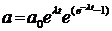 ,
,  . (1a)
The second family of the solutions can be realized at the last period of inflation:
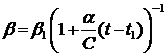 ,
, 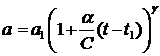 ,
, 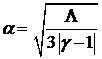 . (2)
. (2)
where  is an arbitrary constant of integration, and a power
  can be chosen to fulfill physical requirements. This ‘power law’ inflation is more suitable for the last stage of inflation, because of the problem of the smooth transition from the inflation stage to the Friedman stage of universe evolution.
Thus the exponential solution (1) can explain the exponential decrease in time at very early universe of the dark energy (the energy of physical vacuum), describing by the effective cosmological constant. This solves the problem of cosmological constant.
This research work has been performed in the framework of the Federal Purposeful Program “Research and Pedagogical Personnel of Innovative Russia” for 2009−2013.
References
1. Babourova O. V., Frolov B. N., Zhukovsky V. Ch. Phys. Rev. D. 2006. V. 74. P. (gr-qc/0 2005).
2. Babourova O. V., Frolov B. N., Kostkin R. S. Dirac's scalar field as an effective component of the dark energy and an evolution of the cosmological ‘constant’. 2011. e-Print: gr-qc/1102.2901.
3. Weinberg S. Rev. Mod. Phys. 1989. V. 61. No 1. P. 1−23.
Self-coordinated system of equations for interacting
electromagnetic and quadratic bispinor fields
Vladimir V. Kassandrov
Institute of Gravitation and Cosmology,
Peoples’ Friendship University of Russia, Moscow
Nina V. Markova
Department of Mathematics,
Peoples’ Friendship University of Russia, Moscow
In Ref.[1] we had shown that any solution to free Dirac equation can be obtained via differentiation from a doublet of scalar fields both obeying free Klein-Gordon equation. This is possible owing to the known factorization property of free Dirac equation. As a consequence, one can obtain then a whole hierarchy of solutions to both Dirac and Klein-Gordon equations. Besides, we had demonstrated that canonical spinor transformations (and even more general ones!) follow as a result of combination of Lorentz transformations for Dirac operator and internal symmetry transformation intermixing the components of the scalar field doublet.

|
Из за большого объема этот материал размещен на нескольких страницах:
1 2 3 |
