


Партнерка на США и Канаду по недвижимости, выплаты в крипто
- 30% recurring commission
- Выплаты в USDT
- Вывод каждую неделю
- Комиссия до 5 лет за каждого referral
5. __, positive economics is similar to the natural sciences.
6. There would be __ that the following __ of positive economics is correct: favourable weather conditions will increase __, reduce the price of wheat, and increase the consumption of wheat.
7. There are __ questions where disagreement remains.
8. New __ will arise and provide __ for further research.
9. __ and __ research can in principle resolve many of the outstanding issues in positive economics.
10. The government should __ health bills of the aged.
11. Many people might happen __ this subjective judgement.
12. Some people believe that all citizens alive today should be able to purchase roughly equal amounts of luxury goods after paying for __ of life, but other people might __.
13. It all depends on __ of the individual or the society that has to make this choice.
14. We can use positive economics __ the detailed implications of making the choice one way or the other.
15. Society might have to devote a great deal of resources to providing _.
16. Positive economics can be used __ the menu of options from which society must eventually make its normative choice.
V. Find in the text English equivalents for the following
каковы бы ни были политические убеждения; в этом отношении; облагать товары налогом; согласованность во взглядах, единогласие в принципах;
неразрешимые вопросы; исследования, проводимые в настоящее время;
квалифицированная и всеобъемлющая исследовательская работа; разделять взгляды; в широком значении, в общем понимании; приблизительно равные количества; привести разумные возражения; то, чему отдается предпочтение в обществе; пролить свет на...
VI. Explain in English
predicting; personal value judgement; proposition
VII. Answer the questions
1. What are two branches of economics?
2. What does the positive economics deal with?
3. What is the aim of normative economics?
4. What is the difference between positive and normative economics in regard to the role of research?
5. What are the global consequences of the government's failure to subsidize the medical bills of the elderly?
VIII. Translate using all the active possible
\. При изучении экономики необходимо различать (2 варианта) позитивную и нормативную экономические теории. Если в позитивной теории мы можем оставаться беспристрастными, независимо от наших политических убеждений, то нормативная теория основывается на личной системе ценностей. В этом отношении различие между двумя теориями очень наглядно.
2. Квалифицированная и всесторонняя исследовательская работа может в некоторой степени исправить положение (3 варианта) в области нерешенных вопросов, порождающих (2 варианта) разногласия среди экономистов. В широком понимании никакая рекомендация правительству не может оказаться правильной или ложной, поскольку она основана на субъективных оценках.
3. Позитивная теория может предложить ряд возможных альтернатив, из которых индивид или общество в целом выбирают наиболее приоритетные.
MICROECONOMICS AND MACROECONOMICS (ТЕОРИЯ МИКРОЭКОНОМИКИ И МАКРОЭКОНОМИКИ)
Many economists specialize in a particular branch of the subject. For example, there are labour economists, energy economists, monetary economists, and international economists. What distinguishes these economists is the segment of economic life in which they are interested. Labour economics deals with problems of the labour market as viewed by firms, workers, and society as a whole. Urban economics deals with city problems: land use, transport, congestion, and housing. However, we need not classify branches of economics according to the area of economic life in which we ask the standard questions what, how and for whom. We can also classify branches of economics according to the approach or methodology that is used. The very broad division of approaches into microeconomic and macroeconomic cuts across the large number of subject groupings cited above.
Microeconomic analysis offers a detailed treatment of individual decisions about particular commodities.
For example, we might study why individual households prefer cars to bicycles and how producers decide whether to produce cars or bicycles. We can then aggregate the behaviour of all households and all firms to discuss total car purchases and total car production. Within a market economy we can discuss the market for paring this with the market for bicycles, we may be able to explain the relative output of these two goods. The sophisticated branch of microeconomics known as general equilibrium theory extends this approach to its logical conclusion. It studies simultaneously every market for every commodity. From this it is hoped that we can understand the complete pattern of consumption, production, and exchange in the whole economy at a point in time.
If you think this sounds very complicated you are correct. It is. For many purposes, the analysis becomes so complicated that we tend to lose track of the phenomena in which we were interested. The interesting task for economics, a task that retains an element of art in economic science, is to devise judicious simplifications, which keep the analysis manageable without distorting reality too much. It is here that microeconomists and macroeconomists proceed down different avenues.
Microeconomists tend to offer a detailed treatment of one aspect of economic behaviour, but ignore interactions with the rest of the economy in order to preserve the simplicity of the analysis. A microeconomic analysis of miners' wages would emphasize the characteristics of miners and the ability of mine owners to pay. It would largely neglect the chain of indirect effects to which a rise in miners' wages might give rise. For example, car workers might use the precedent of the miners' pay increase to secure higher wages in the car industry, thus being able to afford larger houses, which burned more coal in heating systems. When microeconomic analysis ignores such indirectly induced effects it is said to be partial analysis.
In some instances, indirect effects may not be too important and it will make sense for economists to devote their effort to very detailed analyses of particular industries or activities. In other circumstances, the indirect effects are too important to be swept under the carpet and an alternative simplification must be found.
Macroeconomics emphasizes the interactions in the economy as a whole. It deliberately simplifies the individual building blocks of the analysis in order to retain a manageable analysis of the complete interaction of the economy.
For example, macroeconomists typically do not worry about the breakdown of consumer goods into cars, bicycles, televisions, and calculators. They prefer to treat them all as a single bundle called "consumer goods" because they arc more interested in studying the interaction between households' purchases of consumer goods and firms' decisions about purchases of machinery and buildings.
VOCABULARY NOTES
a labour economist – специалист по экономике труда
an energy economist – специалист по экономике (электро) энергии
a monetary economist – специалист по монетарной экономике
an international economist – специалист по мировой экономике
congestion – перенаселенность
to cut across – не соответствовать
a detailed treatment – детальный, подробный анализ
an individual household – отдельное домашнее хозяйство
to aggregate, v – собирать в одно целое
aggregate, n – совокупность
in the aggregate – в совокупности
aggregate, adj – совокупный
the relative output – относительный объем производства
general equilibrium theory – теория общего равновесия
to study simultaneously – одновременно изучать
the complete pattern – полная структура, система, схема
to lose track of the phenomena – потерять след явлений
to devise judicious simplifications – выработать разумные упрощения
to keep the analysis manageable – позволять проводить анализ
to distort reality – искажать реальность
to preserve the simplicity of the analysis – сохранить простоту анализа
to neglect the chain of indirect effects – пренебрегать косвенным воздействием, совокупностью (цепочкой) косвенных результатов, эффектов
to secure higher wages – получить более высокую заработную плату
indirectly induced effects – воздействие, вызванное косвенными причинами
partial analysis – частичный (неполный) анализ
to sweep under the carpet – прятать, маскировать {доел. замести под ковер)
to simplify deliberately – намеренно упрощать
to retain a manageable analysis – сохранить возможность анализа (выполнимый, поддающийся выполнению анализ)
the breakdown of consumer goods – классификация (подразделение) товаров потребления
a single bundle – отдельная единица, величина (доел. набор)
Assignments
I. Suggest the Russian equivalents
cuts across the large number of subject groupings cited above; the sophisticated branch of microeconomics; the complete pattern of consumption, production, and exchange; to devise judicious simplifications; keep the analysis manageable; to retain a manageable analysis; indirectly induced effects
II. Replace the parts in italics by synonyms
pulling out of shape, pay not enough attention; pay no attention; think out, plan;
keep safe, brought about, showing good sense; keep; make less complicated; as a rule, characteristically, be sensible
III. Fill in the gaps with the words and expressions from the text
1. What distinguishes different economists is __ in which they are interested.
2. Urban economics deals with city problems: .land use, transport, __, and housing.
3. We can also classify branches of economics according to__ that is used.
4. The very broad division of approaches into microeconomic and macroeconomic __ the large number of subject groupings.
5. To discuss total car purchases and total car production we can __ the behaviour of all households and all firms.
6. The sophisticated branch of microeconomics known as __ studies __ every market for every commodity.
7. The task for economics is to devise __ simplifications, which keep the analysis __ without __.
8. Microeconomists tend to offer __ of one aspect of economic behaviour but __ with the rest of the economy in order to __ of the analysis, largely __ the chain of __.
9. When microeconomic analysis ignores such indirectly induced effects it is said to be __.
10. Macroeconomics __ the individual building blocks of the analysis in order to ____ a manageable analysis of __ of the economy.
11. Macroeconomists prefer to treat cars, bicycles, televisions, and calculators as a single __ called "consumer goods".
IV. Check your grammar
Define each of the words given below, using the pronouns who and which:
· an energy economist is...who...
· microeconomics is...which...
· international economics is...
· a monetary economist is...
· consumer goods arc...
· macroeconomics is...
· a worker is...
· a miner is...
· coal is...
Complete the following sentences using adjectives or/and adverbs:
e. g.: a relatively difficult branch (adverb and adjective) an expensive cassette player (adjective) to buy something cheaply (adverb)
1. This is a __ book to read. (comparative, easy)
2. __ car production is not always __to estimate __. (total, easy, general)
3. Even some __ tools of __ analysis are not __ known, (common, economic, general)
4. Some microeconomic analyses offer __detailed treatments of __ decisions, (extreme, individual)
5. If we compare the market for cars and bicycles __, we may be able to offer a __ explanation for their __ prices, (careful, good, relative)
6. __ she managed to pass her __ exams __. (fortunate, final, easy)
7. My tutor emphasized the __ importance of putting ideas in a __ order. (great, logical)
8. __analysis ignores __induced effects, (partial, indirect)
9. The __economist keeps his analysis __ without __ distorting reality. (sensible, manageable, undue)
10. She's an __ novelist — something __ and __ happens_in her stories. (excellent, unusual, exciting, constant)
V. Find in me text English equivalents for the following
перенаселенность; собирать в одно целое; теория общего равновесия;
искажать реальность; подробный анализ (рассмотрение); сохранить простоту анализа; косвенное (непрямое) воздействие (эффект); взаимодействие внутри экономики
VI. Explain in English
consumption; exchange; partial analysis; simplification; indirect effect
VII. Answer the questions
1. What distinguishes an energy economist from an urban economist?
2. Are the same questions asked in each area of economic life?
3. What is needed before total car purchases and production can be discussed?
4. What does the general equilibrium theory examine?
5. What can be understood from such a study?
6. What happens when an analysis becomes too complicated?
7. What can keep an analysis manageable?
8. What do most microeconomists leave out of their analysis?
9. What does partial analysis ignore?
10. Why wouldn't most macroeconomists make a breakdown of consumer
goods?
VIII. Translate using all the active possible
1. Макроэкономика – это один из основных разделов экономической теории, который изучает поведение экономики как единого целого. Она анализирует взаимодействие факторов, влияющих на рост национального производства, а также такие процессы, как безработица, инфляция, и т п. Объектом макроэкономики является именно взаимодействие этих величин внутри экономики, при этом сами эти величины рассматриваются упрощенно, абстрактно.
2. Микроэкономика – это один из основных разделов экономической теории, изучающий поведение отдельных экономических единиц, их взаимодействие на рынках, в результате которого формируются цены на производимые товары и услуга и т. д. Микроэкономика стремится к детальному рассмотрению поведения какой-либо экономической единицы, при этом не уделяя достаточного внимания косвенному воздействию этого поведения на другие экономические единицы и на экономику в целом.
РRIСЕ AND DEMAND (ЦЕНА И СПРОС)
The following text will introduce you to the topic of the effect of price and Income on demand quantities.
The Price Responsiveness of Demand
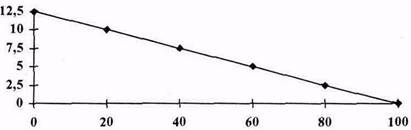
Tabl. 3 presents some hypothetical numbers for the relation between ticket price and quantity demanded, other things equal.
Tabl. 3. The Demand for Football Tickets
PRICE (£/ ticket) | Quantity of tickets demanded (thousands/game) |
12,50 10,00 7,50 5,00 2,50 0 | 0 |
Fig. 2 plots the demand curve, which happens to be a straight line in this example.
Ticket price (£)
Quantity of tickets
Figure 2. The Demand for Football Tickets
For given prices of related goods and consumer incomes, higher ticket prices reduce the quantity of tickets demanded.
How should we measure the responsiveness of the quantity of tickets demanded to the price of tickets? One obvious measure is the slope of the demand curve. The downward slope of the demand curve shows that quantity demanded increases as the price of a good falls. Each price cut of £ 1 leads to 8000 extra ticket sales per game.
Suppose, however, that we wish to compare the price responsive ness of football ticket sales with the price responsiveness of the quantity of care demanded: clearly, £ 1 is a trivial cut in the price of a car and will have a negligible effect on the quantity of cars demanded.
When commodities arc measured in different units it is often best to examine the percentage change, which is unit-free. This suggests that we think about the effect of a 1 per cent price cut on the quantity of care and football tickets demanded. Similarly, it is not the absolute number of cars or tickets we should examine but the percentage change in quantity demanded. Not only does this solve the problem of comparing things measured in different quantity units, it also takes account of the size of the market. Presumably an extra sale of 8000 tickets is more important when ticket sales arc 4000 than when they number 40000.
Thus we reach the definition of the price elasticity of demand, which economists use to measure responsiveness to price changes.
The price elasticity of demand is the percentage change in the quantity of a good demanded divided by the corresponding percentage change in its price.
Although we shall shortly introduce other demand elasticities – the cross price elasticity and the income elasticity — the (own) price elasticity is perhaps the most frequently used of the three. Whenever economists speak of the demand elasticity they mean the price elasticity of demand as it has been defined above.
If a 1 per cent price increase reduces the quantity demanded by 2 per cent, the demand elasticity is – 2. Because the quantity falls 2 per cent, we express this as a change of — 2 per cent, then divide by the price change of 1 per cent (a price rise) to obtain —2. If a price fall of 4 per cent increases the quantity demanded by 2 per cent, then the demand elasticity is — 1/2, since the quantity change of 2 per cent is divided by the price change of – 4 per cent. Since demand curve slopes down, we arc either dividing a positive percentage change in quantity (a quantity rise) by a negative percentage change in price (a price fall) or dividing a negative percentage change in quantity (a quantity fall) by a positive percentage change in price (a price rise). The price elasticity of demand tells us about movements along a demand curve and the demand elasticity must be a negative number.
For further brevity, economists sometimes omit the minus sign. It is easier to say the demand elasticity is 2 than to say it is -2. Whenever the price elasticity of demand is expressed as a positive number, it should be understood (unless there is an explicit warning to the contrary) that a minus sign should be added. Otherwise, we should be implying that demand curves slope upwards, a rare but not unknown phenomenon.
VOCABULARY NOTES
to introduce smb to the topic of – познакомить кого-либо с темой the effects of smth on smth – воздействие чего-либо на что-либо
hypothetical numbers – вымышленные, гипотетические числа
the relation between – соотношение между
quantity demanded – требуемое количество
to plot the demand curve – вычерчивать кривую спроса
for given price – для данной (приведенной) цены
to measure the responsiveness of smth to smth – измерять способность, реагировать (реакция) на
obvious measure – очевидная, наглядная мера
the slope of the curve – покатость кривой
the downward slope – движение кривой вниз
ticket sales per game – продажа билетов на игру
trivial (syn. minor, slight) – незначительный
a negligible effect – мелкий, незначительный эффект
to examine smth – рассмотреть, проанализировать
the percentage change – процентное изменение
unit-free – независящий от характера единиц (<? которых измеряются товары)
this suggests (syn. to imply) – это предполагает
similarly – подобным образом
to take account of (syn. to take into account, consideration) – учитывать, принимать во внимание
presumably (syn. probably) – возможно, вероятно
extra sale – дополнительные продажи
to number – насчитывать
to reach the definition – подвести к определению
the price elasticity of demand – ценовая эластичность спроса
to divide by – разделить на
shortly – зд. вскоре
cross price elasticity – перекрестная эластичность цен
income elasticity – эластичность но доходу
the (own) price elasticity – собственно ценовая эластичность
the most frequently used – наиболее часто используемый
as it has been defined above – согласно определению, приведенному выше
to express smth – выражать что-либо
to obtain (syn. to get) – получить, e. g. to obtain a diploma
a positive percentage change – положительное (плюсовое) процентное изменение
a negative percentage change – отрицательное (минусовое) процентное изменение
movements along a demand curve – движения вдоль кривой спроса
for further brevity – для краткости
to omit the minus sign – опускать знак минуса
it's easier to say – легче сказать
unless there is an explicit warning to the contrary – если только не имеется точного указания на обратное
to add – добавить, сложить
adding, addition – сложение, дополнение
addendum – дополнение, приложение
to imply (syn. to suggest) – предполагать, подразумевать
a rare but not unknown phenomenon – редкое, но встречающееся явление
Assignments
I. Suggest the Russian equivalents
the effect of price and income on demand quantities; the downward slope of the demand curve; movements along a demand curve
II. Replace the parts in italics by synonyms
a minor cut; a slight effect; to consider the size of the market; probably; a clear warning
III. Fill in the gaps with the words and expressions from the text
1. How should we measure __ of the quantity of tickets demanded to the price of tickets?
2. Clearly, £ 1 is a __ cut in the price of a car and will have a negligible effect on the quantity of cars demanded.
3. It is not the absolute number of cars or tickets we should examine but __ in quantity demanded.
4. ___ of demand is the percentage change in the quantity of a good demanded divided by the corresponding percentage change in its price.
5. The price elasticity of demand tells us about movements along __ and the demand elasticity must be a negative number.
6. For further brevity, economists sometimes __ the minus sign.
IV. Check your grammar
Shorten the following sentences without changing their meaning, like this:
Nobody likes prices, which are constantly rising. Nobody likes constantly rising prices.
· A demand curve, which slopes.
· John is a person who works very hard.
· We must develop a policy, which fixes prices better.
· Interest rates, which rise will damp down demand.
· An economy, which is rapidly expanding can get out of control.
· Let's look at the information, which corresponds to this in tabular form. Shorten the following sentences without changing their meaning, like this:
The quantity, which we require is 5000 units. The required quantity is 5000 units.
· A demand curve, which has been drawn inaccurately.
· A price, which has been fixed.
· We can see changes in the price of goods, which are related to each other.
· The prices, which we have been given should be seen as hypothetical.
· If we don't use a model, which has been simplified we shall get bogged down.
· Ours is a company, which is managed well.
· An economy, which is poorly run leads to problems in society.
· That is a theory, which is now out of date.
· On the evidence available, that is a conclusion, which is not justified.
V. Find in the text English equivalents for the following
кривая спроса; реакция на...; при прочих равных условиях; товар, предмет потребления; снижение цены на 1 процент; процентное изменение в количественном показателе спроса; эластичность спроса в зависимости от изменения цены; измерить гибкость реакции на...; положительное (плюсовое) процентное изменение; негативное (минусовое) процентное изменение
V. Explain in English
different units; percentage change; unit-free; absolute number
VII. Answer the questions
1. What does the downward slope of the demand curve show?
2. Give the definition of the price elasticity of demand. Explain it in your own words.
3. Name the three types of the demand elasticity as mentioned above.
4. Explain in your own words how to calculate demand elasticity.
5. Explain why economists sometimes omit the minus sign and how negative and positive numbers should be distinguished.
VIII. Translate using all the active possible
1. Построенная (начерченная) кривая спроса отображает воздействие цен и доходов на количественные показатели (величину) спроса. Нисходящая кривая показывает рост спроса по мере снижения цен.
2. Незначительное снижение цены какого-либо товара мало влияет на величину спроса на этот товар.
3. Понятия перекрестной ценовой эластичности, эластичности доходов и собственно эластичности спроса в зависимости от изменения цен помогают экономистам измерять гибкость реакции на изменения цен.
4. В случае нисходящей кривой спроса мы имеем дело либо с повышением количественного показателя спроса (положительное процентное изменение) при снижении цен (отрицательное процентное изменение), либо с обратной ситуацией (падение величины спроса при росте цен).
PRICE, INCOME AND DEMAND (ЦЕНА, ДОХОД И СПРОС)
In this chapter we're going to investigate the price elasticity of demand for football tickets. Let's start by looking at Table 4. It reproduces the demand data from Tabl. 3, that is to say, it reproduces it in columns one and two.
Tabl. 4. The Price Elasticity of Demand for Football Tickets
PRICE (£/ticket) | Quantity of tickets demanded (thousands/game) | Price elasticity of demand |
12,50 10,00 7,50 5,00 2,50 0 | 0 | -4 -1,5 -0,67 -0,25 0 |
We have to look at column one. As you can see, this shows price cuts of two pounds considering the effects of price cuts of two pounds fifty we can calculate the price elasticity of demand at each price. This price is shown in column three. But how have we calculated this? Let's, as an example, take the price of ten pounds, which you can see in the table. There is a corresponding quantity of twenty thousand tickets demanded. If we consider a price cut to seven pounds fifty, there is a price change here of - 25%, from ten pounds to seven pounds fifty. Now look at the corresponding change in the quantity of tickets demanded, in the next column, column two. The change in the quantity of tickets demanded is a 100%, from 20,000 tickets to 40,000 tickets.
There is a 100% change in demand, and a 25% change in price. So we divide a 100 by – 25, which gives the answer – 4. So we say the demand elasticity at ten pounds is – 4. You calculate other elasticities in the same way, that is by dividing the percentage change in quantity by the corresponding percentage change in price.
Notice one thing here in the table. That is when we begin from the price of twelve pounds fifty the demand elasticity is minus -infinity. It's simply because the percentage change looks like this. Any positive number divided by zero yields plus infinity. When we then divide by the minus twenty per cent change in price, that's from twelve pounds fifty to ten pounds, we obtain or get, minus infinity as the demand elasticity at this price.
There's one more thing to be said at this stage. We say demand elasticity is high, when it is a large negative number. And we say demand elasticity is tow, when it is a small negative number, and when the quantity demanded is relatively insensitive to price. It follows from this that the words high and low refer to the magnitude of the elasticity ignoring the minus sign. The demand elasticity falls when it becomes a smaller negative number and quantity demanded becomes less sensitive to price.
VOCABULARY NOTES
to investigate – исследовать, рассматривать
to reproduce the data – представлять данные price cuts – сокращения цены
a corresponding quantity – соответствующее количество
a corresponding change in the quantity – соответствующее изменение количества
infinity – бесконечность
to yield – приносить, давать
magnitude – величина, размер
Assignments
I. Suggest the Russian equivalents
a price change of minus 25 per cent; high/low demand elasticity; to be insensitive to price; magnitude
II. Fill in the gaps with the words and expressions from the text
considering the effects of price cuts of two pounds fifty we can calculate__ of demand at each price.
2. You calculate other elasticities by dividing __ in quantity by the corresponding percentage change in price.
3. When we divide by the minus twenty per cent change in price we obtain minus __ as the demand elasticity at this price.
4. Demand elasticity is __, when it is a large negative number.
5. Demand elasticity is __, when it is a small negative number.
6. __ falls when it becomes a smaller negative number and quantity demanded becomes less sensitive to price.
III. Find in the text English equivalents for the following
снижение цены на... фунтов; соответствующее количество; разделить сотню на 25; встретить понятие; процентное изменение в количестве; процентное изменение в цене; минус бесконечность/плюс бесконечность
IV. Answer the questions
1. How is the demand elasticity calculated?
2. Why is the demand elasticity minus infinity in the example?
3. In what case can we speak of high/ low demand elasticity?
4. What does the insensitivity of the quantity demanded to the price mean?
5. When does the demand elasticity fall?
V. Translate into English using all the active possible
1. Безграничная эластичность – это такая эластичность спроса, при которой изменение в количестве спрашиваемых или предлагаемых товаров и услуг будет приводить к увеличению дохода. Такая эластичность характерна для условий совершенной конкуренции, когда отдельная фирма не имеет возможности оказывать влияние на рыночную цену и имеет кривую спроса на свой товар или услуги в виде горизонтальной прямой.
ELASTIC AND INELASTIC DEMAND (ЭЛАСТИЧНЫЙ И НЕЭЛАСТИЧНЫЙ СПРОС)
Although elasticity typically falls as we move down the demand curve, an important dividing line occurs at the demand elasticity of – 1.
Demand is elastic if the price elasticity is more negative than -1. Demand is inelastic if the price elasticity lies between -1 and 0.
In Tabl. 4 demand is elastic at all prices of £7,50 and above and inelastic at all prices of £5-00 and below. If the demand elasticity is exactly -1, we say that demand is unit-elastic.

|
Из за большого объема этот материал размещен на нескольких страницах:
1 2 3 4 5 6 7 8 9 10 |
