


Партнерка на США и Канаду по недвижимости, выплаты в крипто
- 30% recurring commission
- Выплаты в USDT
- Вывод каждую неделю
- Комиссия до 5 лет за каждого referral
Министерство общего и специального образования
Российской Федерации
Российский государственный гуманитарный
Университет
, ,
Английский язык для студентов
экономических факультетов
Учебное пособие
Москва: ПРИОР, 1999
THE ECONOMIC ENVIRONMENT (ЭКОНОМИЧЕСКАЯ СРЕДА)
The economy comprises millions of people and thousands of firms as well as the government and local authorities, all taking decisions about prices and wages, what to buy, sell, produce, export, import and many other matters. All these organizations and the decisions they take play a prominent part in shaping the business environment in which firms exist and operate.
The economy is complicated and difficult to control and predict, but it is certainly important to all businesses. You should be aware that there are times when businesses and individuals have plenty of funds to spend and there are times when they have to cut back on their spending. This can have enormous implications for business as a whole.
When the economy is enjoying a boom, firms experience high sales and general prosperity. At such times, unemployment is low and many firms will be investing funds to enable them to produce more. They do this because consumers have plenty of money to spend and firms expect high sales. It naturally follows that the state of the economy is a major factor in the success of firms.
However, during periods when people have less to spend many firms face hard times as their sales fall. Thus, the economic environment alters as the economy moves into a recession. At that time, total spending declines as income falls and unemployment rises. Consumers will purchase cheaper items and cut expenditure on luxury items such as televisions and cars.
Changes in the state of the economy affect all types of business, though the extent to which they are affected varies. In the recession of the early 1990s the high street banks suffered badly. Profits declined and, in some cases, losses were incurred. This was because fewer people borrowed money from banks, thus denying them the opportunity to earn interest on loans, and a rising proportion of those who did borrow defaulted on repayment. These so-called "bad debts" cut profit margins substantially. Various forecasters reckoned that the National Westminster Bank's losses in the case of Robert Maxwell's collapsing business empire amounted to over £100 million.
No individual firm has the ability to control this aspect of its environment. Rather, it is the outcome of the actions of all the groups who make up society as well as being influenced by the actions of foreigners with whom the nation has dealings.
VOCABULARY NOTES
to comprise – включать в себя, составлять
local authorities – местные органы власти
to take (syn. to make) decisions – принимать решения
to play a prominent part – играть заметную (значительную) роль
to shape the environment – формировать обстановку, среду, окружение
to predict (syn. to forecast) – предсказывать
to be aware – осознавать, знать
to cut back on spending – сокращать расходы
enormous implications – большое значение, смысл, влияние
general prosperity – всеобщее процветание
to enable smb to do smth – делать возможным для кого-то, позволять кому-либо что-либо делать
consumers – потребители
to alter – изменяться
a recession – упадок
total spending – общие, суммарные расходы
to decline – снижаться
income – доход
unemployment – безработица
to purchase (syn. to buy) – покупать
to cut expenditure – сокращать расходы
luxury items – предметы роскоши
to affect (syn. to influence smb. smth) – влиять
the extent – степень
to some extent – в некоторой степени
the high street banks – центральные банки
to suffer badly – сильно пострадать
profits – прибыль
to incur (syn. to bear, to suffer) losses – нести убытки, потери
to borrow from – занимать, брать взаймы
to deny the opportunity – лишать возможности
to deny – отрицать
to earn interest – получать процентный доход
loans – ссуды, займы
to default on repayment – не выполнять обязательств по выплате (долгов, процентов и т. п.)
a debt – долг
profit margins – размеры прибыли
the outcome of the actions – результат действий
to make up society – составлять общество
to have dealings – иметь торговые (деловые) связи
Assignments (задания)
I. Suggest the Russian equivalents
the government and local authorities; firms experience high sales; their sales fall; total spending declines as income falls; luxury items; the high street banks suffered badly; to earn interest on loans; so-called "bad debts"
II. Replace the parts in italics by synonyms
The economy comprises millions of people; losses were incurred; the nation has dealings; changes in the state of the economy affect all types of business;
profits declined; losses amounted to over £ 100 million.
III. Increase your vocabulary
There is a set of words related to the word economics. In a table we can show them like this.
Econom | у | ||
ics | |||
ic | al | ly | |
ist |
Each word has a different use. Try to put the right word in the blanks in these sentences:
1. Marx and Keynes are two famous __.
2. Those people are studying the science of__.
3. We sometimes call a person's work his __ activity.
4. People should be very __ with the money they earn.
5. The __ system of a country is usually called the national __.
6. The people in that town live very __.
Translate into English
1. Состояние экономики очень тревожное.
2. Экономическая политика правительства часто подвергается справедливой критике.
3. Она очень экономная хозяйка.
4. Мировая экономика – это наука, которая изучает состояние экономики в разных странах мира.
5. Моя новая машина гораздо экономичнее старой.
The table shows how words are formed around the verb to produce.
Produc | e | r | |
t | iv(e) | ity | |
ion |
Use these words in the suitable blanks in the sentences below:
1. The company __ a new commodity every year.
2. The company's newest __ is a special blue soap powder.
3. The __ of soap powders met last year to discuss prices.
4. That factory is not as __ now as it was 5 years ago.
5. The __ of that factory has gone down over the last 5 years.
6. The manager of the factory has decided that they must increase their of packets of soap powder.
Translate into English
1. В этом году наша компания изготовила (выпустила) вдвое больше автомобилей, чем в прошлом.
2. Производители этой модели оборудования не смогли найти для нее рынка сбыта.
3. Эта фирма известна своей высококачественной продукцией.
4. Производство нового самолета начнется в следующем году.
5. Они работают очень много, но все их усилия не слишком продуктивны.
6. Руководство ищет эффективные способы повышения производительности труда.
IV. Fill in the gaps with the words and expressions from the text
1. The economy is complicated and difficult to __.
2. When the economy __, firms experience high sales and __.
3. The economic environment __ as the economy moves into __.
4. Changes in the state of the economy __ all types of business.
5. During a __ fewer people borrowed money from banks, thus __ to earn interest on __.
6. So-called "bad debts" cut __ substantially.
7. The economic __ is __ of all the groups who make up society as well as __ of the actions of foreigners with whom the nation __.
V. Translate into English
to affect smb, smth
1. Перемена погоды плохо повлияла на выступление спортсменов.
2. Эта новость сильно на него подействовала.
3. Рост цен повлиял на спрос.
4. Его мнение не повлияет на мое решение.
to deny
1. Она рассердилась, узнав, что лишена возможности его видеть.
2. Она ни в чем себе не отказывает.
3. Мы лишены возможности уплатить по счету в срок.
to some, what, such an, a certain extent
1. В некоторой степени вы правы.
2. В какой степени ему можно верить?
3. Ковер был грязный до такой степени, что невозможно было понять, какого он был цвета.
4. В определенной степени я согласен с вами.
VI. Find in the text English equivalents for the following
играть заметную роль; формировать среду; сокращать расходы навар.); сократить размеры прибыли; переживать подъем; переживать тяжелые времена; прийти в упадок; доходы падают (2 вар.); нести убытки; состояние экономики; иметь большое значение для бизнеса в целом;
отсюда, естественно, следует; лишать возможности; результат действий;
не выполнять обязательств по уплате.
VII. Answer the questions
1. What does the economy comprise?
2. What's a boom in the economy? What characterises the state of the economy at that time?
3. What happens when the economy moves into a recession?
4. What are "bad debts"?
5. What happened to some banks in the early 1990s and why?
VIII. Translate using all the active possible
1. Состояние экономики (экономической среды) имеет большое значение для успешной деятельности фирм.
2. Когда экономика находится на подъеме, то фирмы продают больше товаров, что ведет к получению больших прибылей и процветанию.
3. Упадок экономики характеризуется сокращением объема производства и сбыта продукции. Отсюда, естественно, следует, что доходы предприятий снижаются и они несут убытки.
4. Результатом деятельности всех субъектов производства (групп общества) является формирование той или иной экономической среды в которой развивается бизнес.
5. У фирмы не было возможности увеличить расходы на рекламу в результате чего она потеряла часть рынка сбыта.
MEASURING ECONOMIC ACTIVITY (ИЗМЕРЕНИЕ ЭКОНОМИЧЕСКОЙ АКТИВНОСТИ)
There are a large number of statistics produced regularly on the operation of the world's major economies. The UK's economy is no exception in this respect. You will probably have noticed that often the headlines in newspapers or important items on television news programmes relate to economic data and the implications for individuals and businesses. A prime example of this occurs when interest rates are increased: the media responds by highlighting the adverse effects on businesses with debts and householders with mortgages.
Data is provided on a wide range of aspects of the economy's operation. Statistics are available to show.
* the level of unemployment
* the level of inflation
* a country's trade balance with the rest of the world
* production volumes in key industries and the economy as a whole
* the level of wages
* raw material prices, and so forth.
The main statistics illustrating the economy's behaviour relate to the level of activity in the economy. That is, they tell us whether the economy is working at fall capacity using all or nearly all, available resources of labour, machinery and other factors of production or whether these resources are being under-utilized.
The unemployment figures for the economy give an indicator of the level of activity. As the economy moves towards a recession and a lower level of prosperity it is likely that unemployment figures will rise. An alternative measure of the level of activity is national income statistics, which show the value of a nation's output during a year. Economists use the term Gross National Product to describe this data. Changes in the level or trends of such key data have great significance for businesses, as we shall see later.
There are numerous sources of data on the economy of which we can make use. The government publishes much through the Treasury, Department of Trade and Industry, the Bank of England and the Department of Employment. The Central Statistical Office, which was established during the Second World War, publishes about half of the government's economic data.
Much of this is contained in its annual publication, "The Annual Abstract of Statistics". It also publishes the equally valuable "Social Trends" annually. Additionally, private organizations, such as the banks, building societies and universities, publish figures on various aspects of the economy's performance.
Economic statistics are presented in many forms, the most common being graphs and tables. Although these statistics can be valuable in assisting managers, they should be treated with some caution when predicting the future trend of the economy and thus helping the business to take effective decisions.
VOCABULARY NOTES
to measure – измерять, рассчитывать, оценивать
economic activity – экономическая деятельность
is no exception in this respect – в этом отношении не является исключением
important items – важные вопросы, проблемы
to relate to – относиться к чему-либо, иметь отношение; рассказывать
by highlighting the adverse effects on... - в первую очередь освещая неблагоприятное влияние на...
householder – домовладелец, домохозяин
household – домашнее хозяйство
mortgage – закладная
data – данные
on a wide range of aspects – по самым разнообразным аспектам
statistics are available to show – статистика показывает
trade balance – торговый баланс
key industries – основные отрасли промышленности
wages – заработная плата (рабочих)
salary – оклад, жалованье (служащих)
raw material prices – цены на сырье
at full capacity – на полную мощность
available resources – доступные, имеющиеся в наличии ресурсы
labour – труд
machinery – оборудование
factors of production – производственные факторы, факторы производства (труд, земля, природные ресурсы, капитал)
to be under-utilized – не использоваться полностью
unemployment figures – количество безработных
indicator — показатель
national income – национальный доход
the value of a nation's output – оценка объема производства страны
Gross National Product (GNP) – валовой национальный продукт (ВНП)
trend – направление, тенденция, тренд
the Tresuary – Государственное казначейство. Министерство финансов (в Великобритании)
the Department of Employment – Министерство по вопросам занятости (в Великобритании)
the Central Statistical Office – Центральное статистическое управление
to contain – содержать
equally valuable – такой же важный
building societies – англ. строительные общества (специализированные сберегательные учреждения)
graphs and tables – графики и таблицы
to assist – помогать, оказывать помощь
they should be treated with some caution – к этим данным следует относиться с некоторой осторожностью
Assignments
I. Suggest the Russian equivalents
important items on TV programmes relate to economic data and the implications for individuals and businesses; a prime example; the adverse effects; householders; statistics are available to show; available resources of labour; at full capacity; key industries; key data; the value of a nation's output;
the Treasury; building societies; they should be treated with some caution;
trend (find it in 3 sentences)
II. Replace the parts in italics by synonyms
a large number of, the operation of the world's major economies; headlines relate to; the implications for individuals and businesses; by highlighting the adverse effects on businesses; these resources are being under-utilized; figures give an indicator of, changes have great significance for; numerous; additionally;
economic statistics are presented in many forms
III. Fill in the gaps with the words and expressions from the text
1. The headlines in newspapers often __ economic data and __ for individuals and businesses.
2. The statistics tell us whether the economy is working __ using all or nearly all, __ resources of labour, machinery and other factors of production or whether these resources are being __.
3. Economists use the term __ to describe the value of a nation's output during a year.
4. Although these statistics can be __ in assisting managers, they should __ with __ when __ the future trend of the economy.
IV. Find in the text English equivalents for the following
много (многочисленные); в этом отношении; средства массовой информации; подчеркивать, выделять; закладные; объем производства; сырье; не полностью используется; уровень занятости; валовой национальный продукт; опубликовать в каких-либо источниках
V. Increase your vocabulary
it is likely (unlikely) that...
smb is likely (unlikely) to be (to do smth)
1. Эта статистика, возможно, будет опубликована в ежегоднике Центрального статистического бюро.
2. Вряд ли эти цифры говорят о низком уровне занятости.
3. Похоже, что эти производственные мощности используются не полностью.
4. Может быть, экономика будет работать на полную мощность, если будут использованы все факторы производства.
VI. Give explanations in English
media; householders; mortgages; trade balance; wages; building societies
VII. Answer the questions
1. Why does the media relate to economic data and the implications for individuals and businesses?
2. What aspects of the economy's operation are statistics available to show?
3. What do statistics show?
4. What are the sources of data on the economy in the UK? In Russia?
5. What is the GNP?
6. Why should statistics be treated with some caution?
VIII. Translate using all the active possible
1. К официальным статистическим данным по уровню инфляции в стране следует относиться с осторожностью.
2. Валовой национальный продукт – это совокупность товаров и услуг, произведенных национальной экономикой за год.
3. Объем производства продукции в ключевых отраслях промышленности в значительной степени показывает уровень активности населения.
4. Если в экономике отмечается падение производства, то следствием этого становится рост безработицы и понижение уровня зарплаты.
5. Средства массовой информации сообщили об отрицательном влиянии на производство увеличившейся процентной ставки.
THREE ECONOMIC ISSUES (ТРИ ВОПРОСА ЭКОНОМИКИ)
Three economic issues
Economics is the study of how people choose to allocate scarce resources to satisfy their unlimited wants. The main problem in economics is the question of allocating scarce resources between competing uses. In this section three economic issues are discussed to show how society allocates its scarce resources between competing uses. In this connection the question what, how and for whom to produce is of great significance.
The oil price shocks
Oil is an important commodity in modem economies. Oil and its derivatives provide fuel for heating, transport, and machinery, and arc basic inputs for the manufacture of industrial petrochemicals and many household products ranging from plastic utensils to polyester clothing. From the beginning of this century until 1973 the use of oil Increased steadily. Over much of this period the price of oil fell in comparison - with the prices of other products. Economic activity was organized on the assumption of cheap and abundant oil.
In 1973 – 74 there was an abrupt change. The main oil-producing nations, mostly located in the Middle East but including also Venezuela and Nigeria, belong to OPEC — the Organisation of Petroleum Exporting Countries. Recognizing that together they produced most of the world's oil, OPEC decided in 1973 to raise the price at which this oil was sold. Although higher prices encourage consumers of oil to try to economize on its use, OPEC countries correctly forecast that cutbacks in the quantity demanded would be small since most other nations were very dependent on oil and had few commodities available as potential substitutes for oil. Thus OPEC countries correctly anticipated that a substantial price increase would lead to only a small reduction in sales. It would be very profitable for OPEC members.
Oil prices are traditionally quoted in US dollars per barrel. Fig. 1 shows the price of oil from 1970 to 1986. Between 1973 and 1974 the price of oil tripled, from $2,90 to $9 per barrel. After a more gradual rise between 1974 and 1978 there was another sharp increase between 1978 and 1980, from $12 to $30 per barrel. The dramatic price increases of 1973 – 79 and 1980 – 82 have become known as the OPEC oil price shocks, not only because they took the rest of the world by surprise but also because of the upheaval they inflicted on the world economy, which had previously been organized on the assumption of cheap oil prices.
People usually respond to prices in this or that way. When the price of some commodity increases, consumers will try to use less of it but producers will want to sell more of it. These responses, guided by prices, are part of the process by which most Western societies determine what, how and for whom to produce.Consider first how the economy produces goods and services. When, as in the 1970s, the price of oil increases six-fold, every firm will try to reduce its use of oil-based products. Chemical firms will develop artificial substitutes for petroleum inputs to their production processes; airlines will look for more fuel-efficient aircraft; electricity will be produced from more coal-fired generators. In general, higher oil prices make the economy produce in a way that uses less oil.
Oil price ($ per barrel)
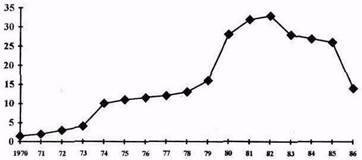
Figure 1. The price of oil. 1970 – 86
How does the oil price increase affect what is being produced? Finns and households reduce their use of oil-intensive products, which are now more expensive. Households switch to gas-fired central heating and buy smaller cars. Commuters form car-pools or move closer to the city. High prices not only choke off the demand for oil-related commodities; they also encourage consumers to purchase substitute commodities. Higher demand for these commodities bids up their price and encourages their production. Designers produce smaller cars, architects contemplate solar energy, and research laboratories develop alternatives to petroleum in chemical production. Throughout the economy, what is being produced reflects a shift away from expensive oil-using products towards less oil-intensive substitutes. The for whom question in this example has a clear answer. OPEC revenues from oil sales increased from $35 billion in 1973 to nearly $300 billion in 1980. Much of this increased revenue was spent on goods produced in the industrialized Western nations. In contrast, oil-importing nations had to give up more of their own production in exchange for the oil imports that they required. In terms of goods as a whole, the rise in oil prices raised the buying power of OPEC and reduced the buying power of oil-importing countries such as Germany and Japan. The world economy was producing more for OPEC and less for Germany and Japan. Although it is the most important single answer to the 'for whom' question, the economy is an intricate, interconnected system and a disturbance anywhere ripples throughout the entire economy,
In answering the 'what' and 'how' questions, we have seen that some activities expanded and others contracted following the oil price shocks. Expanding industries may have to pay higher wages to attract the extra labour that they require. For example, in the British economy coal miners were able to use the renewed demand for coal to secure large wage Increases. The opposite effects may have been expected if the 1986 oil price slump had persisted.
The OPEC oil price shocks example illustrates how society allocates scarce resources between competing uses.
A scarce resource is one for which the demand at a zero price would exceed the available supply. We can think of oil as having become more scarce in economic terms when its price rose.
VOCABULARY NOTES
to allocate resources – распределять ресурсы
scarce resources – ограниченные, скудные ресурсы
scarcity – дефицит
to satisfy unlimited wants – удовлетворять неограниченные потребности
competing uses – конкурирующие сферы использования
to be of great significance – иметь большое значение
commodity (syn. good) – товар, предмет широкого потребления
modern economy – современная экономика
oil and its derivatives – нефть и нефтепроизводные
to provide fuel for heating and transport – обеспечивать топливом системы теплоснабжения и транспорт
basic inputs – основные составляющие
to range from... to... – от... до...
plastic utensils – изделия из пластика
polyester clothing – одежда из синтетических тканей
to increase [-z], v. steadily – постоянно увеличиваться
increase [-s], n. – увеличение
over much of this period – большая часть этого периода
in comparison with (syn. as compared with) – по сравнению с
on the assumption of – исходя из предположения (допущения)
abundant oil – нефть, имеющаяся в изобилии, избытке
an abrupt change – резкое изменение
oil-producing nations – страны, производящие нефть
to be located in – располагаться в
to belong to – принадлежать
OPEC (the Organization of Petroleum Exporting Countries) – ОПЕК (Организация стран – экспортеров нефти)
to raise the price – повышать цену
(о encourage consumers – побуждать, поощрять потребителей
to economize on its use – экономить на использовании
to forecast correctly – правильно прогнозировать
cutbacks in quantity demanded – сокращения требуемого количества
to be dependent on oil – быть зависимым от нефти
to be available (syn. to be in stock; ant. to be out of stock) – иметься в наличии potential substitutes – потенциальные (возможные) заменители
to anticipate – предсказывать, предвидеть, прогнозировать
substantial price increase [-s] – существенное, значительное повышение цен
to lead (led, led) to (syn. to cause, to entail, to result in) – привести к
reduction in sales – сокращение продаж
to be profitable for – быть прибыльным, выгодным
OPEC members — страны – члены ОПЕК.
to quote prices in US dollars per barrel – назначать, котировать цены в долларах США за баррель
to triple ['tripl] – возрастать в три раза, утраивать
a gradual rise – постепенное увеличение
sharp, dramatic increase – резкое повышение
to take by surprise – застать врасплох
upheaval [i:] – переворот
to inflict upheaval on the world economy – наносить удар по (причинять ущерб) мировой экономике
to respond to prices – реагировать на цены
a producer – производитель
to determine what, how and for whom to produce – определять что, как и для кого производить

|
Из за большого объема этот материал размещен на нескольких страницах:
1 2 3 4 5 6 7 8 9 10 |
