


Партнерка на США и Канаду по недвижимости, выплаты в крипто
- 30% recurring commission
- Выплаты в USDT
- Вывод каждую неделю
- Комиссия до 5 лет за каждого referral
- advantages and disadvantages of a sole proprietorship;
- general and limited partnerships;
- ways of creating a general partnership;
- types of partners and their liability;
- property rights of partners;
- dissolution of a partnership;
- public and private companies limited by shares;
- setting-up of a company.
Unit 2. Business Risk

2.1. SCANNING
Risk Management
Part 1
1. Risk means “the possibility of something bad happening at some time in the future; a situation that could be dangerous or have a bad result”. In business sphere this word refers to a lack of predictability about consequences of a particular business decision or situation. There are several different types of risk. Risk may be insurable or uninsurable, as well as controllable or uncontrollable. Risk can be further identified as pure, economic, human, or natural risk.
2. Insurable risk is a risk that meets an insurance company’s criteria for insurance coverage. Insurance is paid protection against loss due to injury or property damage. Uninsurable risk is a risk that is unacceptable to insurance carriers because the likelihood of loss is too high.
3. Controllable risk occurs when conditions can be controlled to minimize the chance of harm. Environmental damage is a controllable risk that, in many cases, can be prevented. Uncontrollable risk cannot be controlled. For example, risk involved in doing business in the global marketplace cannot be controlled.
4. Pure risk is the threat of a loss with no opportunity for gain. Businesses run the risk of loss from employee theft, burglary, bad checks, and accidents involving customers and employees. Businesses do not receive insurance funds for avoiding financial losses due to these occurrences.
5. Economic risk occurs when there is likelihood of economic loss. Even if you are very careful, you will not be able to avoid all risk. You can, however, protect yourself against economic loss. For businesses, economic risk results from changes in overall business conditions. If businesses fail to change their products when competitors offer more features, they may lose sales and face economic harm.
6. Economic risk can be related to property and to your own personal well-being. It can be placed in three categories: personal risk, property risk, and liability risk. Personal risk is risk associated with illness, disability, loss of income, unemployment, aging, and premature death. Property risk is the risk of damage to or loss of property due to theft, wind, fire, flood, or some other hazard. Liability risk is the potential for losses to others that occur as a result of injury or damage that you may have caused.
7. Human risk is the risk of harm caused by human mistakes, dishonesty, or another risk that is attributed to people. Risk may be caused by people who are careless or dishonest. For businesses, human risk ranges from the financial impact of theft or embezzlement to job-related injury or illness.
8. Natural risk is the possibility of a catastrophe caused by a flood, tornado, hurricane, fire, lightning, drought, or earthquake. These natural occurrences can cause damage or loss of property. Some risk is caused by people and is also called natural risk. Power outages, oil spills, arson, terrorism, and even war are classified as natural risk.
 LEXIS
LEXIS
business risk - коммерческий риск
dangerous - опасный; рискованный
lack of predictability – непредсказуемость
insurable - могущий быть застрахованным, могущий быть предметом страхования
uninsurable - не подлежащий страхованию
controllable - поддающийся регулированию
pure risk - чистый риск
natural risk - природный риск
meet – соответствовать
insurance coverage - объём страховой защиты, страховое обеспечение
paid protection - оплачиваемая защита
due to – вследствие, по причине
insurance carrier - страховая компания
environmental damage - вред, наносимый окружающей среде
global marketplace - глобальный рынок
run the risk of loss - подвергаться риску затрат
employee theft - кража, совершенная служащим с использованием своего служебного положения
burglary - кража со взломом
bad check - поддельный чек
accident - несчастный случай
occurrence – происшествие, событие
avoid - избегать
competitor - конкурент
features – характеристики, технические характеристики
well-being – благополучие, здоровье
liability risk – риск ответственности за нанесенный ущерб
disability - нетрудоспособность
unemployment – безработица
aging – старение
premature death - безвременная смерть
hazard - опасная обстановка, стихийное бедствие
dishonesty – нечестность
impact – эффект, влияние, воздействие
embezzlement - присвоение или растрата имущества
power outage - нарушение в системе электроснабжения
oil spill - разливы нефти
2.2. SCANNING
Part 2
Handling Risk
1. Since you cannot completely avoid all risk, you must learn to handle it. There are four ways to handle risk. You can avoid, reduce, or transfer risk. Most people and businesses use a combination of all these methods.
2. Risk avoidance. Avoiding risk involves thinking about the consequences of decisions. In many cases you can avoid risk, but sometimes it is not practical to do so. For a business, risk avoidance means refusing to engage in a particularly hazardous activity.
3. Risk reduction. Some risk cannot be avoided entirely. Instead you may need to practice risk reduction. Business owners reduce risk by designing work areas to lower the chances of accidents or fire. They educate their employees about the safe use of equipment and keep safety equipment ready for use. Businesses also provide information about the correct use of products and warn customers about possible hazards.
4. Risk transfer. Insurance provides a way to transfer a risk of loss to an insurance company. Insurance divides a possible loss among large numbers of people or companies. Economic risk is shared most effectively when many people or businesses are involved. Each individual or company then pays a fee for protection.
5. Individuals and businesses can insure property and people against potential loss by purchasing insurance policies. An insurance policy is a contract between a person and an insurance company to cover a specific risk. In return for the premium, or price for insurance coverage, the insurance company agrees to protect the policyholder against financial loss in case of an accident or loss that is covered in the policy.
6. There are several types of insurance for consumers:
- life insurance offers protection for family members after someone dies.
- health insurance provides money to pay medical bills in case of accident or sickness.
- property insurance covers damages or losses to your property.
- conversely, liability insurance covers damages that you may have caused accidentally to someone else or to someone’s property.
7. Many businesses offer life and health insurance coverage to their employees. They also carry liability and property insurance to protect their panies carry workers’ compensation insurance to protect workers who are injured on the job. Workers’ compensation insurance is required by the government and paid for by employees. It provides medical and income benefits to employees injured on the job.
LEXIS
since - так как
handle - обходиться, обращаться; управляться, справляться с
reduce - ослаблять, понижать, сокращать, уменьшать
work area - рабочее пространство, место работы
safety equipment - оборудование и снаряжение по технике безопасности
insurance – страхование, страховой полис
fee - денежный сбор
policyholder - застрахованное лицо
consumers – потребители
life insurance - страхование жизни
health insurance - медицинское страхование
property insurance - страхование имущества
liability insurance - страхование гражданской ответственности
accidentally – случайно, непредумышленно
compensation insurance - компенсационное страхование работников; страхование пособий, выплачиваемых рабочим в связи с производственной травмой или профзаболеванием

2.3. QUESTIONS
1. How do insurance policies work?
2. In what way can one handle business risk?
3. What can a natural risk be caused by?
4. What can economic risk be related to?
5. What does the word “risk” mean?
6. What is a difference between personal risk and human risk?
7. What kinds of business risk are there?
8. What types of insurance for consumers are there?
9. Why is workers’ compensation insurance required by the government?
2.4. AGREE OR DISAGREE
1. An injured individual or company pays a fee for insurance protection only if an insured accident has occurred.
2. Any kind of risk may be insurable.
3. Liability insurance provides medical and income benefits to employees injured on the job.
4. There is only one way to handle business risk.
5. Uncontrollable risk is the threat of a loss with no opportunity for gain.
2.5. SUPPLEMENT FURTHER INFORMATION on the topic “Risk Management”.
2.6. KEY WORDS
business risk controllable risk health insurance injury insurable risk insurance insurance company insurance coverage liability risk life insurance natural risk | personal risk property damage property insurance property risk pure risk risk management to avoid risk to handle risk to prevent to protect to reduce risk |
 2.7. MAKE A REPORT on the topic “Business risk”, paying attention to the following points in your speech:
- controllable risk and uncontrollable risk;
- pure risk;
- three categories of economic risk;
- risk avoidance;
- risk reduction;
- risk transfer.
Unit 3. Corporate Governance
3.1. SCANNING
Managing the Company
1. The company is managed by: shareholders in general meeting, directors and corporate officers.
2. Board of directors. Companies are led by a group of directors, who meet and vote as a board to set the policies. They are responsible for seeing that the company acts within its powers. The board might also oversee a wide range of employee-related policies.
3. You don’t need special qualifications to be a director of a company, and usually the shareholders elect and also remove directors. However, a company’s certificate of incorporation or its bylaws may specify that one director must be a shareholder and one must be a state resident.
4. Generally, directors serve for a set number of years and must then sit for reelection by the shareholders. Directors meet regularly, at a time and place of their choosing.
5. Corporate officers are appointed by and can be removed by the corporation’s directors. Officers include a president, vice-president(s), secretary, treasurer, assistant officers, and other agents. Officers’ jobs are to implement the policies of the directors by carrying out day-to-day operations of the company. Like directors, officers are subject to the duties of loyalty and due care. Each officer’s duties are generally spelled out in the corporation’s by-laws. Often, directors are also officers and shareholders of the company.
6. Shareholders. Companies need money, called capital, which is obtained by selling shares or stock in the company. If you buy one or more shares, you become a shareholder (also called a stockholder), a member of the corporation. Shareholders are sometimes called owners or investors in the corporation. They are often individual people, but not always. A company can also be a shareholder in another corporation. General and limited partnerships can be shareholders in a corporation.
7. Shareholder rights. Owners of stock in a company acquire certain rights. These rights include the following:
- the right to receive and possess a stock certificate;
- the right to receive dividends as declared by the board of directors;
- the right to transfer all shares;
- the right to authorise the issue of share;
- the right to exercise a vote for each share of stock owned;
- the right to remove and appoint directors and the auditor;
- the right to alter the Memorandum and Articles;
- the right to have ready access to the corporate records;
- the right to sue the company to enforce shareholders’ rights and to sue others on behalf of the company to enforce rights it has neglected.
8. The law provides that a meeting of a corporation’s shareholders be held annually. The purpose of the annual shareholders meeting is to elect the board of directors and to conduct other necessary business. The president or chairman of the board usually presides at shareholders meetings.
9. A majority of the shareholders must be present or represented by proxy before business can be conducted at a shareholders meeting. Decisions of general meetings are decisions of the company and are made by resolutions which are passed by those attending in person or by proxy. A proxy is the right to vote another shareholder’s stock.
10. There are three types of decisions:
Ordinary resolutions: these require a majority of the members voting in person and, where this is permitted by the articles of the company, voting by proxy, at a meeting of which notice has duly been given. The length of notice is usually 14 days.
Extraordinary resolutions: these must be passed by 75% of the members voting in person, or by proxy, at a meeting of which notice has duly been given. The length of notice required is also 14 days.
Special resolutions: these must be passed by 75% of the members voting in person, or by proxy, at a meeting of which at least 21 days’ notice has been given specifying the intention to propose the resolution as a special resolution.
LEXIS
shareholder - владелец акции, акционер
general meeting - общее собрание пайщиков, собрание акционеров
corporate officer - должностное лицо корпорации
board of directors - правление директоров
policies - курс, стратегия, политика
oversee - осуществлять надзор
employee-related – относящийся к найму работников
elect – выбирать, назначать (на должность), делать назначения
remove - смещать, увольнять, освобождать от обязанностей
bylaws - устав корпорации
state resident – человек, постоянно проживающий в стране
serve – работать, состоять на службе
meet regularly – проводить заседания на регулярной основе
treasurer - заведующий финансовым отделом; управляющий финансами корпорации
implement - осуществлять; обеспечивать выполнение, приводить в исполнение
carrying out - осуществление
be subject to – подчиняться
due care - должная заботливость или осторожность
spell out - прописать
stock - акционерный капитал
stockholder - акционер
acquire - получать, приобретать
possess - владеть, иметь, обладать, располагать
stock certificate - сертификат о праве собственности на акции
transfer - передавать, цедировать
issue of share - эмиссия акций, выпуск акций
exercise a vote - использовать право голоса
auditor - аудитор, ревизор отчётности, бухгалтер-ревизор
alter - внести изменения
ready access - непосредственный доступ
corporate records - деловые бумаги корпорации
annually - один раз в год
by proxy - по доверенности, через доверенного
attend in person - присутствовать лично
ordinary resolution - решение общего собрания акционерного общества, принятое простым большинством голосов
give duly notice – своевременно оповещать
extraordinary resolution - решение общего собрания акционерного общества большинством в три четверти голосов
special resolution - специальная резолюция
3.2. QUESTIONS
1. How are companies managed?
2. How can shareholders exercise their right to vote their shares?
3. How often do corporate directors usually meet?
4. What is a corporate director?
5. What is a corporate officer?
6. What is the length of notice required at a meeting of a corporation’s shareholders for passing a special resolution?
7. What rights do shareholders possess?
8. Who presides at shareholders meetings?
3.3. AGREE OR DISAGREE
1. A company can never be a shareholder in another corporation.
2. A person needs special qualifications to serve as a director of a company.
3. All shareholders must be state residents.
4. Corporate directors are chosen for life.
5. Corporate officer’s duties are generally prescribed by the national legislation.
6. Corporation’s directors are appointed by and can be removed by corporate officers.
7. Extraordinary resolutions are called so because they are passed entirely by proxy.
8. Only shareholders of the company may serve as its corporate officers.
9. The law provides that a meeting of a corporation’s shareholders be held once every three months.
3.4. SUPPLEMENT FURTHER INFORMATION on the topic “Corporate management”.
3.5. DEBATES.
1. Why should shareholders be able to sue their own corporation?
2. What advantages do shareholders have in comparison to partnership owners?
3.6. SCANNING
Management Responsibilities
1. A corporation’s directors and officers have a fiduciary relationship with the corporation, hence they are in a position of trust in relation to the corporation and the shareholders. The officers’ fiduciary duties are similar to those of agents. Directors are a different matter, however. Their duties resemble those of agents and employees, but when they act as directors they are actually neither of the two. Directors must perform their duties in good faith and in a manner they believe will be in the best interests of the corporation. The duties are outlined in Figure 2.
3. Business judgment rule presumes that a board or a director acts with due care. The courts defer to managers’ business decisions unless they find instances of fraud, a clear lack of good faith, an abuse of discretion, or an illegal act. As a matter of fact, this rule focuses not on whether a particular decision was the “right” decision but on how the decision was made.
4. Directors and officers are allowed to make mistakes as long as they act legally and in good faith and have not been negligent in performing their responsibilities. Directors and officers are not obligated to ensure that the corporation makes a profit. If the corporation suffers a loss from a transaction the board authorized, the directors are not liable to the shareholders unless they violate the business judgment rule.

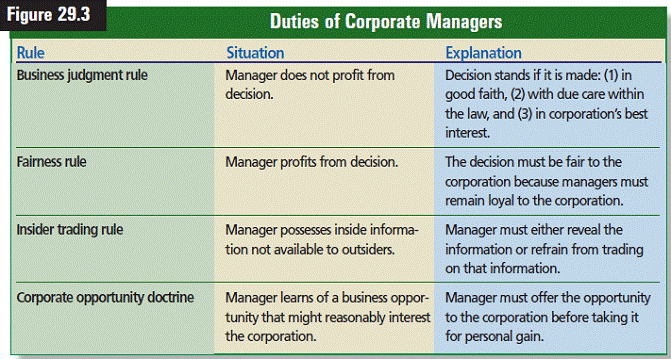
5. Duty of loyalty. Managers have a duty of loyalty to their corporation. Directors and officers must not exploit their positions for personal gain at the expense of the corporation. Their main motivation should be to act with the best interest of the corporation, and they should not engage in any activity that would deliberately damage the corporation. A director’s or an officer’s duty of loyalty may be questioned if he or she has a personal interest in a particular business decision.
6. Fairness rule requires the director or the officer to disclose involvement in the decision, including all the terms and how much profit he or she has made. If, after disclosure, the director or officer obtains the approval of a majority of the directors or the approval of the shareholders, then the decision will stand.
7. Insider trading rule. An insider typically is a corporate director or officer who has information about a publicly traded corporation that is not available to the public. He or she may not buy or sell shares in the corporation if the transaction is based on “inside” information. Any such transaction is referred to as insider trading and is unfair to the corporation and outsiders.
8. Some examples of insider trading include buying or selling stocks just before some major development occurs that will affect their price, or passing valuable information to an outsider who trades in the corporation’s stock and subsequently repays the insider. Under the insider trading rules, directors or officers who possess inside information must either refrain from acting on it or reveal it publicly before acting on it.
9. Corporate opportunity doctrine. According to this doctrine, directors and officers cannot take a business opportunity for themselves if they have sure knowledge that the corporation would want to take that opportunity for itself. The directors must first present the opportunity to the corporation. If the corporation turns it down, then the directors or officers can take the opportunity for themselves.
10. The only exception to this rule is if the director or officer knows that the corporation is financially incapable of taking the opportunity, despite its interest. In such a situation, the director or the officer would be permitted to take the opportunity without violating the doctrine.
LEXIS
fiduciary relationship - имущественные отношения доверительного характера
resemble - походить, иметь сходство
in good faith – добросовестно, с наилучшими намерениями
business judgment rule - правило принятия решения адекватно складывающейся ситуации
defer - считаться (с мнением) (to), полагаться на кого-л. (to)
fraud - обман; мошенничество, жульничество
abuse of discretion – произвол, злоупотребление правом на рассмотрение
negligent – небрежный, халатный, беспечный
ensure - гарантировать, обеспечивать, ручаться
suffer a loss - нести убыток
exploit - пользоваться, использовать
personal gain - личная выгода
at the expense - за счёт
engage in – заниматься
deliberately – преднамеренно, умышленно
damage - наносить ущерб, убыток
disclose involvement – обнародовать причины, сообщить основания (чего-либо)
disclosure - раскрытие; выдача (сведений); сообщение, разглашение
obtain - получать, добиваться
stand - оставаться в силе, быть действительным
insider trading - незаконные сделки с ценными бумагами с использованием конфиденциальной информации
insider - инсайдер (лицо, в силу служебного положения располагающее конфиденциальной информацией о делах фирмы)
transaction - сделка
outsiders - сторонние лица; лица, не осведомлённые о тонкостях биржевых операций
subsequently - впоследствии, позднее, позже, после, потом
repay - вознаграждать, компенсировать
refrain from - воздержаться от
reveal - открывать; обнаруживать
corporate opportunity – выгода от деятельности компании
turn down - отклонять, отвергать (напр. предложение)
financially incapable - недееспособный в финансовом отношении
3.7. QUESTIONS
1. What data is called “inside information”?
2. What is the business judgment rule?
3. What is the fairness rule?
4. What is the corporate opportunity doctrine?
5. Who is in fiduciary relationship with a corporation? What does it mean?
6. Whom does the business judgment rule protect?
7. Why is insider trading regulated by law?
3.8. AGREE OR DISAGREE
1. A corporation’s directors are agents and employees of their company.
2. An insider is valuable information about a publicly traded corporation that is not available to insiders.
3. Corporate directors and officers may not make mistakes in performing their duties.
4. Under corporate opportunity doctrine officers must first present the opportunity to the directors and then to shareholders.
5. When the court examines a particular disputable decision of the board of directors the judge usually focuses on how the decision was made.
3.9. SUPPLEMENT FURTHER INFORMATION on the topic “Management Responsibilities”.
3.10. DEBATES.
1. Are all shareholders individuals? Explain your answer.
2. Do you own any stock? If not, do you think you will one day? Why or why not?
3. Do you think there is a temptation for directors to take a lucrative business opportunity for themselves? Explain your answer.
4. What do you think might happen if the board of directors began to dictate the day-to-day operations of the business?
3.11. KEY WORDS
board of directors business judgment rule bylaws corporate officer corporate opportunity corporate records disclosure due care extraordinary resolution fairness rule fiduciary relationship general meeting insider insider trading notice | ordinary resolution proxy secretary shareholder/stockholder shareholder rights special resolution stock stock certificate to carry out to elect to exercise a vote to remove to serve transaction treasurer |
3.12. MAKE A REPORT on the topic “Corporate governance”, paying attention to the following points in your speech:
- shareholders and their rights;
- decisions of general meetings;
- company’s directors;
- corporate officers;
- management responsibilities.
Unit pany Reorganization
4.1. SCANNING
Corporate Expansion and Dissolution
1. Investors buy shares in a corporation because they hope to make money through what is known as a return on their investment. The directors and officers of a corporation try to make the business earn a profit that can be returned as dividends to the shareholders, or to increase the value of the shares of the corporation so that those shares can be sold at a profit. One way to increase the value of a corporation’s shares is to expand the business.
2. Types of corporate expansion. Ways for a corporation to expand include buying new land, building new manufacturing plants, opening new sales outlets, expanding product lines, and entering new fields of business. Growth and expansion can occur by joining with another corporation through a merger, an asset acquisition, or a stock acquisition (see Figure 3).
3. Merger and consolidation. Merger and consolidation are common methods of business expansion. In a merger, one corporation continues its existence and absorbs another corporation, which gives up its corporate identity. By contrast, in a consolidation two or more companies join to form a new corporation. The new company is a composite of the old companies. As far as results are concerned, there is no significant difference between a merger and a consolidation, and the terms are often used interchangeably. Most of the time, the term merger is now used to describe both scenarios.
4. The boards of directors and shareholders of the corporations being joined together must approve the merger or consolidation. Generally, a two-thirds majority of the shareholders is required, although some state statutes require a super majority as high as four-fifths. Shareholders who dissent from a merger or a consolidation are entitled to be paid for their stock if they want to pull out of the new corporation.
5. Often, dissenters have to give written notice of their dissent before a vote is taken. The cost of paying these dissenters must be considered a cost of the merger. The assets, stock, and debts of the old corporation flow to the new or surviving corporation.
6. Likewise, shareholders of the disappearing corporation become shareholders of the new corporation. Liabilities may also flow to the new corporation, including potential lawsuits.

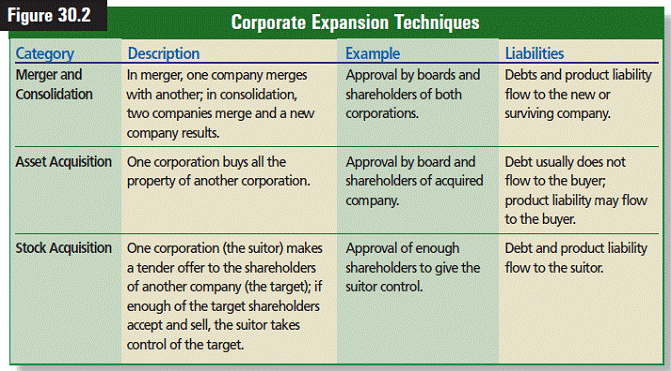
7. Asset acquisition. As the name suggests, in an asset acquisition one corporation agrees to purchase the assets or property of a second corporation. For instance, a corporation might sell its building and all of its equipment. The shareholders and the board of directors of the corporation selling the assets must approve this transaction. One advantage to asset acquisition is that, in general, the debts and the liabilities of the selling corporation do not transfer to the buying corporation. The reason is that the only thing actually transferred is ownership of the property. If a corporation is heavily in debt, it might decide to sell its assets to another corporation to raise cash quickly to pay off those debts.
8. Stock acquisition. Another type of expansion is a stock acquisition, which occurs when an individual or a corporation purchases enough shares of stock in a corporation to control it. A stock acquisition often begins with a tender offer to shareholders of the corporation. This is an offer to buy a number of shares at a specified price. Tender offers are often referred to as takeover bids and are usually communicated to the prospective selling shareholders through a newspaper advertisement. The corporation making the tender offer is referred to as the suitor, and the corporation to be taken over is called the target. The suitor does not have to buy all the stock of the target, but just enough to control the election of directors. The suitor can also sidestep the directors and appeal directly to the shareholders.
9. Because the suitor often wishes to restructure or even dismantle the target corporation, its directors and officers often object to a tender offer. They may fear the loss of their positions, or they may see the takeover bid as a threat to the very existence of the corporation. Under these conditions one of the first steps the managers often take is to launch a public relations campaign to discredit the suitor. In such a campaign, they may refer to the tender offer as a “hostile takeover bid” and to the suitor as a “corporate raider.”
10. Dissolution of a corporation. The government is as concerned about the end of a corporation as it is about the beginning of one. The end of a corporate entity is often referred to as the dissolution of the corporation, and it can come about in two ways. The corporation can decide to end, or a corporation’s dissolution can happen involuntarily.

|
Из за большого объема этот материал размещен на нескольких страницах:
1 2 3 |
