


Партнерка на США и Канаду по недвижимости, выплаты в крипто
- 30% recurring commission
- Выплаты в USDT
- Вывод каждую неделю
- Комиссия до 5 лет за каждого referral
BUSINESS ENGLISH
АНГЛИЙСКИЙ ЯЗЫК
ДЛЯ МАГИСТРАНТОВ
ДНЕВНОГО И ЗАОЧНОГО ОТДЕЛЕНИЙ
|

ОРЕНБУРГ – 2011
Рекомендовано кафедрой иностранных языков и
редакционным советом
Оренбургского института МГЮА имени
Английский язык для магистрантов: Учебное пособие к курсу «Деловой иностранный язык».- Оренбург: Оренбургский институт МГЮА имени , 201с.
Настоящее пособие предназначается для магистрантов дневного и заочного отделений ОИ МГЮА имени . Цель данного пособия – последовательное обучение студентов грамматике и правовой лексике английского языка на основе образовательных текстов, адаптированных для студентов-юристов.
© ОИ МГЮА, 2011
CONTENTS
Предисловие ……………………………………………….. UNIT 1. Forms of business organization ………….. UNIT 2. Business risk ……………………………………. UNIT 3. Corporate governance ……………………….. UNIT pany reorganization ……………………… UNIT 5. Privity of contract …………………………….. UNIT 6. Business Communication ………………….. | 3 4 17 22 30 35 43 |
Предисловие
Настоящее пособие предназначается для магистрантов дневного и заочного отделений ОИ МГЮА имени . Цель данного пособия – последовательное изучение правовой лексики на основе образовательных текстов, объединенных в шесть тематических блоков: "Формы предпринимательства", "Коммерческий риск", «Управление компаниями», "Реорганизация компании", " Договорные отношения", "Деловое общение".
Виды заданий, предлагаемых в учебном пособии:
BEFORE READING - задание выполняется до прочтения тематического текста
SCANNING - подробное изучение текста
LEXIS - лексический минимум, который необходимо усвоить при изучении текста
QUESTIONS - вопросы к прочитанному тексту
AGREE OR DISAGREE - задание предполагает оценку соответствия предложений содержанию изученного материала; если предложение не соответствует действительности, то необходимо внести соответствующие изменения и дать исправленный вариант предложения
SUPPLEMENT FURTHER INFORMATION - задание, предполагающие поиск дополнительной информации по изучаемой проблеме
DEBATES - спорные суждения, выносимые для детального обсуждения темы и для обоснования студентами своей точки зрения по заявленной проблеме
KEY WORDS - ключевые слова по изученной теме; необходимо дать толкование каждого из них, используя материал прочитанных текстов
Unit 1. Forms of Business Organization
 1.1. SCANNING
Creation and Operation of a Sole Proprietorship
1. A sole proprietorship is a form of business that is owned and operated by one person. However, that owner may have any number of agents or employees. A sole proprietorship is the most common type of business and is the easiest to form. Typical sole proprietorships are repair shops, small retail stores, and service organizations.
2. A person who goes into business as a sole proprietor can choose to operate under his own name or under a fictitious name. In selecting a fictitious name, sole proprietors must not choose a company name already in use.
3. There usually are few formal requirements in establishing a sole proprietorship. However, some sole proprietorships, such as restaurants and motels, are required to have licenses to legally operate as businesses. Other sole proprietors, such as barbers or plumbers, must have occupational licenses as well as certain types of liability insurance.
4. Advantages of a sole proprietorship
Sole proprietorships offer specific advantages. These advantages include:
- Ease of creation: a sole proprietorship is the easiest form of business association to form. To create a sole proprietorship, a person needs only to begin the operation of the business.
- Total control: sole proprietorships offer business owners complete control over the operation of the business. All decisions are up to the sole proprietor. However, a sole proprietor is always free to seek the advice of experts such as accountants, attorneys, and financial planners.
- Retention of profits: the proprietor is entitled to keep all of the profits that the firm makes. Proprietors must still pay taxes on the profits that they make, however.
- One-time taxation of profits: sole proprietorships do not pay taxes as a business. Rather, the individual sole proprietor who owns the business pays taxes based upon his or her income.
5. Disadvantages of a sole proprietorship
Sole proprietorships have several disadvantages. They include:
- Limited capital: the business owner has limited access to capital. All money used to finance the business must come from the proprietor’s savings or income, or from loans obtained by the proprietor.
- Unlimited liability: perhaps the biggest disadvantage of a sole proprietorship is unlimited liability. Unlimited liability means that the business owner is responsible for all losses experienced by the business.
- Limited human resources: as the only person responsible for the decisions that affect the business, a sole proprietor is subject to tremendous stress. This stress is multiplied when the owner must make decisions that are outside his or her areas of expertise. Even if he or she consults an expert in such cases, the decision-making responsibility still falls upon the owner.
- Limited lifetime: unlike a corporation, which has perpetual existence, a sole proprietorship lasts only as long as the proprietor. When the proprietor dies or chooses to sell or close the business, the company no longer exists.
 LEXIS
LEXIS
sole proprietorship - единоличное владение (форма владения, при которой все активы принадлежат одному владельцу)
business - предприятие, фирма
own - иметь на праве собственности, владеть
owner - владелец; собственник, хозяин
agent - представитель, посредник, доверенное лицо
employee - служащий, сотрудник, работающий по найму
proprietor - собственник, владелец; обладатель, хозяин
fictitious name - вымышленное имя
occupational license – разрешение на занятие определенной профессиональной деятельностью
advantage - преимущество
ease of creation – простота/лёгкость в создании
total control – полный контроль, полная подотчетность
be up to – зависеть от, быть в ведении
retention of profits – удержание/сохранение всех доходов
one-time taxation of profits – единовременное/разовое взимание налога на прибыли
disadvantage - недостаток
limited capital – ограниченное количество собственных средств владельца предприятия
access to - доступ к
savings or income - накопления или полученная прибыль
loan – заимствование, заём
unlimited liability - неограниченная ответственность
be responsible for - быть ответственным за что-либо, нести ответственность за
human resources - трудовые ресурсы, кадры
be subject to - зависеть от, подвергаться действию
decision-making - процесс принятия решения, выбор решения
fall upon - выпадать на чью-л. долю, доставаться
limited lifetime - ограниченный период существования
perpetual existence - бессрочное существование
 1.2. QUESTIONS
1. How does a sole proprietorship begin?
2. What are the advantages of a sole proprietorship?
3. What are the disadvantages of a sole proprietorship?
4. What is a sole proprietorship?
1.3. AGREE OR DISAGREE
1. All sole proprietorships operate under fictitious names.
2. Like a corporation a sole proprietorship has perpetual existence.
3. Under the law a sole proprietor may not employ agents.
4. Unlimited liability is an advantage of a sole proprietorship.
1.4. SUPPLEMENT FURTHER INFORMATION on the topic “Sole proprietorship”.

1.5. SCANNING
The Nature of Partnership
Part 1
1. Forming a general partnership. When two or more competent parties combine their money, labor, and skills for the purpose of carrying on a lawful business, they create a general partnership. The partners will share in the profits and losses arising from the undertaking. General partnerships can be formed in one of three ways: by agreement, by proof of existence, or by estoppel.
2. By agreement. Forming a general partnership by agreement requires the valid assent of all parties. Such an agreement is usually express and may be written or oral. However if a partnership is to last more than a year, it must be evidenced in writing. Following the same principle, a partnership formed to sell, buy, or lease real property must also be in writing. The partnership agreement is known as the articles of partnership.
3. There are many possible points of difference between partners, so the agreement should be clearly and fully explained. Some important issues that should be covered include the following:
- parties to the agreement
- specific nature, scope, and limits of the business
- planned duration of the business
- amount of each partner’s original investment and procedures for future investments
- provisions regarding salaries, withdrawal of funds, and the division of profits
- terms under which a partner may withdraw from the partnership.
 |
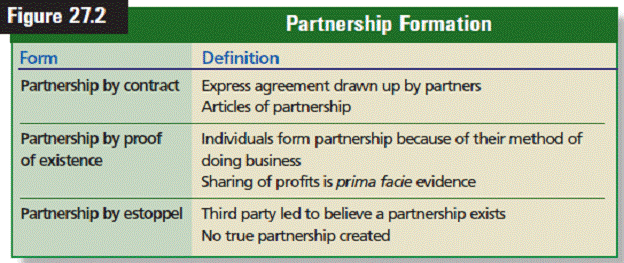
4. By proof of existence Drawing up the articles of partnership is not the only way to form a partnership (see Figure 1). Sometimes a partnership can be formed because of the way that two or more people conduct their business together. Such a partnership is termed a partnership by proof of existence. The law provides a list of characteristics to determine whether a partnership actually exists. The sharing of profits is at the top of this list. If two or more people share the profits of a business venture, it will be difficult for them to deny that a partnership exists.
5. However, there are exceptions to the rule. A person may share profits and not be able to claim partnership status if the share that is paid is one of the following:
- repayment of a debt
- wages to an employee or rent to a landlord
- an annuity to the widow or the widower of a deceased partner
- interest on a loan
- consideration for the sale of a business.
6. By estoppel. If someone does or says something that leads a third party to believe that a partnership exists, then a court may treat the arrangement as a partnership by estoppel. This type of partnership is not a real partnership. It is a way for the court to prevent injustice because someone has relied on the words or actions of another party and has acted accordingly.
7. Types of partners. There are five types of partners: general, secret, silent, dormant, and limited (see Figure 2). Each of these partners is a co-owner of the business and has some liability for the debts of the firm.
 |

8. Every partnership must have at least one general partner. In most firms, the partners are general partners. A general partner plays an active role in the management of the partnership and is publicly known as a partner. A general partner has unlimited liability for the firm’s debts.
9. A secret partner is a general partner who has an active role in the management of the partnership, but whose connection with the partnership is kept a secret. A secret partner also has unlimited liability for the firm’s debts.
10. A silent partner is a general partner who takes no active role in the management of the partnership. A silent partner is known publicly as a partner and has unlimited liability for the firm’s debts.
11. A dormant partner is a general partner who takes no active part in the management of the firm and whose connection with the firm is kept secret. A dormant partner, however, has unlimited liability for the firm’s debts.
12. In contrast, a limited partner is one whose liability does not extend beyond his or her investment. This liability arrangement is known as a limited partnership.
LEXIS
general partnership - полное товарищество, товарищество с неограниченной ответственностью, товарищество на вере
partner - компаньон; партнер; пайщик, участник товарищества
share in profits - иметь право на долю прибыли
undertaking - предприятие; дело
estoppel - лишение права возражения; эстоппель (лишение лица права ссылаться на какие-либо факты ввиду ранее им же сделанного заявления об обратном); процессуальный отвод (лишение одной стороны права отрицать истинность своего заявления, если на основе этого заявления другая сторона произвела определенные действия)
valid assent - юридически действительное согласие
written – письменный
oral - устный
evidenced – подтверждённый, засвидетельствованный
lease real property - арендовать недвижимое имущество
articles of partnership - договор об учреждении товарищества
points of difference – различия, расхождения
parties to the agreement – стороны соглашения
duration - срок действия
original investment - первоначальные капиталовложения
provision – условие, положение договора
withdrawal of funds - изъятие денежных средств, изъятие вклада
division of profits - распределение прибылей
terms – условия
withdraw from - выходить из состава
conduct one’s business – вести свой бизнес
business venture - коммерческое предприятие
deny – отрицать
repayment of a debt - возврат долга
annuity - ежегодная выплата, установленная завещанием
widow – вдова
interest on a loan - процент по кредиту
consideration - денежное выражение по сделке
injustice – несправедливость
rely on – рассчитывать, доверять
general partner - главный партнер с неограниченной (имущественной) ответственностью, полный партнёр
secret partner - негласный член товарищества; мало известный компаньон
silent partner - компаньон, представляющий фирму, но активно не участвующий в ведении дел; компаньон-вкладчик
dormant partner - негласный член товарищества; пассивный компаньон
limited partner - партнер с ограниченной имущественной ответственностью
debts - долговые обязательства
1.6. SCANNING
Part 2
1. Partnership property. Certain rights and limitations arise regarding partnership property. For this reason, it is important to distinguish between property that belongs to the partnership and property that belongs to individual partners. Property contributed directly to the partnership when the partnership is created is partnership property. The law also states that partnership property includes property that is bought with partnership funds.
2. Property rights of the partners. Certain rights arise regarding property that belongs to the partnership. These rights include the right to use the property, the right to manage the firm, and the right to share in the profits.
3. Right to use property. Partners are co-owners of all the real and personal property included in the partnership. As a result, the partners can use the property for partnership business. The property cannot be used for other business unless the other partners give their permission. This co-ownership, called tenancy in partnership, gives rise to other limitations. For example, a partner cannot, on his or her own, transfer ownership of the property. Also, the property cannot be taken by a partner’s personal creditors. Moreover, when a partner dies, the right to use partnership property passes to the other partners.
4. Right to manage the firm. Unless a partner’s rights are limited in the partnership agreement, each partner has an equal voice in managing the partnership’s business. As a result, each partner can bind the partnership on any matter within the scope of its business affairs. In a disagreement about ordinary business matters, the decision of the majority is final.
5. The law provides that some partnership decisions cannot be made without the consent of all the partners. For example, a new partner cannot be admitted to the firm without unanimous consent. Similarly, it takes a unanimous vote of all partners to change the essential nature of the business. A unanimous vote is needed to amend the original articles of partnership.
6. Right to share in the profits. Unless there is an agreement to the contrary, partners share equally in the profits, regardless of their initial capital contribution or the time devoted by each partner to the business. This right can be assigned to others and passes to the partner’s heirs upon the partner’s death. This right also includes the right to an accounting at the end of the partnership.
7. Duties of the partners. Partners must trust one another. Each partner is an agent of the other partner and has duties comparable to those of an agent. Partners have the following duties:
- to always act in good faith and in the best interests of the firm
- to always use their best skill and judgment in looking after the firm’s affairs
- to be loyal to the firm and put the firm’s interests first.
8. Because each partner is an agent of the firm, each may bind the firm by any act that is part of the firm’s business. Any act of a partner that is not a part of the firm’s business is not binding on the firm. Similarly, if the majority of the partners vote not to enter a particular contract, and one of the partners ignores the vote and enters that forbidden contract, then that partner alone is bound to that contract.
9. Liability of the partners. Partners have unlimited liability for all of the debts of the partnership incurred while they are partners, even to the extent of their personal assets. Partners are liable to other members of the firm for their share of the firm’s debts. Partners share losses in the same proportion that they share profits.
10. In addition, partners are jointly liable with their partners on contracts entered into by any member of the firm acting within the actual or apparent scope of the firm’s business. Joint liability means that in the event of a lawsuit, all the partners must be sued together.
11. Limited partnerships. A limited partnership is quite different from a general partnership. The law defines a limited partnership as “a partnership formed by two or more persons. . . having one or more general partners and one or more limited partners.” Limited partners are investors who have no control in managing the partnership, and their names may not appear in the partnership name. A limited partner’s liability for the partnership’s debts does not extend beyond his or her investment in the partnership. Thus, the term «limited» in the title of the partner refers to the partner’s liability.
12. Dissolving a partnership. A dissolution of a partnership is a change in the relationship of the partners that occurs when any partner stops being associated with the business. When a partner dies or voluntarily withdraws from the firm, the firm is dissolved. The firm also may be dissolved by court decree. The partners then are no longer carrying on as co-owners of a business for profit.
LEXIS
arise - возникать
contributed - вносимый
permission - позволение, разрешение
tenancy in partnership - владение в форме товарищества
transfer ownership - передавать право собственности, отчуждать
equal voice in managing – равные права в управлении
bind - связывать (об обязательствах), создавать обязательство
business affairs - коммерческие дела
majority – большинство, подавляющееся большинство
be admitted to - быть принятым в
unanimous consent - единодушное согласие
amend - внести изменения в
to the contrary - в противоположном (ином) смысле
share equally - делить на равные части
regardless – независимо
devoted – посвящённый, уделенный (о времени или усилиях)
assign - передавать (права) другому лицу
heir - наследник, преемник
accounting - составление или представление отчётности
trust - верить, доверять(ся), полагаться (на кого-л.)
comparable - аналогичный
act in good faith - действовать добросовестно
skill and judgment - мастерство и рассудительность
look after - проявлять заботу
ignore - проигнорировать
enter a contract – заключать соглашение, вступать в договорные отношения
incur - нести (ответственность, обязанность, расходы, ущерб и т. д.); принимать на себя; подвергаться чему-л.
personal assets - личное имущество
jointly liable - солидарно ответственный, солидарно обязанный
lawsuit - судебный иск
sue - подавать в суд, возбуждать иск, предъявлять иск
limited partnership - партнёрство с ограниченной ответственностью
extend beyond – выходить за пределы
title – звание, название
dissolve - прекращать деятельность, распускать
dissolution - ликвидация (предприятия), роспуск
court decree - судебное постановление
carry on - продолжать деятельность
1.7. QUESTIONS
1. How can a partnership be created?
2. How can a partnership be dissolved?
3. What are a partner’s rights in relation to property?
4. What are the effects of the dissolution of a partnership?
5. What is a general partnership?
6. What is a limited partnership?
7. What issues should be explained in a partnership agreement?
8. What partnership decisions cannot be made without the consent of all partners?
9. When must an agreement to form a partnership be in writing?
10. Whose interests are protected by the doctrine when a partnership is deemed to be created by estoppel?
1.8. AGREE OR DISAGREE
1. A limited partner’s liability for the partnership’s debts may extend beyond his investment in the partnership.
2. A secret partner is known publicly as a general partner but has limited liability for the firm’s debts.
3. Any act of a partner even if it is not a part of the firm’s business is binding on the whole partnership.
4. Every partnership must have at least one dormant partner.
5. In order to be treated as a partnership a legal entity must satisfy these three requirements: making a partnership agreement, providing sufficient proof of its existence, and having apparent grounds for estoppel.
6. Partners always share equally in the profits of their partnership.
7. Personal property of partners is the same as partnership property.
8. When two or more people conduct their business together we deal with a partnership by estoppel.
1.9. SUPPLEMENT FURTHER INFORMATION on the topic “Partnership relations”.
1.10. SCANNING
Types of Company Limited by Shares
1. There are two types of registered company limited by shares in Great Britain: public and private.
2. Public companies. A public company must be one which is limited by a share capital. It may offer its shares and debentures to the public. The company is identified as a public company by using the words ‘public limited company’ after its name. The phrase may be abbreviated by use of the letters ‘plc’. The company’s memorandum of association must state that it is a public company. The authorised capital of the company must be not less than £50,000.
3. Before it can commence business or exercise any borrowing powers, it must receive a trading certificate from the Registrar of Companies. An application for the certificate must be made in prescribed form and must be signed by a director of the company or by the company secretary.
4. The main advantage of a public company is the capacity to raise money by public subscription. This is usually done by a flotation on the stock exchange.
5. Private companies. A private company is any kind of Registered Company, not being a public company. A private company may not advertise its shares or debentures for sale to the public.
6. The main advantages of a private company include:
(a) it is able to commence trading immediately on incorporation: it does not need a trading certificate;
(b) it does not need a minimum share capital;
(c) it needs to have one member and one director: a public company must have a minimum of two members and two directors;
(d) a private company is able to use the written resolution procedure without the need to hold a formal meeting.
7. There are a wide number of other advantages to having a private company. Most of them require less formality to achieve a particular purpose than does a public company, especially in relation to financial matters.
8. The purpose of the distinction between private and public companies is to allow small companies to enjoy a less rigorous control over their affairs, as there is no need to safeguard the public in relation to investment in the companies. There are much stricter controls in relation to public companies.
9. In order to form a company, prescribed documentation has to be filed with the Registrar of Companies, together with the appropriate fee. At present, this is £20, though there is a same-day service if the documents are presented at Companies House before 3 pm. The same-day service costs £100. If everything is in order, the registrar duly issues a certificate of incorporation.
10. In the case of a private company, this enables the company to begin trading immediately. In the case of a public company, a trading certificate is a further necessity.
11.Memorandum of association is the document which gives basic information about the company to the outside world. The memorandum must contain the following:
(a) the name of the company
(b) the domicile of the company
(c) the objects of the company
(d) that the liability of members is limited, though, of course, this will normally be apparent from the name of the company
(e) the amount of its authorised share capital and its division into shares of a particular value.
12. Articles of association regulate the internal government of the company. They deal with such matters as the issue and transfer of shares, the calling of meetings together with the procedure to be adopted and the taking of votes at them, the appointment of directors and their powers, etc.
LEXIS
registered company - зарегистрированная компания
shares - акционерный капитал, акции
debenture - облигация компании, письменное долговое обязательство
abbreviate – записывать в сокращенном виде, сокращать
plc - Public Limited Company
memorandum of association - меморандум, устав юридического лица, устав акционерного общества (документ, определяющий внешние отношения компании и представляемый к регистрации)
authorised capital - номинальный капитал
commence - начинать
borrowing powers - полномочия, предоставленные директору компании в соответствии с её уставом, для привлечения финансовых ресурсов
trading certificate - сертификат, удостоверяющий регистрацию компании и её право начинать деятельность
Registrar of Companies - бюро регистрации компаний
application - ходатайство
prescribed form - установленный бланк документа
raise money - изыскивать денежные средства, мобилизовать капитал
public subscription - открытая подписка
flotation - выпуск акций через биржу
stock exchange - фондовая биржа
advertise – объявлять, извещать
incorporation - регистрация в качестве корпорации или юридического лица
rigorous – суровый, доскональный, скрупулезный, тщательный; неукоснительный
safeguard - защищать
appropriate fee - надлежащий взнос, пошлина
same-day service – немедленное обслуживание, регистрация в день подачи документов
be in order - быть в порядке
registrar - чиновник-регистратор
issue – выдавать
further necessity – дополнительная необходимость
domicile - юридический адрес
object - цель
apparent - видимый, очевидный, явный
articles of association - учредительные документы
internal government - внутреннее управление, корпоративное управление
calling of meetings - созыв общих собраний
taking of votes – процедура голосования
1.11. QUESTIONS
1. What are the advantages of private companies in comparison with public ones?
2. What documentation should be filed with the Registrar of Companies if one intends to form a company in Great Britain?
3. What does the abbreviation “plc” mean if it goes after company’s name?
4. What information about the company must be stated in its memorandum of association?
5. What is a difference between a certificate of incorporation and a trading certificate?
6. What requirements should a company meet in order to be registered as a public one?
1.12. AGREE OR DISAGREE
1. An application for a trading certificate must be signed by all shareholders and incorporators.
2. In England the phrase “articles of association” is used to describe the document which gives basic information about the company to the outside world.
3. Public companies are able to use the written resolution procedure without the need to hold formal meetings.
4. Sometimes the company is identified as a public company by using the words ‘public limited company’ instead of its name.
5. The authorised capital of a private company in Britain must be not less than £50,000.
6. The main advantage of a private company is that the public may be asked to subscribe for shares.
1.13. SUPPLEMENT FURTHER INFORMATION on the topic “Types of companies”.
1.11. KEY WORDS
agent articles of association articles of partnership authorised capital business dissolution employee general partner general partnership incorporation investment limited liability limited partner limited partnership memorandum of association owner partner | plc registered company Registrar of Companies shares sole proprietorship stock exchange tenancy in partnership to be filed to conduct one’s business to dissolve to own to raise money to share equally to share in profits to transfer ownership trading certificate unlimited liability |
 1.12. MAKE A REPORT on the topic “Forms of business organization”, paying attention to the following points in your speech:

|
Из за большого объема этот материал размещен на нескольких страницах:
1 2 3 |
