


Партнерка на США и Канаду по недвижимости, выплаты в крипто
- 30% recurring commission
- Выплаты в USDT
- Вывод каждую неделю
- Комиссия до 5 лет за каждого referral
I. Put the verbs in brackets into the correct form of the Present Simple or Present Continuous.
1. In winter it (get) ___________________ dark very early and it (snow) ___________________a lot.
2. Sometimes he (stay) ___________________ at home. Now he (skate___________________). That (depend) ___________________ on the weather.
3. Ellen (not/leave) ___________________for work before 8 o’clock.
4. How often ….. you (water) ___________________ flowers?
5. Slow down, you (drive) ___________________too fast.
6. She can’t answer the phone. She (cook) ___________________.
7. They (spend) ___________________ most of the time outdoors.
8. ….. you (use) ___________________the computer at the moment?
9. He (play) ___________________a lot of computer games but (not/play) ___________________now.
10. I’m tired. I (want) ___________________ to go home now.
11. Would you like a cocktail? – No, I (drive) ___________________.
12. Sam (not/like) ___________________reading poetry.
13. ….. you (cook) ___________________ a Mexican dish? Mary (not/eat) ___________________spicy food.
14. ….. they still (work) ___________________?
15. Our students (not/wear) ___________________ a uniform.
16. Be quiet. The baby (sleep) ___________________.
17. He (wash) ___________________ his hair three times a week.
18. Look! Mark (swim) ___________________ in the sea.
II. . Rewrite the following text in the Past Simple.
Paul gets up early in the morning. He has a shower and dresses. Then he has breakfast. He eats a lot for breakfast. After breakfast he takes his bag and drives to work. At work he has a lot of things to do. He is busy till 6 o’clock. Then he goes home.
In the evening he has dinner and then sees a film or surfs the Net. Paul goes to bed at about midnight. He is tired and falls asleep at once.
III. Complete the questions.
1. Pushkin is a great singer, …?
2. They aren’t going to play football today, …?
3. The girl is reading a book, …?
4. Children mustn’t open their textbooks, …?
5. I am in Pobeda Street, …?
6. The woman isn’t in the park, …?
7. Masha can play tennis, …?
8. You don’t have a brother, …?
9. Your mother doesn’t speak French, …?
10. We like to play basketball, …?
11. Her father works in a hospital, …?
12. Rob has a pet Nessie, …?
I. Make the nouns plural:
Man, bed, baby, shelf, foot, woman, rose, bus, ball
II. Make questions to the words in bold:
a. Bill is writing an exercise in his notebook.
b. My father works in the office from 9 a. m.to 6 p. m.
III. Find the mistakes and correct them:
1) I has got two knives.
2) These are a jug of jam.
3) There's a milk in the glass.
4) There are mouses in the house.
5) He's got a umbrella.
6) My fathers' name is John.
7) There is a butter on the table.
8) This is an Ann's pen.
|VI. pen the brackets with the correct form of the Verb – Past Simple or Present Perfect
1) Kevin... (lose) his key. He... (leave) it on the bus yesterday.
2) I... (not play) tennis since I... (be) at school.
3) 1 think our teacher... (forget) about the test! He ... (not say) anything about it in the last lesson!
4) Sarah... (break) her leg. She... (fall) off a horse last week.
5) I... (finish) decorating my room. I..(paint) it last week and I... (put) the new curtains last night.
6) Tom... (see) this film twice.
TEST 2
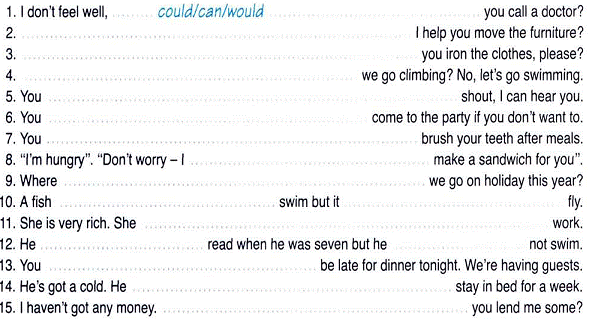
I. Fill in correct modal verb (s)
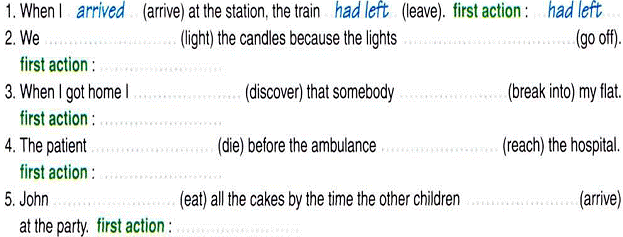
II. Put the verbs in brackets into the Past Simple or Present Perfect. Then write down which action was the first.
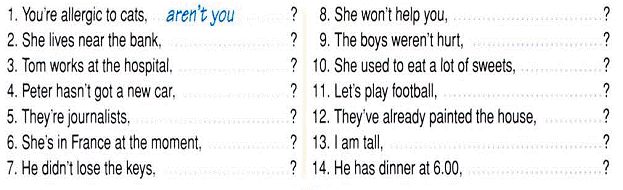
III. Add tags to the following questions:
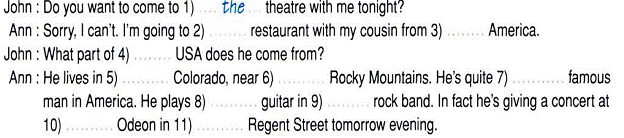
IV. Fill in a/the where necessary.
V. Complete the text with the correct form of the verbs in brackets.
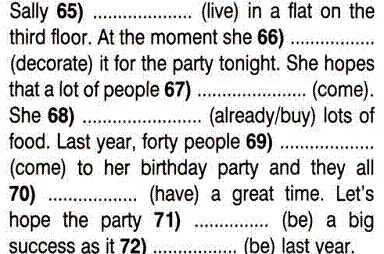
VI. VI. Choose the correct item.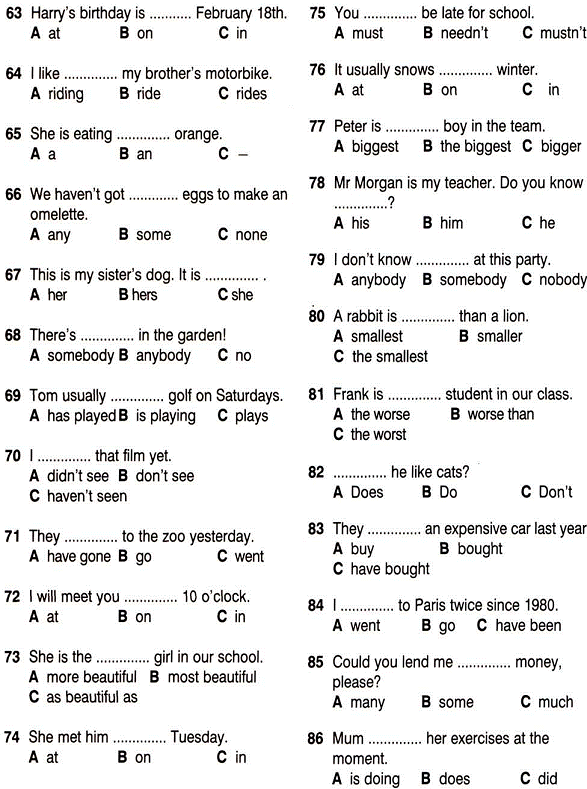
TEST 3
I.
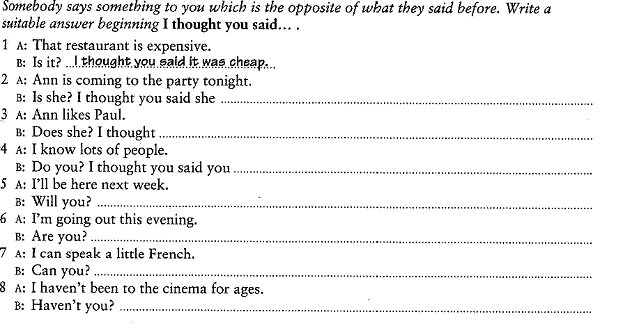
II. Put the sentences into Indirect speech.
1. Не said: "I haven't yet seen the film you are talking about." 2. He said: "I seldom went to see my friend in May as I was very busy." 3. She said to me: "Did you live in St. Petersburg ten years ago?" 4. She said to me: "Are you going to leave St. Petersburg for the summer?" 5. My friend said to me: "The discussion will still be going on when you return." 6. He said: "I am proud of my brother who took the first prize at the competition." 7. He said to me: "Come at nine o'clock, I will be free at that time and we will have a nice cup of coffee." 8. Nina asked her friend: "What did the professor speak about in his lecture?" 9. Ann said: "He is one of the best speakers I have ever heard." 10. She said: "He has just left." 11. She asked her brother: "Will you manage to get tickets to the Philharmonic on Sunday?"
III. Restore the Direct Speech..
1. George said it was very difficult to play that role. 2. He asked why there were so few people in the street. 3. The man asked the boy if he knew where he lived. 4. The woman told him not to worry and go home quietly. 5. She said that she would sleep in the open air. 6. She wondered if I was going to leave St. Petersburg the next day. 7. He told me that he had bought that watch the day before. 8. Ann said that she had just had a telephone call from home. 9. My neighbour asked me to leave the key at my sister's. 10. He said he could not understand the rule. 11. He told me he had bought a ticket the day before.
IV Open the brackets using Future Simple or Present Simple tenses.
1. I (to see)______________ you before you (to start) ______________? 2. What he (to do) ______________ when he (to come) ______________home? 3. Where they (to go) ______________ if the weather (to be) ______________ fine? 4. He (to ring) ______________me up when he (to return) ______________ home. 5. If it (to rain) ______________, we (to stay) ______________at home. 6. She (to walk) ______________home if it.(not to be) ______________ too cold. 7. I am sure he (to come) ______________to say good-bye to us before he (to leave) ______________ St. Petersburg. 8. Please turn off the light when you (to leave) ______________the room. 9. If we (to be) ______________ tired, we (to stop) ______________ at a small village half-way to Moscow and (to have) ______________a short rest and a meal there. 10. If you (to miss) ______________the 10.30 train, there is another at 10.She (to make) all the arrangements about it before she (to fly) ______________there. 12. Before he (to start) ______________for London, he (to spend) ______________a day or two at a rest-home not far from here.
TEST 4
I. Fill the gaps with the correct tenses ( in passive voice).
1. At the last competition the first prize (to win) _________________________ by our team. 2. The question (to settle) _________________________as soon as they arrived. 3. Your report must (to divide) into two chapters. 4. Soon he (to send)_________________________to a sanatorium. 5. The book (to discuss) _________________________ at the next conference. 6. The composition must (to hand) _________________________in on Wednesday. 7. Yesterday he (to tell) _________________________to prepare a speech. 8. The article (to publish) _________________________ last week, if I am not mistaken. 9. The lectures (to attend) _________________________by all of us. 10, A taxi (to call) _________________________fifteen minutes ago, so we are expecting it any moment. 11 The young man (to introduce) _________________________to me only a couple of hours ago, but it seems to me that I've known him for years. 12. The rule explained by the teacher at the last lesson (to understand) _________________________ by all of us. 13. The poem was so beautiful that it (to learn) _________________________by everybody. 14. I hope the invitation (to accept) _________________________ by everybody. 15. The letter (to post) _________________________in half an hour. 16. It seems to me me that music (to hear) _________________________from the next room.
II. Find and correct the mistakes.
1) The policeman arrested the thiefs.
2) "What are you?" — "Tom Smith".
3) You like pizza?
4) I want being a teacher.
5) They play in the garden now.
6) Mother is standing in the window.
7) He swims fastest than me.
8) They got married in 27th of December.
9) She didn't finish her work yet.
10) She is taller of all.
III. Circle the correct answer.
1) He always... at 7 o'clock. a) is getting up, b) has got up, c) gets up
2) Ann... to Paris in 1991. a) has moved, b) moved, c) moves
3) We haven't heard from him... months, a) since, b) yet, c) for
4) He goes to work... bus. a) on, b) by, c) in
5) …….. we go tonight? a) shall, b) will, c) have
6) You... cross the street when the light is red. a) mustn't, b) needn't, c) can't
7) He is wearing... uniform. a) —, b) an, с) а
8) Mark is as... as George. a) taller, b) tall, c) the tallest
9) He... his car a month ago. a) bought, b) buys, c) has bought C
10) Claire dances... than Sue. a) better, b) well, c) the best
IV. Use the verbs in the correct form.
Madonna (1) …………. ... (be) a famous singer. She... …………. ...(act) in several films as well. She …………. . (write) a book some time ago which(4) . …………. ... (become) very popular. She (5) …………. ... (travel) all over the world giving concerts. She (6) …………. ... (have) many hit songs already and she (7) …………. ... (make) more records in the future. She (8) …………. ... (act) in more films too. She (9) …………. ... (become) famous in the 1980's and she (10) …………. ...... (be) a millionaires now.
IV. Put 5 questions (different types) to the text.
Monica Cox
Monica Cox is a tennis player. She has won a lot of competitions. She started playing tennis with her father when she was three years old. Two years ago she went to America to a famous tennis school in California. Monica and her father have travelled to many countries. Last month they went to Australia. Monica played well but she didn't win. She hasn't played at Wimbledon yet, but she hopes to do so.
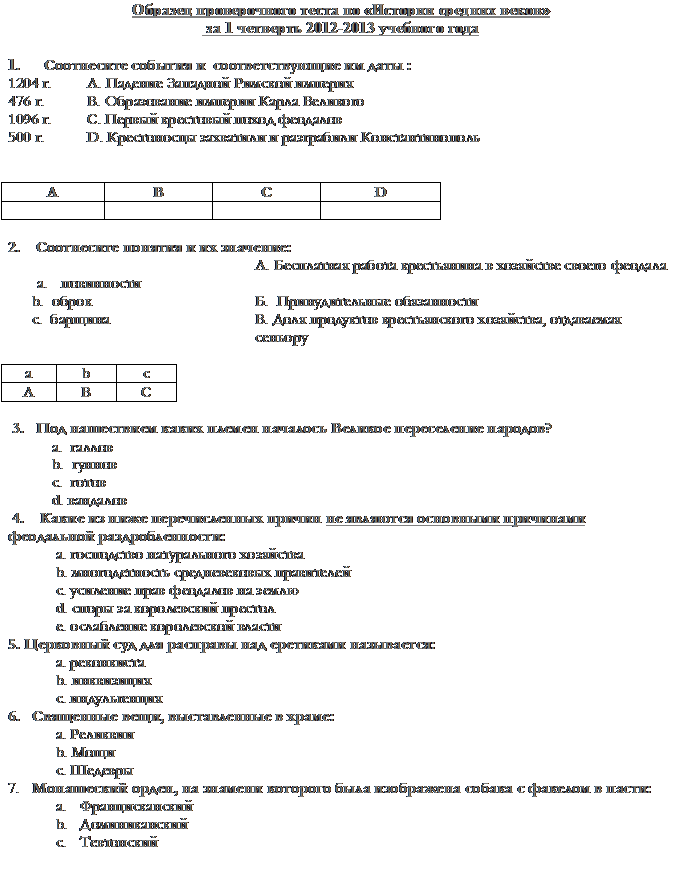
ТЕМАТИЧЕСКОЕ ПЛАНИРОВАНИЕ ЗАОЧНОГО ОБУЧЕНИЯ ПО ИСТОРИИ СРЕДНИХ ВЕКОВ
1 полугодие учебного года
По УМК , « История Средних веков»- изд. «Просвещение», 2002.
НАЗВАНИЕ РАЗДЕЛОВ, ТЕМ | Необходимые навыки | |
1 Ч Е Т ВЕ Р Т Ь | 1. Древние германцы и Римская империя | Знать причины, цели и исходы основных исторических событий, даты, выделенные жирным шрифтом в учебнике. |
2. Королевство Франков и Христианская церковь | ||
3. Возникновение и распад империи Карла Великого. Феодальная раздробленность | ||
4. Западная Европа в IX-XI веках | ||
5. Культура Западной Европы в раннее Средневековье. | ||
6. Византия при Юстиниане. Борьба империи с внешними врагами. | ||
7. Культура Византии | ||
8. Образование славянских государств | ||
9. Возникновение ислама. Арабский халифат и его распад | ||
10. Культура стран халифата | ||
11. В рыцарском замке. Средневековая деревня и ее обитатели. | ||
12. Формирование средневековых городов. Горожане и их образ жизни. | ||
13. Могущество папской власти. Католическая церковь и еретики | ||
14. Крестовые походы | ||
2 Ч Е Т В Е Р Т Ь | 1. Как происходило объединение Франции | Уметь отвечать на вопросы к параграфам, находить на карте государства, места крупных сражений |
2. Что англичане считают началом своих свобод | ||
3. Столетняя война | ||
4. Крестьянские восстания во Франции и Англии. | ||
5. Усиление королевской власти в к. XV в. В Англии и во Франции | ||
6. Реконкиста и образование централизованных государств на Пиренейском полуострове | ||
7. Усиление власти князей в Германии 8. Расцвет итальянских городов. | ||
9. Гуситское движение в Чехии | ||
10. Завоевание турками-османами Балканского полуострова. | ||
11. Культура западной Европы | ||
12. Народы Азии, Америки и Африки в средние века |
ТЕМАТИЧЕСКОЕ ПЛАНИРОВАНИЕ ЗАОЧНОГО ОБУЧЕНИЯ ПО ИСТОРИЯ РОССИИ С ДРЕВНЕЙШИХ ВРЕМЕН ДО КОНЦА XVI века
2 полугодие учебного года
УМК , «История России с Древнейших времен
до к. XVI века»- изд. «Просвещение», 2001
НАЗВАНИЯ РАЗДЕЛОВ, ТЕМ | Необходимые навыки | |
3 Ч Е Т В Е Р Т Ь | 1. Восточные славяне | Знать причины, цели и исходы основных исторических событий, даты, выделенные жирным шрифтом в учебнике. Уметь отвечать на вопросы к параграфам, находить на карте государства, места крупных сражений |
2. Соседи восточных славян | ||
3. Формирование Древнерусского государства | ||
4. Первые Киевские князья | ||
5. Владимир Святославич. Принятие Христианства | ||
6. Расцвет Древнерусского государства при Ярославе Мудром | ||
7. Культура Древней Руси | ||
8. Быт и нравы Древней Руси | ||
9. Начало раздробления Древнерусского государства | ||
10. Главные политические центры Руси. | ||
11. Нашествие с востока. | ||
12. Борьба Руси с западными завоевателями. | ||
13. Русь и Золотая Орда | ||
14. Русь и Литва | ||
15. Культура русских земель в XII-XIII веках. | ||
4 Ч Е Т В Е Р Т Ь | 1. Предпосылки объединения русских земель. Усиление Московского княжества | |
2. Москва – центр борьбы с ордынским владычеством. Куликовская битва | ||
3. Московское княжество и его соседи в к. XVI-сер. XV века | ||
4. Создание единого Русского государства. Падение ордынского владычества | ||
5. Московское государство в к. XV – н. XVI века | ||
6. Реформы Избранной рады | ||
7. Внешняя политика Ивана IV | ||
8. Опричнина. | ||
9. Просвещение, устное народное творчество, литература в XIV – XVI веках | ||
10. Архитектура и живопись в XIV – XVI веках | ||
11. Быт XV-XVI веков |

|
Из за большого объема этот материал размещен на нескольких страницах:
1 2 3 |
