


Партнерка на США и Канаду по недвижимости, выплаты в крипто
- 30% recurring commission
- Выплаты в USDT
- Вывод каждую неделю
- Комиссия до 5 лет за каждого referral
Net income margin dropped by 33 percentage points and was 14.8% by the year’s results, which is related to the extraordinary growth of net income in 2007 due to the sale of the 15% stake in OJSC Telecominvest. Disregarding this transaction, net income margin remained at about the same level in 2008 as in 2007.
By the results of 2008, the receipts per line grew by 3% to make RUR 5,464. The receipts per employee grew by 15% in 2008 compared to 2007, to make RUR 1,079,766. The number of lines per employee increased by 12% to 198 in 2008.
The current liquidity ratio describes the company’s total current assets available to cover its current debt. It was 0.64 in 2008, which is 0.16 percentage points less than the 2007 value. The decrease of the ratio was determined by the following factors:
· the deposited amount from the sale of the 15% interest in OJSC Telecominvest was shown in the “short-term financial investment” line as of the end of 2007,
· transfer of the Series 3 N. W.Telecom bonds from the short-term to the long-term line due to the fulfillment of the offer’s terms in March 2008 and to the return of the Series 3 bonds presented for retirement to the secondary market.
Credit Ratings
Despite the drop of Russia’s sovereign credit rating forecast from “Stable” to “Negative”, which took place in October 2008 due to the uncertain economic policy of the RF and the liquidity crisis on Russian financial markets, the credit quality of N. W.Telecom was highly appreciated by the leading rating agencies, i. e. Fitch Ratings and Standard&Poor’s.
Table 17. N. W.Telecom credit ratings as of 31.12.2008
Rating Agency | Rating | Assigning / revision date | Change |
Fitch Ratings | international credit rating | 25th September 2008 |
|
Fitch Ratings | national credit rating А+ (rus)/The “Stable” forecast | 25th September 2008 |
|
Standard & Poor’s | international credit rating | 26th December 2008 |
|
Standard & Poor’s | national credit rating RuAA- | 26th December 2008 |
|


During the year 2008, in order to improve the ratings, the rating agencies’ experts were actively supplied with comprehensive information on the activity of OJSC N. W.Telecom.
According to the rating agencies’ analysts, confirmation of the high ratings of N. W.Telecom’s credit quality is explained by:
· a balanced financial policy pursued by the Company,
· moderate debt burden,
· N. W.Telecom’s leading position in the traditional telephony segment,
· continuing improvement of the network quality,
· active promotion of new services,
· higher operating profitability,
· higher degree of diversification of N. W.Telecom’s receipts.
RISKS
The business of N. W.Telecom is connected with several risks, which, under certain circumstances, may have a material effect on industrial and financial results. The Company is eager to assess each detected risk and measure the level of its effect on achievement of strategic goals during the time period under review.
Country Risks and Regional Risks
OJSC N. W.Telecom operates in the Russian Federation (RF) and is subject to country risks typical for the RF, the primary risks being political and *****ssia is continuing the economic reform and developing a legal, tax, and administrative infrastructure that would meet the market economy requirements. The Russian economy’s stability will greatly depend on the progress of the reform, and on efficiency of the Government’s actions in the domain of economy and financial, monetary, and crediting policy.
The oil price drop and the liquidity crisis drive capitals of non-resident investors out of Russia, decrease the RF trade turnover balance, reduction of the country’s gold and currency reserve, and rouble devaluation.
An aggravation of the economic situation in the North-Western Federal District of the RF may entail a reduction in the number of industrial and agricultural enterprises of any status of ownership operating in the region, higher unemployment, and a lower solvent demand of residents.
The current negative trends in the economy may result in slower implementation of N. W.Telecom’s investment program, slower growth of the volume of communication services offered by N. W.Telecom in the District, and slower growth rate of revenues.
Probability of war conflicts, introduction of a state of emergency and strikes in the country and in the region, in which OJSC N. W.Telecom operates, is not very strong to consider these risks as circumstances that may significantly affect the activities of N. W.Telecom.
The risks related to any geographic features of the region, such as higher danger of natural disaster, or possible break of transport communication due to remoteness or poor accessibility, are evaluated as minimal.
Industry Risks
Risks related to changes in the industry regulation
The Company's main risk related to continuously changing industry laws is ambiguous interpretation of regulatory documents (or amendments/supplements thereto) defining methods and mechanisms of governmental regulation, in particular, of tariffs for services provided by N. W.Telecom to private customers and communication operators.
According to Federal Law No. 147-FZ of 17.08.1995 "On Natural Monopolies", rates for services of operators who are considered natural monopolists are subject to regulation by state authorities.
Currently, governmental regulation of tariffs for communication services for N. W.Telecom subscribers is provided by the Federal Tariffs Service (FTS) by setting limit tariffs for such services.
Besides, the prices for interconnection and traffic transmission services are also subject to regulation by the government. Currently, governmental regulation of prices for such services is provided by the Federal Communication Agency by setting limit tariffs for appropriate services.
A change of regulated rates for services of operators who are natural monopolists may take place in compliance with the parameters of the forecast of social and economic development of the Russian Federation approved by the RF Government, and may therefore lag behind the variations of the actual economic situation and of the operator's costs.
Thus, the Company sees the risk of delayed tariff updating, which impairs its competitiveness and may adversely affect their business profitability, and, accordingly, the possibility to fulfill N. W.Telecom’s obligations under credits and loans.
Since according to the active law the primary business of OJSC N. W.Telelcom is subject to licensing, changes in the licensing conditions for certain communication services may entail the need of resources re-distribution and the need of changing the Company's plans related to providing such services.
Growth of competition in the industry
There is a growing competition both with alternative fixed communication operators and with cellular (mobile) communication operators in the telecommunication services market of the North-Western Federal District.
Causes of the competition growth:
· reduction of prices for on-network long-distance connections by mobile operators;
· provision of on-network roaming at the price of local connection;
· provision of mobile Internet access services;
· intensified activity of communication operators in promoting services in the "corporate clients" market segment (due to the saturation of the "individual clients" market segment);
· landing of mobile operators’ zonal traffic at lower prices via own local communication networks and/or alternative operators’ networks.
Said factors constitute a risk of replacement of fixed-line communication by cellular communication and a slow-down of N. W.Telecom's revenue growth rate. Escalation of competition might be the most serious risk in the long term.
Selection of OJSC N. W.Telecom as all-in-one telephone service operator with the use of payphones
Having won the tenders for provision of all-in-one communication services (ACS), N. W.Telecom was named the operator of all-in-one telephone communication service using payphones in NWFD. In providing ACS, N. W.Telecom bears losses defined as the difference between the Company’s revenues from providing all-in-one communication services and costs incurred in providing such services, to be refunded in an amount not exceeding the size of compensation for losses as stated in the contract for provision of all-in-one communication services signed by the results of the tender.
The Company faces the risks of refusal to refund losses related to provision of all-in-one telephone communication services using payphones, or of incomplete refunding of such losses from the all-in-one service reserve, due to:
· being late with fulfilling the contracts of all-in-one communication services organization, i. e. delayed commissioning of payphones because it takes long to obtain permissions for the use of radio frequencies;
· non-compliance with the requirements of statutory acts as to the accounting of income and expenses related to all-in-one communication services;
· incomplete accounting of expenses related to all-in-one communication services provision.
In order to minimize the probability of occurrence of the risk of incomplete or denied refunding of losses related to provision of ACS, the Company does its best to prevent situations that might cause such risk.
Implementation of social projects
The increase of the scope of social projects and special projects implemented by the Company as part of federal or regional target programs aimed at development of the infocommunication infrastructure, and at a broader range and higher quality of telecommunication services provided, may result in a reduction in the funding of some of the payback projects forming the investment program.
There are risks related to an increase of the prices of equipment, electric power and other services necessary for the operations, which may result in an increased prime cost of N. W.Telecom’s services, and, as a result, in lower profitability of the business.
N. W.Telecom will take the following actions in case of unfavourable conditions in the market:
· optimize the structure of production expenses;
· revise N. W.Telecom’s investment program towards its reduction;
· amend N. W.Telecom’s marketing policy taking into account the particular market situation;
· change the structure of services provided in order to maximize profit.
Financial Risks
Negative effects of the global financial crisis, such as oil price drop, rouble devaluation, higher interest rates, problems with borrowed funding sources, and considerable growth of the inflation rate, lead to higher costs of N. W.Telecom, and may therefore have an adverse effect on the financial results of its business and on repayment of the existing or potential debt liabilities.
Currency risks.
Material changes in the currency exchange rates increase liabilities denominated in foreign currencies and appropriate costs, and therefore result in reduced reserves and debt service abilities of N. W.Telecom.
The capacity of the Government and the Central Bank of Russia to maintain a stable exchange rate of the Russian rouble will depend on many economic factors, including: inflation rate control and maintaining the international reserves at a sufficient level.
Since a certain part of N. W.Telecom’s liabilities is denominated in US dollars and euros, a material devaluation may complicate meeting such liabilities by N. W.Telecom.
As a possible tool for minimizing the currency risks of the financial crisis during the year 2009, N. W.Telecom intends to convert and deposit on its currency bank accounts any free rouble funds to be formed in accordance with the budget, and to replace a part of its currency debt with roubles as soon as affordable medium-term and long-term bank financing becomes available.
In case of a critical change in the currency exchange rate, OJSC N. W.Telecom can minimize the adverse effect by reducing the share of currency liabilities by orientation towards suppliers, settlements with whom are effected in the RF roubles.
Market risks
Unfavorable financial and economic conditions typical for these days may entail a drop of N. W.Telecom’s services consumption level. Besides, buyers may become partially or wholly incapable of paying for received services of N. W.Telecom. Non-monetary methods may be used as payment in such conditions (cross deliveries, bills and notes, etc.), which will also adversely affect N. W.Telecom’s financial standing and liquidity.
N. W.Telecom settles accounts and keeps its temporarily available cash on accounts of banks having a high reliability rate. However, in case of a crisis of Russia’s banking system and/or particular banks, N. W.Telecom's funds may become frozen on their bank accounts. To reduce possible losses in case of a crisis of Russia's banking system, OJSC N. W. Telecom intends to make efforts aimed at maintaining a high level of current liquidity, forming free crediting limits in credit banks and forming a portfolio of liabilities with a long average term of repayment and a uniform service schedule. Besides, N. W.Telecom uses borrowing instruments oriented at Russian and Western financial market players.
Risks related to changes in interest rates
Given the high volatility of interest rates on the Russian and international financial markets caused by the global financial crisis, N. W.Telecom is subject to an increase in the costs of service of its current and future financial obligations. A rise in interest rates may restrict accessibility of external borrowed funds, and therefore reduce the development rates, since the Company actively uses borrowed funds to finance its everyday business and investment programs.
Depending on the nature of changes in interest rates, the following subtypes of risks may be listed:
· the risk of a general change in interest rates – the risk of a growth or a drop of interest rates for all investments in one or several currencies, irrespective of their term and credit rating;
· the risk of a change in the structure of the interest rate curve – the risk of a change in the rates for shorter investments as compared to longer ones (or vice versa), possibly not related to the change in the general level of interest rates;
· the risk of a change in credit straddles – the risk of a change in the rates for investments with certain credit ratings as compared to the rates for investments with other ratings, possibly not related to the change in the general level of interest rates.
To finance its operations, N. W.Telecom may borrow funds in roubles at a floating interest rate calculated on the basis of the MosPrime rate (Moscow Prime Offered Rate is the indicative rate for granting rouble credits (deposits) on Moscow’s money market.) The use of such instruments enables extension of the repayment period for borrowings on the existing market and expansion of the range of potential investors, but on the other hand increases the risk of higher service costs in case of a rise in the MosPrime rate.
In case of adverse effect of a change in the interest rates on its activities, OJSC N. W.Telecom can:
· use hedging instruments to lower the interest rates, e. g. an interest rate swap agreement (exchange of interest payments for a certain preliminarily agreed conventional amount on a certain date)
· restrict the share of liabilities with a variable interest rate the Company may apply to new borrowed funding at a fixed interest rate, preferably in roubles.
Liquidity risks
The above listed risks form the liquidity risk, i. e. the probability of shortage of cash within the required time and, as a consequence, triggering the risk of N. W.Telecom’s inability to fulfill its obligations. Such a risk event may entail fines, penalties, damage to the Company's goodwill, etc.
In order to minimize the liquidity risks, N. W.Telecom keeps the size of available bank credit limits at an optimal level, and generates a credit portfolio with medium-term liabilities and a smoothed repayment schedule.
Inflation risks
According to the Federal State Statistics Service (Rosstat), the inflation in Russia was 13.3% in 2008. In 2009, it will not go below the 2008 level, being aggravated by the rouble devaluation.
The critical inflation level, at which the Company may face problems in fulfilling its obligations, is much higher than the inflation rate predicted for the next few years; it is 30% per annum, which is above the inflation rate predicted for the next few years.
Higher price rise rates may result both in lower consumption of communication services by customers and in the N. W.Telecom’s higher costs (for example, due to an energy price rise) and higher borrowed funds cost, causing a decrease in profitability indices. In this case, raising rouble tariffs may prove insufficient to compensate for the drop in the services volume in physical terms.
Legal Risks
The Company is subject to legal risks in the same way as other companies of the Russian Federation. OJSC N. W.Telelcom is a communication operator and does not deal with exports of goods, works, or services, therefore legal risks related to the Company's activities are described for the domestic market only.
Currently, the Company regards the risks related to possible changes in currency regulation as minimum, since the Government is pursuing a policy of liberalization of currency regulation.
At the moment, risks related to possible changes in the tax legislation are considered as standard risks for normal business activities of OJSC N. W.Telecom. However, in some cases the Russian legislation allows different interpretations of its standards and is subject to changes, which can occur frequently. In this connection, tax authorities may take a tougher stand in interpreting the tax legislation and tax settlements. As a result, it is possible that transactions and accounting methods that have not been challenged before may be challenged by tax authorities. As such, significant additional taxes, penalties and interest may be assessed. Fiscal periods remain open to review by the authorities in respect of taxes for three calendar years preceding the year of review.
The tax liabilities of N. W.Telecom for the reporting tax period and the previous tax periods were duly charged and completely shown in the Company's accounts and reports.
As a certain part of the equipment purchased by the Company to provide communication services is made of components manufactured outside Russia, the possible change of the customs inspection rules and customs duties may imply certain risks for OJSC N. W.Telecom related to higher costs of purchased fixed assets.
Risk management
In 2008, the Company implemented a Risk Management System (RMS), its main purposes being higher efficiency of threat and ability management and higher capitalization of the Company.
The RMS executive bodies (risk management commission and working team) developed a N. W.Telecom Risk Management Program (hereafter “the Program”.)
In accordance with the Program, the Company has a system of reporting on the progress and results of fulfillment of approved risk management action plans:
· action owners shall quarterly report on RMS actions to appropriate risk owners;
· risk owners shall quarterly report on the risk management progress to the Risk Management Commission;
· the Internal Audit Department shall inspect the risk management process once in 6 months and give recommendations to the commission as to necessary updating of RMS activities.
A summary assessment of the Company’s risks is generated on the basis of risk reports. Risk reports serve for risk management efficiency monitoring. Along with the opinion of the Internal Audit Department on the inspections made, they are a basis for considering changes in the effective N. W.Telecom Risk Management Program.
From the point of view of risks’ effect on the results of the Company’s activity, all risks are subdivided into:
· material,
· moderate,
· insignificant.
Implementation of material risks management action plans is controlled by the Board of Directors. Control of moderate and insignificant risks is a responsibility of risk owners and action owners.
Risk management action plans are development for risk management, including one or both of the options below:
· preventive risk response plan (response to the risk origins or risk factors),
· plan of subsequent response to a risk event (response to risk effects.)
Key Risk Indicators (KRI) are used for measurement and assessment of results of RMS-related activity by units, particular employees, and the Company in general.
The Company’s Board of Directors provides general supervision and efficiency monitoring of the Risk Management System’s activity and approval of the Risk Management Program.
SOCIAL RESPONSIBILITY
Personnel policy principles
The essential principles and goals of N. W.Telecom’s personnel policy consist in a reasonable combination of the processes of personnel renewal and maintaining of its optimal list in terms of number and quality, able to achieve the Company’s targets at a high professional level.
The personnel policy is implemented through strict and skillful personnel management. The personnel management development program has the following goals:
· personnel planning,
· generation of a comprehensive system of intracorporate regulatory and procedural documents and personnel handling principles;
· building and strengthening of a corporate spirit, and generation of a sense of corporate identity attractiveness;
· providing a favorable social environment for an employee.
Among the priority goals of N. W.Telecom in the reporting year were development of the personnel potential, management succession, and strengthening of personnel loyalty. Currently, N. W.Telecom is concentrated on providing career growth abilities inside the Company, thus satisfying both the Company’s needs and the need of potential leaders for self-actualization.
Personnel Number and Wages
In 2008, all structural changes in the Company were performed under the “N. W/Telecom Functional Model and Target Structure” project.
Among the Project’s main goals set by the Company Management are the following:
- unification of the Company’s organization, higher manageability, optimized personnel costs.
The effort of the structural units’ functional unification was started as early as in 2007, when the basic functional of structural units was developed and approved by the N. W.Telecom Management Board along with the type organizational structure. In 2008, in order to delineate explicitly the authorities and responsibility of various structural units, the basic functional was detailed, and Responsibility Matrices were developed for structural units of most functional sectors. It is intended to complete this effort in 2009.
In 2008, all Branches of the Company completed their transition to a target organizational structure oriented at transparent activity of the Branches by achieving a uniform structure and its comprehensive presentation, and building of a functional model as the basis for further regulation of type business processes.
All organizational actions were aimed primarily at optimization of production processes, redistribution of job responsibilities, enhanced centralization of certain functions (maintenance of technological communication infrastructure, reduction of the number of line and station communication sections, processing of primary documents of payment for communication services), improvement of engineering and technologies (some of the Branches commissioned equipment enabling remote monitoring of telephone exchange operation), and reduction in the number of guarded facilities. As a result of the above efforts, the number of structural units was reduced by 38 in the period from 2007 till 2008, and by 270 from 2005 till 2008.
The number of employees by personnel category by the end of the year was as follows: managers, 5.7% of the total number; specialists, 50.8%; office workers, 0.3%; and workers, 43.2%. The number of employees in worker positions decreased by 714 against the end of 2007 due to manning table optimization carried out by the Company with cancellation of worker positions.
Table 18. Employee’s breakdown by personnel category, persons
Personnel category | 31.12.2007 | 31.12.2008 |
Managers | 1,454 | 1,333 |
Specialists | 11,171 | 11,809 |
Office workers | 93 | 75 |
Workers | 10,733 | 10,019 |
Total | 23,451 | 23,236 |
The Company employees’ wage terms are regulated by the N. W.Telecom Collective Agreement for and the Type Provisions on Labor Remuneration to Branch Employees and Provisions on Labor Remuneration to Employees of the N. W.Telecom General Management approved by resolutions of the Company’s Management Board.
In 2008, the Company carried out a package of actions aimed at better employees’ wage terms and unification of such terms for all Branches of N. W.Telecom. New versions of the N. W.Telecom Collective Agreement for and intracorporate regulatory documents on the labor remuneration system, corporate social programs, and other benefits were developed, in particular Provisions on Labor Remuneration, Provision on Bonuses, Provisions on Corporate Social Programs, Provisions on Awards, Provisions on Loaning, Provisions on Non-governmental Pension Insurance, Provisions on Vouchers for Health Center and Resort Treatment and Recreation for Employees and Their Family Members, which became effective on 01.01.2009.
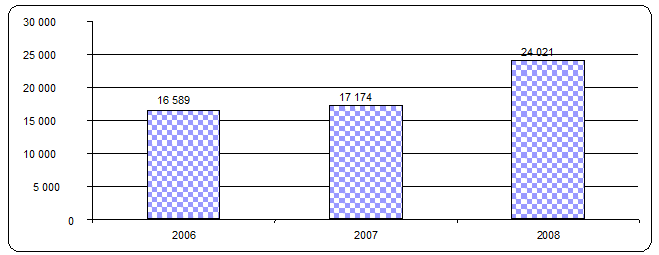
On the basis of Resolution of the Company’s Board of Directors on the increase of the Wages Fund (WF), the salaries of N. W.Telecom Branches’ employees were raised stage by stage from 01.08.2008, by 10% on the average. For motivation of the Company employees, funds for bonuses by the operating results of the year’s 3rd and 4th quarter were assigned out of the centralized wages fund.
In 2008, efforts were continued to change the labor remuneration terms as regards bonuses to employees of the Company’s commercial sector, aimed at building an efficient system of incentives and orientation for personnel engaged in sales and in N. W.Telecom services supporting, thus to achieve the Company's basic goals. The stage-by-stage implementation of the motivation system for various structural units of the Company’s commercial sector, with employees motivated for result achievement, will enable development of entrepreneurship, efficient sales, support, and customer service in N. W.Telecom, thus achieving the Company business goals.
Fig. 5. Changes in the employees’ average monthly pay, roubles
Personnel hiring and adaptation
Continuing unification of all aspects of personnel management, the Company concentrated on management of applicants and new employees from early 2008 on. The Provisions “Personnel Recruiting, Selection, and Hiring for the N. W.Telecom General Management” and “Personnel Recruiting, Selection, and Hiring for the Branches of N. W.Telecom” were developed and approved. These documents strictly define the sequence of all phases of selection for different employee categories. Implementation of these provisions included implementation of a uniform psychological testing package.

|
Из за большого объема этот материал размещен на нескольких страницах:
1 2 3 4 5 6 7 8 9 10 11 12 13 14 15 |
