


Партнерка на США и Канаду по недвижимости, выплаты в крипто
- 30% recurring commission
- Выплаты в USDT
- Вывод каждую неделю
- Комиссия до 5 лет за каждого referral
3.6. Учебная практика рабочей программой не предусмотрена.
4.1 Основная и дополнительная литература
а) основная литература
1. Агабекян, для технических вузов : учеб. пособие / , . - Ростов н/Д : Феникс, 20с.
б) дополнительная литература:
1. English For Food Experts (Английский для товароведов): учебно – методическое пособие по английскому языку для студентов 2 –го курса/. – Майкоп, 2011. – 59с.
2. Foreing Trade Documentation : учеб.-метод. пособие по англ. яз. для студентов технол. фак. специальности "Таможенное дело"/ [сост.: , ]. - Майкоп: , 20с.
First Steps into Business: учеб. пособие для студентов 2-3 курсов неязыковых вузов, изучающих «Деловой иностранный язык»/ сост. . - Майкоп: Глобус, 2007в) программное обеспечение и Интернет-ресурсы
1. Tutor – компьютерная обучающая программа (три уровня)
2. Baron's TOEFL - компьютерные тесты на CD
3. BBC English lessons (video)
4. BBC Business English (video) «Bibery systems».
5. Follow me (video course)
6. Подборка фильмов по страноведению
Listening:
Free downloads: http://www. elllo. org
Voice of America news: http://www. /english
Reading:
Social Issues: http://www. multcolib. org/homework/sochc. html
http://www. *****/index. php? id=71 – основные правила составления деловых писем;
http://www. *****/articles/etiket/work. asp - правила делового этикета. Этикет деловых отношений. Этика делового общения.
Dictionaries:
Dictionaries(collection);http://
4.2. Лабораторные занятия рабочей программой не предусмотрены.
4.3 Материально-техническое обеспечение дисциплины
Материально-техническое обеспечение дисциплины включает:
1) библиотечный фонд ФГБОУ ВПО «МГТУ»;
2) мультимедийное оборудование для проведения практических занятий и презентаций
4.4 Раздаточный материал
Тексты, тесты и грамматические задания находятся в УМК в количестве соответствующем наполняемости группы.
Дополнения и изменения в рабочей программе
за ________/________ учебный год
В рабочую программу
(наименование дисциплины)
для направления (специальности)
(номер направления (специальности)
вносятся следующие дополнения и изменения:
Дополнения и изменения внес _________________________________________
(должность, Ф. И.О., подпись)
Рабочая программа пересмотрена и одобрена на заседании кафедры _______
___________________________________________________________________
(наименование кафедры)
«____»___________________200_г.
Заведующий кафедрой _________________ _____________
(подпись) (Ф. И.О.)
4.3.Перечень обучающих, контролирующих компьютерных программ, видеокейсов, кино - и телефильмов, мультимедиа и т. д.
1. Tutor – компьютерная обучающая программа (три уровня)
2. Baron's TOEFL - компьютерные тесты на CD
3. BBC English lessons (video)
4. BBC Business English (video) 5. Follow me (video course)
4.4. Раздаточный материал.
Тестовые задания (тексты с пробелами, тексты с вопросами, лексико – грамматические задания).
Примерный перечень вопросов к зачету (экзамену) по всему курсу.
Тесты (зачет)
1.
1. I _______ the manager tomorrow morning.
a) will see b) am seeing c) won’t see d) don’t see
2. What ______ when you saw him?
a) did John do b) John was doing c) was John doing d) has John done
3. Have you ever been _______ Italy?
a) in b) at c) to d) inside
4. It’s the 10th time Sam ________ me for a dance this evening.
a) has invited b) invited c) had invited d) would invite
5. I ______ about it for a long time.
a) knew b) had known c) have known d) have been knowing
6. I _______ Sam since Monday.
a) didn’t see b) haven/t seen c) wouldn’t see d) am not seeing
7. Let’s walk _______ 10 miles!
a) other b) the other c) another d) some
8. John is never ill.
a) So am I b) Never am I c) So I am d) Neither am I
9. I don’t know _______ telephone number.
a) their b) theirs c) them d) they
10. Parents want ________ happy.
a) that their children were b) their children to be c) that their children will be d) the children are happy
11. You have classes every day, _______?.
a) have you b) haven’t you c) don’t you d) do you
12. Bad news _______ fast.
a) travel b) travels c) will travel d) have travelled
13. His father always gives him ______ .
a) good advices b) good advice c) the good advice d) a good advice
14. We saw ________ the street.
a) him to cross b) him crossing c) how he crossed d) that he crossed
15. When _______ your train leave tomorrow?
a) does b) will c) is d) would
16. Sam has won some money. Really? What ______ he_______ with this money?
a) will – do b) is – going to do c) does – do d) would – do
17. This text is the ______ difficult I’ve ever read.
a) less b) more c) least d) some
18. Your idea is good. My idea is _____.
a) more better b) gooder c) much better d) much good
19. This film is different _______ what I expected.
a) of b) with c) from d) to
20. Moscow is famous _______ its Red Square. a) for b) with c) because d) about
2.
1) A reporter should work hard to _______ his paper’s insatiable demand for
news.
a) to provide b) to satisfy c) to inform d) to perceive
2) The purpose of public relations to shape opinions can be _______ only if people receive messages constantly and consistently.
a) completed b) provided c) accomplished d) motivated
3) A public relations communicator _______ told to prepare tailored messages
designed for specific audiences.
a) has b) had c) should d) was
4) Editors demand that information________ newsworthy.
a) must be b) is c) be d) could be
5) Media ___ give your information credibility and importance by deciding that it is newsworthy.
a) editors b) personnel c) employers d) gatekeepers
6) Reporter’s dependence on the media requires that he _____ accurate and honest at all times.
a) is b) would be c) be d) must be
7) Teenagers’ tastes, preferences and opinions are shaped by _____ they see in the media.
a) that b) which c) what d) how
8) On a more specialized level, the media ______ no longer just mass communication.
a) is b) are c) has been d) could be
9) The jobs of public relations personnel and journalists are _______ dependent.
a) both b) greatly c) reluctantly d) mutually
10) The word “flacks” is somewhat ______ to the word “hacks”.
a) like b) akin c) referred d) alike
11) ________ protests from the public relations community the word “flacks” has been forbidden.
a) because of b) due to c) by means of d) despite
12) Disagreement or angry feelings between people is called ______.
a) stack b) freely c) gimmick d) friction
13) Both media and advertisers ______ to trade advertising for editorial space.
a) want b) have decided c) are willing d) preferred
14) He put in a _____ for his new project.
a) alien b) penchant c) coverage d) plug
15) It should be taken ______ that many reporters are generalists.
a) to attention b) most likely c) into consideration d) to responsibility
16) Reporters are often ______ for not understanding the topic they are publishing.
a) criticize b) blame c) faulted d) garbled
17) The latest interview had the highest television _______ this season.
a) survival b) influence c) rating d) evidence
18) In the _______ for ratings a journalist misquoted the executive’s interview.
a) run b) race c) effort d) hearsay
19) Some periodicals publishing hearsay or gossip are called________.
a) trash b) incompetent c) penchant d) sensations
20) Mr. Smith _____ sense of humour.
a) prefers b) lacks c) needs d) races for
3.
1. It should be taken ______ that many reporters are generalists.
a) to attention b) most likely c) into consideration d) to responsibility
2. Reporters are often ______ for not understanding the topic they are publishing.
a) criticize b) blame c) faulted d) garbled
3. The latest interview had the highest television _______ this season.
a) survival b) influence c) rating d) evidence
4. In the _______ for ratings a journalist misquoted the executive’s interview.
a) run b) race c) effort d) hearsay
5. Some periodicals publishing hearsay or gossip are called________.
a) trash b) incompetent c) penchant d) sensations
6. Mr. Smith _____ sense of humour.
a) prefers b) lacks c) needs d) races for
7. A reporter should work hard to _______ his paper’s insatiable demand for
news.
a) to provide b) to satisfy c) to inform d) to perceive
8. The purpose of public relations to shape opinions can be _______ only if people receive messages constantly and consistently.
a) completed b) provided c) accomplished d) motivated
9. A public relations communicator _______ told to prepare tailored messages
designed for specific audiences.
a) has b) had c) should d) was
10. Editors demand that information________ newsworthy.
a) must be b) is c) be d) could be
11. Media ___ give your information credibility and importance by deciding that it is newsworthy.
a) editors b) personnel c) employers d) gatekeepers
12. Reporter’s dependence on the media requires that he _____ accurate and honest at all times.
a) is b) would be c) be d) must be
13. Teenagers’ tastes, preferences and opinions are shaped by _____ they see in the media.
a) that b) which c) what d) how
14. On a more specialized level, the media ______ no longer just mass communication.
a) is b) are c) has been d) could be
15. The jobs of public relations personnel and journalists are _______ dependent.
a) both b) greatly c) reluctantly d) mutually
16. The word “flacks” is somewhat ______ to the word “hacks”.
a) like b) akin c) referred d) alike
17. ________ protests from the public relations community the word “flacks” has been forbidden.
a) because of b) due to c) by means of d) despite
18. Disagreement or angry feelings between people is called ______.
a) stack b) freely c) gimmick d) friction
19. Both media and advertisers ______ to trade advertising for editorial space.
a) want b) have decided c) are willing d) preferred
20. He put in a _____ for his new project.
a) alien b) penchant c) coverage d) plug
4.
1. What do you want ___________ ?
a) me to do
b) that I’ll do
c) I do
d) For me to do
2. Where ___________ you last night at the time of the burglary?
a) were
b) was
c) did
d) have you been
3. I _________ Michael for ages.
a) didn’t see
b) don’t see
c) haven’t seen
d) saw not
4. I _________ get up very early now.
a) must to
b) have to
c) should to
d) ought
5. My brother Nick is very good _________ maths.
a) for
b) at
c) about
e) in
6. I’m very busy at the moment. I ___________ for my English exam.
a) am preparing
b) prepare
c) have been preparing
d) am going prepare
7. Christmas is __________ popular and colourful holiday in Great Britain.
a) most
b) the most
c) most of all
d) very
8. I have known Dr Simon __________ 1982.
a) since
b) for
c) about
d) from
9. you have never been to Canada, __________ ?
a) isn’t it
b) is it
c) haven’t you
d) have you
10. The Sahara is _________ desert in the world.
a) the hottest
b) hottest
c) the most hot
d) the hotter
11. John is not interested _________ politics.
a) about
b) in
c) for
d) over
12. I’m sure we _________ before.
a) have never met
b) haven’t never met
c) didn’t met
d) had met
13. I’ve lost my wallet. When __________ ?
a) have you lost it
b) did you lose it
c) had you lost it
d) you lost it
14. Everyone __________ of Bill Gates, the icon of American business and the richest man in the world.
a) have heard
b) has heard
c) is hearing
d) has been heard
15. Everybody _________ to go to the dentist at least once a year.
a) should
b) must
c) ought
d) have
16. Who ____________ America?
a) discovered
b) did discover
c) did discovered
d) discovers
17. Tom _________ Ann since childhood.
a) is loving
b) was loving
c) has been loving
d) has loved
18. Have you seen Mary’s boyfriend ___________ ?
a) yet
b) still
c) just
d) else
19. I want ____________ me.
a) you to help
b) that you help
c) you helping
d) that you’ll help
20. Would you like _________ piece of cake?
a) other
b) another
c) more
d) others
5.
1. He … the farm since 1947.
a) has owned b) have been owning c) own d) owned
2. Have you ever been … Scotland?
a) in b) at c) to d) into
3. He has been unemployed … he left college.
a) for b) before c) since d) during
4. I … to visit this beautiful country.
a) always wants b) have always been wanting c) always had wanted d) have always wanted
5. Who … so loudly there?
a) is saying b) speaks c) is telling d) is speaking
6. What’s that music you are … ?
a) hearing b) listening c) listening to d) listen
7. Jim is going to London tomorrow because his uncle … to see him.
a) want b) is wanting c) wants d) had wanted
8. We’ve never met before, … we?
a) haven’t b) have c) are d) aren’t
9. It happened when you … to your secretary.
a) talked b) were talking c) were told d) said
10. I told him he shouldn’t read while he …
a) eats b) ate c) is eating d) was eating
11. What … you … since I last saw you?
a) did … do b) do … do c) have … done d) were … done
12. I … my keys and cannot remember where I saw them last.
a) lost b) am losing c) have lost d) had lost
13. I can’t recognize him. He … a lot.
a) changed b) is changing c) was changed d) has changed
14. By the time we arrived, the party …
a) finished b) has finished c) had finished d) will finish
15. Did you see him this morning? Yes, he … in the hall laughing.
a) stood b) has stood c) was standing d) stands
16. He came in and saw Nelly who … a strange picture.
a) draws b) drew c) has drawn d) was drawing
17. … you … from Jane lately?
a) Did … hear b) Have … heard c) Do … hear d) Will … hear
18. It’s the most serious disease I … ever ….
a) will … examine b) am … examining c) would examine d) have …. examined
19. I know him well. I … him since our childhood.
a) know b) knew c) am knowing d) have known
20. It’s the 3rd time Ann … her exam.
a) fails b) has failed c) failed d) will fail
6.
1. The bones of the skull … together firmly.
a) connect b) have connected c) are connected d) are connecting
2. The doctor … his patients successfully last year.
a) has treated b) was treated c) will treat d) treated
3. In the first term medical students … basic theoretical subjects.
a) teach b) have taught c) are taught d) will teach
4. The chest … by the breastbone into two parts on each side of which there are seven ribs.
a) divides b) has divided c) divided d) is divided
5. The patient … hospital recently.
a) leave b) left c) has left d) was left
6. This patient … to the operation yesterday.
a) taken b) took c) was taken d) has taken
7. The patient’s temperature … every two hours.
a) will take b) will be taken c) is taking d) has taken
8. Each rib … of a head, neck and body.
a) is composed b) compose c) composes d) has composed
9. The patient … from the clinic last week.
a) discharged b) is discharged c) wasn’t discharged d) discharge
10. Most diseases … by living insects.
a) have spread b) are spread c) spread d) are spreading
11. Ten tons of blood …. through the heart daily.
a) are pumped b) pump c) have pumped d) are pumping
12. The nurse …. already … the temperature.
a) was taken b) has taken c) will take d) is taking
13. The patient’s blood group … by the nurse tomorrow.
a) will determine b) will be determined c) has determined d) is determined
14. The doctor … not … this method of treatment yet.
a) has … used b) was … used c) is … used d) is … using
15. The scientists …. the total weight of the blood.
a) found out b) find out c) finded out d) is finding out
16. The venous blood … in the lungs.
a) is oxygenated b) oxygenates c) is oxygenating d) has oxygenated
17. When the blood … out carbon dioxide it takes in oxygen in the lungs.
a) has discharges b) discharges c) discharging d) has discharged
18. The skeleton … of bones.
a) was composed b) is composed c) composing d) has composed
19. Nick … to visit the doctor.
a) told b) was told c) is telling d) tells
20. The patient … special medicine..
a) will be given b) is being given c) are given d) will give
7. Select the one word or phrase that completes the sentence best.
1.An important part of the relationship is based on mutual …. and …. .
a) sources … press kits b) media … information c) trust … credibility d)friction … adversaries
2.Public relation materials … media outlets the time, money and effort of gathering their own news.
a) provide b) accomplish c) process d) save
3.The reporter cannot depend … legwork alone to satisfy his paper’s insatiable demand … news.
a) on … for b) for … upon c) of … to d) on … with
4.These areas of friction often contribute to an …
a) advertising pressure b) adversarial atmosphere
c) comprehensive information d) hype and promotion
5.Most of the products of investigative journalism are the result of routine access to …
a) spokespersons b) speakers c) speakermen d) public people
6. He has a … in computer engineering.
a) experiment b) attempt c) background d) essay
7.The jobs of public relations personnel and journalists are …… dependent.
a) both b) twice c) reluctantly d) mutually
8. … to develop a local angle before sending materials to specific publications.
a) Give the time b) Save the time c) Waste the time d) Take the time
peting media deserve equal opportunity to receive information …
a) in timely b) on a time manner c) in a timely manner d) timeless
10. Here’s a list of general … for dealing effectively with the media.
a) guides b) guidelines c) fine lines d) headlines
8.
1. You … your seats beforehand if you want to go to Paris on a through train.
a) had better to look b) had better look
c) had to better look d) had to look better
2. I hadn’t expected Jane to apologize, but I had hoped … .
a) her calling me b) her to call me
c) that she would call me d) that she call me
3. They … him because Nick didn’t say that.
a) must misunderstand b) had to misunderstand
c) must be misunderstanding d) must have misunderstood
4. You should have your tooth … soon.
a) be take out b) be taken out c) take out d) taken out
5. … you rather sit by the fire?
a) Don’t b) Won’t c) Will d) Wouldn’t
6. We’ve spent … time here.
a) so many b) such many c) so much d) such much
7. It was … that we decided to walk though the time pressed.
a) such nice weather b) too nice weather
c) so nice weather d) such a nice weather
8. … three years passed before we met again.
a) The other b) Another c) Other d) The others
9. It was careless … you to forget … the door.
a) of … to lock b) for … to lock c) of … locking d) to … locking
10. Either Jane or her parents … to speak to me.
a) is going b) are going c) has been going d) have been going
11. He felt satisfied … he had done.
a) with all the work b) at all work
c) by all the work d) by all work
12. Her house wasn’t … .
a) a better then ours b) any better than our
c) better than our d) any better than ours
13. If you feel that you don’t trust someone, you are suspicious … .
a) at him b) of them c) with them d) on him
14. He has … books on history as my Dad has.
a) half of b) a half less c) half as many d) a half as many
15. The midterm was … the beginning.
a) like b) same c) alike d) similar
16. Will you try to find out what time … at the airport.
a) does the plane arrive b) the plane arrives
c) arrives the plane d) did the plane arrive
17. I am not interested in his offer. - … .
a) either is she b) neither is she
c) nor she is d) neither she is
18. The whole summer was sunny ad warm, … a change.
a) that b) what c) who d) which
19. You worry too much. I wish you … worry so much.
a) don’t b) won’t c) didn’t d) wouldn’t
20. I overslept this morning. If only I … this morning.
a) wouldn’t oversleep b) hadn’t overslept
c) haven’t overslept d) didn’t oversleep
9.
An important part of the relationship _____ on mutual trust and credibility helps any medium do its job of informing readers, listeners, or viewers.a) is based b) based c) basing d) which base
The percentage was higher among editors but much lower among reporters, _____ spent most of their time covering “hard news”.a) who b) that c) which d) those who
a) is b) would be c) be d) were
These messages _____ widely _____ via the Internet at present.a) are _____ disseminated b) are being disseminated
c) have been disseminated d) have disseminated
This is important to you because the media, _____, serve as third party endorses of your information.a) however b) though c) as it is d) by inference
______ the miracle of satellite communications, the world is a global village of shared information.a) By means of b) Through c) With the purpose d) By the
mass media have the _____ 0f multiplying an organization’s messages and reaching millions of people at the same time.a) ability b) chance c) opportunity d) capability
Many journalists openly disdain public relations people and call them “_____”.a) gate – keepers b) target audience c) press agents d) flacks
Journalists also resent the use of ______ in sending materials to the news media.a) friction b) gimmicks c) slack d) hype
Media outlets are dependent on advertising _____ for survival.a) press-kits b) revenues c) gimmicks d) business
Magazines are well known for running stories and fashion ______ that tend to feature their advertisers.a) layouts b) outlets c) revenues d) coverage
CNN _____ to have continuous live coverage of the national party conventions.a) increases b) relates c) intends d) runs
A survey by the American Management Association found that 83 percent of the public relations directors thought that ______ was the major reason for inaccurate stories.a) increase b) advertising c) sloppiness d) penchant
a) overvalued b) overemphasized c) misquoted d) wined and dined
The newspaper ______ the murder story.a) covered b) featured c) run d) review
Special education helps executives to give a 30 second “______”.a) broadcast b) sound bite c) interview d) outlet
Interviews can get _____ as they go through several levels of personnel at a newspaper.a) related b) advertised c) increased d)distorted
Some reporters tend to make _____ generalization.a) simplistic b) reluctant c) soft d) independent
He has ______ in computer engineering.a) a tendency b) a statement c) consideration d) a background
Hearsay is not allowed as _______ in court.a) commitment b) accusation c) headline d) evidence
Тексты:
When I was a little boy I had passion for maps. I looked for hours at South America or Africa or Australia and lost myself in the glories of exploration. At that time there were many blank spaces on the earth, and when I saw one that looked particularly inviting on a map I would put my finger on it and say, “When I grow up, I will go there”. The North Pole was one of these places, I remember. Well, I haven’t been there yet, and shall not try now. Other places were scattered all over the globe. I have been to some of them, and … well, we won’t speak about that but there was one – the biggest, the most blank, so to speak – where I wanted to go.
In fact, by that time it was no longer a blank space. It had got filled since my boyhood with rivers and lakes and names. It had ceased to be mysterious. The map now showed a mighty big river, forests, mountains. The river was like a snake with its head in the sea and its body curving over a vast land. Then I remembered that a big company traded on that river and to do this they needed lots of steamboats.
So I started applying to the company, which was a new departure for me. The man said. “My dear fellow…” and left it at that. I then wrote to my aunt who had friends high up in the company. She was determined to make me captain of a river steamboat, if that was what I wanted.
I got my appointment, of course; and I got it very quickly. It appeared that the company had received news that one of their captains had been killed by natives.
The incident concerned a disagreement over two hens. The captain thought that he was treated unfairly in a deal over the hens and attacked the chief, whose son killed him. The natives left the village believing the death would bring bad luck. What became of the hens I don’t know.
Questions:
Why did the writer like maps as a boy?a) He liked all the details on them.
b) He liked to dream about exploring.
c) He liked to think about the people living in the places shown.
d) He liked their shapes.
How had the biggest blank space changed?a) Some of the cities had changed names.
b) It had changed shape.
c) New towns had been established.
d) It had been explored, and details were now marked on it.
How did the company react to his initial application for a job?a) They hired him immediately.
b) They contacted his aunt.
c) They didn’t do anything.
d) They told him to wait a few months.
How did he finally get the job he wanted?a) He kept asking the company.
b) He asked a relation to help him.
c) He went to another company.
d) He asked an acquaintance to help him.
Why was there a vacancy for a new captain?a) Because the company had just got a new ship.
b) Because the last captain had been killed.
c) Because the last captain had suddenly left.
d) Because the last captain had gone on strike.
Part A
Directions
For each problem in Part A, you will hear a short statement. The statements will be spoken just one time. They will not be written out for you, and you must listen carefully in order to understand what the speaker says.
When you hear a statement, read the four sentences in your test book and decide which one is closest in meaning to the statement you have heard.
Then, on your answer sheet, find the number of the problem and mark your answer.
(A) Sally went to the wrong class.(B) Sally was late for class because she got lost.
(C) Sally missed the class.
(D) Sally had some trouble finding the class, but she arrived on time.
(A) Jane is going on vacation.(B) Jane is leaving her job temporarily for health reasons.
(C) During the summer, Jane often misses work because of illness.
(D) Jane is sick of working all the time.
(A) Henry arrived at work on time this morning.(B) Henry was two hours late this morning.
(C) Henry worked late today.
(D) Henry was an hour late for work this morning.
(A) I’m not sure which type of flowers Jane sent me.(B) Jane received many kinds of flowers.
(C) I received many kinds of flowers from Jane.
(D) I appreciate Jane’s sending me flowers when I was ill.
(A) William slept all the way from Georgia to New York.(B) George didn’t sleep at all on the trip.
(C) William was half asleep all the time that he was driving.
(D) William didn’t sleep at all on the trip.
(A) Too many people came to the meeting.(B) There were not enough people at the meeting to inspect the documents.
(C) We had expected more people to come to the meeting.
(D) There were not enough seats for all the people.
(A) The professor said he was sorry that he had not announced the test sooner.(B) The professor was sorry that he had forgotten to bring the tests to class.
(C) The professor was sorry that he hadn’t given the test earlier.
(D) The professor said he was sorry that he had not given the results of the test sooner.
(A) Mary is taking a leave of absence from her job because of her health.(B) Mary is not going to return to her job.
(C) Mary is right to quit her job.
(D) Mary did very good work, but now she is quitting her job.
(A) John will be able to buy groceries.(B) John doesn’t have enough money to buy groceries.
(C) John wouldn’t buy groceries even if he had enough money.
(D) John can’t find his grocery money.
(A) Harry sold no magazines.(B) Harry sold only one magazine.
(C) Harry has never sold as many magazines as he sold today.
(D) Harry sold five magazines at one house.
(A) Eighty people came to the rally.(B) Forty people came to the rally.
(C) One hundred sixty people came to the rally.
(D) one hundred people came to the rally.
(A) We are going to meet Fred and Mary at the movies if we have time.(B) We went to the movies with Fred and Mary, but the theater was closed.
(C) We couldn’t meet Fred and Mary at the movies because we didn’t have any money.
(D) Fred and Mary were supposed to meet us at the movies, but their car broke down.
(A) Frank told the contractor to do the work in spite of the cost.(B) Frank told the contactor that the price was too high.
(C) Frank cannot afford the work on his house.
(D) Frank repaired his own house.
(A) I studied last night because I had to.(B) I tried to study last night, but the material was too hard.
(C) I couldn’t study last night because I was very tired.
(D) I studied last night because I was bored.
(A) John was supposed to give the awards at the banquet, but he didn’t.(B) John was given an award, but he refused it.
(C) John didn’t go to the banquet.
(D) John went to the awards banquet, but he refused to give a speech.
(A) Edna goes to a movie every year.(B) Edna hasn’t gone to a movie yet this year, but last year she did.
(C) Edna doesn’t go to a movie unless she has the time.
(D) Edna hasn’t seen a movie for a long time.
(A) He is out of sugar.(B) He puts only sugar in his coffee.
(C) There isn’t enough sugar in his coffee.
(D) He likes sugar, but the coffee he is drinking has too much.
(A) Arnold was embarrassed because his date wanted to pay for her own meal.(B) Arnold had less than $ 15.
(C) Arnold didn’t want his date to know how much the food cost.
(D) Arnold didn’t want to pay for his date’s meal.
(A) George didn’t have $ 1, 000 for the man.(B) George wanted more than $ 1, 000 for the car.
(C) George agreed to take $ 1, 000 for his car.
(D) George thought that $ 1, 000 was too much to pay for a used car.
(A) Harvey turned around to answer the teacher’s question.(B) Harvey is an intelligent student.
(C) Harvey must have been embarrassed.
(D) Harvey looked in the red book for the answer to the question.
Part B
Directions
In Part B, you will hear 15 short conversations between two speakers. At the end of each conversation, a third voice will ask a question about what was said. The question will be spoken just one time. After you hear a conversation and the question about it, read the four possible answers and decide which one would be the best answer to the question you have heard. Then, on your answer sheet, find the number of the problem and mark your answer.
(A) She’s tired of teaching.(B) She was dismissed from her job.
(C) She’s changing jobs.
(D) The school is too hot.
(A) She got up later than usual.(B) The bus was late.
(C) She forgot her class.
(D) Her clock was wrong.
(A) $ 39(B) $ 35
(C) $ 4
(D) $ 5
(A) She thinks his lectures are boring.(B) She thinks his tests are too long.
(C) She doesn’t like his choice of test questions.
(D) She doesn’t think he prepares well enough.
(A) getting a suntan(B) swimming
(C) taking a bath
(D) watching for an eclipse
(A) looking for water(B) planting something
(C) looking for something
(D) getting dirty
(A) a movie(B) a documentary
(C) a soccer game
(D) a comedy
(A) America(B) England
(C) Switzerland
(D) Sweden
(A) 2:50(B) 2:15
(C) 3:50
(D) 3:15
(A) The woman will go home for dinner.(B) The woman won’t go to the concert.
(C) The man and woman will eat together.
(D) Both of them will go home before going to the concert.
(A) Wiwtner(B) Wittner
(C) Wittmer
(D) Witner
(A) 7:55(B) 7:45
(C) 7:50
(D) 8:00
(A) $ 17.50(B) $ 19.95
(C) $ 35
(D) $ 70
(A) 5(B) 3
(C) 2
(D) 8
(A) on a train(B) on a boat
(C) on a plane
(D) on a bus
Barron’s TOEFL Test № 8 Reading
Text № 1
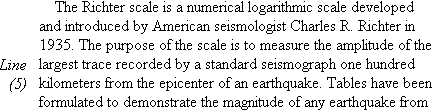
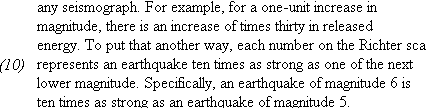
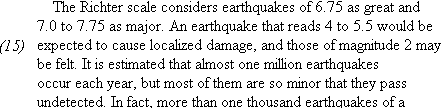

Questions 1-10
What does this passage mainly discuss?a) Earthquakes b) The Richter scale c) Charles F. Richter d) seismography
In what kind of textbook would this passage most likely be found?a) History b) Biology c) Geology d) Mathematics
According to information in the passage, what does the Richter scalea) The distance from the epicenter b) The amplitude of the largest trace
c) The degree of damage d) the location of the epicenter
The word “standard” in line 4 could be replaced bya) reliable b) complex c) conventional d) abandoned
What is the value of the tables?a) They allow us to interpret the magnitude of earthquakes
b) They help us to calculate our distance from earthquakes
c) They record all earthquakes d)They release the energy of earthquakes
The word “those” in line 15 refers toa) magnitudes b) damage c) earthquakes d) energy
According to the Richter scale, which of the following numbers would indicate that there had probably been damage to the immediate areaa) 7.0 b) 6.0 c) 5.0 d) 2.0
The word “undetected” in line 18 is closest in meaning toa) with no damage b) with no notice c) with no name d) with no problem
How does each number on the Richter scale compare?a) Each number is one hundred times as strong as the previous number
b) Each magnitude is ten times stronger than the previous magnitude
c) The strength of each magnitude is one less than the previous magnitude
d) The scale decreases by five or six for each number
The author mentions all of the following in the explanation of the Richter scale EXCEPTa) it was introduced in 1935 b) it was developed by an American seismologist
c) it detects all earthquakes d) it measures the magnitude of earthquakes
Barron’s TOEFL Test № 8 Reading
Text № 2
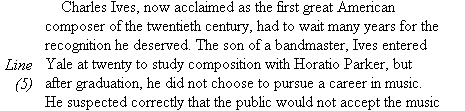
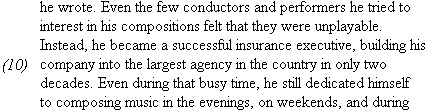
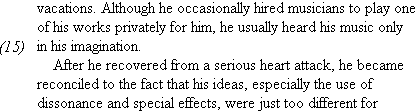
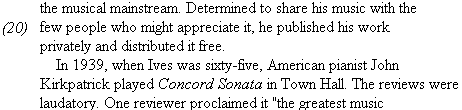
Questions 11-20
What does the passage mainly discuss?a) Modern musical composition b) Charles Ives’ life
c) The Pulitzer prize d) Career choices
the word “suspected” in line 6 could best be replaced bya) desired b) guessed c) worried d) recalled
Why didn’t the public appreciate Ives’ music?a) It was not performed for a long time b) It was very different from the music of the time
c) the performers did not play it well d) He did not write it down
The word “they” in line 8 refers toa) conductors b) performers c) interest d) compositions
The phrase “became reconciled to” in line 17 is closest in meaning toa) accepted b) repeated c) disputed d) neglected
How did Ives make a living for most of his life?a) He conducted a band b) He taught musical composition
c) He owned an insurance company d) He published music
How did Ives first share his music?a) By publishing free copies b) By playing it himself
c) By hiring musicians to perform d) By teaching at Yale
Where was Ives’ work first publicly performeda) New York b) Europe c) Yale University d) Town Hall
How was the performance of Concord Sonata received?a) There were no reviews b) The musicians felt it was unplayable
c) the public would not accept it d) It established Ives as an important composer
In what year did Ives receive the Pulitzer prize?a) 1939 b) 1947 c) 1965 d) 1973
Barron’s TOEFL Test № 8 Reading
Text № 3
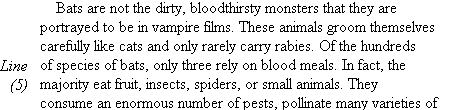
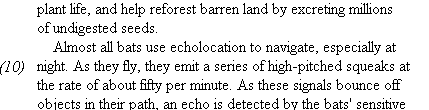
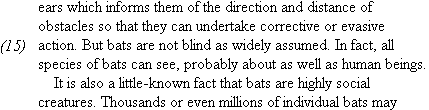
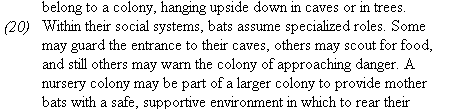
 Questions 21-30
a) They are dirty and they carry rabies b) They are like the monsters in vampire films
c) They are clean, helpful members of the animal world
d) They are not very important in the animal world
According to the passage, how are bats like cats?a) they both carry rabies b) Cats groom themselves, and so does bats
c) Both cats and bats eat pests d) Bats use echolocation and cats do, too
What do most bats eat?a) Blood meals b) Fruit and insects c) Leaves and trees d) Large animals
The word “enormous” in line 6 could best be replaced bya) very heavy b) very regular c) very large d) very necessary
Which of the following are NOT characteristic of most bats?a) They pollinate plants b) They have specialized roles in their colony
c) They use echolocation d) They eat blood
How do bats help reforest the land?a) By eating pests b) By hanging upside down in trees at night
c) By excreting seeds d) By taking evasive action
The word “emit” in line 10 is closest in meaning toa) send b) continue c) find d) stop
According to the passage, how do bats navigate?a) By responding to the echoes of their signals bouncing off objects
b) By warning the colony of approaching danger with high squeaks
c) By beating their wings fifty times per minute
d) By using their sensitive ears to hear the noises in their environment
Where in the passage does the author refer to the visual range of bats?a) Lines 9-10 b) Lines 11-20 c) Lines 12-14 d) Lines 15-16
The word “some” in line 20 refers toa) social systems b) specialized roles c) bats d) colonies
Barron’s TOEFL Test № 8 Reading
Text № 4
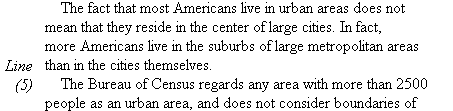
 Questions 31-40
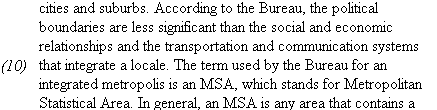
a) Metropolitan Statistical Areas b) Types of Population Centers
c) the Bureau of Census d) Megapolises
Where do most Americans live?a) In the center of cities b) In the suburbs surrounding large cities c) In rural areas d) In small towns
According to the Bureau of Census, what is an urban area?a) An area with 2500 people or more b) An area with at least 50,000 people
c) the eighteen largest cities d) A chain of adjacent cities
Which of the following are NOT considered important in defining an urban area?a) Political boundaries b) Transportation networks
c) Social relationships d) Economic systems
The word “integrate” in line 10 is closest in meaning tos) benefit b) define c) unite d) restrict
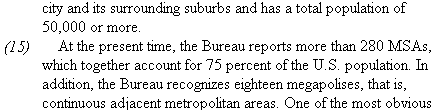
According to the Bureau of Census, what is an MSA?a) The center of a city with a population of 50,000 people to the boundaries of the surrounding suburbs
b) A city and its suburbs with a total population of at least 50,000 people
c) The surrounding suburbs of a city with a total population of 50,000 people
d) Any area with a total population of 50,000 people
How many MSAs are there in the USA?a) 10 b) 18 c) 280 d) 2500
Where in the passage does the author suggest that three-quarters of the US population now resides in MSAs?a) Lines 4-5 b) Lines 8-10 c) Lines 11-12 d) Lines 15-16
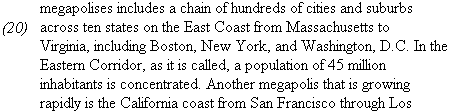
A megapolis is:a) one of the ten largest cities in the USA b) one of the eighteen largest cities in the USA
a) one of the one hundred cities between Boston and Washington
b) any number of continuous adjacent cities and suburbs
How many people live in the Eastern Corridor?a) 4 to 5 million b) 10 million c) 45 million d) 75 million
Тексты по специальности для письменного перевода
Требование к письменному переводу иноязычного текста
Основным требованием к письменному переводу текста по специальности на русский язык является его адекватность оригиналу. Перевод должен представлять собой адекватную передачу английского текста средствами русского языка в неразрывном единстве содержания и формы.
Texts:
Who Is a Journalist and Why Does it Matter? Disentangling the Legal and Ethical Arguments
Erik Ugland, Marquette University
Jennifer Henderson, Trinity University
The contemporary debate about ‘‘who is a journalist’’ is occurring in two distinct domains: law and professional ethics. Although the debate in these domains is focused on separate problems, participants treat the central question as essentially the same. This article suggests that the debates in law and professional ethics have to be resolved independently and that debate within those domains needs to be more nuanced. In law, it must vary depending on whether the context involves constitutional law, statutory law, or the distribution of informal privileges by government officials. In professional ethics, the debate should not be oriented around a single definitional threshold but should identify tiers that take account of different communicators’ unique goals, tactics, and values.
Shifting Roles, Enduring Values: The Credible Journalist in a Digital Age
Arthur S. Hayes, Fordham University
Jane B. Singer, University of Central Lancashire/University of Iowa
Jerry Ceppos, Markkula Center for Applied Ethics Santa Clara University
When everyone can be a publisher, what distinguishes the journalist? This article considers contemporary challenges to institutional roles in a digital media environment and then turns to three broad journalistic normative values— authenticity, accountability, and autonomy—that affect the credibility of journalists and the content they provide. A set of questions that can help citizens determine the trustworthiness of information available to them emerges from the discussion.
Death in Gambella: What Many Heard, What One Blogger Saw, and Why the Professional News Media Ignored it
Douglas McGill, The McGill Report
Jeremy Iggers, Twin Cities Media Alliance
Andrew R. Cline, Missouri State University
Doug McGill published several articles about the massacre of 425 members of the Anuak tribe by the Ethiopian military in 2003 and 2004 on his Web site, The McGill Report. The mainstream news media ignored it. McGill’s narrative demonstrates the impact of his reporting on the Anuak community worldwide, its impact on several beneficiary groups in the United States, and the lack of interest by the mainstream news media that failed to fulfill journalism’s primary purpose. Two responses follow McGill’s narrative. Jeremy Iggers examines the social and economic realities that make it difficult for journalists to fulfill their primary purpose. He suggests that partnerships between journalists and engaged citizens may provide a new model for journalism. Andrew Cline examines the rhetorical and ethical nature of the journalistic transaction between journalist and audience. Who counts as a journalist arises from the experiences of an audience that uses a journalist’s work as a civically important text.
The Role of Journalist and the Performance of Journalism: Ethical Lessons From ‘‘Fake’’ News (Seriously)
Sandra L. Borden, Western Michigan University
Chad Tew, University of Southern Indiana
Some have suggested that Jon Stewart of The Daily Show with Jon Stewart (TDS) and Stephen Colbert of The Colbert Report (TCR) represent a new kind of journalist. We propose, rather, that Stewart and Colbert are imitators who do not fully inhabit the role of journalist. They are interesting because sometimes they do a better job performing the functions of journalism than journalists themselves. However, Stewart and Colbert do not share journalists’ moral commitments. Therefore, their performances are neither motivated nor constrained by these commitments. Using a virtue theory framework, we suggest that this distinction between journalists and their imitators is morally significant because it implies differences in the kinds of excellence these moral agents are pursuing in their work. Rather than evaluating the work of Colbert and Stewart in the role of journalists, we propose analyzing their contributions to media ethics in the role of media critics.
Who Is a Development Journalist? Perspectives on Media Ethics and Professionalism in Post-Colonial Societies
Bala A. Musa, Department of Communication Studies Azusa Pacific University
Jerry Komia Domatob, Department of Mass Communications Alcorn State University
Journalistic practice and professionalism across the globe are characterized by certain universals as well as unique particularities. In most post-colonial societies, the ethical philosophies and professional ethos of journalists reflect the tension between the commitment to integrity and social responsibility, shared by journalists worldwide, and the contextual interpretation and application of these principles. This article examines the ethics and ethos of development journalism as a philosophically, culturally, and historically evolving professional ideology. It surveys the ethical landscape of development journalists and shows how development journalists balance the dialectic of a universalist ethical philosophy and a relativistic professional ethos.
Sports Journalism as Moral and Ethical Discourse
Thomas P. Oates, Northern Illinois University
John Pauly, Marquette University
This paper explores the marginalized practice of sportswriting to demonstrate the limited ways in which the question ‘‘who is a journalist?’’ has been answered within the profession. Following John Dewey and Raymond Williams, we offer an alternative view of democratic culture that values narrative as well as information. We also discuss how ‘‘New Journalists’’ (and other writers since), in their quest for fresh, sophisticated storytelling strategies, turned to sports as a cultural activity worthy of serious examination. Our goal is to demonstrate that sportswriting fundamentally resembles other forms of reporting and that journalism should not use sports as an ethical straw man against which to defend the virtue of its serious work. This suspension of our usual ethical judgments would deepen our sense of the moral significance of sportswriting and allow us to rethink journalism’s relation to democratic culture in productive new ways.
Mass Media
Mass media is a term used to denote a section of the media specifically envisioned and designed to reach a very large audience such as the population of a nation state. It was coined in the 1920s with the advent of nationwide radio networks, mass-circulation newspapers and magazines, although mass media was present centuries before the term became common. The term public media has a similar meaning: it is the sum of the public mass distributors of news and entertainment across mediums such as newspapers, television, radio, broadcasting, which require union membership in large markets such as Newspaper Guild, AFTRA, & text publishers. The concept of mass media is complicated in some internet media as now individuals have a means of potential exposure on a scale comparable to what was previously restricted to select group of mass media producers. These internet media can include television, personal web pages, podcasts and blogs.
The communications audience has been viewed by some commentators as forming a mass society with special characteristics, notably atomization or lack of social connections, which render it especially susceptible to the influence of modern mass-media techniques such as advertising and propaganda. The term "MSM" or "mainstream media" has been widely used in the blogosphere in discussion of the mass media and media bias.
Перечень тем по специальности
1. Public Relations
2. Writing in Public Relations
3. Writing for newspapers
4. The art of Editing.
5. Media Dependence on Public Relations
6. Public Relations Dependence on the Media
7. Areas of Friction
8. Tips and Background Materials
9. Advertising
10. Advantages and Disadvantages of Advertising
Дополнения и изменения в рабочей программе за______________________________ /_________ учебный год
В рабочую программу_____________________________________________
(наименование дисциплины)
для специальности (тей)___________________________________________
(номер специальности)
вносятся следующие дополнения и изменения:
Дополнения и изменения внес ________________________________
(должность. Ф. И.О. подпись)
Рабочая программа пересмотрена и одобрена на заседании кафедры
______________________________________________________________________
(наименование кафедры)
« » 200 г.
Заведующий кафедрой __________ __________
(подпись) (Ф. И.О.)

|
Из за большого объема этот материал размещен на нескольких страницах:
1 2 3 |
