

Партнерка на США и Канаду по недвижимости, выплаты в крипто
- 30% recurring commission
- Выплаты в USDT
- Вывод каждую неделю
- Комиссия до 5 лет за каждого referral
 Task 1.
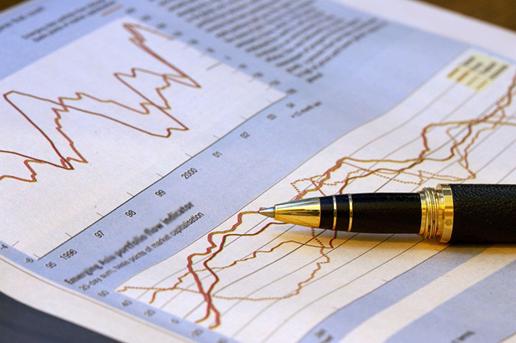
Look through the following chart and make up the same in English.

 Task 2.
You can see four charts depicting Financial system. Study them, compare and make conclusion which one, to your mind, is the most complete. Translate them into English.
Chart 1. Financial system of Ukraine.

Chart 2. Financial System.


Chart 3. Financial system of Ukraine.

Chart 4. The structure of the financial system of Ukraine according to the form of property and functioning peculiarities.


 Task 3.
Translate the following charts (№ 5, 6, 7, 8, 9, 10) into English and comment on them.
Chart 5. Finances.
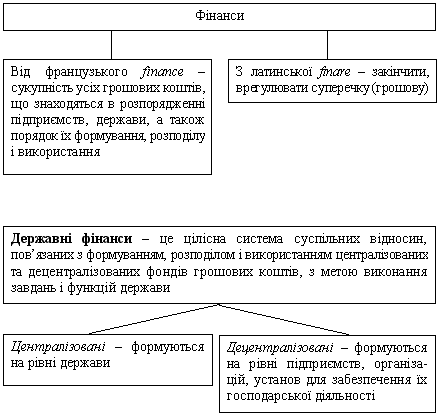
Chart 6. The local budgets of Ukraine.


Chart 7. The state expenditures.
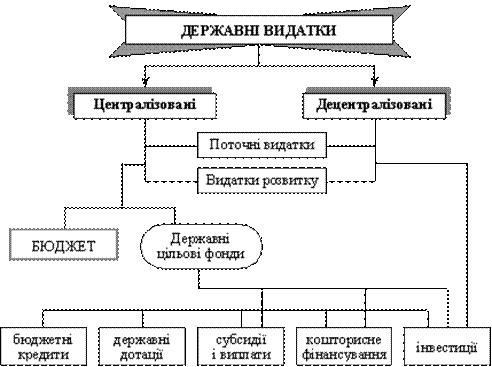
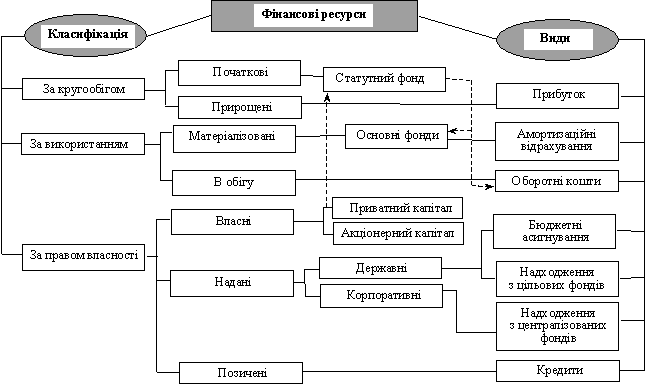 Chart 8. Financial resources.
 Chart 9. The world financial resources.
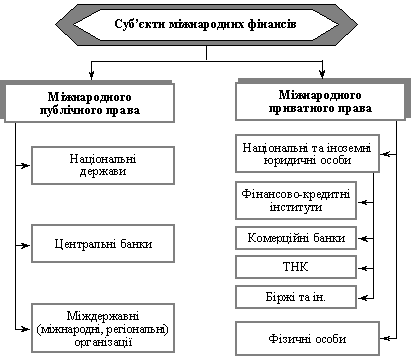
Chart 10. The subjects of the international finances.
 Task 4.
Answer the questions to the text in writing.
1. What is the subject of the financial science?
2. What does the subject “Finance” study?
3. What financial categories does the financial science use?
4. What parts are finances divided into?
5. What do the public finances include?
6. What do the private finances include?
7. What is the core of finances?
8. What is initial for public finances?
9. What is initial for private finances?
10. What are finances expressed with?
11. What kind of transactions do finances reflect?
12. Does the financial science study financial resources as they are?
13. What is the special social purpose of finances?
14. What is typical of finances and how do finances differ from money?
15. What are the functions of finances? Which function is the main?
16. What allocation phases are there?
17. What are the types of the financial allocation?
18. What are the subject and object of the allocation function?
19. What is the primary allocation? What is the primary earnings for individuals, the legal entity and the state?
20. What does re-allocation imply?
21. How are the centralized funds divided according to the level of their centralisation?
22. What way can finances as an economic implement influence the public production?
23. What are the three main directions of the financial influence?
Task 5.
Decide if the statement is true or false.
The subject of the financial science is an aggregate of the financial relations appearing in the economic system among the State, juridical persons and individuals.Revenues are initial for public finances and expenditures are initial for private finances.
The core of finances reflects only those transactions which can be measured in value indexes. The science of finance studies financial resources as they are but not the economic relations that appear in the process of their formation, allocation and use. The objects of the allocation function are GDP value and also a part of the national wealth and the subjects of the allocation are legal entities and individuals and the state. Primary allocation implies making and using the centralized funds. Re-allocation is the allocation of the added value and formation of the primary income of the subjects that take part in the GDP making. Financial providing the needs for expanded reproduction, financial regulation of the economic and social processes and financial stimulation are main directions of the financial influence on the processes of the social development.

Task 6.
Make your own presentation and speak on one of the topics:
- 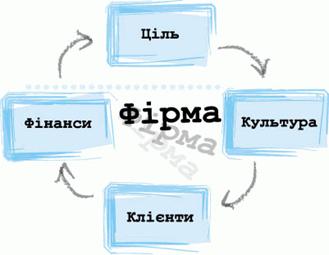 “Finances” ;
- “Financial system of Ukraine”;
- “Financial resources”;
- any other topic concerning finances.
Task 7.
Do the tests.
Test 1. Banks. Choose the correct answer.
1. Every Friday Fred ….. money out of the bank.
a. cashed | b. drew | c. robbed | d. stole |
2. The … of the pound has fallen recently.
a. expense | b. price | c. value | d. worth |
3. In order to buy his house Mr Not-Too-Rich had to obtain a large ….. from his bank.
a. capital | b. debt | c. finance | d. loan |
4. The accounts show a ….. of $ 500 this month.
a. decrease | b. deficit | c. deterioration | d. devaluation |
5. Violetta drew ….. all her savings from the bank to pay for her trip to Thailand.
a. along | b. in | c. out | d. up |
6. The bank will require three ….. signatures when you open an account.
a. natural | b. sample | c. specimen | d. trial |
7. Miss Thrifty phoned the bank to ….. how much money there was in her account.
a. check | b. control | c. inspect | d. test |
8. Corruption in the running of the town’s largest bank has recently been … in the local newspaper.
mented | b. discovered | c. exposed | d. found |
9. Many people save money to ….. for their old age.
a. cater | b. equip | c. provide | d. supply |
10. Mr Royce had to ….. all his savings from the bank to pay for a new car.
a. exchange | b. retire | c. subtract | d. withdraw |
11. The bank is offering a ….. to anyone who can give information about the robbery.
pensation | b. prize | c. premium | d. reward |
12. The ….. of the bank where I work is in the suburbs.
a. branch | b. house | c. quarter | d. seat |

13. I didn’t write it. That’s not my ….. on the cheque.
a. firm | b. letter | c. mark | d. signature |
14. I’m afraid that the bank will refuse my application for an extended ….. .
a. balance | pensation | c. estimate | d. worth |
15. At this bank you can get 14% ….. on your savings.
a. interest | b. rate | c. rent | d. salary |
16. I want $ 500-worth of French francs. What is the … rate, please?
a. currency | b. exchange | c. market | d. money |
17. Miss Positive ….. the bank manager that she would be able to repay the loan.
a. assured | b. ensured | c. certified | d. insured |
18. The debt should be paid ….. within thirty days of receiving this statement.
a. all over | b. as a whole | c. for good | d. in full |
19. I have just ….. an account in this bank.
a. entered | b. made | c. opened | d. registered |
20. Miss Thrifty ….. only $ 15 out of the bank every week.
a. draws | b. extracts | c. pulls | d. removes |
21. Please complete the ….. form and return it to the branch manager.
a. encased | b. enclosed | c. enveloped | d. inserted |
22. We ….. to inform you that settlement of your account is three months overdue.
a. apologize | b. are displeased | c. dislike | d. regret |
23. $ 1 is ….. to 1.6 German marks.
parable | b. changeable | c. equivalent | d. variable |
24. We cannot give you the money until you show us some form of …..: a passport or a driving licence will do.
a. identification | b. identity | c. paper | d. surety |

Test 2. Banks. Put each of the following words or phrases into its correct place in the text below.
account bank bank income credited creditor
debtor deposit depositors funds hide
interest loan paid pocket record
safekeeping save spend withdraw
People (1) ….. money in bank for future use. A man may be (2) ….. each week for his work. He probably will not want to (3) ….. all his pay the day he receives it. It may be risky for him to carry all his unspent money in his (4) ….. , or to (5) ….. it at home. So he may decide to put some of his money in a bank for (6)…… . The money he puts in the bank is called a (7) ……. . This money is (8)…... , or added, to his (9) ….. . An account is a (10) ….. of the money a depositor has in the bank. When the depositor wants to (11) ….. , or take out, part of his deposit, the (12) ….. must be ready to pay him.
Banks use the money of (13) ….. for loans to those who need (14) ….. . The bank that makes the loan is called a lender, or (15) ….. . The bank charges the borrower, or (16) ….. , interest for the use of (17) ….. . Charging (18) ….. for the use of money is the chief source of (19) ….. .
Test 3. Banks. Choose the correct answer.
1. Please find enclosed our ….. scale for life insurance premiums.
a. gauging | b. raising | c. sliding | d. slipping |
2. My enquiries did not ….. any information of value.
a. affect | b. arouse | c. elicit | d. extort |
3. His bank manager decided to give him financial ….. for the new shop.
a. backing | b. footing | c. lifting | d. standing |
4. Many people who go to see their bank manager have a ….. problem.
a. cash-book | b. cashing up | c. cash flow | d. petty cash |
5. Reminders must be sent out to all customers whose accounts are more than a month ….. .
a. indebted | b. overdue | c. unbalanced | d. unpaid |
6. The notes in the wallet were all ….. American dollars.
a. counterfeit | b. false | c. mimic | d. mock |

Answers:
Test 1. Banks.
1. b 5. c 9. c 13. d 17. a 21. b
2. c 6. c 10. d 14. d 18. d 22. d
3. d 7. a 11. d 15. a 19. c 23. c
4. b 8. c 12. a 16. b 20. a 24. a
Test 2. Banks.
People (1) SAVE money in bank for future use. A man may be (2) PAID each week for his work. He probably will not want to (3) SPEND all his pay the day he receives it. It may be risky for him to carry all his unspent money in his (4)POCKET, or to (5) HIDE it at home. So he may decide to put some of his money in a bank for (6) SAFEKEEPING. The money he puts in the bank is called a (7)DEPOSIT. This money is (8) CREDITED, or added, to his (9) ACCOUNT. An account is a (10) RECORD of the money a depositor has in the bank. When the depositor wants to (11) WITHDRAW, or take out, part of his deposit, the (12)BANK must be ready to pay him.
Banks use the money of (13) DEPOSITORS for loans to those who need (14) FUNDS. The bank that makes the loan is called a lender, or (15) CREDITOR. The bank charges the borrower, or (16) DEBTOR, interest for the use of (17)LOAN. Charging (18) INTEREST for the use of money is the chief source of (19) BANK INCOME.
Test 3. Banks.
 1. c 2. c 3. a 4. c 5. b 6. a

|
Из за большого объема этот материал размещен на нескольких страницах:
1 2 3 |
