

Партнерка на США и Канаду по недвижимости, выплаты в крипто
- 30% recurring commission
- Выплаты в USDT
- Вывод каждую неделю
- Комиссия до 5 лет за каждого referral
Institutions
Other countries like Israel, Hungary, or Finland have set up or currently discuss new institutions for the protection of future generations instead of enshrining clauses for the protection of future generations into their Constitutions (see the articles of Shoham and Lamay, van Opstaal and Timmerhuis, Jávor, Agius in this volume). The new institutions are designated ‘Ombudsman for Future Generations’, ‘Committee for Future Generations’, ‘Ecological Council,’ ‘Future Council,’ or ‘Third Chamber’. But what can maintain the protection of future generations more effectively, changes to the constitution or the creation of new institutions? In the solution provided by written law, the Constitutional Court becomes the institution which watches over a balance of the interests of present and future generations. In case of a new institution, the institution itself becomes the watch-dog.
These kinds of new institutions make sense if they really have the competencies to protect future generations. This means, for instance, that these institutions can veto or at least freeze laws or that they can propose laws themselves. Without this responsibility the advisory system is merely extended. In Germany, for instance, there are already four institutions: the German Advisory Council on the Environment (Sachverständigenrat für Umweltfragen, www. umweltrat. de), the German Advisory Council on Global Change (Wissenschaftlicher Beirat der Umweltregierung für Globale Umweltveränderungen, www. nachhaltigkeitsrat. de), the German Council for Sustainable Development (Rat für Nachhaltige Entwicklung) and the Parliamentary Advisory Council on Sustainable Development (Parlamentarischer Beirat für nachhaltige Entwicklung, www. bundestag. de/parlament/parl_beirat/) which was appointed in 2004. They all do not have the necessary power to stop laws which threaten the well-being of future generations.
The question of how an institution with real power would be staffed also requires special attention. One could imagine that the members are nominated by parliament, are provided by associations and NGOs or that they are elected by the people. These proposals - apart from the latter one - are democratically problematic. Just consider the House of Lords in Great Britain, which is under heavy criticism for having too much power for a not elected body. For similar reasons, the Senate in Bavaria was abolished (Tremmel and Viehöver 2001, p. 21). It could start legislative initiatives as a so-called ‘Second Chamber’ and was a place of refuge for association lobbyists. On the other hand, very mighty institutions like the European Central Bank are also not staffed by democratic elections and still enjoy a high level of public support.
The matrix of the institutionalisation of Intergenerational Justice
If the first question is ‘written law vs. new institution’, a second fundamental decision is ‘range of coverage’. Both clauses in constitutions and new institutions can be conceived to deal with either ecological questions and financial questions or posterity in general. In the latter example the Constitutional Court or the new institution would have to decide case by case which needs of future generations should be prioritised.
The possible combinations are shown in the matrix below with examples in the fields.
Table 3 – The matrix of the institutionalisation of Intergenerational Justice
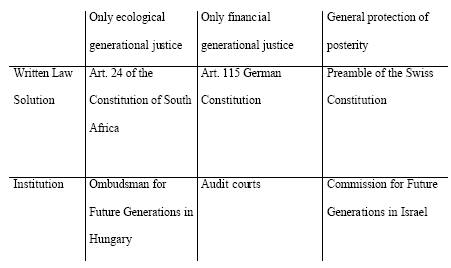
Source: own source
The wording: do future humans have ‘rights’?
When it comes to changes of the constitution, wording is crucial. Hence, first it is necessary to assess whether one can rightfully write: ‘Future generations have rights’.3 At the beginning of the debate about future generations it was frequently argued that future generations had no rights, but instead that present generations were merely morally obliged to them (Brown-Weiss 1989, p. 96; Beckerman 2004). Because of Edith Brown-Weiss’ intervention, the UNESCO resolution which was originally entitled ‘Declaration for the Rights of Future Generations’ was renamed into ‘Declaration on the Responsibilities of Present Generations towards Future Generations’.
Moral and codified rights
What is the relationship between moral and codified (‘written’) rights? An obligation according to written law and a moral obligation are factually connected but not identical. In general, the relationship of morality and law can be characterised as follows. Firstly, there are moral commandments, or respectively obligations, that are not codified; secondly, there is an intersection between both fields; and thirdly, legal norms may exist that are not moral.

Source: own source
Figure 3 – Moral and codified rights
For instance, many obligations towards animals and plants as well as towards future generations belong to the first category, since they are not yet codified within legal order. Particularly during the past few decades, the growing acceptance of ethics concerning the future lead to the circumstance that worldwide constitutions that have been adopted and draft constitutions verbatim refer to future generations. Conceptually, the idea of rights of future vs. succeeding generations is preceded by another thought which arose much earlier. Namely, we are talking about the development of the idea of human - and civil rights. Important documents were the ‘Magna Charta’ (1215), the British ‘Bill of Rights’ (1689), the ‘Declaration of Independence of the United States of America’ (1776) and the ‘Declaration of Human and Civil Rights’ in the course of the French Revolution (1789) and finally the UN ‘General Declaration on Human Rights (1948) where human rights, which at first only applied at the national level, then found their way into public international law. But who would agree with the statement that men and women had no human rights before 1215?
If the obligation of today’s generation towards the future was, for example, already anchored in the Dutch constitution, but not yet in the Belgian constitution before the following year, then one could hardly claim that in this year the Belgians would not yet have moral obligations towards posterity. That would repeat the mistake some people made when they claimed that people in a specific state have no human rights just because their government is opposed to the Charter of Human Rights. Moral norms that are at the same time legal norms and vice versa belong to the second category. Most legal norms in democratic, liberally organised states are also moral norms (for example ‘Thou shall not kill’).
Last but not least, there is a third category: those laws of dictatorial states that are deemed unjust everywhere else, for example the Nuremberg Racial Laws of Hitler’s Third Reich.
Hence, it can be stated that it is enough to justify that future people have moral rights. Taking a bird’s eye view, the written law is always adjusted according to the changes in the moral convictions within a society.
Semantic investigation of the term ‘to have (moral) rights’
The position of the fathered but still unborn child is acknowledged in certain fundamental rights. It has the legal capacity to hold rights, for instance the right not to be killed if the conditions for a legal abortion are not fulfilled. But below we will exclusively deal with non fathered, ‘potential’ individuals. According to Beckerman, the general proposition that future generations cannot have anything, including rights, follows from the meaning of the present tense of the verb ‘to have’. ‘Unborn people simply cannot have anything. They cannot have two legs or long hair or a taste for Mozart’, Beckerman writes in the Intergenerational Justice Review (Beckerman 2004; 1999; 1994). Beckerman’s argument is correct, but of minor importance. It reminds us to use the future tense instead of the present tense, that is, to say: ‘Future Generations will have rights’ instead of ‘Future Generations have rights’. It is important to understand that Beckerman’s argument cannot be used to denounce the term ‘rights’ and to replace it by ‘needs’, ‘interests’, ‘wishes’ and the like. If future generations cannot have ‘rights’, they cannot have ‘interests’ and so on, either. They will have interests, just as they will have rights. If we want to favour the term ‘interests’ over ‘rights’, we must find other arguments. The hint to using the future tense instead of the present tense in the wording of constitutional amendments is just a minor aspect. It is more important which nouns, verbs or adjectives are chosen. Beckerman claims that his argument denounces the term ‘rights of future generations’ (Beckerman 2004; 1999), but he is incorrect.
Having rejected Beckerman’s claim does not of course mean that we have proven that it is more appropriate to use ‘rights’ instead of another noun in constitutional amendments.
The figure of ‘conditioned’ rights
Some scholars admit that future generations have rights, but they still differentiate. Callahan argues that our obligations towards future generations are weaker than our obligations towards present generations, because the claims of future individuals are conditioned claims. ‘The claim of future generations against us is a conditional claim, in the sense that it depends upon their existing to make the claim [….] over against that situation are presently living human beings, whose claims are actualised claims, whose rights are in no sense conditional’ (Callahan 1980, p. 82; Hösle 1997, p. 808). Birnbacher holds the opinion that rights always imply obligations: ‘A right can only exist when someone else has an obligation towards the legal subject’. (Birnbacher 1988, p. 100). The reversed conclusion is as follows: anywhere where a party A has an obligation in relation to another party B, B has a right in relation to A. But according to Birnbacher, for this statement to be true, the following condition must be fulfilled: the obligation will be demanded in the name of A. If a presently living, malnourished person has the right not to die of hunger, he does not have to wait for others to remember that they ought to not let him starve. He himself can demand that others not let her starve. But if the starving person is so weak that he cannot express himself anymore, he has by no means forfeited his right. Thus, if someone cannot assert a right himself, assigning a right to him means demanding from others to fulfil the corresponding obligation (Birnbacher 1995, p. 100).
Sometimes it is argued that a substantial characteristic of the term ‘right’ (related to codified and moral rights) is attributed to the possibility to renounce them. According to this definition, one can indeed understand that future generations cannot have rights because they are not able to renounce them. However, this understanding of the term ‘right’ is problematic because neither animals, nor children, nor any minors have rights. ‘The situation in which future subjects are prevented from asserting their rights against those alive today due to logical reasons, and where present subjects do not assert their rights because of contingent reasons cannot be a conclusive reason to withhold moral rights from one group and not the other’. (Birnbacher 1988, p. 98)
Who can decide on definitions?
The resulting question that concludes from the formulation ‘future humans will have rights’, is about the definition of the term ‘rights’. Winfred Beckerman defines the term ‘rights’ in a way that from the proposition that all rights imply obligations it is not possible to deduce that all obligations imply rights. Many philosophers (for example Birnbacher or Dierksmeier) define rights in a way that all obligations imply some kind of rights. For them, ‘rights’ and ‘obligations’ are just two sides of a coin. Other philosophers even denounce that a right does not necessarily imply an obligation. Gosepath (2004) uses the example of an orphan who has a right to be raised in a family. But that does not imply the obligation for a concrete family (or any family) to adopt him.
By which criteria can the dispute about the definitions of ‘rights’ and ‘obligations’ be decided? Words can and often do change their meanings over time. Despite or just because of the terrific career of the term ‘rights’, an agreement regarding its meaning could not yet be reached. Scarcely any scientist denies that scientific terms must be well-defined and precise. The possibility to criticize theories in a constructive way becomes more difficult, if theories contain terms that stay permanently imprecise and plurivalent. Notwithstanding, the community of scientists should not regard a definition on which they agreed as being definite. Every definition is preliminary, so that the definition process regarding future scientific criteria has to be started again occasionally. Max Weber expresses it the following way:
The history of social sciences is a constant change and remains a constant change between efforts to arrange facts in proper order by composing definitions, [….] and the regeneration of definitions on a modified basis. [….] The terms are not aims but means to the end of cognition regarding the important coherences from individual standpoints: due to the fact that the content of historical definitions could change necessarily, it is important to formulate them exactly. (Weber 1904, p. 207)
To find out if the meaning ascribed to a word by a specific user at a given moment in time is correct, we have to apply different criteria, among them 1.) the term’s utilization by scientists, 2.) meaning at first usage, 3.) fertility, 4.) necessity (for an extensive study see Tremmel 2003a). The most important criterion is the term’s utilization by the majority of scientists. A great deal of philosophers and law scholars have become convinced that potential humans receive something for which the expression ‘rights’ is appropriate. This example is illustrative to show how convictions about the appropriate attribution of the word ‘rights’ are reached: during the construction work of a nursery school a terrorist hides a bomb. We assume that the bomb is configurated in such a way that it will explode exactly 40 years later. We also assume that at this time only teachers under 30 and children are in the building. If the terrorist’s plan was revealed today, would he have to be punished? Whatever the answer, he can only be punished if he has violated the rights of others. Whoever feels that this terrorist has committed a crime also has a feeling for the ‘rights’ of future individuals (Birnbacher 1988, p. 59; Unnerstall 1999, p. 98). A further example is as follows: imagine a manufacturer who manufactures porridge for up to two-month-old babies and has a technical defect at his production centre. The result of this is that the products which will be on the market in three months are contaminated with fragments of glass. Almost everybody would consider him worthy of punishment even though the victims are not yet born. But in tort law this is only possible if someone has been harmed, that is, her rights are infringed upon. It is from a moral perspective that in this sense we believe that future generations have (moral) rights.4 For an autonomous rational human being there is no transcendental authority who decides if such attributions are correct or incorrect. If by now a majority of scientists attribute rights to animals - which was considered as inconceivable in earlier epochs - animals have ‘received’ these rights. Materially nothing has changed. Nevertheless, in the collective consciousness of mankind these ‘rights’ now exist. According to Kant, man can and must decide by himself what is morally correct and rightful. Thence the attribution of (moral) rights is only a semantic step and not a step that regards content. Therefore I will continue to speak of ‘rights of future people’.5 But at the same time I think that this quarrel is quite futile. There are much more important features in the field of intergenerational justice than the question whether future people will have ‘rights’ or mere ‘needs’.6 Imagine a freshly married couple who are talking about ending the use of contraceptives to conceive a child. The wife says: ‘But remember that you must not work too long hours in your office. Our baby child has a right that you spend time with him.’ Is it worth the effort to argue here whether or not the woman should have used ‘need’ instead of ‘right’ (or ‘will have’ instead of ‘has’) in her phrase? Not likely. It rather makes sense to discuss how much time for work and hobbies the father should give up in favour of the interests of his son. For a theory of intergenerational justice the situation is just the same. Therefore I will turn to more important questions.

|
Из за большого объема этот материал размещен на нескольких страницах:
1 2 3 4 5 6 7 |
