

Партнерка на США и Канаду по недвижимости, выплаты в крипто
- 30% recurring commission
- Выплаты в USDT
- Вывод каждую неделю
- Комиссия до 5 лет за каждого referral
 ЧастИНА 1
МЕТОДОЛОГІЧНІ ПРОБЛЕМИ СУЧАСНОЇ ЕКОНОМІКИ
Розділ 1
Економіка природокористування і
еколого-економічні проблеми
УДК 330.34
Joerg Tremmel[1]
Intergenerational justice in national constitutions –
new vision of sustainable development problems
Today’s generation has the capacity to affect the future more than ever before in the history of mankind. This article justifies the need to institutionalize Intergenerational Justice, focusing on changes in national constitutions. In this context, a ‘matrix of the institutionalization of intergenerational justice’ is developed.
Introduction
Today’s generation has the capacity to affect the future more than ever before in the history of mankind. This article justifies the need to institutionalise Intergenerational Justice, focussing on changes in national constitutions. In this context, a ‘matrix of the institutionalisation of intergenerational justice’ is developed. In dealing with the wording, Beckerman’s argument that we cannot attribute ‘rights’ to future generations is rejected. Afterwards, some concrete proposals to institutionalise ecological and financial generation protection clauses are drafted. Finally, current initiatives by young members of parliament are portrayed although their proposals are not bold enough.
The structural problem of democracy: future individuals have no votes
The principle of democracy, in its traditional and narrow form, can conflict with the maxim of intergenerational justice. The need to appease the electorate every four or five years means that politicians direct their actions towards satisfying the needs and desires of present citizens – their electorate. The interests, therefore, of future generations are all too often neglected.
Due to his limited time in office, a politician will not have to take responsibility for the consequences of her actions and also cannot be made liable for them. Today’s technological advancements mean that the consequences of our present undertakings, such as the instalment of nuclear energy plants, will have far reaching effects and a potentially deeply negative influence on the quality of life for numerous future generations.
Nuclear power stations in a country like Germany have produced 7196 tons of plutonium waste products (PU-239) until now. Plutonium has a half-life period ofyears, meaning that there will still be one gram of today’s plutonium remaining in years. Yet, even one single gram threatens human health.
If one considers that the history of mankind only began to be recordedyears ago, it becomes clear how long the impact of our current actions will be felt by future generations. Relevant time scales for human and environmental development differ widely (see figure 1). Today’s generation thus has the power to shape the future like never before. Yet, unfortunately, increases in technological possibilities have not gone hand in hand with an increase in the morality and far-sightedness of today’s decision makers.1
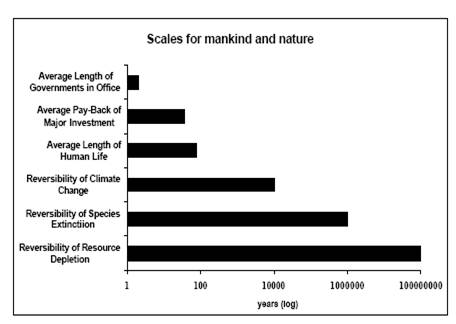
Figure 1 – Relevant time scales for human and environmental development
In the words of the former German president, Richard von Weizsäcker,
Every democracy is, generally speaking, founded on a structural problem, namely the glorification of the present and a neglect of the future. It is an indisputable fact that we cannot and do not want to be ruled differently than by representatives elected for a fixed amount of time - with no more leeway at their disposal than precisely their legislative terms of office for what they offer as solutions to our problems. We are not saying that the all politicians are unconcerned with the future. It is only faced with the problem of having to acquire a majority. (Friedrich; Mändler; Kimakowitz 1998, p. 53)
In today’s elections those individuals who will be born in the future cannot participate. They are not taken into account for the calculations of a politician, whilst he is organizing his re-election. If they could make their interests in the political decision-making process heard, majority conditions for important political decisions would be different. Policy on energy may serve as an example here: at present, the form of power production, based on fossil fuels, as utilised by today’s generation, facilitates a uniquely high standard of living, but today’s generation is thereby creating serious disadvantages for itself and future generations in the medium-term between the next fifty to one hundred years. We already know today - and having this knowledge is the crucial point - that such an energy policy leads to increased levels of carbon dioxide in the atmosphere. As a consequence, the natural greenhouse effect is strengthened and temperatures rise worldwide. More and stronger hurricanes, inundations, streams of refugees and new conflicts will be the future results of this short-sighted policy. If only these future individuals, who are born in the next 200 years, could vote on energy policies, this would create a huge majority which would facilitate a quick shift to renewable sources of energy. If only these future individuals could vote on financial policy, public debt would be significantly lower than today. This fundamental dilemma of democracy leads to a preference for the present and to oblivion with regard to the future. Hence, succeeding generations are confronted with a structural disadvantage if democracy is not improved (Tremmel 1996). Generational justice affects the distribution of resources and life opportunities between generations. In view of the voicelessness of future generations it is not surprising that there will be insufficient resources remaining for them due to the competition for resources between present individuals and groups. Even if nature and mankind are not endangered as a whole, but ‘only’ parts of mankind and determined elements of nature (Renn and Knaus 1998, p. 18), the right of future generations to spend their life on an ecologically intact, biologically diverse planet, is nevertheless threatened like never before in the history of mankind. The ‘futurization’ of ecological problems means an existential danger for future generations.
In the face of present and future problems we cannot afford to ignore these problems any longer: we need new future ethics, in order to maintain the opportunities of future generations. This new ethic is already developing, but a significant change of consciousness is, as yet, not sufficiently reflected in positive law. It is precisely this that is necessary. The term ‘institutionalisation’ of intergenerational justice describes measures to safeguard the interests of future generations through institutions or written law. It is naive to hope that politicians will act in the interests of future generations in the same way that they do for those citizens who are alive today. The reason is not pure self-interest of today’s politicians, it rather lies in the political framework of every democracy. Every party tries to obtain votes, and therefore must concentrate on the short term perspective, that is, the preferences of the present electorate and the present interests of influential groups. In so far politicians of all parties, who want to look further ahead than at the next election (or even the next 30 years), are disadvantaged in the competition with their short-term thinking political rivals. Hence, ambitious politicians who strive for many terms cannot act in favour of future generations if there is a trade-off between the interests of the present and future generations. Therefore the framework of political action and responsibility need to be changed. Of course this must happen in such a way that the core principles of democracy remain intact. It is absurd to believe that doing away with liberal democracy is the solution to resolve the structural problem of democracy, as described above. Democracy is one of the most important social institutions that we can pass on to future generations; for this and many other reasons its abolishment is inconceivable. Additionally, such an abolishment would cause irreparable damage in relation to the maxim of generational justice for generations to come. If the influence of the electorate in politics, which is the very essence of liberal democracy, is to be maintained, terms of political office must be short, with frequent elections.
Three types of clauses for Intergenerational Justice in national constitutions
In order to solve the structural problem of democracy, different countries have chosen different approaches. Discussions revolved firstly around whether the protection of posterity should be ensured in substantive law by enshrining it in the constitution itself, or by establishing a new institution; and secondly which policy fields the protection of posterity should concern.
Clauses in national constitutions
Let us first collect examples for clauses in constitutions. The increasing acceptance of future ethics has resulted in the fact that constitutions and constitutional drafts, worldwide, especially the ones which were adopted in the last few decades, refer to generations to come. These clauses can be grouped into three categories: general clauses for intergenerational justice, ecological generational justice clauses and financial generational justice clauses. Obviously, the fields of ecology and finances were deemed by many states so prone to intergenerational misconduct that they wanted to mention them explicitly.2
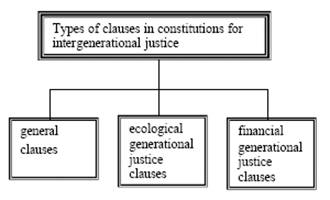
Figure 2 – Typology of clauses in constitutions
Here are a few examples for constitutions that include general clauses for the protection of future generations, usually in the preambles:
Table 1 – General clauses for the protection of future generations from constitutions
Country | Lieu | Wording | Year of adoption |
Estonia | Preamble | ‘Unwavering in their faith and with an unswerving will to safeguard and develop a state; [...] which shall serve to protect internal and external peace and provide security for the social progress and general benefit of present and future generations; [...] the Estonian people adopted [...] the following Constitution.’ | June 1992 |
Czech Republic | Preamble | ‘[...] resolved to jointly protect and develop the inherited natural and cultural, material and spiritual wealth, resolved to abide by all time-tried principles of a law-observing state, [...]’ | 16 December 1992 |
Czech Republic | Charter of Fundamental Rights and Freedoms Preamble | ‘The Federal Assembly, [...] recalling its share of responsibility towards future generations for the fate of life on this Earth, [...] has enacted this Charter of Fundamental Rights and Freedoms […]’ | 16 December 1992 |
Poland | Preamble | ‘[...], recalling the best traditions of the First and the Second Republic, obliged to bequeath to future generations all that is valuable from our over one thousand years’ heritage, [...]’ | April 1997 |
Switzerland (federal constitution) | Preamble | ‘In the name of God Almighty! Whereas, we are mindful of our responsibility towards creation; […] are conscious of our common achievements and our responsibility towards future generations; […].’ | 18 April 1999, amended 15 October 2002 |
Ukraine | Preamble | ‘Aware of our responsibility before God, our own conscience, past, present and future generations‘ | June 1996 |
Other constitutions explicitly mention the environment or sustainable development, either solely or cumulatively by a general clause (see table 2).

|
Из за большого объема этот материал размещен на нескольких страницах:
1 2 3 4 5 6 7 |
